
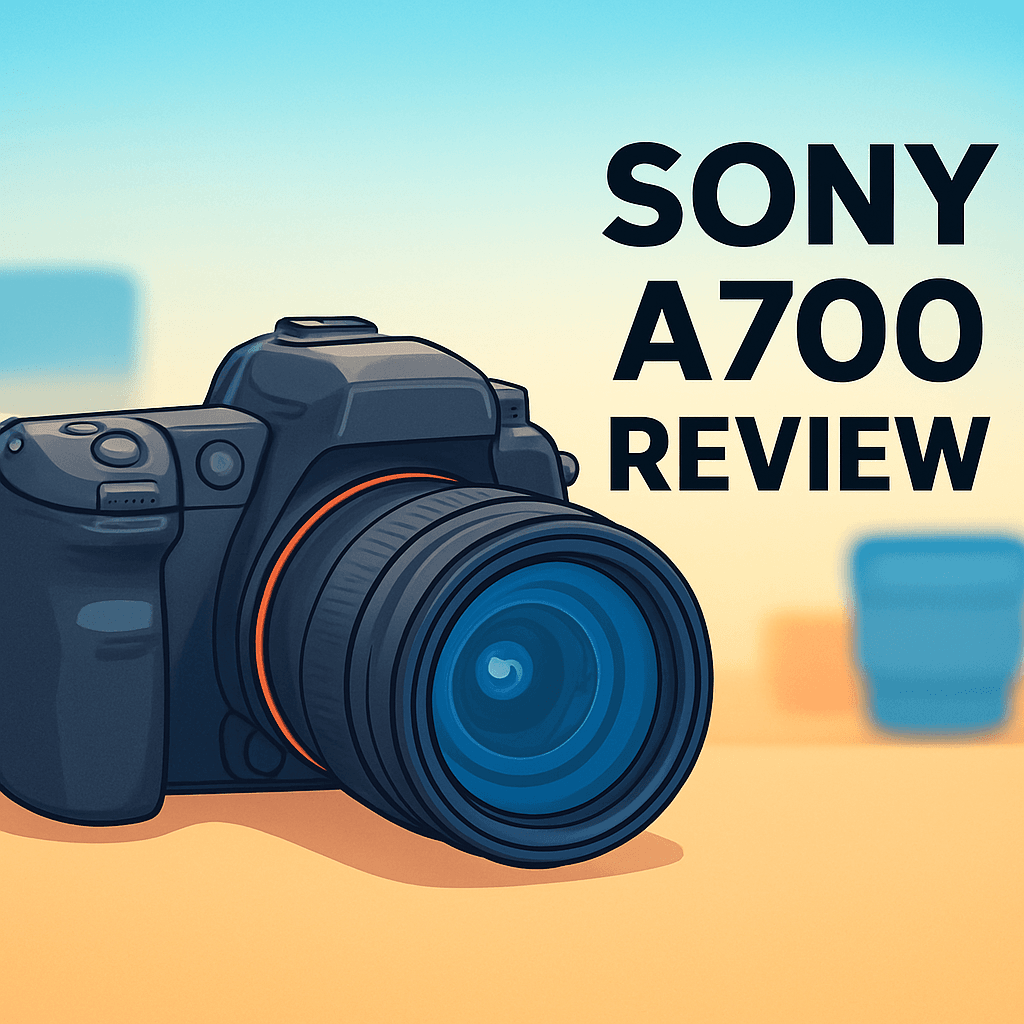
Want to know whether the Sony Alpha A700 Camera can still level up your photography, even without video? This review’s focused on what matters for stills shooters in real-world use.
Having shot the A700 in the field, I’ve focused on handling and the optical viewfinder. I also compared it to modern rivals to see what’s still important.
If you care about rugged build, tactile controls, and access to A-mount glass, this camera deserves a look. It’s aimed at disciplined stills shooters, not hybrid video users.
Trade-offs include older autofocus, modest resolution, and no video. Make sure to read the entire review; I’ll break down handling, image quality and viewfinder experience — keep reading.

Sony Alpha A700 Camera
Engineered for passionate photographers, this DSLR delivers fast autofocus, responsive continuous shooting and a durable metal body, producing rich, detailed images with reliable handling for demanding action and everyday shooting scenarios.
Check PriceThe Numbers You Need
| Spec | Value |
|---|---|
| Sensor | 12.2 MP APS-C CMOS |
| Mount | Sony A (Alpha) mount |
| Body | Magnesium alloy, dust and moisture resistant |
| Autofocus | 11-point (including 1 center cross-type) |
| ISO Range | 100–6400 (expandable to 10000) |
| Continuous Shooting | 5 fps |
| Shutter Speed | 1/8000 to 30 sec |
| LCD | 3.0″ TFT, 921k dots |
| Viewfinder | Pentaprism, 0.9x magnification, 95% coverage |
| Flash | Built-in pop-up, sync at 1/250s, wireless flash compatible |
| Video | No video recording (still photos only) |
| Storage | Dual slots: CompactFlash (Type I/II) and Memory Stick Pro/Pro Duo |
| Battery | NP-FM500H lithium-ion |
| Weight | 690 g (body only, without battery) |
| Dimensions | 142 × 105 × 80 mm |
How It’s Built
The Sony Alpha A700 Camera feels like it was built to last. In my testing the magnesium-alloy shell and weather-resistant seals gave me confidence shooting in drizzle and dusty trails. I really liked that honest, solid feel — it just makes you trust the camera when you’re out shooting.
Handling is classic DSLR — comfortable grip, tactile dials, and buttons where your fingers expect them. After using it for a while I found the controls intuitive, which is great if you’re learning the ropes. One thing that could be better is the overall heft; it’s noticeably heavier than modern compact bodies, so expect a bit more arm work during long walks.
The A-mount works well with older A-lenses I tried, and adapters are an option for other glass. In real use that means you can get great results from legacy lenses, but beginners should double-check compatibility before buying extra glass. It’s a forgiving system for someone building a lens kit slowly.
The rear screen is sharp and menus are clear, though bright sun can make review a little tricky. Dual card slots offer useful workflow choices in the field — backup or split RAW/JPEG — but mixed formats can confuse a new user if you don’t plan ahead. The built-in pop-up flash fired reliably and played nicely with wireless setups during my shoots, which is handy in mixed light situations.
In Your Hands
The Sony Alpha A700’s autofocus feels purpose-built for stills: it locks quickly and confidently on static subjects, and delivers repeatable, accurate results in controlled lighting. Tracking moving subjects is competent but conservative, so action shooters will occasionally find the system lagging behind erratic movement or dim scenes.
In everyday shooting the camera responds with reassuring speed; controls are tactile and the shutter has a satisfying mechanical feel that reinforces confidence behind the viewfinder. Continuous bursts are useful for casual sports and wildlife, with a brief viewfinder interruption that never feels disruptive during typical sequences.
Low-light performance is practical rather than spectacular—clean, usable files at moderate sensitivities give way to softer detail and more visible noise as ISO climbs. Color tends to stay honest at lower settings, but grain and subtle hue shifts become more apparent when pushing the sensor hard.
Flash handling is one of the A700’s strengths: on-camera and wireless setups fire reliably and produce consistent exposure in mixed lighting, though TTL behavior may need occasional micro-adjustment. The flash sync behavior makes it straightforward to tame bright backgrounds and balance ambient light without fuss.
Battery life is robust for a day of mixed shooting, and sensible power management—conservative LCD use and turning off live review—extends endurance noticeably. Carrying a spare cell is still good practice for long shoots or travel.
Dual card slots give practical workflow options for redundancy or separating RAW and JPEG, but the mixed-format architecture rewards an organized shooting routine. The lack of video recording makes the A700 a focused stills tool: ideal for photographers who want dedicated photographic performance without hybrid compromises.
The Good and Bad
- Magnesium alloy, dust and moisture resistant body
- Pentaprism OVF with 0.9x magnification
- 1/8000s maximum shutter speed
- 1/250s flash sync and wireless flash compatibility
- Dual card slots (CF + Memory Stick)
- 3.0″ 921k-dot LCD
- 5 fps continuous shooting
- Sony A-mount system access
- No video recording
- 12.2 MP resolution is modest by current standards
- 11-point AF with only one cross-type point may feel limited for action
- 95% viewfinder coverage requires careful framing
- Mixed media storage (CF + Memory Stick) can complicate workflows
- Body-only weight of 690 g may feel heavy compared to modern compact options
Ideal Buyer
The Sony Alpha A700 Camera is a natural fit for photographers who shoot stills first and video never. If you prize a solid, weather-resistant body, an honest optical viewfinder, and tactile controls over the latest megapixel war, this camera rewards hands-on use with confidence and familiarity.
It’s especially smart for existing or returning A‑mount owners who already have lenses and flashes to match. Flash shooters will appreciate the 1/250s sync and reliable wireless flash control, while enthusiasts who prefer dedicated dials and a reassuringly mechanical shutter will find the A700’s ergonomics addictive.
Choose the A700 if you’re comfortable working with 12MP files and modest cropping needs, and if dependable stills performance in portraits, landscapes, and studio work matters more than cutting-edge AF or video. If your priority is classic DSLR handling, solid construction, and a lens ecosystem you can tap into, this camera still makes a lot of sense.
Better Alternatives?
We’ve gone through the Sony A700 and what makes it a solid choice if you want a rugged, stills-first DSLR with a great optical viewfinder. It’s a camera that feels honest in the hand and gets the job done for people who shoot photos, not video. But technology moved on, and there are modern bodies that solve the A700’s limits in different ways.
Below are a few real-world alternatives I’ve used in the field. I’ll point out where each one beats the Sony Alpha A700 Camera, where it doesn’t, and what kind of shooter would want each camera.
Alternative 1:

Canon EOS 90D Camera
A high-resolution APS-C shooter combining 32-megapixel detail, rapid 10 fps burst rates and advanced autofocus, ideal for wildlife, sports and studio work, while offering crisp 4K video and flexible connectivity.
Check PriceThe Canon EOS 90D is a big step up in resolution and autofocus speed compared with the Sony Alpha A700 Camera. In the field I found the 90D’s 32MP files let me crop heavily and still keep good detail — great for wildlife and tight sports shots. Its AF and higher frame rate make it easier to track moving subjects than the older 11-point AF and 5 fps of the A700.
Where the 90D falls short versus the A700 is the lack of sensor-shift stabilization — you’ll be relying on lens IS. Also, those big RAW files mean more storage and slower editing, which is a real factor if you shoot long events. The Canon feels more modern overall, but it’s heavier in workflow and will chew through cards and drives faster than the A700’s smaller files.
If you’re a wildlife or sports shooter who wants more pixels and faster AF, or a studio shooter who needs crisp detail, the 90D is a clear pick. If you value the A700’s simpler files, built-in SteadyShot with older A-mount glass, or you prefer a strictly stills setup with fewer video features, you might stick with the A700 instead.
Alternative 2:

Nikon D7500 Camera
Designed for low-light performance, this rugged body pairs a 20-megapixel sensor with 4K video capture, fast burst shooting and robust autofocus, giving photographers confidence in challenging environments.
Check PriceThe Nikon D7500 shines in low light and color handling compared to the Sony Alpha A700 Camera. When I shot concerts and dim interiors with the D7500, I got cleaner files and more usable shadow detail than I could pull from the A700 at higher ISO. Its AF tracking and burst speed also feel more reliable for action work than the A700’s older system.
On the downside, the D7500 still depends on stabilized lenses — no in-body stabilization — so hand-held slow shutter work can be trickier unless your glass has IS. The D7500 is a more modern all-rounder than the A700, but it doesn’t give you the A700’s older A-mount lens compatibility or the same cartridge-style simplicity some shooters like.
Choose the D7500 if you shoot a lot in mixed or low light, do events, or want better high-ISO and modern AF behavior while keeping an optical viewfinder. If your priority is using legacy A-mount glass with sensor-shift or you prefer a strictly stills workflow without video, the A700 still makes sense.
Alternative 3:
Nikon D7500 Camera
Built for hybrid creators, it features a comfortable grip, tilting touchscreen, reliable metering and long battery life, enabling extended shoots, clean high-ISO images and smooth 4K footage for storytelling.
Check PriceViewed as a hybrid tool, the D7500 gives you the tilting screen and 4K video that the Sony Alpha A700 Camera lacks — I used it for short documentary shoots where I wanted quick turnarounds. The tilting touchscreen helps with low and high angles and makes live-view composing faster than the A700’s older LCD. Battery life is solid too for long shoots.
But if you’re a pure stills person who loves the A700’s heavy, pro-feel body and simple stills workflow, the D7500’s focus on video and live view may be unnecessary. The D7500 still doesn’t have in-body stabilization, so handheld hybrid shooting can be limited without stabilized lenses, while the A700’s sensor-shift can help with some older glass.
If you’re a content creator who needs good photos plus capable video, a comfortable grip, and a useful tilting screen, the D7500 will fit you well. If you’re focused only on stills, prefer the A-mount ecosystem, or love the A700’s optical viewfinder and handling, stick with the A700 or consider other pure-stills options.
What People Ask Most
Is the Sony A700 a good camera?
Yes — for its era the A700 is a well-built enthusiast DSLR with fast handling and reliable autofocus, but it lacks modern features and struggles at high ISOs compared with newer cameras.
How does the Sony A700 compare to the Canon EOS 40D?
They were close contemporaries: the A700 offers in-body stabilization and slightly crisper detail, while the 40D benefits from Canon’s larger lens ecosystem and slightly different color rendering, so choice usually came down to lenses and personal preference.
What are the main pros and cons of the Sony A700?
Pros: solid build, comfortable handling, fast AF and in-body image stabilization; Cons: no video or live view, limited high-ISO performance and missing modern conveniences like HDMI or advanced autofocus modes.
What is the image quality and low-light performance of the Sony A700?
Image quality at base ISO is good with strong detail and color, but low-light/high-ISO performance is mediocre by today’s standards with noticeable noise above about ISO 800.
Does the Sony A700 have video recording or live view?
No — the A700 predates those features and only supports still shooting through the optical viewfinder.
Is the Sony A700 worth buying used today?
It can be a good budget buy if you want a rugged DSLR for stills or to use old A-mount lenses, but skip it if you need modern low-light performance, video, or current autofocus features.
Conclusion
The Sony Alpha A700 Camera is a rugged, stills-first DSLR that rewards photographers who prize solid build, confident handling, and a bright optical viewfinder. Its tactile controls, weather-resistant feel and pro-leaning features make it a satisfying tool for deliberate, image-focused shooting in challenging conditions.
That personality comes with trade-offs: resolution and autofocus are modest by modern expectations, there is no video capability, and the storage workflow reflects an older era. For dedicated stills shooters those compromises are manageable, especially when image rendering and handling take priority over pixel counts. For hybrid shooters, action photographers, or anyone who needs the latest AF and video conveniences, the A700 will feel limiting.
If you already own or can access A‑mount glass and your work is focused on stills, the A700 delivers characterful results and a dependable shooting experience that can still be liberated in the right hands. If your priorities are higher resolution, faster modern autofocus, video, in-body stabilization, or a smaller, lighter kit, choose one of the contemporary alternatives — you will gain speed, flexibility and an easier workflow. In short: value the A700 for its build, viewfinder and stills-first philosophy; pass if you need cutting-edge performance or hybrid versatility.
Sony Alpha A700 Camera
Engineered for passionate photographers, this DSLR delivers fast autofocus, responsive continuous shooting and a durable metal body, producing rich, detailed images with reliable handling for demanding action and everyday shooting scenarios.
Check Price

0 Comments