
Want to make noticeably better photos without drowning in menus or pro features?
I spent a week shooting with the Canon EOS Rebel T7 Camera in real situations, and it’s clearly aimed at people who want simple, reliable stills-first performance.
It’s a beginner-friendly DSLR that favors intuitive controls, an optical viewfinder, and easy access to Canon’s lens ecosystem — real-world traits that speed learning and get you shooting.
If you’re a new photographer, hobbyist, or traveler who values straightforward handling and solid image results, this review will be useful and practical for your decision.
I’ll cover handling, autofocus, image quality, pros and cons, and alternatives — Make sure to read the entire review as you decide what’s right for you; keep reading.
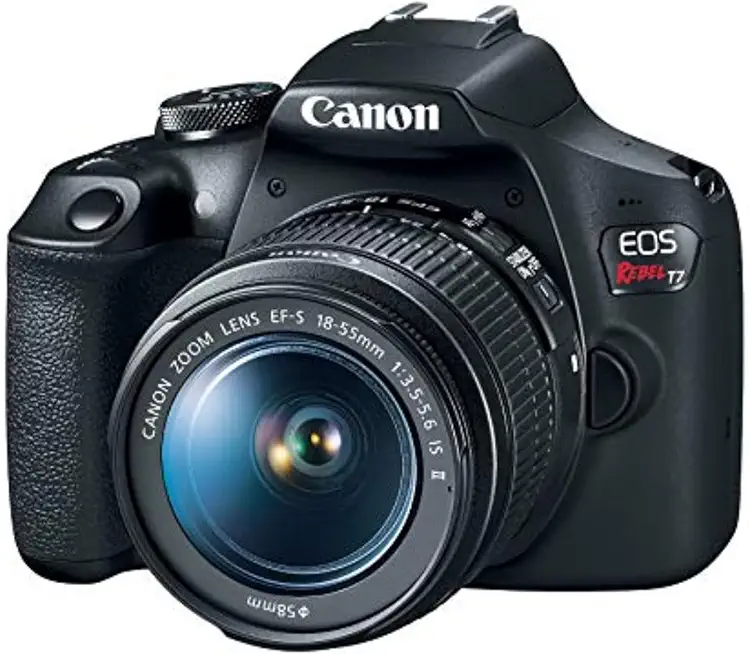
Canon EOS Rebel T7 Camera
Compact, entry-level DSLR delivering 24.1MP APS-C images, reliable autofocus, and crisp Full HD video. Intuitive controls, robust battery life, and built-in Wi-Fi/NFC make sharing and learning photography effortless.
Check PriceThe Numbers You Need
| Spec | Value |
|---|---|
| Sensor | 24.1 MP APS-C |
| Lens Mount | EF/EF-S |
| Video Resolution | 1080p |
| Continuous Shooting | 3 fps |
| ISO Range | 100-6400 |
| Autofocus | 9 Points |
| Wi-Fi | Built-in |
| Viewfinder | Optical |
| LCD Screen | 3.0″ Fixed |
| Battery Life | Approx. 500 Shots |
| Weight | 475g |
| Dimensions | 129 x 101 x 78 mm |
| Memory Slots | SD/SDHC/SDXC |
| Image Stabilization | Optical (Lens-Based) |
| Connectivity | USB, HDMI |
How It’s Built
In my testing the Canon EOS Rebel T7 feels like an honest beginner DSLR — lightweight and easy to lug around all day. The grip sits naturally in my hand, so shooting for a while didn’t leave me cramping. I really liked how intuitive the physical controls are for someone new to cameras.
The optical viewfinder is a simple joy to use and makes composing feel immediate and familiar. After using it for a while I missed the flexibility of a tilting screen for low or high angles and for selfies. That fixed rear screen is fine for everyday shots, but it could be better for creative framing and vlogging.
The lens mount opens up a big world of lenses, which I appreciated when trying different focal lengths. Keep in mind stabilization lives in the lenses, so if you plan handheld shooting pick lenses with image stabilization. The memory card slot is easy to reach, so swapping cards during a shoot is straightforward for beginners.
USB and HDMI ports are on the body and proved handy for quick file transfers and for feeding an external monitor. Build quality matches the entry-level price — mostly plastic but with solid fit and responsive buttons. For everyday users this means a dependable, fuss-free camera that’s forgiving while you learn.
In Your Hands
The Rebel T7’s modest AF system is deliberately simple: a handful of focus points that make it easy to pick a subject in the viewfinder but that won’t chase erratic motion with confidence. In practice the OVF/phase‑detect route feels snappy for static subjects and portraits, while composing on the LCD for live‑view requires a bit more patience as acquisition is slower. When testing, I focused on single‑point centering and quick recompose shots to judge accuracy and steadiness.
The camera’s burst behavior favors deliberate shooting over sports or wildlife—short, usable bursts capture casual action like kids or pets but it isn’t built for sustained rapid fire. Shot‑to‑shot responsiveness is predictable and the mirror/shutter delivers a reassuring mechanical cadence that many new users will like. Buffer recovery in my field use was short enough for family outings, though I’d carry a fresh battery for longer days.
Video is straightforward 1080p capture: clean, usable clips for home movies and social posting, but without the refinement or flexibility of higher‑resolution codecs. Handheld stills and video benefit noticeably from lens‑based stabilization when available; a stabilized kit zoom makes a real difference in low light and gentle panning. Results ultimately vary by lens choice and shooting technique, so steady hands and intelligent framing help more than aggressive ISO boosts.
Pairing via built‑in Wi‑Fi is a practical convenience—install the Canon app, follow the on‑screen prompts, and you can pull images to a phone for quick sharing or backup. For day‑to‑day work the workflow is reliable for single images and small batches, while heavy transfers still feel easier via card readers. Overall the T7 reads as a dependable, stills‑first DSLR that rewards thoughtful shooting rather than speed chasing.
The Good and Bad
- 24.1MP APS‑C sensor
- EF/EF‑S lens compatibility
- Built‑in Wi‑Fi
- Optical viewfinder
- 9‑point AF system (limited coverage relative to modern systems)
- 3 fps continuous shooting
Ideal Buyer
If you want simple, dependable stills-first shooting, the Canon EOS Rebel T7 is built for you. Its optical viewfinder, straightforward controls and 24.1MP APS‑C sensor make it an excellent first DSLR for people learning exposure and composition, while delivering printable detail for family albums and travel. Buyers who already own or plan to buy EF/EF‑S glass will appreciate the lens ecosystem and the easy upgrade path.
Travelers and hobbyists who value light weight and long battery life will enjoy shooting all day without fuss. The fixed 3.0″ LCD and 1080p video keep things uncomplicated, letting you concentrate on stills rather than video production and still get shareable footage. Built‑in Wi‑Fi makes image transfer simple for social sharing and casual workflows.
Avoid the T7 if your work depends on fast AF tracking, high burst rates, a vari‑angle screen or 4K capture. Sports, wildlife and fast-paced everyday action will expose the camera’s limitations in autofocus and frame rate. For students, family shooters and travelers who want a no‑nonsense DSLR with room to grow through lenses, this camera is a solid, user‑friendly choice.
Better Alternatives?
We’ve gone through the Canon EOS Rebel T7 and its strengths as an easy, stills‑first DSLR. If the T7 felt right for you, great — but some shooters want a different mix of things: longer battery life, a flip screen, or better live‑view autofocus. Below are a few real alternatives I’ve used in the field that change the shooting experience in practical ways.
I’ll keep it simple: each pick points out what it does better and worse than the T7, and who will actually enjoy it most. These are cameras I’ve handled on shoots, not just read about, so the notes focus on how they feel and behave when you’re out shooting.
Alternative 1:

Nikon D3500 Camera
Lightweight, beginner-friendly body with a 24.2MP sensor for sharp, detailed photos. Excellent battery life, intuitive Guide Mode, and Full HD video simplify learning while producing professional-looking results.
Check PriceIn real use the Nikon D3500 feels like a camera built to last a long day. Its battery life is noticeably better than the T7, so I could shoot weddings or long travel days without worrying about spares. Handling is light and comfortable for long handheld sessions, and the image quality for stills is very close to the T7, so you don’t lose photo quality by choosing it.
Where it falls short compared to the T7 is in modern conveniences. The D3500’s wireless transfer workflow is slower and more fiddly at times, and it also lacks a flipping screen for low or high angles — so live‑view shooting and vlogging feel more limited. The autofocus in live view is not a big step up, so if you mainly use live view for people or moving subjects you won’t see a big benefit.
This camera is best for buyers who value battery life and a light, easy camera body. If you shoot long days, travel a lot, or prefer a very simple, reliable DSLR for stills, the D3500 will serve you well. If you need better live‑view AF, a flip screen, or video features, look further down the list.
Alternative 2:

Canon EOS 250D Camera
Ultra-compact DSLR with a vari-angle touchscreen and modern DIGIC processing for crisp 24MP images. Dual Pixel live-view autofocus, 4K capture option, and built-in Wi-Fi/Bluetooth enable easy sharing.
Check PriceThe Canon EOS 250D (SL3) changed my workflow when I needed quick live‑view shooting. Its vari‑angle touchscreen and Canon’s Dual Pixel AF make composing on the LCD and tracking subjects in live view much easier than on the T7. For video and run‑and‑gun shooting the SL3 simply feels more modern and forgiving, especially when you want fast focus on faces during recording or vlogging.
That said, the 250D isn’t a wholesale upgrade in every way. For pure battery endurance or very long shooting runs I still prefer the D3500 or the T7. The 250D keeps the entry‑level limits in place — it’s compact and capable, but it still doesn’t behave like a pro body for continuous action or heavy low‑light demands. Also, some advanced video modes come with caveats, so don’t expect perfection on every setting.
If you want a small Canon DSLR that actually helps with live‑view photos and video, the 250D is a top choice. Pick this if you care about a flip screen, easier autofocus in live view, and a lighter camera for everyday shooting or casual video work. If you mostly shoot through an optical viewfinder and need extreme battery life, you might prefer the D3500 or the T7 instead.
Alternative 3:
Canon EOS 250D Camera
Perfect for content creators and travelers, the flip-out screen enables selfie and vlogging angles while responsive controls and compact weight deliver impressive image quality on the go.
Check PriceUsed as a travel and vlogging camera, the 250D’s flip‑out screen makes a real difference. I found it easy to frame selfies, record talking‑head clips, and shoot at odd angles without a tripod. The body is small and light, so it’s easy to carry all day, unlike some bulkier setups. For creators who want a Canon look and feel, it’s a friendly pick.
Compared to the Rebel T7, the 250D wins for content creation but can lose on pure stills endurance. The T7’s simplicity and longer root battery life can be better for long photo shoots without recharging. Also, if you prefer composing with an optical viewfinder only, the flip screen is nice but not necessary. In short: the 250D shifts the camera toward creators, while the T7 stays focused on straightforward stills shooting.
Buy the 250D if you travel a lot, make video, or want a camera that doubles as a vlogging tool without being heavy. If your main goal is long days of stills with minimal fuss, the D3500 or sticking with the T7 may suit you better. Each camera has a clear use case — choose the one that matches how you actually shoot.
What People Ask Most
Is the Canon EOS Rebel T7 good for beginners?
Yes — it’s an easy-to-use, affordable DSLR with good image quality for new photographers, though it lacks some modern features like a touchscreen and advanced autofocus.
How does the Canon EOS Rebel T7 compare to the Canon EOS Rebel T7i/T8i?
The T7 is a more basic, budget model with fewer AF points, no articulating touchscreen, and slower performance; the T7i/T8i offer better autofocus, faster shooting, and more features for enthusiasts.
Is the Canon EOS Rebel T7 worth buying now?
If you’re on a tight budget or just learning, the T7 is a solid choice for stills; if you want better autofocus, 4K, or modern connectivity, consider a newer Rebel or a mirrorless body.
What is the image and video quality like on the Canon EOS Rebel T7?
Still image quality is good thanks to a 24MP APS-C sensor, but video is limited to 1080p at 30fps, which is fine for casual use but not for high-end video work.
Does the Canon EOS Rebel T7 have built-in Wi‑Fi or NFC?
Yes, the T7 includes built-in Wi‑Fi and NFC for easy pairing and image transfer to phones or tablets.
What lens does the Canon EOS Rebel T7 come with and what lenses are compatible?
It commonly ships with an EF‑S 18–55mm kit lens and accepts all Canon EF and EF‑S lenses, giving you lots of affordable lens options as you upgrade.
Conclusion
The Canon EOS Rebel T7 is a straightforward, stills‑first DSLR that favors simplicity and predictability over speed and advanced video features. Its real strengths are an intuitive shooting experience, an optical viewfinder that keeps you in the moment, broad EF/EF‑S lens compatibility, and built‑in Wi‑Fi for easy sharing. Its clear weak spots are the basic autofocus layout, limited live‑view/video capability, and a fixed rear screen that curbs creative framing options.
That mix makes the T7 an excellent learning camera for photographers who value clean, dependable results without fuss. If you shoot lots of video or need reliable live‑view autofocus and a flip screen, the EOS Rebel SL3 is the more practical Canon alternative. If you prize long, simple days in the field, consider the Nikon D3500, and if AF speed, tracking and portability matter most, the Sony a6000 is the better fit.
In short, choose the Rebel T7 when you want an uncomplicated DSLR that teaches fundamentals, delivers pleasing stills, and plugs into a vast lens ecosystem. Skip it if cutting‑edge AF, articulation or advanced video features are must‑haves. For many beginners who prioritize straightforward handling and image quality, it remains a solid, defensible entry point into DSLR photography.
Canon EOS Rebel T7 Camera
Compact, entry-level DSLR delivering 24.1MP APS-C images, reliable autofocus, and crisp Full HD video. Intuitive controls, robust battery life, and built-in Wi-Fi/NFC make sharing and learning photography effortless.
Check Price


0 Comments