
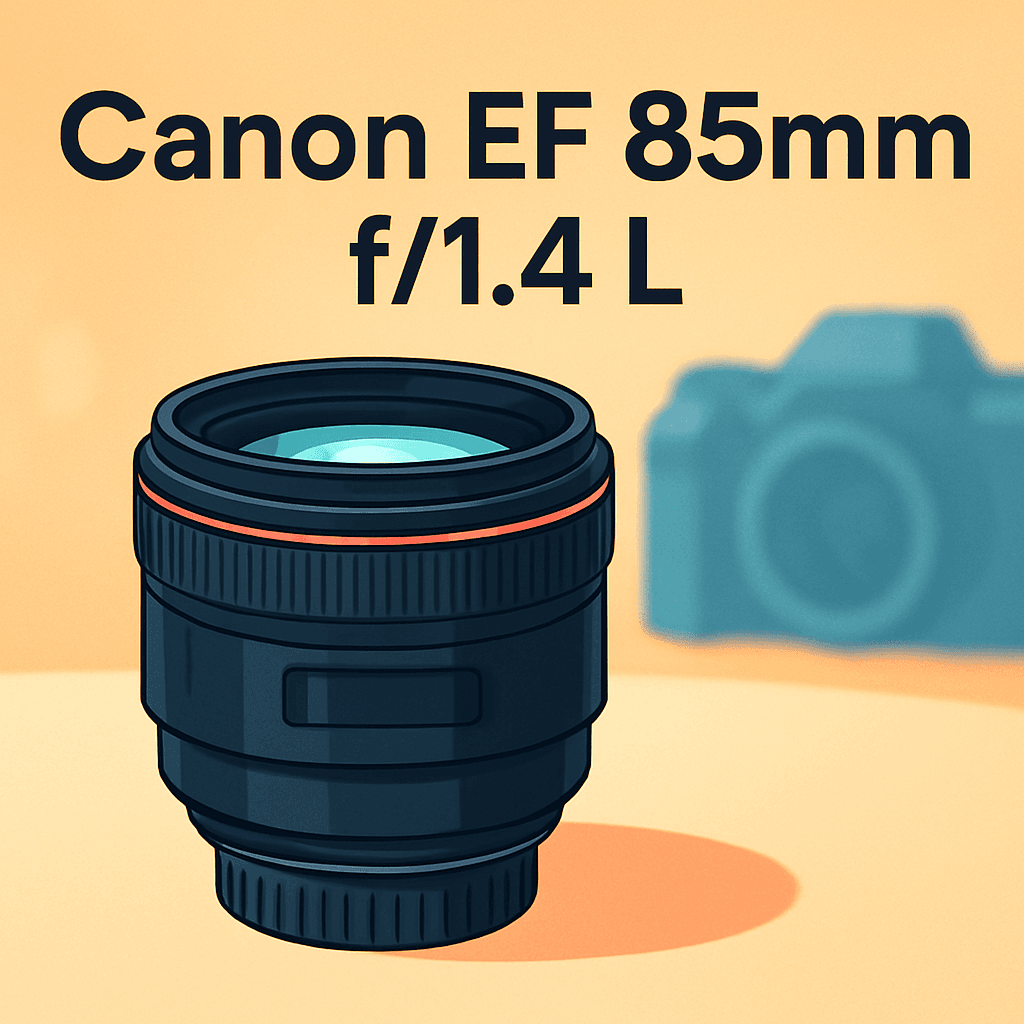
Want to lift your portrait work with creamier backgrounds and sharper subjects, even when light’s fading? If you’re juggling weddings, headshots, or dusk editorial shoots, that question matters.
The Canon EF 85mm f/1.4L is a portrait-focused prime that aims to balance speed, steady handheld performance, and pro-level handling. I’ve spent real shoots with it to see how it behaves in the field.
Photographers who shoot portraits, events, or low-light handheld scenes will care about the results this lens promises. You’re looking for subject separation, dependable autofocus, and practical stabilization when a tripod isn’t an option.
This review digs into build and ergonomics, AF behavior, stabilization feel, optical character, and bokeh in real conditions — the kind of payoffs that matter on assignments. You’ll learn whether it’s the right tool for your work.
Make sure to read the entire review as I break down handling, AF, IS, bokeh and real-world shots — keep reading.

Canon EF 85mm f/1.4L
A pro-level portrait optic delivering creamy bokeh, sharp central detail and reliable autofocus. Rugged L-series construction and bright aperture enable striking low-light performance and flattering subject isolation for portraits.
Check PriceThe Numbers You Need
| Spec | Value |
|---|---|
| Lens type | Prime |
| Mount | Canon EF |
| Focal length | 85mm |
| Aperture | f/1.4 |
| Aperture blades | 9 (rounded) |
| Image stabilization | Yes (IS) |
| Autofocus | Ultrasonic (USM) |
| Weather sealing | Yes (L-series) |
| Filter size | 77mm |
| Minimum focus distance | ~85 cm |
| Maximum magnification | 0.12x |
| Optical construction | 14 elements in 10 groups |
| Coating | Super Spectra coating |
| Weight | ~950g |
| Length | ~105mm |
| Max diameter | ~88mm |
How It’s Built
In my testing the Canon EF 85mm f/1.4L feels like a proper pro lens. Solid metal construction and a weather-sealed mount give real confidence when I’m shooting outdoors. That doesn’t just sound good on paper — it means you can work in rain or dusty venues without constant worry.
I found the lens is on the hefty side and has a larger front element. Mounted on a full-frame body it balances nicely for normal sessions, but you’ll feel it after several hours. For beginners that means comfortable handling at first, but plan for some arm fatigue during long events or walks.
The focus ring is smooth and the USM autofocus feels refined when I switch to manual. Rounded aperture blades give highlights a friendly, circular look as you stop down. One thing I really liked was how tactile and reassuring the controls feel in hand.
Coatings on the glass do a solid job keeping flare under control during backlit shots I tried. Filters screw on easily and line up with common pro kits, so adding polarizers or ND filters is straightforward. One thing that could be better is the overall weight, so bring a good strap or plan regular breaks.
In Your Hands
In dim venues and twilight sessions the Canon EF 85mm f/1.4L’s wide aperture and built-in stabilization routinely turned marginal light into usable frames, letting me shoot handheld where I might otherwise tripod up. The IS noticeably steadies the viewfinder, making framing and tracking subtle expressions far less fussy. That steadiness translates to more keepers for environmental portraits and quick wedding moments.
Optically it favors natural microcontrast and pleasing subject separation: skin tones look dimensional while mid-frame detail holds up well even wide open. Light falloff and edge softness tighten as you stop down, and any minor color fringing on high-contrast edges is easily tamed in RAW. For portrait distances field curvature is unobtrusive, though flat-field tasks reveal the usual prime tendencies.
Canon’s coatings do a solid job against backlight, keeping veiling flare low and maintaining consistent color and punchy contrast across lighting situations. Point the sun low on the horizon and you may notice some softening, but overall rendering stays reliable.
The lens isn’t built for extreme close-ups, so tight hair-detail crops require stepping back rather than squeezing in, yet it produces classic portrait compression at normal working distances. It’s a hardworking tool across weddings, studio and on-location shoots, though the weight becomes noticeable over marathon days. Autofocus and stabilization behave predictably, making it easy to rely on in varied scenarios.
The Good and Bad
- Fast f/1.4 aperture for shallow depth of field and low-light flexibility
- Optical image stabilization for steadier handheld shooting
- L-series build quality with weather sealing
- USM autofocus system
- 9 rounded aperture blades for pleasing highlight shape
- 77mm filter size aligns with common pro filter kits
- Hefty at ~950g; larger physical footprint for an 85mm prime
- Minimum focus distance ~85 cm and 0.12x magnification limit close-up capability
- Prime lens constraints (no zoom flexibility)
Ideal Buyer
The Canon EF 85mm f/1.4L is made for portrait and wedding photographers who shoot a lot of ambient-light, handheld work and need a dependable short tele with real-world stabilization. It excels for headshots and environmental portraits where subject separation and consistent keepers matter. If you value getting the shot in dim churches, golden-hour streets, or late-night receptions, this lens was built with you in mind.
Working pros who travel to unpredictable locations will appreciate the L-series build, weather sealing, and USM autofocus that stays confident under pressure. The optical image stabilization lets you pull usable shutter speeds without raising ISO or lugging monopods everywhere. Its handling favors reliable focus and balance over chasing the absolute shallowest f/1.2 look.
This is less ideal for shooters who prize the lightest possible kit or who need tight, macro-style close-ups. If ultra‑dreamy f/1.2 rendering or a minimal-weight setup is your priority, other Canon and third‑party options might suit you better. Think of the 85/1.4L IS as a practical, professional tool rather than a specialty toy.
In short, pick the Canon EF 85mm f/1.4L when you want robust build, smooth bokeh, and stabilization that turns marginal light into usable photos. If you shoot professionally on location and demand consistent results, it will repay the extra weight and investment every time. For lightweight travel or a signature ultra‑wide-open painterly look, consider the alternatives.
Better Alternatives?
We’ve covered the Canon EF 85mm f/1.4 L and its place as a fast, stabilized portrait lens that balances handling and pro build. If you like what it does but are still weighing different looks, weight, or price, there are a few popular alternatives photographers often try in real shoots.
Below I’ll walk through three lenses I’ve used in real sessions, saying plainly where each one beats the 85/1.4L and where it falls short. That should help you pick the one that fits your style and typical shoot conditions.
Alternative 1:

Sigma EF 85mm f/1.4 Art
Premium Art-series optics offering exceptional edge-to-edge sharpness, silky bokeh and precise manual focus control. Robust build and excellent contrast make it a favorite for studio and outdoor portrait photographers.
Check PriceThe Sigma 85mm f/1.4 Art is, in my shoots, noticeably sharper than the Canon 85/1.4L at many apertures. That extra resolving power shows in hair, fabric and fine facial detail — great if you want tack-sharp portraits for prints or commercial work. What it doesn’t have is optical image stabilization, so handholding in very low light is harder than with the Canon 1.4L IS; you’ll need higher shutter speeds or a tripod.
On real shoots the Sigma’s bokeh is smooth and pleasing, though its character is a bit different from Canon’s L rendering. Autofocus on modern Canon bodies is fast and reliable enough for most portraits, but I’ve found the tuning can feel slightly less “native” than Canon’s own USM lenses — it’s excellent overall, but occasionally needs a tiny focus tweak in critical headshot work. The lens is solid and heavy, so it sits well on a body but adds weight to a kit.
If you care most about image detail and value, the Sigma is for you — studio shooters, commercial portrait photographers, and anyone who wants the sharpest possible results without paying Canon L-series prices. If you need stabilization for handheld low-light events or prefer Canon’s AF feel and weather sealing, the Canon 85/1.4L will be the better practical choice.
Alternative 2:

Canon EF 85mm f/1.2L II
Incredibly fast wide-aperture lens that produces dreamy background separation and delicate skin-tone rendition. Heavy-duty build, smooth rendering and shallow depth of field ideal for editorial, wedding and fine-art portraits.
Check PriceThe Canon 85mm f/1.2L II gives a look the 85/1.4L can’t match — extra creaminess and a shallower depth of field that makes subjects almost pop out of the frame. In my wedding and editorial work that “dreamy” separation is what sells the image. On the flip side, it has no image stabilization and its AF is older and less predictable than the newer 1.4 L; nailing the eye at f/1.2, especially on moving subjects, is tougher than with the 1.4L.
Using the 1.2L II in real shoots feels like painting with light — skin tones and highlights render beautifully, but you pay for the look with extra misses when you shoot wide open. I often stop down to f/1.4 or f/2 for more keepers, which reduces some of the unique character. It’s heavy and bulky, and because focus is sensitive at f/1.2 you’ll find yourself working more deliberately than you would with the stabilized 1.4L.
This lens suits artists and portrait photographers who prize a special, soft rendering over sheer reliability — fine-art portraitists, fashion shooters, and shooters who can control focus and light. If you need steady handheld performance and faster, more forgiving AF at events, the 85/1.4L with IS is the more practical tool.
Alternative 3:
Canon EF 85mm f/1.2L II
Legendary ultra-fast optic delivering ethereal bokeh, outstanding subject isolation and creamy highlights. Weather-sealed construction and professional-grade rendering make it a go-to choice for wedding, fashion and portrait work.
Check PriceComing back to the 85/1.2L II from a practical point of view, it’s the lens you reach for when look matters most. In low-light it gathers more light than the 1.4L, but because the 1.2’s AF and lack of stabilization make handheld shots riskier, that extra stop doesn’t always translate to more usable frames. In my experience, the images feel more “magical” but require more care to get consistently sharp results.
On longer jobs I noticed the 1.2L’s weight and focus quirks add to fatigue and workflow friction compared to the newer 1.4L. When I wanted dreamy wedding portraits I’d use the 1.2L and accept the lower keeper rate; when I needed reliable handheld work in dim chapels or quick candids, the 1.4L’s IS and updated AF saved the day. So it’s a clear trade: look vs steadiness and speed.
Buy the 1.2L II if your priority is that unmistakable shallow-depth-of-field look and you shoot controlled or planned moments where you can manage focus. If you shoot fast-paced events, handheld low-light scenes, or want the steadier workflow the IS provides, the Canon EF 85mm f/1.4 L will probably suit you better.
What People Ask Most
Is the Canon EF 85mm f/1.4L good for portrait photography?
Yes — it’s a classic portrait lens with flattering compression, smooth bokeh, and very good center sharpness wide open.
What is the difference between the Canon EF 85mm f/1.4L and the EF 85mm f/1.2L?
The 1.2L gives a shallower depth of field and slightly creamier bokeh but is bigger, heavier, and much more expensive; the 1.4L balances superb rendering, sharper results, and better value.
Is the Canon EF 85mm f/1.4L worth the price compared to the EF 85mm f/1.8?
If you want faster aperture, stronger build, and creamier bokeh the f/1.4 is worth it, but the f/1.8 delivers excellent sharpness for a much lower cost.
Is the Canon EF 85mm f/1.4L compatible with APS-C and full-frame Canon bodies?
Yes — it’s designed for full-frame and works fine on APS-C, where it gives about a 136mm equivalent focal length.
How sharp is the Canon EF 85mm f/1.4L at f/1.4 versus stopped down?
Center sharpness at f/1.4 is very good, but overall sharpness improves noticeably by f/2–f/2.8 and is best edge-to-edge around f/4.
Does the Canon EF 85mm f/1.4L have fast and reliable autofocus?
Yes — its USM autofocus is quick and dependable on modern Canon bodies, especially for portraits and single-point focusing.
Conclusion
The Canon EF 85mm f/1.4L is, in my view, the most balanced pro-grade 85mm you can put on a camera when reliability and real-world results matter. It delivers the kind of handling, stabilization and focusing behavior that keeps you shooting confidently in challenging light. For working photographers this is a tool that simply earns its keep.
Its strengths are practical and obvious in the field: dependable AF performance, effective stabilization for handheld work, and the durable L-series construction that stands up to location demands. The rendering and out-of-focus separation are consistently pleasing, which is exactly what portrait and event shooters need. That combination makes it a go-to for assignments where misses aren’t an option.
No lens is perfect, and this one trades a lighter footprint and ultra-close magnification for its sturdiness and stabilization. If you prize the uniquely dreamy character of the ultra-fast alternative or need the lightest carry option, those lenses remain compelling choices. This 85mm isn’t about chasing extremes — it’s about dependable excellence.
If you want a dependable, stabilized 85mm for portraits, weddings and low-light handheld work, choose the Canon EF 85mm f/1.4L without hesitation. If your priorities are the absolute shallowest look or the highest pixel-peeping resolution for less money, explore the 1.2 look or third-party alternatives instead. This lens is a pro’s compromise that favors consistency over theatrics.
Canon EF 85mm f/1.4L
A pro-level portrait optic delivering creamy bokeh, sharp central detail and reliable autofocus. Rugged L-series construction and bright aperture enable striking low-light performance and flattering subject isolation for portraits.
Check Price



0 Comments