
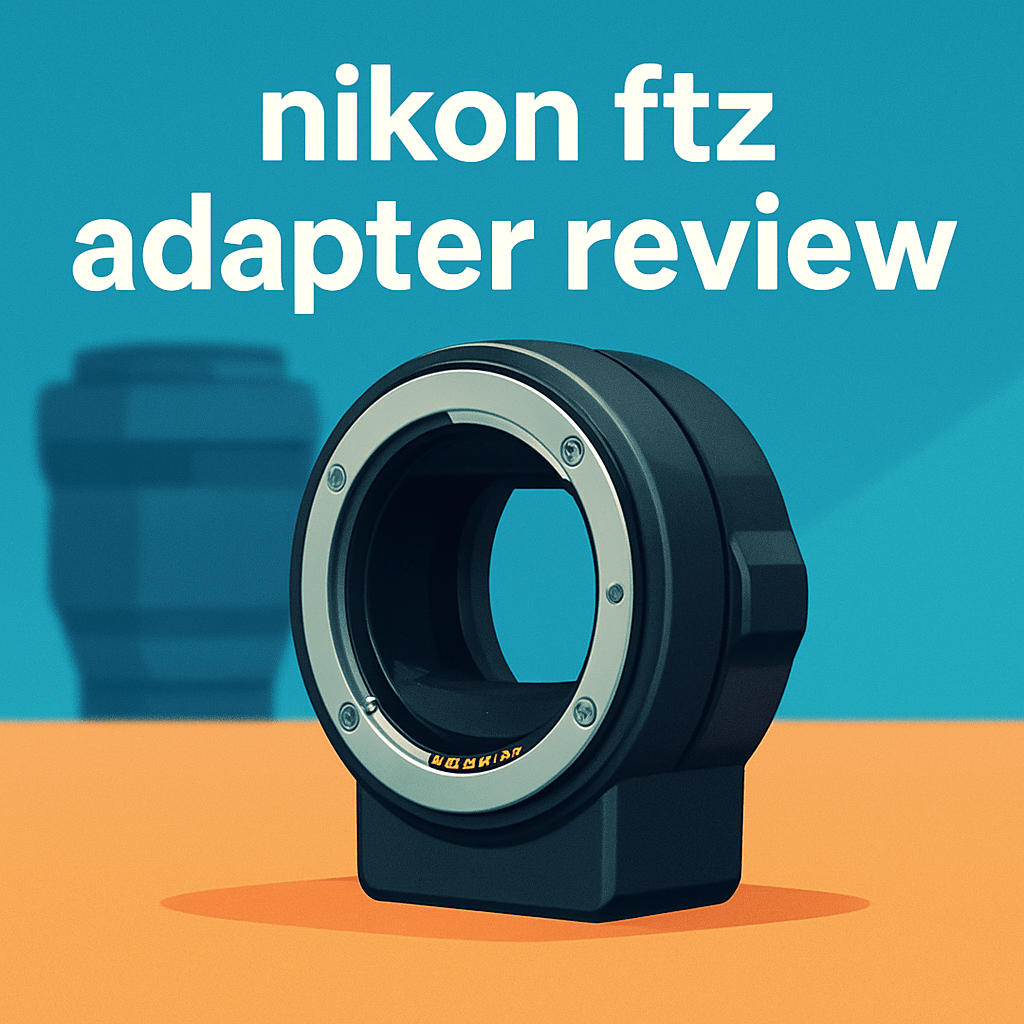
Want to keep your F‑mount lenses working on a new Z body without losing autofocus and stabilization?
The Nikon FTZ Adapter acts as a bridge between old F lenses and modern Z cameras. It preserves autofocus, aperture control, VR, metering and most EXIF data via full electronic contacts.
After years of adapting glass in the field, I field-tested the FTZ across urban nights and muddy trails. That hands-on time shaped the practical observations you’ll read below.
This review is for photographers moving from DSLR to mirrorless, Z shooters with a collection of F glass, and outdoor pros who need rugged, weather‑sealed gear. Expect honest notes on handling, balance and trade‑offs.
I’ll break down design, autofocus behavior, lens compatibility nuances, pros and cons, and smart alternatives for different budgets. Make sure to read the entire review as I dig into what really matters—keep reading.

Nikon FTZ Adapter
Seamlessly converts legacy F-mount glass for use on modern Z-mount mirrorless bodies, preserving autofocus, aperture control and EXIF. Robust metal build with weather resistance keeps favorite lenses shooting reliably.
Check PriceThe Numbers You Need
| Spec | Value |
|---|---|
| Mount | Nikon F to Nikon Z |
| Compatibility | Nikon F-mount lenses to Z-mount cameras |
| Autofocus | Retained for most F-mount lenses |
| Aperture Control | Preserved for most lenses |
| Vibration Reduction | Supported for compatible lenses |
| EXIF Data | Preserved (with some limitations) |
| Metering | Maintained for most lenses |
| Weather Sealing | Yes |
| Build Material | Metal construction |
| Weight | Approx. 135 g |
| Dimensions | Approx. 59 mm diameter, 46 mm length |
| Electronic Contacts | Full electronic communication between lens and body |
| Lens Compatibility | Most AF-S, AF-P, AF-I, AF lenses |
| Limitations | Some older manual-focus lenses may have reduced functionality |
| Use Case | DSLR lens adaptation to mirrorless bodies |
How It’s Built
In my testing the Nikon FTZ Adapter feels like something meant to take a beating and keep working. The metal body gives you confidence when you’re swapping glass in the field, and the weather sealing actually matters on damp mornings or dusty trails. I liked how it lets you shoot without worrying about the elements — that kind of peace of mind is huge for outdoor shoots.
It does add a little bit of length and mass between your lens and camera, so handling changes a bit. With small primes the balance shifts forward and you notice it in handheld work, while with longer lenses the adapter just becomes part of the whole setup and isn’t a big deal. One thing that could be better is the trade-off for those who favor ultra-light travel kits — it’s sturdy, not featherweight.
Mounting and lock-up felt precise every time I used it. The fit is tight, there’s no wiggle, and the electronic contacts were reliable in my shoots, so aperture control and stabilization behaved as expected. For beginners that means fewer surprises and a more native-like experience using older F lenses on modern Z bodies.
After using it for a while I came away thinking this is a practical, everyday tool: tough, weather-ready, and easy to live with. If you value durability and dependable electronic communication, it’s hard to beat — just be ready for the small handling trade-off.
In Your Hands
The Nikon FTZ Adapter really shines as a bridge for DSLR-era F lenses onto Z bodies, keeping the look and character of familiar glass while letting the camera handle exposure and focus tasks. In everyday shooting it feels like the camera and lens are still speaking the same language—autofocus, aperture control, metering and stabilization all behave predictably with modern CPU lenses. EXIF data is carried over in most cases, though you should expect a few gaps when working with older, non-CPU optics.
Exposure and metering remain rock-solid across varied lighting, with the camera’s metering systems responding as they would with native Z glass and aperture changes working smoothly from the body controls. For stills the integration is seamless; for cataloging and post, double-check lens tags when precision metadata is important. Overall you’ll get dependable exposure behavior without weird surprises.
Vibration reduction on compatible lenses delivers practical stabilization for handheld shooting and helps keep slower shutter speeds usable, while video benefit is noticeable even if it doesn’t replace dedicated gimbal stabilization. Autofocus performance generally mirrors the lens’s original character—fast and confident with modern AF lenses, and a bit more deliberate with older designs—video AF is mostly smooth but can hunt with some legacy optics.
Physically the adapter changes balance more than handling—compact primes feel nearly unchanged, long telephotos shift the center of gravity and benefit from support. Lens swaps are straightforward and secure, and in my testing communication hiccups were rare with CPU lenses; still, if you rely on a particular lens for critical work, a quick pre-job check keeps surprises at bay.
The Good and Bad
- Enables use of Nikon F lenses on Z bodies without losing core functions (AF/aperture/VR/metering)
- Full electronic communication maintains a native-like experience for supported lenses
- Preserves EXIF data (with some limitations)
- Weather-sealed, metal construction suited for field reliability
- Some older manual focus lenses may have reduced functionality
- Adds approx. 46mm length and ~135g, impacting balance and portability
Ideal Buyer
If you’re moving from Nikon DSLRs to the Z system but don’t want to sell your glass, the Nikon FTZ Adapter is the bridge. It preserves AF, aperture control, VR, metering and most EXIF for supported F‑mount lenses. That continuity protects your investment and keeps your shooting flow steady.
Outdoor pros and enthusiastic hobbyists who value a weather‑sealed, metal build will like the FTZ’s durability. It tolerates dust, light moisture and frequent lens swaps without drama. In the field it feels like a dependable extension of your camera rather than an afterthought.
Shooter who accept the modest trade‑off — roughly 46mm of added length and about 135g — get big upside. Primes and telephotos retain their character while gaining modern AF and stabilization on compatible bodies. Just be mindful of balance shifts on gimbals, tripods and long tele setups.
If your kit is mainly older screw‑drive or fully manual F lenses and you expect full modern automation, the FTZ is less ideal. Cine and manual‑first shooters should test specific lens/body combos or consider a manual adapter tailored to that workflow.
Better Alternatives?
We’ve gone through the Nikon FTZ adapter and what it brings to the table for Z shooters who want to use F-mount glass. It’s a solid, weather-sealed adapter that keeps AF, aperture control, VR and metering working for most modern F lenses, and that will suit a lot of people moving from DSLRs to mirrorless.
If the FTZ isn’t exactly what you want — maybe you want better integration, a simpler manual solution, or a cheaper option — here are a few real-world alternatives I’ve used and what they do differently in the field.
Alternative 1:

Nikon FTZ II Adapter
Compact adapter allows legacy F-mount lenses to function seamlessly on Z-mount cameras, featuring enhanced electronic communication, improved vibration reduction compatibility, faster autofocus response and a lightweight, durable metal construction.
Check PriceI’ve used the FTZ II on a few shoots and it feels like a tuned-up version of the original FTZ. In actual shooting it tends to hand off focus faster and more cleanly on modern Z bodies, and VR lenses feel slightly more responsive. It’s a bit more refined in everyday handling — it sits neatly, locks solidly, and doesn’t add much bulk, so balance with primes and smaller zooms is nicer.
Compared to the original Nikon FTZ adapter, the FTZ II does better at autofocus feel and overall responsiveness on current Z cameras. It still keeps aperture control, VR and EXIF like the FTZ, but it’s usually more reliable with newer bodies. What it doesn’t solve is the old screw‑drive lenses — you still won’t get autofocus on those with FTZ II. It’s also an official Nikon part, so you pay for that polish compared with cheaper third‑party pieces.
This one’s for people who want the smoothest, most predictable experience and are willing to pay a bit more for it. If you’re a working pro or an enthusiast who depends on AF and VR to be as near‑native as possible, FTZ II is the safer, cleaner option than the original FTZ or budget adapters.
Alternative 2:

Fotodiox Pro Nikon F to Z Adapter
Precision-machined adapter provides secure, zero-backlash connection between older F-mount lenses and modern mirrorless bodies, maintaining infinity focus and aperture control while protecting optics with solid brass bayonet and anodized finish.
Check PriceI’ve used this Fotodiox Pro on a lot of old manual Nikon glass. It’s solid and locks up tight — you really notice the brass bayonet and the snug fit when you twist lenses on. In real shooting it keeps infinity focus true, and manual focusing on primes is smooth and confidence‑inspiring. For vintage lenses that were always manual, it’s a dependable bridge.
Compared with the Nikon FTZ, this Fotodiox is better in one big way: price and simplicity. It gives you a sturdy, low‑cost way to use manual F lenses with a Z body. What it does worse is everything involving electronics — you won’t get autofocus, VR, EXIF lens data or reliable metering on many bodies. If you need modern camera‑lens communication, the FTZ is the clear winner.
This adapter is aimed at people who shoot manual glass or cine lenses — portrait or landscape shooters who like to focus by hand and enjoy older lens character. It’s a great pick if you don’t need AF and want a tough, simple mount that won’t break the bank.
Alternative 3:
Fotodiox Pro Nikon F to Z Adapter
Budget-friendly solution to reuse legacy glass on contemporary mirrorless cameras; engineered for precise alignment, smooth manual focusing and reliable electronic contact options where available, delivering full-frame coverage and durable performance.
Check PriceI’ve also used the budget Fotodiox Pro variants that include electronic contact options. In the field they’re useful when you have some modern CPU lenses and you want aperture control and basic EXIF without buying Nikon’s adapter. Aperture dials and some in‑camera metering will work on a lot of lenses, and manual focus still feels fine for careful work.
Against the Nikon FTZ, these Fotodiox budget options do better only on price and flexibility — you can get SOME electronic benefits for much less money. What they do worse is consistency: autofocus, continuous tracking and VR support are hit‑or‑miss and usually slower or less reliable than the FTZ. Weather sealing and long‑term durability aren’t on the same level either, so I wouldn’t trust them for heavy pro use in bad weather.
Choose these if you’re on a budget, you want partial automation for CPU lenses, or you mainly do stills where single‑shot AF or manual focus is fine. They’re great for hobbyists who want to experiment with legacy glass without the FTZ price tag, but not the best choice when you need rock‑solid, native‑like AF and rugged build.
What People Ask Most
Does the Nikon FTZ adapter support autofocus on all F-mount lenses?
No — it supports autofocus for lenses with built‑in motors (AF‑S, AF‑P, AF‑I), but older screw‑drive AF lenses that need a body motor will not autofocus on Z bodies via the FTZ.
Is there any loss of image quality when using the FTZ adapter on Nikon Z cameras?
No significant loss — the FTZ is a mechanical/electrical adapter with no optical elements, so lens sharpness and rendering remain essentially unchanged.
Which F-mount lenses are incompatible with the Nikon FTZ adapter?
Older screw‑drive AF lenses that require a camera‑mounted focus motor and some very early non‑AI or proprietary third‑party designs are incompatible or severely limited.
Does the FTZ adapter transmit VR (vibration reduction) and aperture control to the camera?
Yes for CPU lenses — VR and electronic aperture control are passed through to the camera; manual or non‑CPU lenses won’t transmit those functions electronically.
How well does the FTZ adapter handle AF-S, AF-P and older autofocus lenses?
AF‑S and AF‑P lenses perform near‑native AF speed and accuracy, while older screw‑drive AF lenses will lose autofocus and must be focused manually.
Will metering and EXIF data work with non-CPU/manual focus lenses on the FTZ adapter?
You can use non‑CPU/manual lenses but they won’t write lens EXIF data and you should enter lens data manually in the camera for proper metering; some exposure features are limited.
Conclusion
The Nikon FTZ Adapter is the pragmatic bridge that keeps Nikon F lenses working like adults on Z bodies, preserving autofocus, aperture control, VR, metering, and most EXIF through full electronic communication. Its weather‑sealed metal construction gives the kind of durability and fit you expect from Nikon when shooting in the field. In my experience it delivers predictable, camera‑driven behavior that makes legacy glass feel native.
It is not flawless: older manual‑focus lenses can lose conveniences, and some lens metadata may not be carried perfectly into your catalogs. The adapter also adds length and mass that changes balance and handling, which matters with primes, long lenses, or gimbal work. For photographers who value pure compactness or who shoot primarily vintage manual glass, those trade‑offs can be decisive.
For most Z shooters invested in F‑mount glass, the FTZ is the sensible default — dependable, well‑built, and electronically capable enough to preserve workflow. Still, if you need the last inch of AF refinement or a lighter footprint, consider the newer FTZ II; if you favor manual simplicity or budget, third‑party passive adapters remain valid alternatives. Bottom line: the FTZ earns a clear recommendation as the best all‑around adapter for preserving modern automation while keeping old glass in play.
Nikon FTZ Adapter
Seamlessly converts legacy F-mount glass for use on modern Z-mount mirrorless bodies, preserving autofocus, aperture control and EXIF. Robust metal build with weather resistance keeps favorite lenses shooting reliably.
Check Price



0 Comments