
Looking for a long lens that’s easier to carry without losing field performance? You’re in the right place.
The Canon EF 400mm f/4 DO II USM brings 400mm reach in a compact, stabilized, weather‑resistant package that aims at mobility and real‑world action shooting.
If you shoot wildlife, field sports, or aviation and value handheld mobility, this lens promises practical gains. I’ve put it through tough field days to see how it holds up.
I’ll cover handling, stabilization, AF, sharpness, usability, pros and cons, and practical alternatives. Make sure to read the entire review as…
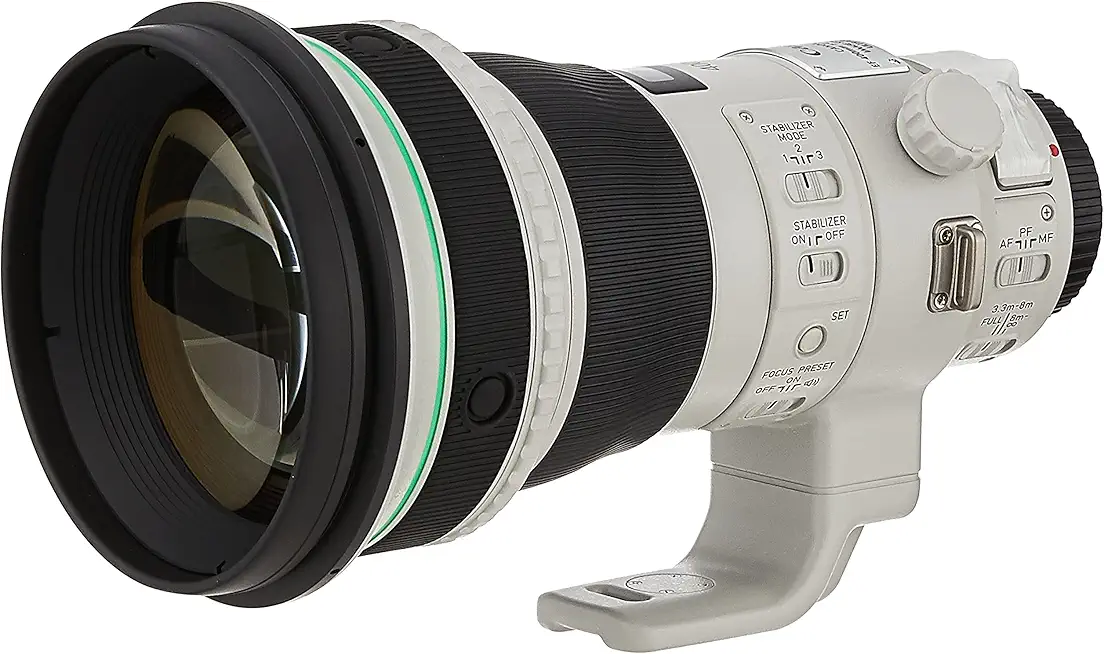
Canon EF 400mm f/4 DO II USM
Compact, lightweight telephoto featuring diffractive optics for exceptional sharpness and reduced chromatic aberration. Fast autofocus and portable design suit travel, birding, and sports where agility and reach matter.
Check PriceThe Numbers You Need
| Spec | Value |
|---|---|
| Focal Length | 400mm |
| Maximum Aperture | f/4 |
| Minimum Aperture | f/32 |
| Lens Mount | Canon EF |
| Optical Design | Diffractive Optics (DO) |
| Image Stabilization | Yes, 4 stops (IS) |
| Autofocus Motor | Ultrasonic Motor (USM) |
| Minimum Focus Distance | 2.5 m |
| Maximum Magnification | 0.13x |
| Filter Size | 52mm |
| Dimensions | Approx. 127mm diameter × 249mm length |
| Weight | Approx. 2100 g |
| Lens Construction | 15 elements in 10 groups |
| Weather Sealing | Yes, dust and moisture resistant |
| Diagonal Angle of View | 6°10′ (full-frame) |
How It’s Built
In my testing the Canon EF 400mm f/4 DO II USM feels shockingly compact for a long prime. The diffractive design keeps the barrel short and the build tight. That means it’s easier to carry and less tiring on long walks.
Build quality is solid with reassuring heft and clean weather seals that stood up to drizzle and dusty trails during my shoots. For beginners that means you can keep shooting when the weather turns without panic. It’s not a do-anything storm lens, but it’s far more confident in the field than many telephotos.
Controls are well laid out with a smooth focus ring and positive switches that don’t flop around in your hand. I found those switches a bit small when wearing gloves, which can slow you down in fast action. The small front filter thread is handy for compact filters but makes rotating polarizers fiddly.
Balance on a full-frame body felt predictable and doable handheld for short bursts, and it sits nicely on a monopod for longer sessions. One thing I really liked was how travel-friendly it is without sacrificing feel or durability. One thing that could be better is glove-friendly ergonomics and slightly larger, easier-to-use controls.
In Your Hands
In the field the Canon EF 400mm DO II USM’s stabilization is one of its defining strengths, taming camera shake so handheld static subjects stay usable at shutter speeds where you’d normally reach for a monopod. For panning action it’s surprisingly forgiving, letting you follow birds or sideline players with steadier framing than expected. The IS also calms the viewfinder, which helps lock focus quickly on skittish targets.
Shooting in low light around dawn and dusk felt practical thanks to the lens’s relatively bright aperture; stabilization kept sensitivity needs and shutter demands from escalating, so keeper rates remained healthy without resorting to extreme noise. On a monopod or tripod the IS gives extra confidence for careful compositions as light fades. Fast, consistent focus plus steadier framing makes late‑day sequences far less nerve‑wracking.
In everyday use the lens fills the frame beautifully for medium‑to‑large subjects—shorebirds, waterfowl, and field athletes—where working distance feels comfortable and subject separation looks cinematic. It’s less suited to very small close‑ups without cropping or getting closer, so plan approaches when tight framing is crucial. That relatively close focusing feel is handy for environmental portraits of wildlife.
Built to shrug off drizzle and dust, the lens proved dependable on long travel days and variable weather, inspiring confidence for multi‑hour field sessions. Its compact footprint compared with traditional super‑telephotos makes hikes and airport transitions more tolerable, though it’s still a presence after hours. At extreme ranges atmospheric heat and shimmer are the true limit to detail, so steady technique, patient timing, and judicious support are the keys to the best results.
The Good and Bad
- 400mm reach at a bright f/4 aperture
- 4-stop Image Stabilization for handheld and low-light support
- Diffractive Optics design for a relatively short 249 mm length and approximately 2.1 kg carry weight
- Weather sealing for dust and moisture resistance in outdoor use
- f/4 is not as bright as f/2.8, offering less subject isolation and low-light headroom
- Diffractive Optics rendering characteristics may not suit every shooter and can introduce unique artifacts or tonal nuances
Ideal Buyer
The Canon EF 400mm f/4 DO II USM is aimed at shooters who need a true 400mm prime with a bright f/4 aperture, built-in stabilization and weather resistance without hauling giant glass. It’s for photographers who demand reach, reliability and steady shots in the field.
If you travel to remote hides or hike long trails, its roughly 2.1 kg weight and short 249 mm profile become decisive advantages. You still get pro-level handling and 4-stop IS in a package that fits overhead bins and tight backpacks.
Birders, wildlife specialists, field-sports and aviation photographers will find its combination of reach, fast operation and stabilization particularly useful. The lens rewards operators who prefer handheld mobility and quick framing over lugging bulkier f/2.8 alternatives. Fast USM AF and stout weather sealing keep you shooting when the action heats up or the weather closes in.
It’s best for photographers who accept the trade-offs of an f/4 DO optic—slightly different rendering and less low-light headroom than f/2.8 primes—in exchange for compactness and travelability. If you prioritize ultimate speed, absolute bokeh rendering or the last stop of low-light performance, a heavier f/2.8 or longer prime might suit you better. For those balancing image quality with portability, this lens hits a very practical sweet spot.
Better Alternatives?
We’ve already looked closely at the Canon EF 400mm f/4 DO II — its compact size, built-in stabilization, and real-world handling make it a great choice when you need a 400mm reach without hauling giant glass. But that DO design and the f/4 aperture mean some photographers will want more speed, more reach, or a different rendering in the field.
Below are three lenses I’ve used in real shoots that cover those needs. I’ll say plainly what each one does better and worse than the DO 400, and who I’d recommend them to based on real shooting time, not just the specs.
Alternative 1:

Canon EF 400mm f/2.8L IS III USM
Professional-grade super-telephoto with an ultra-bright maximum aperture, state-of-the-art stabilization, and razor-sharp optics for unparalleled subject separation. Built tough for demanding wildlife and sports shooters in challenging conditions.
Check PriceI’ve shot sports and birds with the 400mm f/2.8 III and the most obvious difference is speed. At f/2.8 you get faster shutter speeds and a much shallower depth of field, so subjects separate from background more easily and you can freeze motion in darker conditions. In practice that means better keep rates on fast action and more pleasing, creamy backgrounds compared with the DO 400.
What the 400/2.8 gives up is compactness and weight. It’s noticeably bigger and heavier than the DO 400, so long hikes or travel days feel more tiring. I found myself reaching for a monopod more often and stowing it in a bigger case. It’s also pricier, so you’re paying for that extra speed and a more “classic” rendering.
This lens is for shooters who put image quality and low-light/fast-action performance first — sports photographers, professionals, or serious wildlife shooters who don’t mind the extra bulk and cost to get better subject isolation and cleaner out-of-focus areas in real-world shoots.
Alternative 2:

Canon EF 500mm f/4L IS II USM
Long-reach prime delivering outstanding resolution and contrast across the frame. Robust image stabilization and fast autofocus ensure tack-sharp results for distant subjects; a staple for birders and action photographers.
Check PriceThe 500mm f/4 II gives you an immediate practical advantage over the DO 400: more reach. When you can’t get closer to birds or distant wildlife, that extra 100mm matters — you fill the frame more often and need less cropping. In my field work this translated into more usable shots of small birds and subjects far off the trail.
On the downside, the 500/4 is larger and heavier than the DO 400 and less convenient to carry all day. I found it more comfortable on a monopod or tripod for long sessions, and it’s not as friendly for handheld moves or tight travel setups. Optically it feels more “traditional” and often renders slightly more contrast than the DO lens, but you pay in portability.
Choose the 500/4 if reach is your priority — birders and wildlife shooters who spend time in one location or who can use a monopod/tripod will love the tighter framing and solid sharpness at distance. If you need to hike light or change positions quickly, the DO 400 still wins on convenience.
Alternative 3:
Canon EF 500mm f/4L IS II USM
Exceptional telephoto performance with creamy bokeh and precise subject isolation, optimized for use with teleconverters and long-distance shooting. Durable construction and weather sealing keep you shooting through harsh field conditions.
Check PriceAnother way I used the 500/4 II was with teleconverters and long-distance subjects — it plays well with extenders and still gives pleasing bokeh and solid subject isolation. Compared to the DO 400, the 500/4 often holds up better when you add a 1.4x or 2x converter, so you get more reach without a big loss in practical image quality.
That said, using converters and the 500/4 increases the size, weight, and need for support even more. In handheld work the DO 400 often felt more manageable and quicker to set up, while the 500/4 plus converter became a more deliberate, tripod/monopod-only setup. If you’re switching focal lengths a lot, the DO’s compactness is nicer in the field.
Buy the 500/4 with converters in mind if you regularly shoot very distant subjects and want the flexibility to add reach without changing to a much bigger lens. It’s a good match for birders and distant wildlife shooters who accept extra weight for added range and smoother backgrounds when shooting through long glass.
What People Ask Most
What does DO stand for in the Canon EF 400mm f/4 DO II?
DO stands for Diffractive Optics, which uses diffractive elements to make the lens shorter and lighter while keeping long focal length performance.
How much does the Canon EF 400mm f/4 DO II weigh?
It weighs about 2.1 kg (around 4.6 lb), significantly lighter than many conventional 400mm f/4 lenses.
Is the Canon EF 400mm f/4 DO II good for bird and wildlife photography?
Yes — its light weight and f/4 reach make it excellent for bird and wildlife work in the field, especially when hiking or handholding.
Can you use 1.4x or 2x teleconverters with the Canon EF 400mm f/4 DO II?
Yes, it accepts Canon 1.4x and 2x teleconverters; 1.4x is a solid option, while 2x cuts AF performance and image quality more noticeably.
How does the image quality of the Canon EF 400mm f/4 DO II compare to the Canon EF 400mm f/4L IS USM?
The DO II is very good but the traditional 400mm f/4L IS USM generally has a slight edge in sharpness and contrast, while the DO II wins on weight and portability.
Is the Canon EF 400mm f/4 DO II weather-sealed and durable for field use?
Yes, it has L-series level dust and moisture resistance suitable for field use, though you should still avoid heavy exposure to extreme weather and handle it carefully.
Conclusion
The Canon EF 400mm f/4 DO II USM is a purposeful telephoto that trades absolute optical bulk for real-world portability and stabilized reach. Its diffractive-optics compactness and weather-resistant build make it an easy choice when you need long glass that won’t slow a long day in the field.
In practice it handles like a workhorse: steady in hand or on a monopod, quick enough to grab errant action, and sharp where it counts while showing the characteristic DO rendering that some will love and others will learn to work around. The lens’s working distance and framing habits reward thoughtful positioning, but they also reveal limits for tight close-ups of small subjects.
If your priority is travel-friendly reach with reliable stabilization and practical all-weather use, this lens delivers strong value. If ultimate low-light speed, the last ounce of subject isolation, or longer reach are non-negotiable, consider the heavier, faster, or zoom alternatives instead. For most wildlife and field-sports shooters who prize mobility without surrendering performance, the 400mm DO II is a smart, pragmatic tool.
Canon EF 400mm f/4 DO II USM
Compact, lightweight telephoto featuring diffractive optics for exceptional sharpness and reduced chromatic aberration. Fast autofocus and portable design suit travel, birding, and sports where agility and reach matter.
Check Price

0 Comments