
Want a single lens that handles travel, portraits, street and landscapes without weighing down your kit? Or wondering if a constant f/4 zoom is enough for most real-world shoots?
The Canon EF 24-70mm f/4L promises pro-grade versatility in a compact package. I took it into the field on shoots from rainy streets to sunrise landscapes.
It pairs constant f/4 with image stabilization and L-series weather sealing. Add a fast USM focus drive and you’ve got reliable, portable performance.
Works on full-frame and APS-C bodies — expect wider framing on full-frame and extra reach on crops. In practice you’ll find fewer lens swaps and steadier handheld shots.
I’ll dig into handling, sharpness, stabilization, and where it wins or loses to rivals. Make sure to read the entire review as I share real-world pros, cons, and whether it deserves a spot in your bag — keep reading.

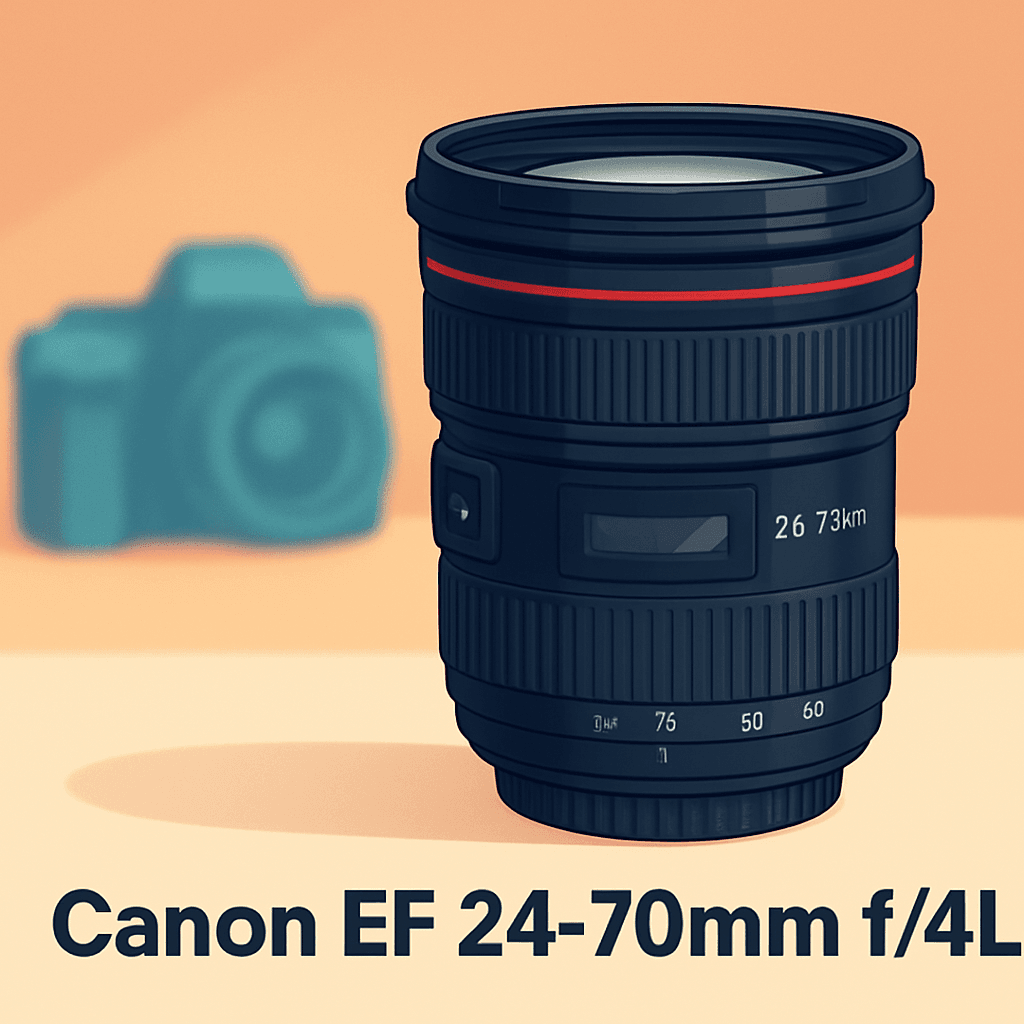
Canon EF 24-70mm f/4L
Lightweight, constant-aperture standard zoom delivering edge-to-edge sharpness and reliable weather sealing. Ideal for travel and everyday shooting, it balances portability with professional image quality for landscapes, portraits, and events.
Check PriceThe Numbers You Need
| Spec | Value |
|---|---|
| Focal length | 24-70mm |
| Maximum aperture | f/4 (constant) |
| Lens mount | Canon EF |
| Lens series | L-series (professional-grade) |
| Image stabilizer | Yes, Optical Image Stabilization (IS) |
| Autofocus type | Ultrasonic Motor (USM) |
| Minimum focusing distance | Approx. 0.38 m (1.25 ft) |
| Maximum magnification | 0.24x |
| Lens construction | 14 elements in 11 groups |
| Filter size | 67 mm |
| Dimensions (Diameter x Length) | Approx. 83.5mm x 94.5mm |
| Weight | Approx. 600g |
| Weather sealing | Yes (dust and moisture resistant) |
| Minimum aperture | f/22 |
| Compatible sensor format | Full-frame (also compatible with APS-C with crop factor) |
How It’s Built
In my testing the Canon EF 24-70mm f/4L feels like a proper pro zoom—solid but not heavy. The L-series build and weather sealing gave me confidence shooting in drizzle and dusty streets. It’s an EF-mount lens that works on full-frame and crop bodies.
On a full-frame body it balances nicely and doesn’t pull on the camera, so handheld shooting stays comfortable. On smaller APS-C bodies it feels a touch nose-heavy but still fine for travel. The extra reach on crop sensors is often useful.
The zoom ring moves smoothly with good resistance and the throw feels natural for quick framing. The focus ring is nicely damped and allows precise manual pulls. The AF/MF and IS switches click firmly, though I wish they were larger for gloved use.
The hood fits snugly and helped control flare in backlit shots I tried. I liked the solid finish and weather seals, but after heavy daily use I noticed small scuffs on the paint—annoying, not fatal.
The classic L looks and clear markings make it easy for beginners to read settings quickly. The common filter size is a practical plus when sharing filters between lenses.
In Your Hands
The USM autofocus is quietly confident in everyday shooting, locking onto faces and eyes with a reassuring snap on modern Canon bodies and remaining unobtrusive in run-and-gun situations. For moving subjects it tracks competently, though in very low-contrast scenes it can take an extra beat to settle rather than lurching into focus.
Canon’s stabilization makes handheld work noticeably easier, giving you steadier framing in dimmer light and smoother casual video without gimbals. You’ll notice a slight startup/settle behavior when engaging IS, but viewfinder steadiness and panning remain comfortably predictable for most run-and-gun shooting.
The constant f/4 aperture is a practical compromise: it won’t deliver the shallowest backgrounds a faster lens provides, but it lets you keep a consistent exposure approach across the zoom and lean on stabilization and modern high-ISO performance when needed. That balance makes the lens a go-to for travel, events, and documentary work where flexibility matters more than extreme low-light headroom.
Close-focus ability is surprisingly useful for product details and environmental close-ups, offering crisp rendering at near distances while stopping short of true macro. The lens holds microcontrast well up close, so textures and fine detail read nicely in images.
From environmental wide framing to standard walk-around perspectives and tighter portrait crops, the zoom covers the practical bases photographers use most. On cropped bodies the field of view tightens, which can be a benefit if you want extra reach but reduces the widest environmental stance.
In real-world use flare is well controlled with the hood in place, and mild vignetting or distortion are easily corrected in post if desired. Color and contrast skew toward neutral yet punchy, delivering images that require little tweaking for everyday editorial and client work.
The Good and Bad
- Constant f/4 aperture across the zoom range
- Optical Image Stabilization for reliable handheld shooting
- L-series build with weather sealing (dust and moisture resistance)
- USM autofocus for quiet, precise focusing
- f/4 is slower than f/2.8, offering less subject isolation and requiring higher ISO or slower shutter speeds in low light
- 70mm long end may feel limiting compared with 24-105mm alternatives
Ideal Buyer
The Canon EF 24-70mm f/4L is aimed at shooters who want a pro‑grade, stabilized standard zoom that won’t weigh down a day of walking. Its L‑series build, weather sealing and optical IS make it a dependable go‑to when reliability matters as much as optics. If you value steady, all‑around performance over the extra stop of speed, this is the lens for you.
Travel, street, documentary and event photographers will appreciate the 24–70mm range for its flexibility from environmental context to head‑and‑shoulders framing. Portrait and landscape shooters who favor portability and consistent f/4 rendering will find it a practical compromise between primes and heavier f/2.8 zooms. On APS‑C bodies it becomes a useful short telephoto, making single‑lens kits even more versatile.
This lens is perfect for photographers who prefer one‑lens simplicity—fast enough autofocus, useful close‑focus, and IS that saves shots when light falls off. It’s also a smart choice for pros who need an L‑series backup that’s lighter and easier to carry all day.
It’s less ideal for shooters chasing maximum background separation or the absolute lowest‑light speeds; opt for f/2.8 alternatives if that’s your priority. Likewise, if you regularly need reach past 70mm, a 24–105 or longer lens will suit you better.
Better Alternatives?
We’ve already gone through what the Canon EF 24-70mm f/4L brings to the table: a compact, weather-sealed L-series zoom with image stabilization that’s easy to carry and steady in hand. It’s a great all-rounder for travel, street, and run-and-gun shoots where weight and stability matter more than the last stop of brightness.
If you’re thinking about other options, most people are weighing extra reach, more speed, or higher ultimate sharpness. Below are three lenses I’ve used in the field and how they stack up against the 24-70 f/4L so you can pick the one that fits your shooting style.
Alternative 1:

Canon EF 24-105mm f/4L
Versatile walkaround zoom with a steady aperture that covers wide to short-telephoto perspectives. Smooth autofocus and robust build make it a go-to choice for travel, weddings, and documentary work.
Check PriceThe 24-105mm f/4L is the obvious choice if you want more reach without changing your shooting habits. In real shoots it lets me tighten a portrait or grab a subject across a small room without switching lenses, and it keeps that same constant f/4 look and image stabilization as the 24-70 f/4L, so handholding late-evening scenes is still very doable.
Where it loses out to the 24-70 f/4L is in edge and long-end sharpness — I’ve noticed the 24-105 can be a touch softer at 105mm and in the corners compared to the 24-70 at equivalent settings. Autofocus and build are solid, but if you care about the last bit of resolution for big prints, the 24-70 f/4L feels a bit crisper to my eye.
Choose the 24-105 if you want one-lens convenience for travel, weddings, or documentary work where that extra 35mm at the long end saves you from swapping glass. Stick with the 24-70 f/4L if you prioritize a slightly sharper, more compact walkaround lens and you rarely need the extra reach.
Alternative 2:
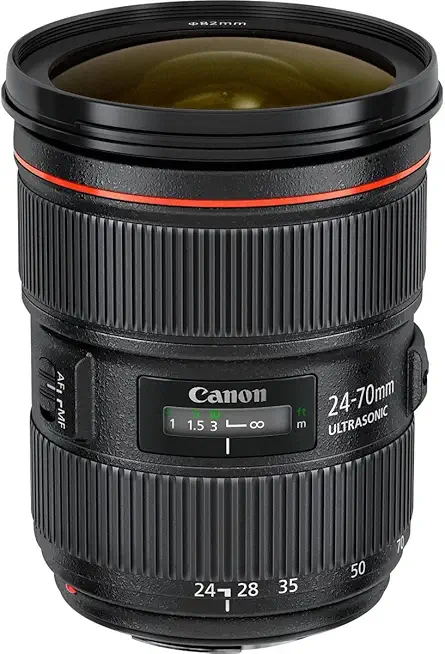
Canon EF 24-70mm f/2.8L II
Professional-grade standard zoom offering fast f/2.8 speed, exceptional corner-to-corner sharpness, and creamy background separation. Built for demanding shooters who need consistent performance in low-light and studio environments.
Check PriceSwitching to the 24-70 f/2.8L II gives you a big jump in low-light ability and subject separation. I often reach for it for weddings and portraits because the f/2.8 lets you drop the shutter speed or lower ISO while getting much smoother background blur than the f/4 option.
But that speed comes with trade-offs: there’s no image stabilization, so you’ll rely on faster shutter speeds or a tripod for slow-light scenes. It’s also heavier and more tiring to carry on long shoots compared with the f/4L, and you’ll notice the difference in a packed bag or a day of walking around a city.
This is the lens for shooters who need top performance in low light or want shallower depth of field — event pros, portrait shooters, and commercial photographers who put image quality above a lighter kit. If you value stabilization and portability more, the f/4L stays the smarter daily lens.
Alternative 3:
Canon EF 24-70mm f/2.8L II
Flagship-level optics deliver stunning resolution and contrast across the zoom range, with robust construction and reliable autofocus. A favorite among professionals for events, portraits, and fast-paced commercial shoots.
Check PriceOn shoots where absolute sharpness, contrast, and AF reliability matter, the 24-70 f/2.8L II really shines. I’ve used it for commercial jobs and fast-paced events where every frame must be tack-sharp across the frame — it consistently delivers cleaner-looking images than the 24-70 f/4L, especially wide open.
The downside compared to the f/4L is the same practical stuff I’ve felt in the field: more weight, no stabilization, and a higher price. If you’re bouncing between long handheld sessions and need steady framing at slower speeds, the absence of IS is noticeable; you compensate with higher shutter speeds or bumping ISO.
Pick this one if you’re a pro who needs the best image quality and build, and you’re fine carrying a heavier lens. If you shoot travel, run-and-gun, or value having IS in your walkaround kit, the 24-70 f/4L or the 24-105 f/4L will likely suit you better.
What People Ask Most
Is the Canon EF 24-70mm f/4L sharp?
Yes — it’s consistently sharp across the frame, especially when stopped down a stop or two, and performs very well for general shooting.
Does the Canon EF 24-70mm f/4L have image stabilization?
The EF 24-70mm f/4L IS version includes optical image stabilization, which helps for low-light and handheld work.
How does the Canon EF 24-70mm f/4L compare to the Canon EF 24-70mm f/2.8L?
The f/2.8 is faster with shallower depth of field and heavier build, while the f/4 is lighter, often similarly sharp stopped down, and usually cheaper with IS on the f/4 model.
Is the Canon EF 24-70mm f/4L good for portraits and landscapes?
Yes — the focal range covers tight portraits to wide landscapes; bokeh is more restrained than f/2.8 but still very usable for portraits.
Can I use the Canon EF 24-70mm f/4L on Canon RF mirrorless cameras?
Yes — it works perfectly on RF bodies with the Canon EF‑EF‑R adapter, retaining autofocus and image stabilization functionality.
Is the Canon EF 24-70mm f/4L weather-sealed and suitable for professional use?
Yes — as an L-series lens it has robust build quality and weather sealing, making it suitable for professional and field use.
Conclusion
The Canon EF 24-70mm f/4L is a stabilized, weather-sealed L-series standard zoom that smartly balances portability and professional build. Its image stabilization and USM autofocus deliver reliable handheld performance and quick subject acquisition in everyday shooting. Optically it punches above its weight with consistently strong rendering and useful close-focus capability that makes it a true one-lens workhorse.
That said, the constant f/4 aperture is a clear tradeoff; you lose some low-light latitude and creamy background separation compared with faster zooms. The short long end can feel restrictive for shooters who want extra reach without changing lenses. And while it is compact for an L lens, it isn’t the featherweight choice for ultralight travel kits.
If your priorities are stabilized, weatherproofed versatility and a lighter, dependable kit for travel, street, documentary, or events, I’d pick the Canon EF 24-70mm f/4L without hesitation. If you need more reach, look toward the 24-105 f/4L; if maximum low-light performance and subject isolation matter most, the f/2.8 24-70 options remain the better call. Overall this lens earns a clear recommendation as a practical, pro-grade everyday zoom for photographers who value steadiness and reliability over outright speed.
Canon EF 24-70mm f/4L
Lightweight, constant-aperture standard zoom delivering edge-to-edge sharpness and reliable weather sealing. Ideal for travel and everyday shooting, it balances portability with professional image quality for landscapes, portraits, and events.
Check Price


0 Comments