
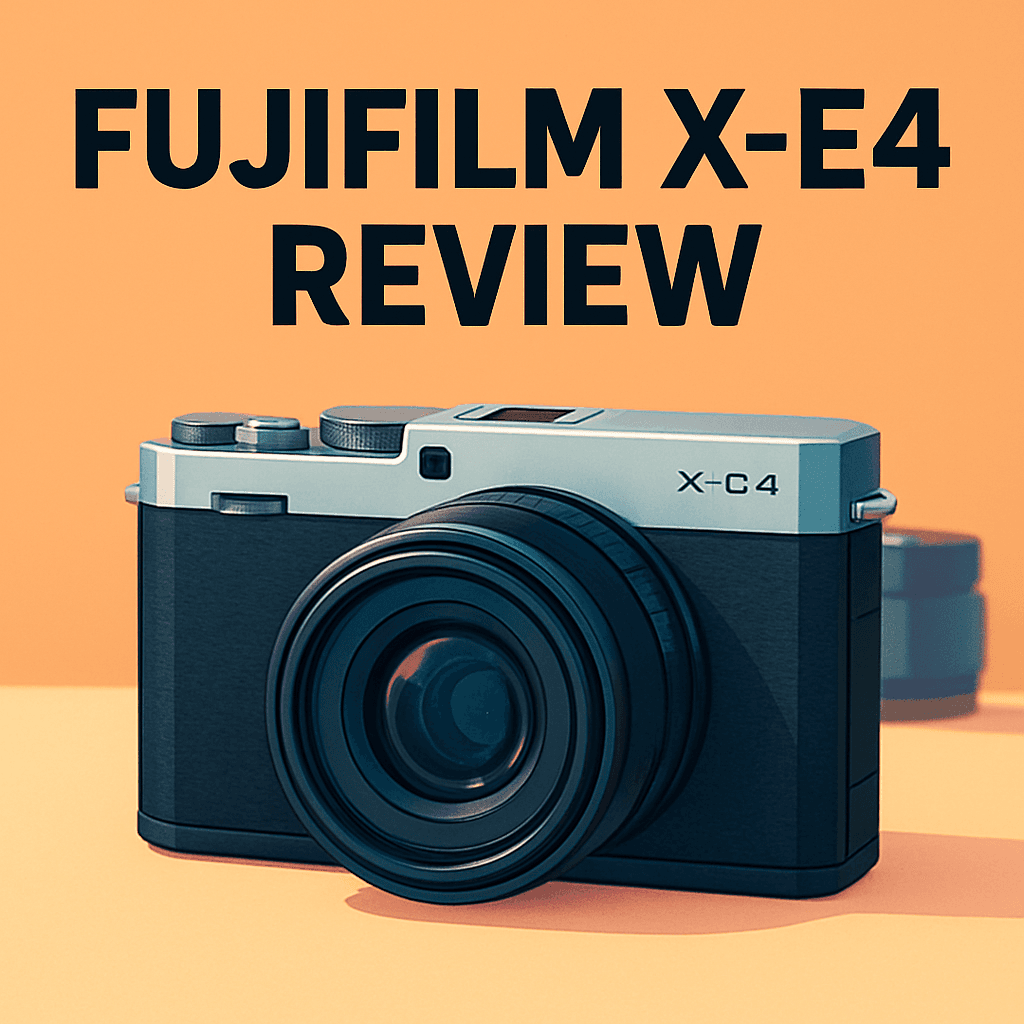
Want better travel and street photos without hauling a big camera bag? This fujifilm x-e4 review looks at a compact, rangefinder-style mirrorless that promises portability and great JPEGs.
I field-tested the Fujifilm X-E4 Camera on city walks and weekend trips, shooting stills and casual video. You’ll get Fujifilm’s film-like colors and quick handling that suit everyday use.
It’s lightweight and pocketable, but there are tradeoffs—no in-body stabilization and 4K tops out at 30p. Make sure to read the entire review as I break down where this camera truly shines and who should buy it—keep reading.

Fujifilm X-E4 Camera
Sleek rangefinder-style mirrorless with a 26.1MP APS-C sensor, classic controls, and renowned film simulations. Lightweight for travel, it delivers sharp detail, fast autofocus, and 4K video for creatives.
Check PriceThe Numbers You Need
| Spec | Value |
|---|---|
| Sensor | 26.1 MP APS-C X-Trans |
| Lens Mount | Fujifilm X-mount |
| Image Stabilization | No built-in stabilization |
| Continuous Shooting | Up to 20 fps |
| Autofocus | Phase Detection |
| ISO Range | 160–12800 (expandable to 51200) |
| Shutter Speed | 1/4000 to 30 sec |
| Video Resolution | 4K at 30 fps |
| Viewfinder | 2.36M-dot OLED |
| Screen Type | 3.0″ tilting touchscreen |
| Weight | Approximately 340 grams |
| Dimensions | 121.3 x 72.9 x 32.7 mm |
| Battery Life | Around 380 shots |
| Memory Cards | SD / SDHC / SDXC |
| Film Simulations | Available with various styles |
How It’s Built
In my testing the Fujifilm X-E4 Camera feels shockingly solid for such a slim body. It didn’t creak or wobble in my hands, and that gives you confidence on the street even though I wasn’t checking weather sealing. For day-to-day use that means you can toss it in a bag and not worry about a fragile toy.
The tiny footprint and light weight make this camera a real pocketable companion. I wore it on walks and trips and barely noticed it, which is great for travel or shooting all day. The tradeoff is fewer big dials and a shallow grip, so I found long one-handed sessions less comfy than chunkier models.
The tilting 3.0″ touchscreen was one of my favorite bits. Shooting low or high angles felt easy and intuitive, and touch focus works when you need it fast. The little EVF is bright and usable for quick framing, though you’ll miss a deeper viewfinder hump if you like one-handed shooting.
Mounting lenses is straightforward thanks to the X-mount ecosystem, which makes lens choices simple for beginners. I liked how portable it made my kit, but I wished the controls were a bit more tactile for fast adjustments. Overall, it’s built for carry-first shooters who want a dependable, compact camera.
In Your Hands
Autofocus on the Fujifilm X-E4 feels confident in everyday shooting — it nails quick street snaps and locks onto faces for portraits with reassuring consistency in good light. In lower light or with fast, unpredictable subjects it can hesitate, so pairing it with a fast lens smooths the experience for demanding scenes.
The camera’s continuous shooting is great for catching decisive moments and short action sequences; it pulls off short bursts reliably and is best used for sequences rather than marathon chases. I found the buffer handles a healthy run but you’ll notice a slowdown once you push long continuous bursts, so learn to time your bursts for the moments that matter.
For stills I kept to the cleaner end of the sensitivity range for maximum detail and only pushed higher settings when convenience outweighed perfect low‑light purity. The shutter range covers typical daylight work comfortably, and long exposures are straightforward from a tripod when you want night or creative motion shots.
Battery life comfortably carries you through a day of mixed shooting, though I still pack a spare for full-day assignments or long travel shoots. Using faster UHS cards made a visible difference in responsiveness — shots and short video clips write quickly and feel more fluid during busy sessions.
Video at 4K 30p produces pleasing color and detail for run‑and‑gun clips, but handheld work benefits from stabilized lenses or a gimbal since there’s no in‑body stabilization. For casual cinematic clips and social videos it’s an easy tool, provided you mind composition and use deliberate, steady moves.
The Good and Bad
- Compact and pocketable
- High-resolution APS-C X-Trans sensor
- Fast continuous shooting
- Film simulations available
- No in-body image stabilization
- Ultra-high-definition video limited to thirty frames per second
Ideal Buyer
If you favor portability and the tactile pleasures of a rangefinder-style camera, the Fujifilm X-E4 Camera is tailored for your kit. It’s perfect for travel, street, and everyday shooting where pocketability matters more than a deep grip. Small primes balance beautifully on the slim body for long walks and quick captures.
JPEG-first shooters who adore Fujifilm’s film simulations will find the X-E4 especially rewarding, delivering ready-to-share color and character straight from the camera. Hybrid creators capturing casual 4K 30p clips will appreciate the image quality so long as they accept there’s no IBIS. If you plan to shoot low-light handheld video, budget for stabilized lenses or a gimbal.
Enthusiasts who want a second body that won’t weigh down a pack or a daily carry camera that invites spontaneous shooting will love this model. Street photographers, documentary shooters, and photojournalists seeking discreet, high-quality stills are ideal buyers. Pair it with fast primes or OIS glass and you’ve got a versatile, stylish tool that prioritizes feel and finish over brute force features.
Buyers who prioritize a polished JPEG workflow and minimal gear will appreciate how quickly the X-E4 delivers usable files. It’s a smart choice for photographers who value image character and mobility. Consider it if you want Fuji color in a truly pocketable form.
Better Alternatives?
We’ve already dug into the Fujifilm X‑E4 — how it feels in hand, how it shoots stills and casual video, and where it fits as a compact travel and street camera. If you like the Fuji look and the small, rangefinder-style body, it’s a strong pick, but it’s not the only way to get great images.
Below are a few real-world alternatives I’ve used in the field. I’ll point out what each does better and worse than the X‑E4 and who I’d recommend them to, so you can pick the one that fits your shooting style.
Alternative 1:

Fujifilm X-T30 II Camera
Compact enthusiast mirrorless packing a 26.1MP APS-C sensor, enhanced autofocus and processing, versatile film simulations, and 4K video. Intuitive dials and quick burst shooting suit street, portrait, and travel photography.
Check PriceWhat it does better: The X‑T30 II gives you nearly the same image look and film simulations as the X‑E4 but with a deeper grip and more physical dials. In real shooting I found it easier to hold for longer sessions and faster to change settings on the fly. That extra grip makes one‑handed shooting and tracking subjects a bit more comfortable.
What it does worse: It’s not as pocketable as the X‑E4 — you feel the difference when you try to slip it into a jacket pocket. It also doesn’t add in‑body stabilization, so low‑light handheld shooting still needs fast lenses or a tripod just like the X‑E4.
Who should buy it: Choose the X‑T30 II if you love Fujifilm colors and want better ergonomics for long days. It’s great for street and travel shooters who want faster access to controls but still want a compact kit that won’t slow you down.
Alternative 2:

Sony Alpha a6400 Camera
High-performance APS-C hybrid offering 24.2MP stills, 4K video, and lightning-fast real-time autofocus with eye-tracking. 11 fps continuous shooting and a flip-up LCD make it ideal for vlogging and action.
Check PriceWhat it does better: The a6400 shines for autofocus — tracking moving people and animals felt more reliable when I shot action and run-and-gun video. The flip‑up screen also makes it easy to frame vlogs or selfie-style clips, which is handy if you do a lot of solo video work.
What it does worse: The Sony colors and JPEGs aren’t the same as Fuji’s film simulations, so if you want that classic Fuji look straight from the camera you’ll spend more time in post. The body also feels different in hand — smaller controls and menu navigation are less dial-centric than Fujifilm’s layout, which some photographers find less intuitive for quick changes.
Who should buy it: Go for the a6400 if you need dependable autofocus for moving subjects or do a lot of vlogging. It’s ideal for hybrid shooters who want great tracking and a big lens selection to grow into.
Alternative 3:
Sony Alpha a6400 Camera
Compact, responsive mirrorless built for creators: 24.2MP sensor, real-time tracking AF, durable body, and crisp 4K capture. Fast startup, long battery life, and versatile lens ecosystem for growth.
Check PriceWhat it does better: In day-to-day shooting the a6400 feels snappy — it wakes fast, locks focus quickly, and the lens choices for the E‑mount are huge. I appreciated how smoothly it handled mixed shooting: stills of kids on the move, quick run-and-gun events, and handheld 4K clips all came out usable without fuss.
What it does worse: It’s not a Fuji in terms of handling or color straight out of camera. If you prefer tactile dials, classic film-like JPEGs, and the rangefinder feel of the X‑E4, the Sony will feel more clinical and less playful. Also, like the X‑E4, there’s no in‑body stabilization, so handheld low-light video still needs care.
Who should buy it: The a6400 is a smart pick for creators who want an all-around performer with top-tier autofocus and a big lens pool. If you shoot lots of moving subjects, vlog frequently, or plan to expand lenses, this one grows with you.
What People Ask Most
Is the Fujifilm X-E4 worth buying?
Yes—if you want a compact, stylish camera with excellent image quality and Fuji colors; skip it if you need IBIS, lots of physical controls, or long battery life.
How does the Fujifilm X-E4 compare to the Fujifilm X-T30 / X-T30 II?
They share similar image quality and AF, but the X-E4 is slimmer and more rangefinder-styled while the X-T30 series offers more traditional controls and a slightly more ergonomic grip.
Does the Fujifilm X-E4 have in-body image stabilization (IBIS)?
No, the X-E4 does not have IBIS, so stabilized shooting relies on lenses with optical stabilization or faster shutter speeds.
How good is the autofocus on the Fujifilm X-E4?
The AF is fast and reliable for stills, with solid face/eye detection in good light, though it can struggle in very low light or with extreme fast action compared to higher-end bodies.
Is the Fujifilm X-E4 good for video?
It’s capable for hybrid shooters with sharp 4K video and great color, but lacks IBIS and some pro video features, so it’s best for short to medium-length clips rather than heavy video work.
What is the battery life like on the Fujifilm X-E4?
Battery life is modest—enough for a few hundred shots per charge—so bring one or two spare batteries for full-day shoots or extended video recording.
Conclusion
The Fujifilm X-E4 Camera pares photography down to what matters most: great images and nimble handling. It pairs a high-quality X-Trans sensor with Fujifilm’s film simulations and responsive performance that suits travel and street work. Handling feels intuitive whether you’re shooting stills, roaming a city, or recording casual clips.
Its strengths are obvious: lovely color straight out of the camera, fast burst capability, and a light, unobtrusive form factor that invites daily use. The tradeoffs are equally clear — there’s no in-body stabilization, video tops out at 4K with modest frame options, and the slim body sacrifices a deeper grip for pocketability. If you plan heavy handheld low-light video or demanding stabilization-free shooting, that matters.
For photographers who prize portability, Fuji’s color science, and an uncomplicated JPEG workflow, the X-E4 is a compelling value. If you need a beefier grip, more advanced tracking for video, or different ergonomics, consider a different X-series body. Choose the Fujifilm X-E4 Camera when you want a joyful, lightweight shooter that favors image character and ease of use over technical bells and whistles.
Fujifilm X-E4 Camera
Sleek rangefinder-style mirrorless with a 26.1MP APS-C sensor, classic controls, and renowned film simulations. Lightweight for travel, it delivers sharp detail, fast autofocus, and 4K video for creatives.
Check Price

0 Comments