
Ever missed the decisive moment because your lens simply couldn’t keep up with the speed of the action? Capturing split-second drama requires gear that’s blazingly fast, reliably sharp, and built to survive a rugged schedule of games and travel.
For Nikon shooters, finding the best Nikon Z lenses for sports presents a crowded field of tempting options and conflicting claims. It’s easy to be overwhelmed by spec sheets and marketing blurbs when what matters is real-world performance.
On the field, what counts is autofocus that locks and follows, lenses with useful reach, and stabilization that keeps long tele shots sharp. Durability and handling also matter — you need gear that performs in rain, under stadium lights, and during marathon shoots.
Different disciplines push different priorities: courtside work favors nimble, fast glass, while open fields and tracks demand reach and steady panning. Your position, the venue, and how close you can get to the action will shape the best lens choice more than brand alone.
This guide cuts through the noise to highlight top Nikon Z options for action photography, focusing on practical trade-offs and real-world results. Whether you’re a pro shooting pro sports or an enthusiastic hobbyist chasing weekend games, you’ll find advice to help you pick lenses that actually deliver.
1. Nikon Z 70-200mm f/2.8 VR S

Nikon NIKKOR Z 70-200mm f/2.8 S
Professional constant-aperture telephoto zoom for fast-action sports, portraits and low-light shooting; outstanding sharpness, fast autofocus and smooth bokeh.
Check PriceThe Nikon Z 70-200mm f/2.8 VR S is the go-to lens for professional sports photographers using Nikon Z mount bodies.
It’s praised for sharpness across the zoom range, including corners, even wide open at f/2.8 — that corner-to-corner rendering is what makes it stand out in fast action work.
Autofocus is fast, reliable and nearly silent, which is ideal for fast-paced sports and for staying discreet in arenas and stadiums.
Weather sealing is another practical benefit; it holds up well in outdoor, unpredictable conditions so you can keep shooting when the weather turns.
The constant f/2.8 delivers strong low-light performance for indoor arenas and night games, letting you maintain faster shutter speeds and cleaner images without pushing ISO too high.
Many pros pair this lens with high-end Z bodies (Z8, Z9) to get the most from its autofocus and image quality, especially when tracking rapid movement.
There are trade-offs: it’s heavy for extended use and carries a high price point, so it’s more of a professional tool than an every-day pick for hobbyists.
If you need a reliable, sharp, weather-sealed short tele with excellent low-light ability and near-silent AF, this lens is mostly a great choice — just be prepared for the weight and cost.
- Exceptional sharpness across entire zoom range, even at the edges
- Fast and accurate autofocus with minimal hunting
- Robust build quality and weather sealing
- Constant f/2.8 for low light and shallow depth of field
- Heavy for extended use
- High price point — less accessible for casual/amateur photographers
2. Nikon Z 100-400mm f/4.5-5.6 VR S

Nikon NIKKOR Z 100-400mm VR S
Versatile long-range zoom delivering superb reach, stabilisation and edge-to-edge clarity for wildlife and motorsport photographers.
Check PriceThe Nikon Z 100-400mm f/4.5-5.6 VR S is a workhorse telezoom for outdoor sports, especially motorsport where reach and versatility matter most. It consistently captures distant subjects with excellent image quality, even at the long end, so you get usable frames without needing to crop aggressively.
Autofocus is fast and reliable with minimal lag when tracking fast subjects, which makes it a lens you can trust on the sidelines or at trackside. The lens feels comfortable to handle despite its size, and the built-in VR is effective enough to make handheld shooting practical when you can’t mount a monopod.
Weather sealing is another practical benefit — shoot through dust, spray, or light rain without immediately worrying about the glass. That robustness paired with the lens’s image quality and reach is why many photographers favor it for outdoor events where conditions aren’t controlled.
There are trade-offs: the aperture narrows to f/5.6 at the long end, which becomes limiting in low light and forces higher ISOs or slower shutter speeds. It’s also on the bulkier side, so for long day-long assignments you’ll feel the weight more than with lighter glass.
If your work is primarily outdoors and you need a reliable, versatile telezoom that delivers good IQ, fast AF, and practical stabilization, the Z 100-400mm is an excellent choice. If you frequently shoot dim arenas or need the absolute light-gathering performance, consider the aperture limitation in your kit planning.
- Excellent reach and image quality for distant subjects
- Fast, accurate autofocus with minimal lag
- Robust build quality and weather sealing
- Effective built-in image stabilization (VR)
- Aperture narrows to f/5.6 at the long end — limiting in low light
- Bulky and heavy for extended periods
3. Nikon Z 180-600mm f/5.6-6.3 VR

Nikon NIKKOR Z 180-600mm f/5.6-6.3 VR
Extreme telephoto reach for distant subjects; lightweight handling, vibration reduction and reliable autofocus ideal for birding and outdoor sports.
Check PriceThe Nikon Z 180-600mm f/5.6-6.3 VR is a go-to option when reach and value matter most. It’s popular among wildlife and sports shooters because it delivers extreme focal length without the price or bulk of pro primes.
In the field it performs well — the lens is surprisingly sharp even at the long end, and autofocus is consistently fast and reliable for tracking moving subjects. Built-in image stabilization is highly effective, which makes handheld panning and shooting from the sidelines much more usable than you might expect for a 600mm-equivalent reach.
What I appreciate most as a working photographer is the compact, lightweight design; it’s far easier to carry and maneuver during long shoots than larger super-telephotos. That portability, plus the long reach, makes this lens ideal for motorsports and wildlife where you can’t get close to the action.
There are trade-offs: the aperture narrows to f/6.3 at the long end, which limits low-light performance and depth-of-field control. In very dim conditions the lens can be slower to focus despite its usually reliable AF, so it’s not the best choice for indoor arenas or dusk games.
If your work is mostly daytime outdoor sports, wildlife, or track events and you need serious reach on a budget — this lens is a very practical tool. If you regularly shoot in low light or need the absolute fastest AF in dim stadiums, you’ll feel the limitations of the f/6.3 maximum aperture sooner.
- Exceptional reach for distant subjects
- Fast and reliable autofocus with minimal lag
- Highly effective built-in image stabilization
- Compact and lightweight design for easier transport
- Aperture narrows to f/6.3 at the long end — limiting in low light
- Can be slower to focus in very low-light conditions
4. Nikon Z DX 50-250mm f/4.5-6.3 VR
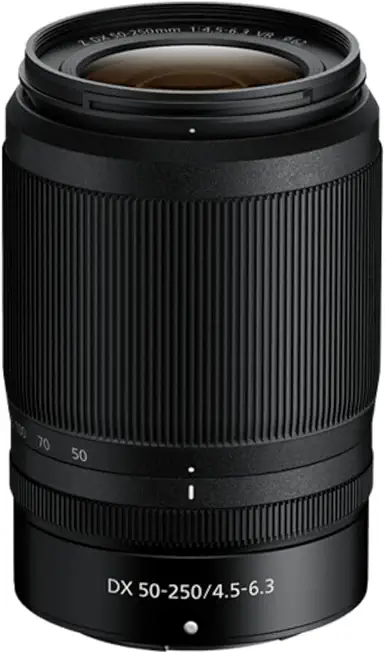
Nikon NIKKOR Z DX 50-250mm VR
Compact APS-C telezoom offering flexible focal range, image stabilization and sharp performance for travel, wildlife and everyday telephoto use.
Check PriceThe Nikon Z DX 50-250mm f/4.5-6.3 VR is a go-to tele for crop-sensor Z shooters like the Z50, Z30 and Zfc. It’s a popular choice because it pairs reach with portability, so you can follow action all day without feeling weighed down.
In the field the lens feels compact and lightweight, which matters when you’re shooting long matches or multiple events back-to-back. That design makes it easy to handhold for extended periods and to move quickly between angles.
Autofocus on this DX zoom is fast and reliable with minimal lag when tracking subjects, so you won’t miss a lot of decisive moments. The built-in image stabilization (VR) is effective for handheld shooting and helps keep shutter speeds usable when panning or when light drops slightly.
Optically it’s sharp, especially at the wide end of the zoom. For the price you get very good image quality, which makes it a strong value for hobbyists, content creators, and photographers stepping up from kit zooms.
Where it shows limits is low-light work. The aperture narrows to f/6.3 at the long end, which can force higher ISO or slower shutter speeds in dim arenas. In very low-light conditions the lens can also be slower to lock focus, so it’s less ideal for dim indoor sports or late-night action.
Overall, if you shoot primarily outdoors or in decent light and want a light, affordable tele for a crop Z body, this lens is hard to beat for the price. If you frequently need fast low-light performance, you may want to consider other options.
- Compact and lightweight
- Fast and reliable AF with minimal lag
- Effective built-in image stabilization
- Good value for money
- Aperture narrows to f/6.3 at the long end
- Can be slow to focus in very low-light conditions
5. Nikon Z 24-120mm f/4 S

Nikon NIKKOR Z 24-120mm f/4 S
All-in-one constant-aperture standard zoom delivering consistent f/4 performance, exceptional sharpness and smooth bokeh for run-and-gun shooting.
Check PriceAs a working photographer I often reach for the Nikon Z 24-120mm f/4 S when my day requires flexibility and reliable image quality. It’s a lens favored by photojournalists and sports photographers because it covers so many shooting situations without changing glass.
The 24–120mm range gives you true wide-angle capability for capturing venue context and tight telephoto reach for closer action. That makes it ideal for sideline work, mixed assignments, and when you need to move quickly between wide and tight framing.
Autofocus on this lens is fast and reliable with minimal lag, which matters when you’re tracking players or following unpredictable moments. In practice it locks quickly and rarely hunts, so you spend more time shooting and less time waiting for focus.
Build quality is solid and the weather sealing is genuinely useful for outdoor sports in adverse conditions. If you shoot in rain, dust, or windy stadiums, that durable construction gives you confidence to keep working.
Optically the lens is sharp even at the long end and delivers excellent image quality across the zoom range, with minimal distortion and chromatic aberration. That balance of sharpness and controlled aberrations makes it a very practical all‑rounder for editorial and sports work where you need clean, usable files straight out of the camera.
The trade-offs are real: the maximum aperture of f/4 can be limiting in low-light arenas and some users find the lens heavy for extended handheld use. If you shoot mostly outdoors or in well-lit environments and value versatility and image quality, this lens is a very strong choice.
- Versatile focal length range for wide and telephoto shooting
- Fast and reliable autofocus with minimal lag
- Robust build quality and weather sealing
- Excellent image quality with minimal distortion/chromatic aberration
- Maximum aperture f/4 — limiting in low light
- Some users find it heavy for extended use
Choosing Focal Lengths for Sports
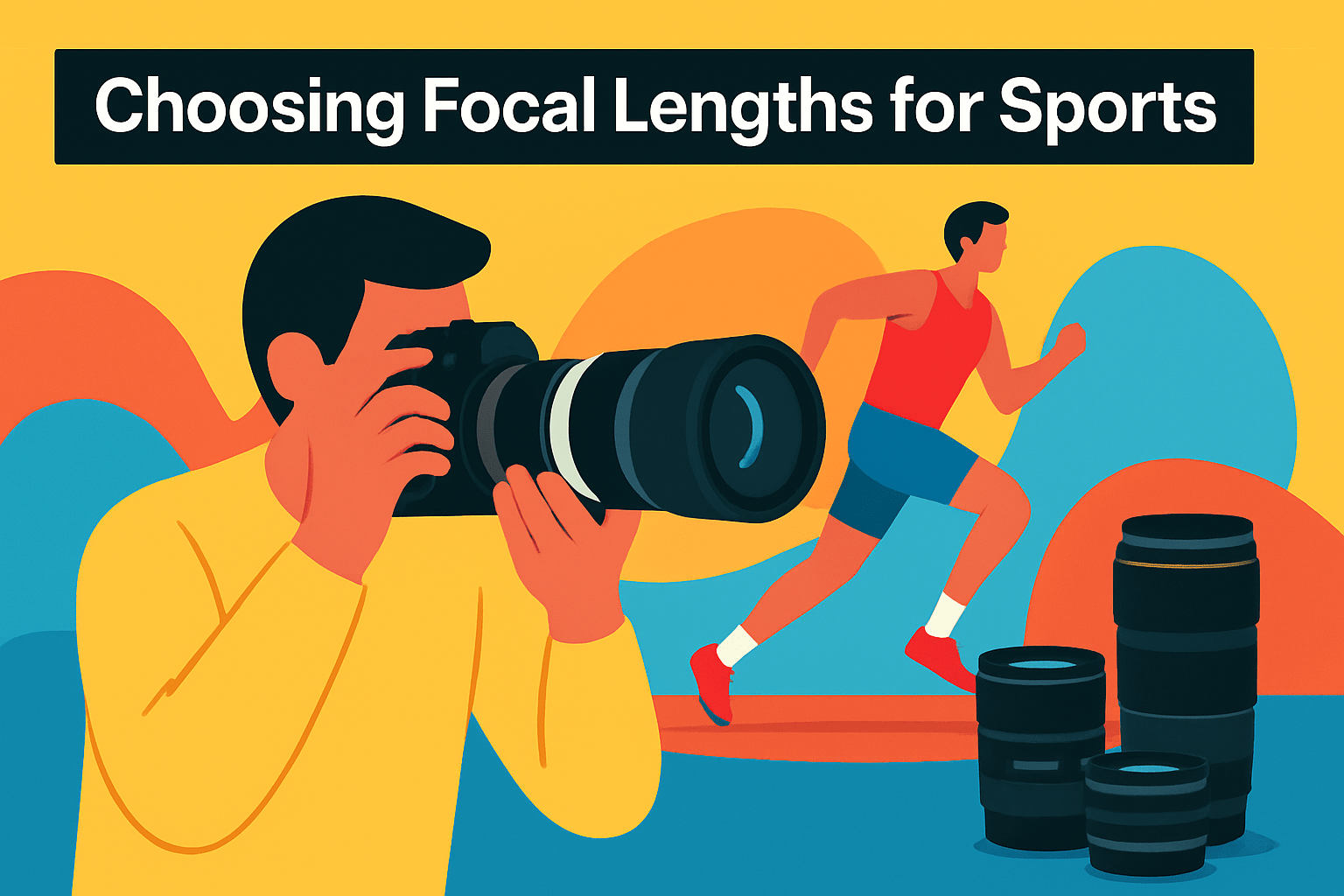
Choosing the right focal length starts with two simple questions: how far you’ll be from the action, and how much of the scene you want to include. There’s no one-size-fits-all lens—venue size, your shooting position and the sport’s pace dictate the range you need. Think in terms of reach and isolation: longer glass compresses backgrounds and helps you isolate decisive moments.
For indoor arenas I almost always reach for 70–200mm. It’s close enough for courts and mats but long enough to tighten on faces and key moments. A constant f/2.8 keeps shutter speeds high in dim lighting and helps separate athletes from busy backgrounds.
On large outdoor fields you’ll need far more reach. Sidelines are usually covered well with 200–400mm, while shooting from the stands often pushes you toward 400–600mm. Keep in mind many long zooms narrow to f/5.6–6.3 at the long end, so plan for higher ISO once the light drops.
Tracks, motorsports and cycling often demand 300–800mm depending on how far the action runs from you. Longer lenses make panning smoother and give you the compression to isolate subjects at speed. If hauling a giant prime isn’t practical, teleconverters can stretch your reach—but expect a loss of light and potential AF trade-offs.
If you use a DX body, a compact 50–250mm is surprisingly capable and gives extra effective reach. Primes will reward you with speed and edge-to-edge sharpness in low light, while zooms buy adaptability when you can’t change position. My practical setup is a fast 70–200mm for close action and a longer tele zoom for field or stand work.
Always check your assigned spot before the game and imagine the angles you’ll need. Balance weight and reach for long shifts—comfort matters more than ego. Pick focal lengths that let you tell the story of the sport, not just record isolated moments.
Key Lens Features for Sports
When I pick a sports lens I think in terms of survival: can it find and hold a subject, freeze motion, and survive rain or dust? Fast autofocus, strong stabilization, a bright aperture and rugged weather sealing are the features that separate a lens that works from one that frustrates you. Balance them against weight and budget.
Autofocus is king — prioritize lenses with fast drive motors and reliable continuous tracking. Eye-detection and subject-tracking matter in real games because athletes change direction and sprint out of frame in a heartbeat. Always test a lens on your camera in the light you’ll be shooting; AF that’s stellar in sunlight can struggle under arena lights.
A fast maximum aperture is crucial for freezing motion and keeping ISO manageable in dim venues. That’s why I reach for an f/2.8 when I can; it buys shutter speed and subject separation. If weight or budget is tight, a lighter f/4 or the long f/5.6–6.3 zooms work outdoors where there’s plenty of light.
Image stabilization makes a big difference with long glass and when you’re panning to follow athletes. Use the lens’ panning or SPORT mode, and turn VR off if you’re locked to a tripod or gimbal. Stabilization also helps when you add a teleconverter or shoot handheld from the stands.
Weather sealing and build quality aren’t luxuries — they’re essentials if you shoot in rain, mud, or dusty tracks. A balanced lens with a solid tripod collar and an easy focus ring keeps you shooting longer. If a lens is heavy, plan for a monopod or stronger support instead of prolonged handheld work.
Teleconverters extend reach but come with trade-offs: 1.4x costs roughly one stop of light and 2x about two stops, and AF may slow. Prioritize optics with ED elements and modern coatings to preserve sharpness and control chromatic aberration. Quiet, smooth focus motors are a bonus for discreet sideline shooting and video.
What People Ask Most
What is the best Nikon Z lens for sports photography?
It depends on the sport, shooting position, and lighting. Many professionals favor the 70–200mm f/2.8 VR S for its sharpness and low-light ability, while longer zooms like the 100–400mm and 180–600mm are chosen for reach and crop-sensor or versatile walkaround options are common.
Which Nikon Z telephoto lens is best for sports?
The best telephoto depends on how much reach you need and where you shoot. Lenses such as the 100–400mm and 180–600mm are popular for distant subjects, while the 70–200mm f/2.8 serves well as a short telephoto for sidelines and indoor work.
What Nikon Z lens is best for indoor sports and low light?
The 70–200mm f/2.8 VR S is frequently recommended for indoor and low-light environments because of its constant aperture and strong performance. Other zooms with narrower apertures can work but may be more limiting in dim arenas.
Is the Nikon Z 70-200mm f/2.8 good for sports photography?
Yes, it is widely considered a go-to lens for professional sports photographers on Nikon Z bodies. It is praised for sharpness, fast near-silent autofocus, and weather sealing, though it is heavier and relatively expensive.
What focal length do I need for sports photography with a Nikon Z camera?
Choose focal length based on the sport and your shooting position: shorter telephoto ranges work for indoor courts, mid to long telephoto for sideline and stands, and very long reach for distant tracks and motorsports. Consider whether you prefer primes for speed or zooms for versatility when making your choice.
Which Nikon Z lens has the fastest autofocus for sports?
Several Nikon Z lenses offer very fast and reliable autofocus, with the 70–200mm f/2.8 VR S often described as especially quick and nearly silent. Other lenses like the 100–400mm and 180–600mm are also reported to have fast AF, and no single lens is universally identified as the absolute fastest.
Can Nikon Z lenses keep up with professional sports photography?
Yes, many Nikon Z lenses are widely used by professionals for sports due to fast autofocus, effective stabilization, and weather sealing. These attributes make them suitable for demanding, fast-paced shooting environments.
Conclusion on Nikon Z Sports Lenses
Choosing the right Nikon Z lens comes down to matching focal reach and key features to the sport, your shooting position, and the lighting you’ll face.
Prioritize fast, reliable autofocus, effective stabilization, weather resistance, and a comfortable, balanced design that lets you shoot for long stretches.
Short telephoto ranges suit close-action and indoor arenas, while longer telephotos give the reach needed from stands or distant sidelines, and the choice between primes and zooms is a trade-off between speed and versatility.
If you want to sharpen your shooting and gear choices, read more articles on our site for practical tips, comparisons, and workflow ideas to improve your results.
Have a question or experience to share? Leave a comment below and we usually reply within a few hours.




0 Comments