
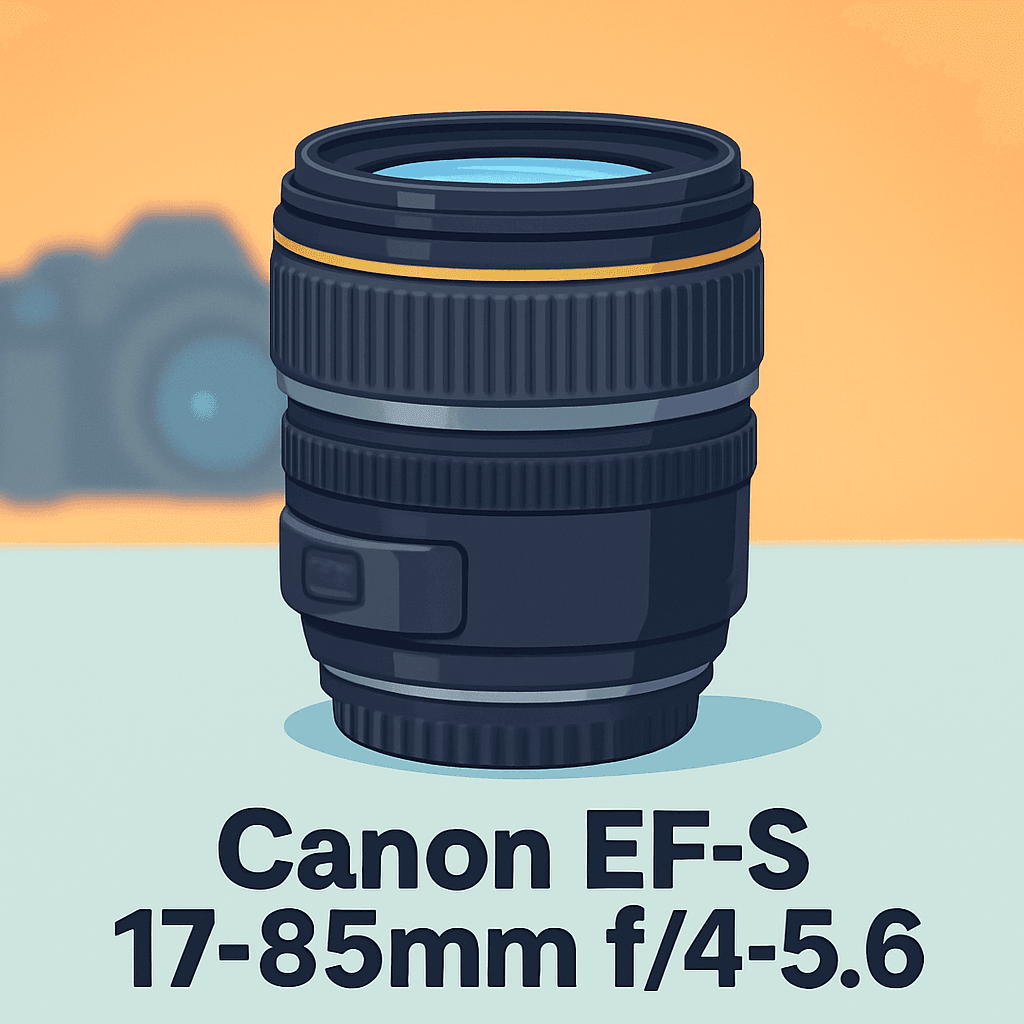
Want one lens that handles travel, street, family portraits and landscapes without you constantly swapping glass?
The Canon EF-S 17-85mm f/4-5.6 IS USM is a versatile APS-C walkaround zoom with a variable aperture, optical stabilization and USM autofocus that aims to do just that.
I took this lens into the field to see how it balances size, handling and real-world performance on everyday shoots with Canon APS-C bodies.
In this review I’ll cover handling and build, how it performs across the focal range, sharpness behavior, autofocus in stills and live view, and who gets the most value—keep reading.

Canon EF-S 17-85mm f/4-5.6 IS USM
A versatile mid-telephoto to wide-angle zoom designed for APS-C cameras, offering effective stabilization and speedy autofocus for sharp travel, portrait, and landscape photography with reliable build and responsive handling.
Check PriceThe Numbers You Need
| Spec | Value |
|---|---|
| Lens mount | Canon EF-S |
| Focal length | 17-85mm |
| Equivalent focal length (APS-C crop) | approx. 27-136mm |
| Maximum aperture | f/4 to f/5.6 (variable) |
| Minimum aperture | f/22 to f/32 |
| Image stabilization | Optical Image Stabilizer (IS) |
| Autofocus | Ultrasonic Motor (USM) |
| Minimum focusing distance | 0.35 m |
| Maximum magnification | 0.23x |
| Filter size | 67mm |
| Lens construction | 15 elements in 12 groups (incl. 3 aspherical) |
| Diaphragm blades | 7 rounded blades |
| Angle of view (diagonal) | 78° 30′ – 18° 25′ |
| Dimensions (diameter × length) | approx. 75 × 85 mm |
| Weight | approx. 475 g |
How It’s Built
In my testing the Canon EF-S 17-85mm f/4-5.6 IS USM felt like a true everyday walkaround lens for APS-C bodies. The EF-S mount keeps it compact and the field of view ranges from wide interiors and landscapes to tighter portraits without swapping glass. That wide-to-short-tele reach makes framing quick and obvious when you’re out shooting travel or family moments.
Under the hood it uses several special elements and a rounded seven-blade diaphragm, which I found helps keep out-of-focus highlights pleasant and not too harsh. After using it for a while I appreciated how those design choices give smoother background falloff than you’d expect from a kit zoom. For beginners that means easier looking portraits without chasing super-fast glass.
The size and weight struck a good balance on my mid-sized APS-C bodies, so it didn’t make the camera feel front-heavy during long walks. I also liked the common filter thread size — handy for slap-on polarizers or ND filters when shooting landscapes or bright scenes. In practice that makes adding creative filters painless.
The zoom ring has a moderate throw that lets you recompose quickly, and the focus ring is fine enough for small manual tweaks at the long end. I did notice a little extension and some slight play if I pointed the lens down, so there’s minor zoom creep to watch for. Overall the build felt everyday tough, but it’s not overbuilt metal — a little more solidity here would be welcome.
One thing I really liked was the lens’s practical balance and handling for all-day use. One thing that could be better is firmer barrel control to eliminate that tiny creep over time. For beginners this lens is forgiving, easy to carry, and won’t intimidate as you learn framing and manual tweaks.
In Your Hands
The 17–85mm spread really is a Swiss-army range in the field: the widest end breathes for interiors and sweeping landscapes, the mid-range is perfect for candid street and environmental portraits, and the long end tightens framing for headshots and detail work without feeling cramped. Transitioning between those zones feels natural on a walkaround day when you don’t want to swap glass constantly. I reached for it on city strolls and family outings for that exact flexibility.
Optical stabilization makes handheld shooting noticeably more confident, especially when you’re working from the hip or in dim interiors. The viewfinder steadiness is tangible and lets you compose longer without immediately resorting to a tripod. For travel that meant sharper keepers and fewer missed moments.
The lens’s variable maximum aperture means it rewards good light and asks for more ISO or slower shutter choices when things are darker; background separation is pleasant at the longer end but won’t match faster primes. Stopping down gives useful depth and improves overall rendering for landscape work. It’s a practical, daylight-oriented tool rather than a low-light specialist.
Close-focusing capability is useful for food, small product shots, and detail images, letting you fill the frame without a dedicated macro. That said, it won’t substitute for true macro magnification or the working distance macro shooters sometimes need. For everyday close-ups it’s more than adequate.
In real scenes the lens delivers punchy contrast and natural color reproduction that work well straight out of camera; backlit scenes are handled with reasonable flare resistance when you watch angles and use the hood. Expect some wide-end distortion and subtle vignetting wide open, both of which are readily corrected in editing, and minor color fringing on high-contrast edges that is usually easy to tame in post.
Mechanically you can reframe quickly across the zoom range and the AF/IS combo keeps pace for most family, travel, and event situations. Exposure metering stayed dependable across changing light, though rapid shifts highlight the tradeoffs of a variable aperture. Paired with on-camera flash it’s a reliable, do-everything companion for everyday shooters.
The Good and Bad
- Useful 17-85mm range (approx. 27-136mm equivalent) for one-lens coverage
- Optical Image Stabilizer for handholding at slower shutter speeds
- USM autofocus: fast and quiet operation
- Reasonable size and weight for daily carry (approx. 75 x 85 mm; 475 g)
- Variable maximum aperture f/4-5.6 limits light gathering and background blur
- EF-S mount restricts use to APS-C Canon DSLRs (no native full-frame compatibility)
Ideal Buyer
The Canon EF-S 17-85mm f/4-5.6 IS USM is best for Canon APS‑C DSLR owners who want one lens that handles wide interiors to short telephoto framing. It’s for shooters who prefer a single versatile walkaround optic over carrying multiple primes. Expect a useful 27–136mm equivalent range that solves most daily shooting needs.
This lens suits travel, street, family and event photographers who value stabilization and quiet USM autofocus over a fast constant aperture. Its IS helps pull usable shots in lower light without a tripod. Background blur won’t match fast primes, but the flexibility is unbeatable when you’re on the move.
Enthusiasts upgrading from the basic 18‑55 kit or hybrid shooters who switch between stills and casual video will find the size, weight and handling appealing. Manual focus feel and a practical close‑focus distance make it handy for food and product snapshots. The 67mm filter thread also makes polarizers and NDs easy to add for landscape work.
This isn’t the best pick for low‑light pros, full‑frame shooters or anyone after true macro performance. If you’re comfortable shooting in good light, relying on IS, or using flash, the lens rewards with convenience and consistent results. Buy it when you want a dependable do‑everything APS‑C starter or upgrade lens without chasing headline apertures.
Better Alternatives?
We’ve already dug into what the Canon EF-S 17-85mm f/4-5.6 IS USM does well: a useful walkaround range, steady IS and quiet USM AF that works for most everyday shooting. If you like that one-lens approach but want different trade-offs, there are a few lenses I’d reach for instead depending on what I’m shooting.
Below are three real-world alternatives I’ve used in the field. I’ll say plainly what each lens does better and worse than the 17-85, and who I think should pick each one so you can match gear to the way you shoot.
Alternative 1:

Canon EF-S 15-85mm f/3.5-5.6 IS USM
Expansive wide-to-tele zoom delivering excellent edge-to-edge sharpness and versatile framing, featuring optical stabilization and precise autofocus for everyday shooting, landscapes, interiors, and travel with professional image quality.
Check PriceCompared to the 17-85, the 15-85 gives you a noticeably wider field at the short end and generally cleaner, crisper images. In the field I found landscapes and tight interiors look better framed at 15mm, and the center-to-edge sharpness feels tighter overall. If you care about straight lines and fine detail for prints, this one is a clear step up.
The trade-offs are simple: it’s heavier and usually costs more. I noticed the lens feels a bit more solid on the camera, which I liked, but you’ll notice the extra weight on long walks. Low-light performance is similar to the 17-85 in most cases, but the slightly faster wide end gives you a touch more breathing room at 15mm.
Pick the 15-85 if you shoot a lot of landscapes, travel photos, or interiors and want better image quality and a wider view. If you value lighter walkaround gear or need to save money, the 17-85 still makes sense, but for photographers who want the best image look from an APS-C zoom in this range, the 15-85 is the one I’d recommend.
Alternative 2:

Canon EF-S 18-135mm f/3.5-5.6 STM
Compact all-purpose zoom with extended reach and whisper-quiet focusing ideal for photo and video; smooth focus transitions, lightweight design, and dependable performance make it perfect for travel and run-and-gun shoots.
Check PriceThe 18-135mm beats the 17-85 in reach — I’ve used it to grab tighter headshots and distant details without switching lenses, and that extra reach is really handy on trips. Its STM motor makes autofocus very smooth and almost silent in video and live view, so it’s a nicer choice when you’re shooting hybrid stills and video.
Where it loses to the 17-85 is in snappy single-shot AF feel and sometimes edge sharpness at the long end. For fast-action sports or when I needed the most immediate focus response, the 17-85’s USM felt a bit quicker. Also, wide-angle isn’t as expansive as the 17mm end, so interiors and very wide landscapes will feel slightly tighter.
If you’re a traveler, vlogger, or everyday shooter who wants one lens that covers most situations and doesn’t make much noise in video, the 18-135 STM is a great choice. If you frequently shoot fast action or demand the widest framing possible, stick with the 17-85 or the wider 15-85 instead.
Alternative 3:
Canon EF-S 18-135mm f/3.5-5.6 STM
A single-lens solution offering broad focal coverage for everyday photographers, combining compact portability with smooth, near-silent AF and consistent image quality—great for vlogging, street scenes, and family moments.
Check PriceThinking of the 18-135 as a true one-lens solution: in everyday shooting it’s extremely convenient. I often kept it mounted on a camera for whole trips because it covers wide to reasonably long telephoto without changing glass. Its size and balance make it easy to carry all day compared with heavier zooms.
On the downside, in careful comparison shots I saw that it doesn’t quite match the 17-85 for edge-to-edge micro-contrast in mid-range shots, and the long end can soften a bit if you pixel-peep. For casual use — social photos, street work, family events — that softness rarely mattered, but it’s something to notice if you crop heavily or print large.
Choose this version of the 18-135 if you want a compact, quiet, all-purpose zoom that’s friendly for video and everyday shooting. If your priority is the sharpest images possible across the frame or the fastest AF for action, the 17-85 (or stepping up to the 15-85) would be a better fit.
What People Ask Most
Is the Canon EF-S 17-85mm f/4-5.6 a good lens?
Yes — it’s a versatile, budget-friendly walkaround zoom for APS-C cameras that gives useful reach and decent everyday performance, though it’s not a pro-level optic.
Does the Canon EF-S 17-85mm f/4-5.6 have image stabilization (IS)?
Yes — it includes Canon’s IS to help steady handheld shots and reduce blur from camera shake.
Is the Canon EF-S 17-85mm f/4-5.6 compatible with full-frame Canon cameras?
No — EF-S lenses are designed for APS-C bodies and won’t mount or work properly on full-frame Canon DSLRs.
How sharp is the Canon EF-S 17-85mm f/4-5.6?
It’s reasonably sharp in the center, especially stopped down, but softer wide open and toward the edges, particularly at the long end.
What is the crop‑factor equivalent focal length of the Canon EF-S 17-85mm f/4-5.6?
On Canon’s 1.6× APS-C bodies it equals roughly a 27–136mm full-frame focal length.
How does the Canon EF-S 17-85mm f/4-5.6 compare to the Canon EF-S 17-55mm f/2.8?
The 17-55mm f/2.8 is faster, sharper, and better in low light for professional use, while the 17-85mm gives more zoom range and is more budget- and travel-friendly.
Conclusion
The Canon EF-S 17-85mm f/4-5.6 IS USM is a quietly competent, do-everything walkaround zoom for Canon APS-C shooters. Its combination of stabilization, USM-driven autofocus and manageable heft makes it an easy lens to live with day-to-day. It simply makes city walks and family outings easier.
It’s not a specialist — the variable maximum aperture and APS-C-only design mean it won’t replace faster primes or serve full-frame bodies. Close-up capability and the background separation you get from faster glass are the clearest tradeoffs here.
For travel, family and street photographers who prioritize flexibility and low-vibration handling over ultimate resolution, it’s a pragmatic choice with real-world strengths. If absolute corner-to-corner sharpness or aggressive low-light performance are priorities, look elsewhere. Experienced shooters will notice the limits, but most users will forgive them for the convenience.
Choose this lens if you want a stabilized, quiet-AF, one-lens solution and can live with the aperture compromises. If you crave wider coverage and a visible optical step up, consider the 15-85; for more reach or video-friendly AF look to the 18-135; for the tightest budget and smallest footprint, the 18-55 remains sensible. Weigh those trade-offs against your shooting priorities before buying.
Canon EF-S 17-85mm f/4-5.6 IS USM
A versatile mid-telephoto to wide-angle zoom designed for APS-C cameras, offering effective stabilization and speedy autofocus for sharp travel, portrait, and landscape photography with reliable build and responsive handling.
Check Price


0 Comments