
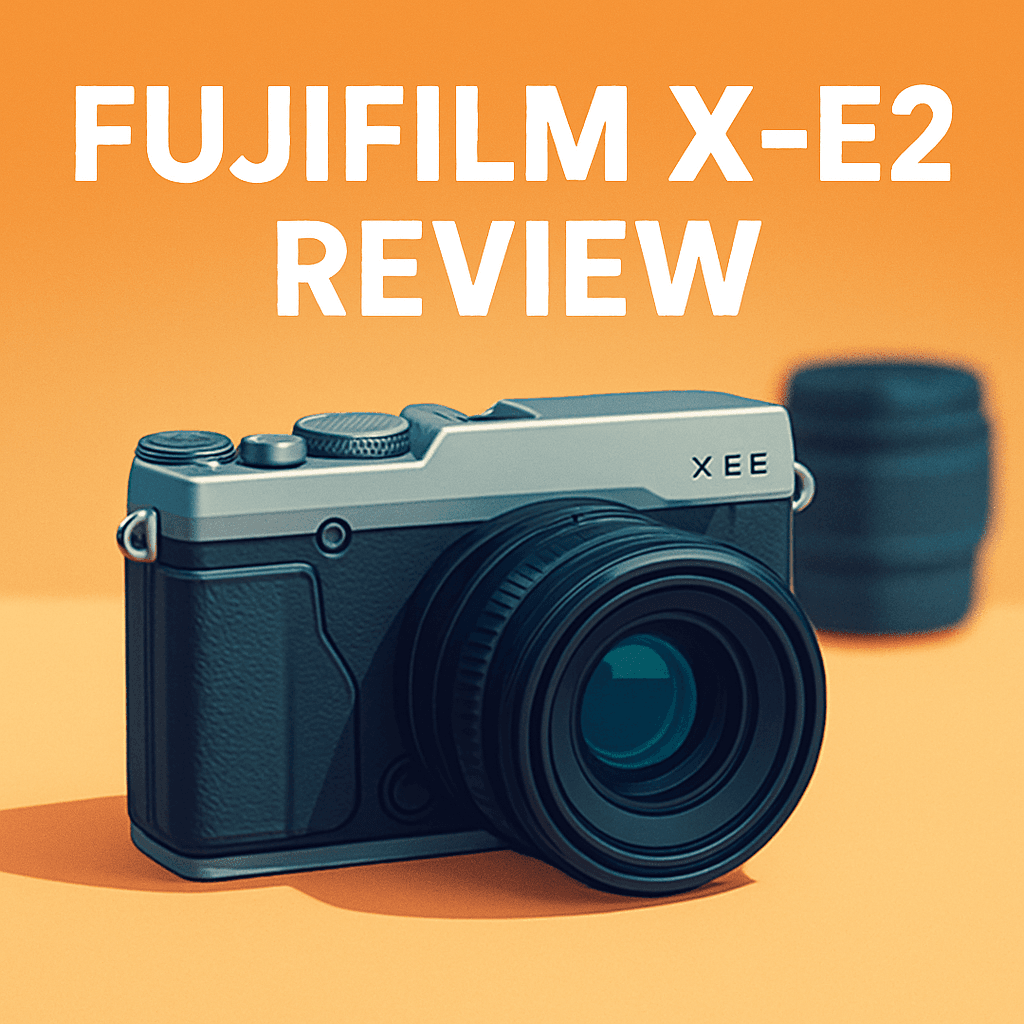
Want a compact camera that makes your photos feel more like film without slowing you down? The Fujifilm X-E2 Camera pitches tactile, manual-first controls and Fujifilm’s beloved color science into a pocketable mirrorless body.
After some field time with an X-E2, I started testing how that promise translates to real shoots — street walks, travel days, and tight portrait sessions. You’ll find an EVF, film-simulation color, and a stills-first personality here, while video stays in the 1080p era.
I’ll evaluate build and handling, responsiveness, image quality and autofocus, and explain who benefits most in everyday use — especially street, travel and casual-pro shooters who love straight-out-of-camera color. Make sure to read the entire review as I unpack what works and what doesn’t, so keep reading.

Fujifilm X-E2 Camera
Retro-styled mirrorless shooter delivering rich color rendition and tactile controls. Compact, lightweight body with responsive handling and strong JPEG output—ideal for street, travel, and everyday documentary photography.
Check PriceThe Numbers You Need
| Spec | Value |
|---|---|
| Sensor | 16.3 MP APS-C X-Trans CMOS II |
| Lens mount | Fujifilm X-mount |
| ISO range | 200–6400 (100–51200 extended) |
| Max shutter speed | 1/4000 sec (mechanical), 1/32000 sec (electronic) |
| Continuous shooting | 7 fps |
| Autofocus | 49-point hybrid (phase/contrast) |
| Viewfinder | 2.36M-dot OLED (100% coverage) |
| LCD | 3.0″ 1.04M-dot fixed |
| Video | 1080p Full HD up to 60 fps |
| Wi-Fi | Built-in |
| Weight | 350 g (with battery and card) |
| Dimensions | 129 x 75 x 37 mm |
| Image processor | EXR Processor II |
| Film simulation modes | Multiple (including Velvia, Provia, Astia, etc.) |
| Flash | Hot shoe (no built-in flash) |
How It’s Built
In my testing the Fujifilm X-E2 Camera felt compact and light—easy to carry all day and quick to pull out when a moment appears. After using it for a while it almost disappears in a shoulder bag, so you shoot more. With small primes it balances nicely; with heavier lenses you notice the weight shift.
I found the manual dials wonderfully direct and satisfying to use. The clicky feel makes exposure simple to learn and fast to change without hunting through menus. I really liked how tactile controls kept me in the moment and sped up street shoots.
The EVF is clear and helpful, especially in bright sun when the rear screen can wash out. The fixed LCD is the camera’s one real compromise—low and high angle work becomes a bit of a stretch. For beginners that means thinking about your stance more than tilting a screen.
There’s a hot shoe for flashes and built-in Wi‑Fi for quick transfers, which I used often on walks. After using it a lot I wished for a tilting screen more than an internal flash. Overall it’s a simple, well-made body that teaches you to shoot by feel.
In Your Hands
The Fujifilm X-E2 Camera feels lively in hand thanks to its efficient processing and thoughtful interface — JPEGs and film simulations render quickly and the camera wakes and responds without fuss, which keeps you in the moment during street and travel work. Menus and dials are tactile, so changing exposure or film looks is a quick, reflexive act rather than a menu dive.
Shutter options give practical flexibility: the mechanical shutter is dependable for most everyday shooting, while the electronic shutter is invaluable when you need silent operation or to shoot wide in bright light. Continuous burst performance is brisk enough to capture short, decisive sequences — think running kids, a dog leap, or a quick street scene — though it’s not aimed at sustained sports coverage.
ISO handling is usable for hand‑held low‑light work, with noise that leans more filmic than clinical and remains manageable for web and modest print sizes. Video is in the Full HD era and serves well for casual clips and social sharing, but it’s clearly oriented toward stills-first users rather than modern hybrid shooters.
Built‑in Wi‑Fi proved reliable for on‑the‑fly image transfers and remote shooting during my outings, speeding delivery of selects to a phone for social posts. Ultimately the X-E2’s responsiveness, tactile controls, and compact balance deliver a fluid, photographer‑centric shooting experience that rewards deliberate composition and quick reactions.
The Good and Bad
- Compact and light: 129 x 75 x 37 mm; 350 g
- Tactile manual controls: aperture, shutter speed, exposure compensation dials
- 2.36M-dot OLED EVF with 100% coverage
- Fujifilm film simulation modes for strong SOOC color
- LCD is fixed (less flexible for high/low angles)
- Video limited to 1080p (no 4K)
Ideal Buyer
The Fujifilm X-E2 Camera is made for photographers who put tactile control and color first. Its manual dials, compact rangefinder layout, and X‑Trans film simulations reward intuitive, in‑camera decisions and, paired with compact X‑mount primes, create a nimble, satisfying kit. If you love shooting street, travel, or everyday life and want beautiful straight‑out‑of‑camera color, this is built for you.
Bring it on city walks, short trips, or portrait sessions where size, balance, and responsiveness matter. The 7 fps drive and electronic shutter give you flexibility for fleeting moments, while the 16.3MP X‑Trans files print and share very well and usable high‑ISO performance to around ISO 3200 keeps many low‑light scenes practical. Built‑in Wi‑Fi and a crisp EVF keep the workflow fast and pleasant.
Skip the X‑E2 if you need modern face/eye AF, 4K video, in‑body stabilization, or the latest high‑resolution sensor for large commercial prints. It’s not a hybrid video machine or a studio workhorse, but it excels when stills, Fuji color, and hands‑on shooting matter most. For photographers who prioritize feel, simplicity, and distinct Fuji color over cutting‑edge specs, this camera hits the sweet spot.
Better Alternatives?
We’ve already gone through how the X-E2 handles, shoots, and where it shines for stills work. If you like the X-E2’s size and classic controls but want more modern speed, better low-light performance, or reliable 4K video, there are a few Fuji options that change the playing field in real shooting.
Below are three cameras I’ve used in real life that answer different needs — from the smallest pocketable upgrade to a compact body with more traditional handling and a more video-friendly take. I’ll point out what each one does better and what it gives up compared to the X-E2, and who I’d recommend each for.
Alternative 1:

Fujifilm X-E4 Camera
Ultra-compact mirrorless powerhouse marrying modern autofocus with classic rangefinder looks. Fast performance, 4K video, and refined handling make it a go-to for creators craving portability without compromise.
Check PriceI’ve shot with the X-E4 on walks and short trips — it’s noticeably smaller and lighter than the X-E2 and fits into a jacket pocket much easier. In real shooting the newer sensor and autofocus make focus lock-up and tracking far simpler, and you’ll see cleaner files at higher ISOs than the X-E2. Video is a real upgrade too: 4K feels usable for quick clips where the X-E2’s 1080p is limiting.
What it does worse than the X-E2 is mostly about feel. The X-E4’s slimmer body gives you less to hold onto, and I missed the deeper grip and the slightly more tactile dial layout of the X-E2 when shooting all day. It also still lacks in-body stabilization, so for low-light hand-held shots you’ll want a stabilized lens or a tripod — same limitation as the X-E2.
If you’re a street or travel shooter who wants the clean Fuji look with modern AF and 4K in a truly pocketable package, the X-E4 is the pick. Choose it if portability and updated performance matter more to you than the older camera’s chunkier feel and button layout.
Alternative 2:

Fujifilm X-T30 II Camera
High-performance APS-C shooter with snappy autofocus, detailed image rendering, and flexible exposure controls. Compact but capable, it delivers vibrant colors and swift operation for enthusiast photographers and content creators.
Check PriceThe X-T30 II felt familiar but fresher when I used it alongside the X-E2 — it keeps Fuji’s tactile dials but adds much faster AF and better handling of tricky light. In real shoots I noticed quicker subject acquisition and more consistent eye detection, so you spend less time hunting focus than on the X-E2. The 4K video and overall responsiveness also make it a more comfortable hybrid tool for short video work.
Compared to the X-E2, the X-T30 II gives better autofocus and cleaner high-ISO images, but it still doesn’t solve the lack of in-body stabilization. It’s a bit less pocketable than the X-E4 and some people might prefer the X-E2’s rangefinder feel, but overall it’s more modern and more forgiving in fast-paced scenes. Battery life and continuous shooting feel improved in normal use.
If you’re an enthusiast who wants a compact body with quicker AF, nicer handling, and real 4K video without stepping up to a larger pro body, the X-T30 II is a strong choice. I’d recommend it to photographers who shoot portraits, street, and run-and-gun events and want smoother autofocus and colors straight from the camera.
Alternative 3:

Fujifilm X-T30 II Camera
Versatile companion offering refined ergonomics, robust 4K capture, and impressive low-light performance. Intuitive menus and advanced film-simulation modes inspire creativity for hybrid shooters and vloggers.
Check PriceUsing the X-T30 II for longer shoots showed me it’s not just faster — it’s also more flexible creatively than the X-E2. The film-simulation output is still that Fuji look we love, but with better noise control and more usable shadow detail in low light. For vloggers and hybrid shooters the 4K capture and improved AF during recording make pull-focus and talking-head clips much less stressful than trying to use the X-E2 for the same job.
Where it falls short vs the X-E2 is mostly in the personal feel — some shooters still prefer the X-E2’s older control layout and the way its dials sit under the fingers. The X-T30 II improves handling broadly, but it won’t replace a larger, grippier camera if you need long lens work or heavy battery life. And, like the X-E2, you still need stabilized lenses for easy hand-held slow-shutter shots.
Pick this X-T30 II variant if you want a small, creative camera that handles low light and video better than the X-E2 while keeping Fuji’s colors and film modes. In short: it’s for creators who need modern AF and 4K, but still want a compact, fun camera to shoot every day.
What People Ask Most
Is the Fujifilm X-E2 worth buying?
Yes—if you want a compact, well-built APS-C camera with excellent JPEGs and manual controls at a good used price, it’s a solid choice; skip it if you need the fastest AF or modern video features.
How good is the image quality of the Fujifilm X-E2?
Very good for its age: the 16MP X-Trans II sensor delivers sharp files, strong color rendition and excellent in-camera JPEGs up to moderate ISOs.
How does the autofocus perform on the Fujifilm X-E2?
The AF is reliable for stills, street and portraits but slower and less accurate on fast action or in very low light compared with newer cameras.
What are the main pros and cons of the Fujifilm X-E2?
Pros: great image quality, compact rangefinder styling, tactile controls and access to Fuji lenses; cons: older AF system, limited video features and shorter battery/feature set than modern bodies.
What lenses are compatible with the Fujifilm X-E2?
It uses Fujifilm X-mount lenses, including XF and XC series, and can accept adapted lenses (like M-mount) with the proper adapter.
Does the Fujifilm X-E2 have Wi‑Fi and what is its battery life?
Yes, it has built-in Wi‑Fi for image transfer and remote control, and you can expect roughly 300–350 shots per charge depending on shooting habits.
Conclusion
The Fujifilm X-E2 remains a compelling choice for photographers who put stills first. Its compact body, tactile manual dials and purposeful control layout make shooting feel rewarding and fast. Fuji’s color science and a confident electronic viewfinder produce images that often need little correction, and built‑in wireless tools keep a modern workflow humming.
That charm comes with trade‑offs you should accept up front. The fixed rear screen and absence of a built‑in flash reduce compositional flexibility, and the camera’s video and autofocus capabilities feel dated next to modern hybrids. If you frequently chase fast action, video projects, or very low‑light hand‑held tele work, there are more capable options now.
In short, choose the X-E2 if you prioritize hands‑on operation, distinctive Fuji color straight out of camera, and a light, discreet package for street, travel, and everyday photography. If you need the fastest AF, higher-resolution files, or up‑to‑date video, look to newer models. For photographers after a classic shooting experience with pleasing results, the X-E2 still delivers strong value and personality that’s hard to replace.
Fujifilm X-E2 Camera
Retro-styled mirrorless shooter delivering rich color rendition and tactile controls. Compact, lightweight body with responsive handling and strong JPEG output—ideal for street, travel, and everyday documentary photography.
Check Price



0 Comments