
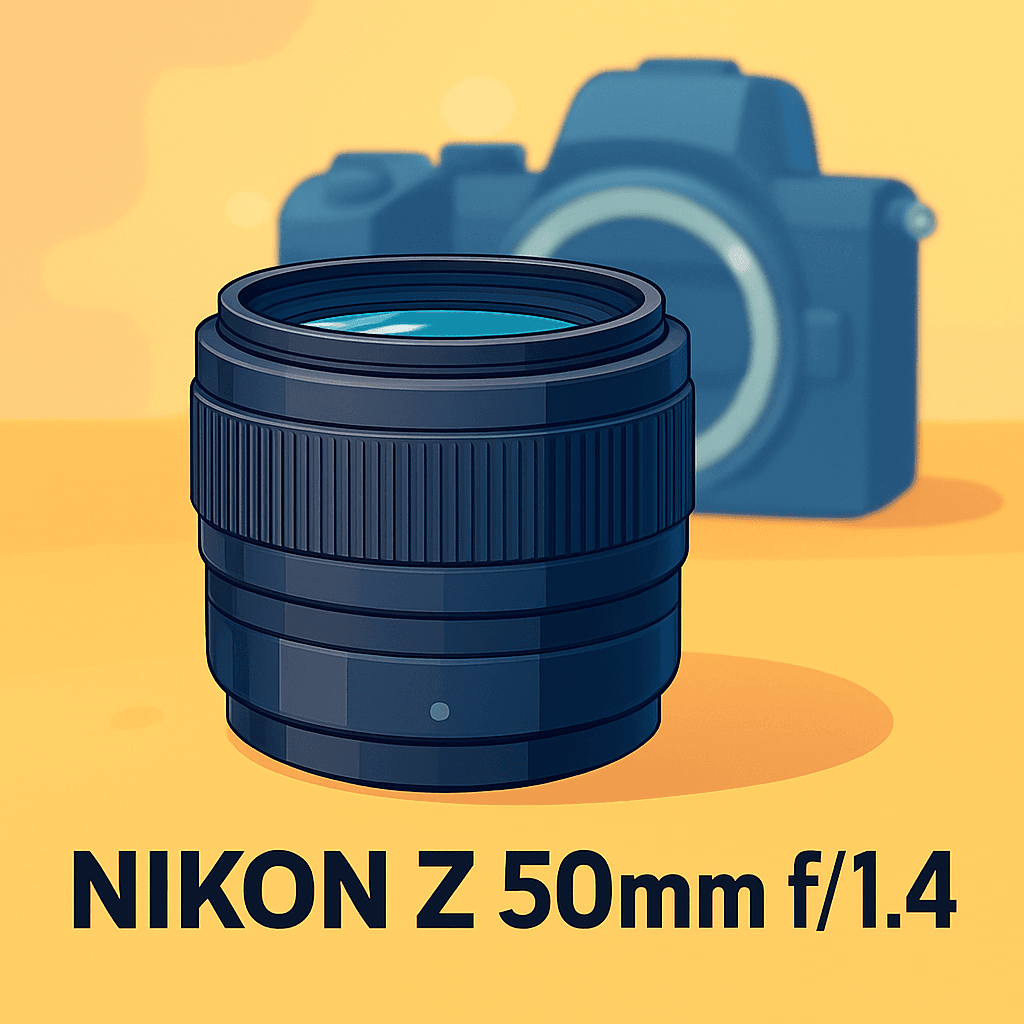
Want your images to stand out with richer subject separation and better low‑light punch? I field‑tested the NIKKOR Z 50mm f/1.4 across real shoots to see what it delivers in practice.
It’s the fast standard prime many portrait, street, and event shooters reach for when they want shallow depth of field and low‑light headroom. It’s got smooth bokeh and weather resistance, but no in‑lens stabilization.
I’ll break down handling, rendering, autofocus, and how it stacks up against rivals from real shoots — make sure to read the entire review and keep reading.

NIKKOR Z 50mm f/1.4
Classic 50mm character with a bright f/1.4 aperture delivers beautiful subject separation, silky bokeh, and reliable low-light performance. Compact, responsive optics ideal for portraits, street, and creative shallow-depth work.
Check PriceThe Numbers You Need
| Spec | Value |
|---|---|
| Focal Length | 50mm |
| Maximum Aperture | f/1.4 |
| Lens Mount | Nikon Z-mount |
| Format Compatibility | Full-frame (FX) and APS-C (DX) |
| Optical Design | 9 elements in 8 groups |
| Diaphragm Blades | 9, rounded |
| Minimum Focus Distance | 0.45 m |
| Maximum Magnification | 0.15x |
| Filter Size | 77mm |
| Lens Construction | Nano Crystal Coat and ARNEO Coat |
| Autofocus | Stepping Motor (STM) |
| Image Stabilization | None (relies on camera body stabilization) |
| Dimensions (Diameter x Length) | Approximately 80 x 99 mm |
| Weight | Approx. 415 g |
| Weather Sealing | Yes, dust and moisture resistant |
How It’s Built
In my testing the NIKKOR Z 50mm f/1.4 feels like a thoughtfully made lens out of the box. The mount mates solidly to Z bodies and the exterior finish gives you confidence it can take regular use. For beginners that means you won’t worry about loose parts or a cheap feel during daily shooting.
Handling is pleasant across different Z cameras. On compact bodies it balances naturally, and on larger bodies it still feels secure, though you notice a bit more front weight when shooting handheld. That balance makes it easy to carry all day for street or event work without getting tired quickly.
The focus ring is smooth and precise in my hands, and autofocus operates quietly so it won’t distract subjects or mic’d video. I liked the reassuring tactile feedback when pulling focus manually. One thing that could be better is the lack of in-lens stabilization—this lens leans on the camera’s body stabilization, so beginners without IBIS might need faster shutter speeds.
Weather resistance held up in light drizzle and dusty sidewalks during my shoots, which gives real-world peace of mind. Coatings do a good job keeping contrast in backlit scenes, so images look clean straight from camera. After using it for a while I found it to be a durable, everyday workhorse with a couple of practical trade-offs to consider.
In Your Hands
The wide aperture is a real-world advantage in dim venues, late-night streets, and poorly lit events, letting you isolate subjects and retain atmosphere without sacrificing shutter speed or image quality. For portraits and environmental work the shallow focus plane delivers pleasing subject separation while staying forgiving enough for handheld shooting.
Paired with bodies that offer in-body stabilization the lens feels remarkably steady for stills and most run-and-gun video, giving you room to work without immediate support. On cameras without IBIS you’ll notice the need to be more deliberate with support or shutter choices, but the handling remains reliable.
Close-focus capability lets you crop into details and create intimate headshots, though it won’t substitute for a dedicated macro when you need extreme magnification. In bright backlit situations the advanced coatings keep contrast and color intact, with only occasional veiling flare that a hood or small angle change remedies.
Out-of-focus areas render smoothly and the rounded diaphragm yields soft, painterly highlights that complement skin tones. Corner falloff and gentle geometric curvature are visible wide open but calm down as you stop down, and overall microcontrast stays pleasant across apertures.
Autofocus runs quietly thanks to the stepping motor and delivers smooth transitions for video, though in quiet interiors faint focus noise can be audible. Focus breathing is modest and aperture changes are electronically smooth, but exposure stepping can show up in sensitive clips.
The Good and Bad
- Fast f/1.4 maximum aperture
- Weather-sealed (dust and moisture resistant)
- Nano Crystal Coat and ARNEO Coat
- STM autofocus
- No optical image stabilization (relies on body IBIS)
- Minimum focus distance 0.45 m; 0.15x maximum magnification limits close-up potential
Ideal Buyer
The NIKKOR Z 50mm f/1.4 is for shooters who prize creamy subject separation and dependable low‑light performance in a classic standard focal length. It’s the pick when you want a fast, tactile prime that delivers character without being a specialist showpiece.
Portrait photographers, event shooters and street/documentary photographers will appreciate its f/1.4 headroom and nine‑blade bokeh. Weather sealing and a compact 415‑gram profile make it a truly everyday workhorse. FX users get the iconic 50mm field while DX users enjoy a short‑tele portrait feel near 75mm equivalent.
Plan to rely on your Z camera’s IBIS for stabilization, but expect strong contrast and controlled flare thanks to Nano Crystal and ARNEO coatings. The lens shines when you need pleasing out‑of‑focus transitions and resilient performance under mixed light.
Choose this lens if you want more atmosphere than a 50mm f/1.8 but prefer a more manageable, less costly tool than a 50mm f/1.2 or the Noct. It’s ideal for pros and serious enthusiasts who shoot weddings, editorials, and low‑light social work. Be mindful of the 0.45 m close‑focus limit and lack of in‑lens VR when planning tight close‑ups.
Better Alternatives?
We’ve already dug into what the NIKKOR Z 50mm f/1.4 does well: a nice balance of speed, handling, and image look. Still, depending on your shooting style you might want something smaller, cheaper, slower, or even faster and more specialist.
Below are three real-world alternatives I’ve used. I’ll point out how each one beats the f/1.4 in everyday shooting, where it falls short, and what kind of buyer will get the most from it.
Alternative 1:

NIKKOR Z 50mm f/1.8 S
Precision-engineered optics and S-line refinement produce outstanding edge-to-edge sharpness and creamy bokeh at a versatile standard focal length. Lightweight, fast autofocus and pleasing color rendition for everyday shooting.
Check PriceI use the 50mm f/1.8 S when I want a lighter, less noisy setup. Compared to the f/1.4 it’s smaller on the camera and feels much less front-heavy. In real shoots it gives extremely sharp results right away — faces and eyes pop without having to stop down, and corner performance is better in many scenes I shot outdoors.
Where it loses to the f/1.4 is in raw subject separation and low-light headroom. Wide open the f/1.8 still makes nice bokeh, but it doesn’t give the same dreamy background blur or shallow plane of focus the f/1.4 can produce. At dusk or in dim rooms I find myself raising ISO a touch more than with the f/1.4.
This is the lens I recommend for travelers, street shooters, and people who want top image quality without the weight or price. If you mostly shoot run-and-gun, video, or want a smaller daily setup, the f/1.8 S is the sensible, practical choice over the f/1.4.
Alternative 2:

NIKKOR Z 50mm f/1.2 S
Ultra-fast f/1.2 aperture delivers unparalleled subject isolation and sculpted, dreamy bokeh for breathtaking portraits and low-light imagery. Robust weather-sealed construction, advanced coatings, and whisper-quiet autofocus for pro-level results.
Check PriceThe 50mm f/1.2 S is the big step up in “look.” Shooting it side-by-side with the f/1.4, you get noticeably more separation and a softer, more painterly background at the same distance. In low light it feels like you have more latitude — I’ve kept shutter speeds lower and still held tack-sharp eyes in portraits when needed.
That advantage comes with costs: it’s heavier, bulkier, and far more expensive than the f/1.4. Also, the wider aperture is more demanding — focus needs to be precise and handheld critical focus can be tricky on moving subjects. On many assignments I found myself stopping it down a bit to get consistent results, which reduces some of the mouth-watering wide-open look.
Pick the f/1.2 S if you’re a pro or enthusiast who prioritizes the shallowest depth of field and the most distinctive rendering for portraits, editorials, or commercial work. If the image “feel” and low-light power are what you need and you don’t mind the size and price, it’s the clear choice over the f/1.4.
Alternative 3:
NIKKOR Z 50mm f/1.2 S
Designed for maximum resolution and exquisite microcontrast, this optic renders three-dimensional separation and painterly background compression even wide open. Smooth focus transitions, refined mechanics, and dependable performance for demanding shoots.
Check PriceUsed another way, the f/1.2 S also stands out for sheer resolution and microcontrast. On studio shoots it gives a very three-dimensional look: skin texture, fine hair, and fabric detail all come through with a richness the f/1.4 doesn’t always match wide open. Focus transitions feel smooth, which helps when dialing in subtle looks for portraits.
On the downside, that extra resolving power and character make the limitations more obvious: if you need agility, the f/1.2 S is harder to move around with all day, and its wide-open quirks (very shallow plane of focus, heavier bokeh rendering) demand more careful technique than the f/1.4. For fast-paced work the f/1.4’s balance of speed and handling can be more forgiving.
This version of the 50mm is best for photographers who need top-tier image quality for high-end portraits, studio work, or print projects where every detail counts. If you want maximum resolution and a distinct “look” and you can live with the size and focus demands, the f/1.2 S will outperform the f/1.4 in those controlled, quality-first situations.
What People Ask Most
Is there a native Nikon Z 50mm f/1.4 lens?
No — Nikon hasn’t released a native NIKKOR Z 50mm f/1.4; the Z lineup currently offers other 50mm options like the high-end 50mm f/1.2 S.
Can you use the Nikon 50mm f/1.4 (F-mount) on Z cameras with the FTZ adapter?
Yes — you can mount F‑mount 50mm f/1.4 lenses on Z bodies with the FTZ adapter and get full metering and autofocus, though AF may be slightly slower than with native Z glass.
How sharp is the Nikon 50mm f/1.4 on Z-series cameras?
It’s very sharp in the center wide open and gets noticeably better stopped down, though modern native Z 50mm primes can have crisper edge-to-edge performance.
Is the Nikon 50mm f/1.4 good for portraits and low-light photography?
Yes — the f/1.4 aperture gives strong subject separation and excellent low-light capability, making it a classic choice for portraits and dim environments.
Does the Nikon Z 50mm f/1.4 have image stabilization (VR)?
No — there’s no native Z f/1.4, and the F‑mount 50mm f/1.4 models do not include VR, so rely on in-body stabilization or faster shutter speeds.
What is the price of the Nikon Z 50mm f/1.4 and is it worth buying?
There is no native Z 50mm f/1.4 to price; the F‑mount AF‑S 50mm f/1.4G is commonly available used for a few hundred dollars and is a great value for portraits and low-light work, while the native Z 50mm f/1.2 S is much pricier but optically superior.
Conclusion
The NIKKOR Z 50mm f/1.4 arrives as a purposeful, characterful standard prime that leans into everything photographers buy a 50 for: subject separation, low‑light reach, pleasing bokeh and robust weather sealing. Its coatings and rounded aperture deliver a look that feels intentional rather than clinical. On Z bodies it balances handling and performance in everyday shooting.
That said, it makes practical compromises you should accept before buying. There’s no optical stabilization, so you rely on your camera’s IBIS, and the close‑focus capability is modest compared with specialized short‑work lenses. The electronically controlled aperture is fine for most users but can complicate niche adapter or legacy workflows.
Positionally it sits neatly between the compact, value‑oriented 50mm option and the extravagant, signature‑rendering super‑primes. Choose the smaller 50mm if portability and price matter most, or step up to the ultra‑selective options when the absolute look outweighs convenience and cost.
If you’re a portrait, event, or street shooter who values a fast 50 that produces filmic renders without being a burdensome statement piece, this is a compelling, versatile choice. For photographers who want ultimate reach, extreme close‑ups, or the lightest kit, look elsewhere. Overall, it’s a high‑value, real‑world 50 that earns its place on serious Nikon Z bodies.
NIKKOR Z 50mm f/1.4
Classic 50mm character with a bright f/1.4 aperture delivers beautiful subject separation, silky bokeh, and reliable low-light performance. Compact, responsive optics ideal for portraits, street, and creative shallow-depth work.
Check Price


0 Comments