
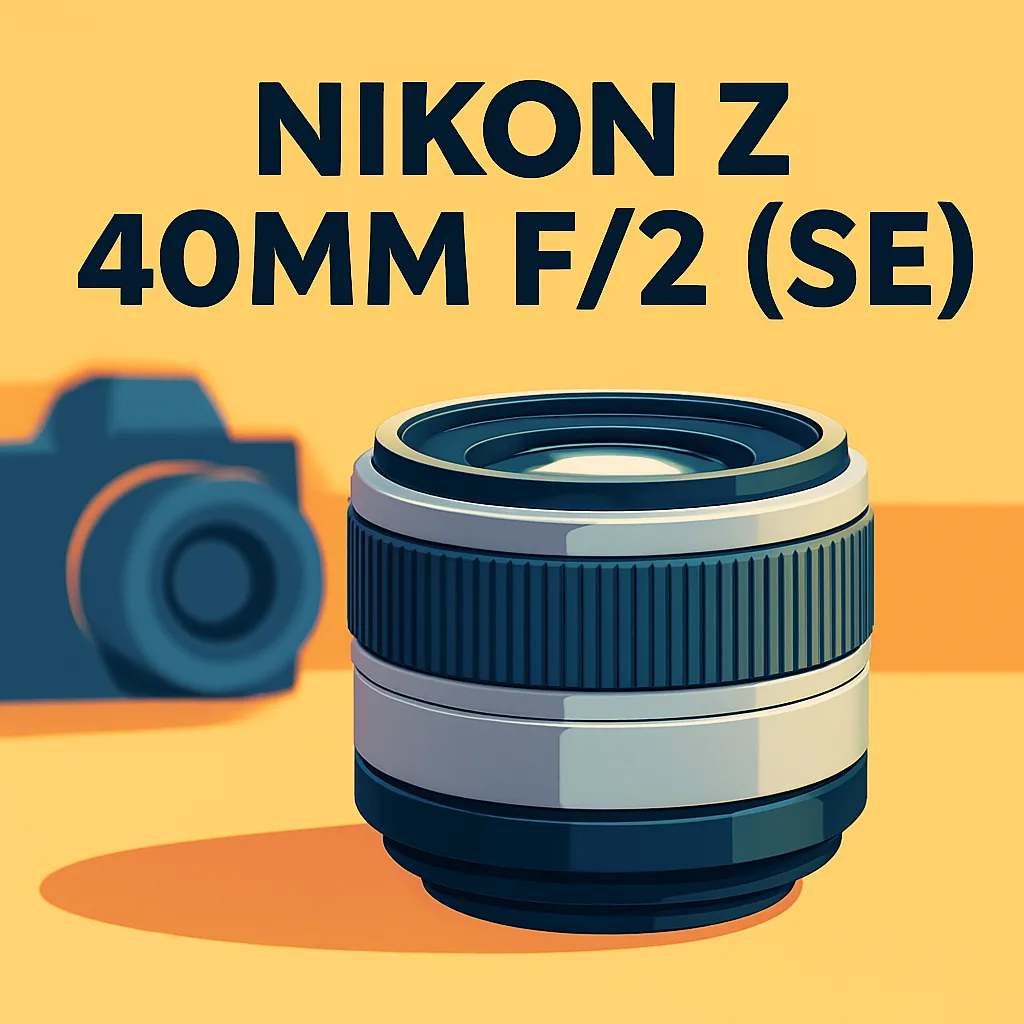
Want a small, stylish lens that actually makes your everyday photos better without weighing you down?
The Nikon NIKKOR Z 40mm f/2 SE is a compact, lightweight standard prime with a bright f/2 and retro-inspired styling, and it works on both full-frame and APS-C bodies. I’ve field-tested it on streets, trips, and casual shoots, so you’ll get practical notes from real use.
If you shoot street, travel, environmental portraits or casual video and value pocketability and character, this review will cover what matters most — handling, real-world images, and who benefits. Make sure to read the entire review as I dig into the details—keep reading.

Nikon NIKKOR Z 40mm f/2 SE
Classic 40mm compact prime with bright aperture, delivering creamy bokeh and sharp mid-frame resolution. Lightweight metal build, smooth focus control, perfect for street, portrait, and everyday creative shooting.
Check PriceThe Numbers You Need
| Spec | Value |
|---|---|
| Lens type | Standard prime |
| Focal length | 40 mm |
| Maximum aperture | f/2 |
| Lens mount | Nikon Z-mount |
| Format compatibility | Full-frame (FX); APS-C (DX) |
| Angle of view | Approx. 57° (full-frame) |
| Minimum focusing distance | 0.29 m (0.95 ft) |
| Optical construction | 9 elements in 8 groups |
| Aperture blades | 7, rounded diaphragm |
| Filter size | 52 mm |
| Autofocus | Yes — stepping motor (STM) |
| Image stabilization | No (relies on camera body IBIS) |
| Weight | Approx. 230 g (8.1 oz) |
| Dimensions (diameter x length) | Approx. 65 x 53 mm (2.6 x 2.1 in) |
| Finish | Retro-inspired Special Edition coating and design |
How It’s Built
In my testing the Nikon NIKKOR Z 40mm f/2 SE feels like a little classic camera lens you actually want to use. The retro-inspired finish is more than eye candy — it’s pleasant to hold and gives the lens a friendly, tactile vibe. I really liked that touch; it made shooting feel deliberate and fun.
It’s compact and light, so I kept it on small Z bodies all day without fatigue. On larger bodies it still balances fine but feels a bit more like a small partner than a full-size tool. That compactness made it easy to slip into a small bag for travel and street work.
The controls are simple, which I appreciated as a beginner-friendly trait — no switches to fiddle with while you’re composing. The front takes small, affordable filters, which is handy for on-the-go shooting. The rounded diaphragm gives a soft, pleasant out-of-focus look that helps subjects pop without looking harsh.
What could be better is the weather protection; this isn’t built like Nikon’s tougher pro lenses, so I’d avoid heavy rain and rough handling. I shot close-ups of the mount and finish to check fit and found everything well-made, just not sealed for serious abuse. For everyday shooters who value style and portability, it’s a lovely, usable lens.
In Your Hands
The 40mm view settles into a comfortable middle ground — noticeably wider than a tight fifty but less environmental than a classic thirty-five — which makes it a go-to for street, travel, and everyday storytelling. Framing feels natural and unobtrusive; I found it easy to capture both context-rich scenes and head-and-shoulders portraits without constantly swapping lenses. That balance is what makes it a genuinely versatile walk-around focal length.
That bright f/2 aperture is more than cosmetic: it unlocks useful low-light performance and believable subject separation for environmental portraits and evening street work. At wide aperture the subject gently lifts from the background without isolating them from context, while stopped down you retain crispness with pleasing tonal transitions. It’s the sort of rendering that rewards practical shooting rather than pixel-peeping.
Close-focusing capability lets you get intimate with small subjects — think food, product details, and immediate foregrounds — while still keeping a smooth falloff behind the subject. The bokeh has a friendly, rounded character that complements candid portraits and tabletop work, and flare is handled conservatively in backlit scenarios. Those near-MFD shots are particularly useful for social and editorial assignments.
Autofocus driven by a stepping motor is quiet and confident, more than adequate for stills and casual video work; hunting is rare in typical urban and indoor scenes. There’s no optical stabilization, so performance benefits noticeably from bodies with in-body stabilization; handheld low-light work is comfortable with IBIS, and requires a steadier hand without it. For run-and-gun shooting the compact, unobtrusive package encourages keeping the lens on the camera.
Color and contrast felt neutral and dependable across varied lighting, lending files that are easy to grade without fighting the lens. Mounted on smaller bodies the lens becomes almost pocketable and the slightly tighter framing appeals to hybrid shooters who move between photos and clips. In practice it’s a discreet, reliable tool that simply lets you shoot more often.
The Good and Bad
- Compact and lightweight (approx. 65 x 53 mm; 230 g)
- Bright f/2 maximum aperture for low light and subject separation
- Versatile 40 mm field of view (approx. 57° on full-frame) for everyday shooting
- Retro-inspired SE styling for classic aesthetics
- No optical stabilization; relies on camera IBIS if available
- Not S-line; build and sealing less pro-grade than S-line alternatives
Ideal Buyer
If you prize small size and discretion, this is the lens you’ll reach for every time you leave the house. Its compact footprint and f/2 brightness make it ideal for street, travel and daily carry. It’s unobtrusive in crowds and easy to stash in a daypack.
The SE’s retro styling isn’t just cosmetic — it speaks to shooters who want gear with character. Photographers who enjoy tactile finishes and a classic look will appreciate the Special Edition charm.
Z‑mount users seeking a simple, bright standard prime with fast AF will find it a perfect companion. It feels balanced on both small Z bodies and larger FX cameras, and it works equally well on DX bodies when you need extra reach. Many creators will simply keep it on the camera as their go-to general-purpose lens.
If you demand S‑line level weather sealing, pro-grade build or the very fastest apertures, look elsewhere. This lens trades ultimate ruggedness and absolute top-end speed for portability and character.
Hybrid shooters and casual videographers will like the quiet STM autofocus and manageable size that encourages spontaneous shooting. Rely on body IBIS where needed and enjoy a lens that is designed to be carried, used, and loved every day.
Better Alternatives?
We’ve already dug into the Z 40mm f/2 SE: its small size, easy handling, vintage look, and f/2 speed make it a great everyday lens for street, travel, and casual portraits. It’s the sort of lens you’ll leave on your camera because it’s light and unobtrusive, and the images have a pleasing, natural look.
If you’re thinking about other options, it usually comes down to three things: do you want the exact same optical performance without the retro styling, more speed and pro-grade build, or a lens that behaves better for video and demanding use? Below are a few alternatives I’ve used in the field, with the real-world differences you’ll notice and who each one is best for.
Alternative 1:

Nikon NIKKOR Z 40mm f/2
Versatile standard-length prime offering fast f/2 speed for low-light and subject separation. Exceptional sharpness, natural rendering, and responsive autofocus make it ideal for travel, documentary, and hybrid shooters.
Check PriceThe regular Nikon Z 40mm f/2 is basically the same lens you’ve been reading about but without the SE retro finish. In real use the image quality, autofocus feel, and handling are identical — you won’t see any difference in sharpness or focus speed when you swap them on the same camera. If you care only about shooting and not the vintage look, it gives you the same compact performance.
What it does worse compared to the SE is purely cosmetic: you lose that special retro styling and the unique packaging that some shooters enjoy. There’s no functional upgrade, so if you were hoping for better weather sealing or more robust build, you won’t get it here. Practically, though, there’s nothing photographers will miss in the frame or in AF behavior.
Buyers who prefer this model are people who want the exact shooting experience of the 40mm f/2 but a simpler, more modern finish — or those looking for the same lens at a slightly different price or availability. It’s ideal for photographers who want discreet, consistent results without the SE styling.
Alternative 2:

Nikon NIKKOR Z 35mm f/1.8 S
Ultra-sharp wide-angle prime with an impressive f/1.8 aperture for stunning low-light performance and smooth background separation. Advanced optics deliver edge-to-edge clarity and minimal chromatic aberration.
Check PriceThe 35mm f/1.8 S is a big step up if you want more low-light ability and shallower depth of field. On the street and in tight indoor spaces the extra stop of light and stronger background separation make subjects stand out more, and the S-line optics deliver punchier detail across the whole frame — I noticed crisper corners and clearer fine texture compared to the 40/2 on the same scenes.
Where it’s worse is size, weight, and cost. The 35/1.8 S is noticeably larger and heavier on small Z bodies, so it’s less pocketable and more obvious on the street. That wider field of view also changes how you compose: it feels more like a general-purpose wide than the slightly tighter, more neutral 40mm, so your framing and subject distance habits need to shift.
This is the lens for shooters who want pro-level optics and weather sealing — landscape, editorial, and low-light portrait shooters who need edge-to-edge sharpness and can live with the larger size. If you care about ultimate image quality and don’t mind the extra bulk, you’ll appreciate what the 35/1.8 S brings.
Alternative 3:
Nikon NIKKOR Z 35mm f/1.8 S
Quiet, quick autofocus and robust weather-sealed construction support demanding photo and video work. Natural color rendering, beautiful bokeh, and consistent sharpness across the frame for professional results.
Check PriceUsed as a hybrid stills/video lens, the 35/1.8 S really shines. The autofocus is fast and quiet, which matters when you’re recording and don’t want focus hunting or motor noise. Color and rendering are very neutral and pleasing straight out of camera, and the bokeh at wide apertures is smooth — I often reach for this lens when I need reliable autofocus and consistent color for client work.
Against the 40mm f/2 SE, the 35/1.8 S loses the small, stealthy feel. It’s bulkier and more noticeable when you’re trying to be unobtrusive on the street. If you like the SE’s retro look and the way it disappears on a small camera, you’ll miss that with the 35 S. The price is also higher, so it’s a bigger investment.
Choose the 35/1.8 S if you shoot a lot of video, run-and-gun commercial work, or need a weather-sealed lens that keeps delivering in poor conditions. It’s aimed at pros and hybrid shooters who want tougher build and more consistent performance, while the 40mm SE still wins for anyone wanting the smallest, simplest carry option.
What People Ask Most
Is the Nikon Z 40mm f/2 (SE) a full-frame (FX) lens or for APS-C (DX) cameras?
It’s an APS-C (DX) Z‑mount lens, so on full‑frame bodies it will either vignette or force crop to DX mode.
Is the Nikon Z 40mm f/2 (SE) a good lens for portraits?
Yes — on DX bodies it behaves like a ~60mm equivalent with f/2, which is great for headshots and environmental portraits with pleasant background separation.
How does the image quality of the Nikon Z 40mm f/2 (SE) compare to other Nikon Z prime lenses?
Image quality is very good for its size and price, though it doesn’t quite match the resolution and micro‑contrast of Nikon’s higher‑end S‑line primes.
Does the Nikon Z 40mm f/2 (SE) have fast and accurate autofocus for stills and video?
Yes — autofocus is quick, quiet, and reliable for everyday stills and run‑and‑gun video work.
Is the Nikon Z 40mm f/2 (SE) weather-sealed or dust/splash resistant?
No, this lens does not have Nikon’s professional weather sealing, so avoid prolonged use in heavy rain or dusty conditions.
What does the “(SE)” mean on the Nikon Z 40mm f/2 (SE) and is it worth the extra cost?
SE stands for Special Edition and mainly refers to the silver/retro styling to match cameras like the Z fc; it’s only worth the extra if you care about the look, not performance.
Conclusion
The Nikon NIKKOR Z 40mm f/2 SE is an irresistible everyday tool — small, bright and styled with real character. It delivers a flexible field of view and a tactile, retro finish that invites you to carry it and shoot. Its size and personality change the way you work more than its spec sheet does.
Its strengths are clarity of purpose and effortless handling, making it a perfect companion for street, travel and casual portraits. The compromises are clear: no optical stabilization and a non‑S‑line build that stops short of pro‑grade sealing and heft. That tradeoff is deliberate and will suit photographers who prioritize feeling and portability over brute force.
If you value compactness and the simple, characterful rendering this lens offers, it’s an excellent value and a lens you’ll reach for day after day. If you need maximum speed, heavy weather protection or the last ounce of resolving power, consider the S‑line alternatives such as the 35/1.8 S or 50/1.8 S instead. Look through the sample gallery with your typical subjects in mind and how it sits on your camera, and you’ll know which direction to take.
Nikon NIKKOR Z 40mm f/2 SE
Classic 40mm compact prime with bright aperture, delivering creamy bokeh and sharp mid-frame resolution. Lightweight metal build, smooth focus control, perfect for street, portrait, and everyday creative shooting.
Check Price

0 Comments