
Looking for a single lens that handles travel, events, portraits and low-light for your Sony APS-C camera?
You’re not alone.
The Sony E 16-55mm f/2.8 G is Sony’s fast standard zoom for APS-C.
It pairs a constant f/2.8 with G-series optics, quiet linear AF and light weather sealing for real-world shooting.
I ran it through street shoots, dim interiors and a rain-splashed wedding to see how it performs where it matters.
You’ll want to know how it feels on a small Sony body, how the AF locks, and whether the rendering and bokeh hold up in print and online.
I’ll break down build, handling and optical character, then cover AF behavior, chromatic aberration, pros/cons and practical alternatives for APS-C shooters.
Make sure to read the entire review as I separate marketing claims from real-world payoffs—keep reading.

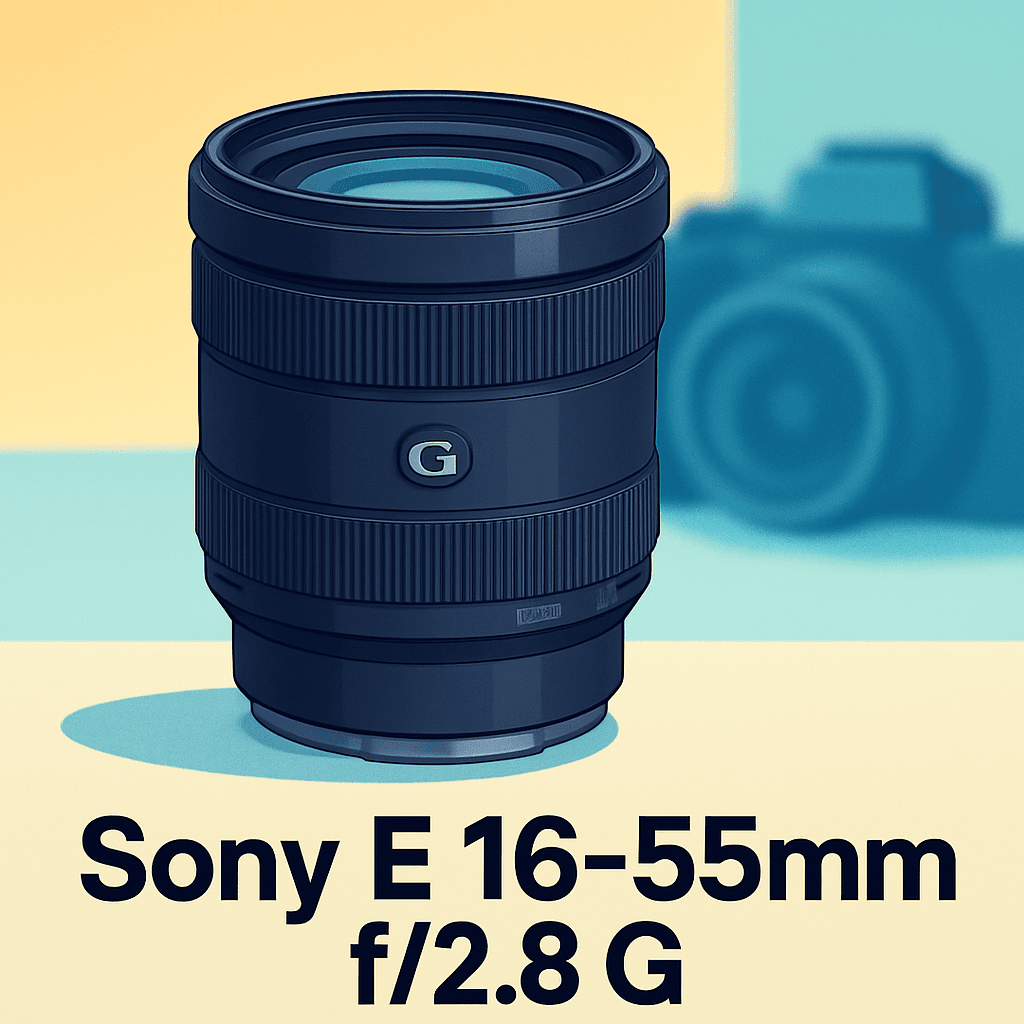
Sony E 16-55mm f/2.8 G
Professional-grade APS-C zoom delivering edge-to-edge sharpness and consistent f/2.8 brightness. Fast autofocus, robust construction, and pleasing background separation make it perfect for portraits, events, and travel photography.
Check PriceThe Numbers You Need
| Spec | Value |
|---|---|
| Focal length | 16–55mm (≈24–82.5mm equivalent, APS-C) |
| Maximum aperture | f/2.8 (constant) |
| Lens mount | Sony E-mount (APS-C) |
| Optical stabilization | No (relies on in-body) |
| Optical construction | 17 elements in 12 groups |
| Aperture blades | 9 (circular diaphragm) |
| Minimum focus distance | 0.33 m |
| Maximum magnification | 0.2× |
| Filter size | 67 mm |
| Dimensions | 70.5 × 97 mm |
| Weight | 494 g |
| Dust/moisture resistant | Yes |
| Focus system | Linear motor AF; quiet/fast |
| Lens hood | Supplied |
| Custom button | Yes |
How It’s Built
In my testing the Sony E 16-55mm f/2.8 G immediately felt like a premium lens in hand. It has a solid, reassuring weight and balances nicely on Sony APS-C bodies, so it doesn’t feel front-heavy or awkward. For everyday shooting that balance makes framing and moving between focal lengths feel natural.
The build includes weather sealing so I felt confident shooting in light rain and dusty streets, though I wouldn’t push it into a storm. After using it for a while the finish still looks clean and the mount feels tight. That kind of confidence matters when you’re out shooting travel or events.
Both the zoom and focus rings are smooth with just the right resistance for precise adjustments. The linear motor focus drive was quiet in real use, which I liked for low-profile shooting. There’s a custom button placed where your thumb naturally rests, and I found it handy for quick focus or function access.
The supplied hood fits snug and does a good job taming flare when the sun creeps into the frame. I liked how it slid on and stayed put during fast swaps. That small thing makes shooting in contrasty light much less stressful.
If there’s one downside it’s the mass—after a full day of walking you’ll notice it more than a tiny pancake lens. Beginners should know it’s not the lightest option, so plan your kit accordingly for long hikes or gimbal work. Overall, I liked the solid feel and thoughtful controls, even if it’s a bit hefty for all-day carry.
In Your Hands
In the field the Sony E 16-55mm f/2.8 G delivers an immediately pleasing balance of sharpness and contrast. Wide-open it renders striking center detail and punchy micro-contrast while the edges come into their own with a bit of stopping down. That behavior makes it forgiving for portraits and crops, yet capable of holding detail for large prints when used more conservatively.
The lens’s out-of-focus rendering is among its strengths — specular highlights round off smoothly thanks to the circular diaphragm, producing creamy backgrounds without harsh mechanical shapes. Bokeh transitions are gentle and organic at shallower depths of field, which helps separate subjects in environmental portraits and event work. Stopped down for landscapes the rendering tightens up, delivering crispness across planes.
Flare control is solid with the hood in place; you can still coax character from backlit scenes but keeping the hood on better preserves contrast. Geometry and corner shading are largely handled by in-camera corrections, though raw shooters will notice subtle residual distortion and falloff at the extremes. When deliberately stopped down you also get pleasing sunstars, which can be a nice creative touch.
Close-focus capability lets you tackle detail shots and tight environmental portraits without carrying a dedicated macro, but it isn’t a substitute for true close‑up work. The constant fast aperture is invaluable in low light, though the lack of in-lens stabilization means relying on body stabilization or faster shutter speeds for handheld twilight and video. I reached for this zoom for travel/street work at the wide end, mid-range portraits, mixed-light events, and stopped-down landscapes with reliably professional results.
The Good and Bad
- Constant f/2.8 aperture through 16–55mm range
- G-series optical design: 17 elements/12 groups with 3 AA and 2 ED elements
- Linear motor AF: quiet/fast operation
- Dust/moisture resistant construction
- No optical stabilization (OSS): relies on in-body stabilization or higher shutter speeds
- Weight of 494g: consider for all-day carry on smaller APS-C bodies
Ideal Buyer
If you shoot on a Sony APS‑C body and want one go‑to optic for travel, events, environmental portraits and everyday work, this is the lens. The Sony E 16‑55mm f/2.8 G gives a true fast standard zoom that’s built to perform in mixed light. It’s aimed at photographers who like to shoot wide and mid‑tele without swapping lenses.
Choose this lens if you prize a constant f/2.8 for subject separation, quick and quiet linear‑motor AF, and G‑series rendering over the smallest size. Weather resistance and a solid, balanced feel on crop bodies make it a dependable field companion. The nine‑blade diaphragm also helps deliver pleasing bokeh at close distances.
Be realistic about trade‑offs before buying. There’s no optical stabilization, so you’ll want a body with IBIS or be comfortable raising shutter speeds for hand‑held low‑light work. At roughly 494g it’s not the lightest option for all‑day carry, but it’s sturdier and sharper than many compact alternatives.
If you value peak corner micro‑contrast, native Sony handling and consistently fast AF for event and editorial work, this lens fits perfectly. If lighter weight, built‑in stabilization, or extra reach are higher priorities, consider the Tamron or Sigma alternatives instead.
Better Alternatives?
We’ve already gone through the Sony E 16-55mm f/2.8 G and what makes it a strong, all‑around fast standard zoom for APS‑C bodies: constant f/2.8, solid optics, quiet AF and a build that feels like it can take some real use. That lens is a great choice when you want consistent speed, punchy files, and predictable handling.
If that sounds ideal but you have other priorities—lighter carry, extra reach, built‑in stabilization, or a smaller price—there are a few real-world alternatives worth looking at. Below are three lenses I’ve shot with and relied on in the field, with honest notes on how they differ from the 16‑55mm in day‑to‑day use.
Alternative 1:

E 18-50mm f/2.8 Contemporary
Ultra-compact, lightweight wide-to-standard zoom offering constant f/2.8 brightness in a pocketable package. Ideal for travel and vlogging with snappy focusing, crisp optics, and versatile everyday framing.
Check PriceI used the 18–50mm on short trips and a day of street shooting where every ounce and inch mattered. Compared to the 16–55 G, the 18–50 wins on size and weight by a big margin—it’s noticeably more pocketable and far easier to carry on a gimbal or in a small bag. That makes it a great pick if you want a fast zoom without the bulk of the Sony G.
Optically it gives you a similar f/2.8 look in the frame center and very usable sharpness for photos and video. But you do trade off a bit of the 16–55’s corner punch and the extra two millimeters at the wide end. In low light the images look very pleasing, yet the 16–55 still has the edge for micro‑contrast and overall subject pop, especially at 16mm.
If you’re a traveler, vlogger, or somebody who values a small kit over the last bit of corner sharpness or weather sealing, the 18–50mm is a smart pick. If you need the absolute widest angle or the more rugged feel and slightly crisper files of the Sony G, stick with the 16–55.
Alternative 2:

Tamron Sony E 17-70mm f/2.8 Di III-A
Wide-ranging zoom with a constant bright aperture that covers wide-angle to short telephoto. Smooth, dependable focusing and strong optical performance make it a go-to for travel, landscapes, and run-and-gun shooting.
Check PriceI’ve shot weddings and travel stories with the Tamron 17–70, and its one‑lens feel is real. The extra reach to 70mm makes framing portraits and isolating subjects easier than the Sony’s 55mm top end, and the Tamron’s built‑in stabilization (VC) helps a lot for handheld low‑light and video. That stabilization is the clear practical win over the 16–55 when you need steady handheld shots without cranking ISO.
In everyday use the Tamron is a touch larger and heavier than the Sony 16–55, but not cumbersome. Image quality is very good across the range and the AF is quick and dependable. The trade‑off is that in some scenes—wide open at the widest focal lengths—the Sony G still delivers slightly better clarity and micro‑contrast. For critical landscape corners or editorial work, I’d still reach for the 16–55.
If you want an all‑around, do‑everything lens for travel, family events, and run‑and‑gun video, the Tamron is the better one‑lens solution. Pick it if stabilization and extra reach matter more to your shooting than the final bit of corner resolution and Sony’s weather sealing.
Alternative 3:
Tamron Sony E 17-70mm f/2.8 Di III-A
Versatile all-in-one APS-C zoom combining a generous constant aperture with excellent close-focus capability. Delivers vibrant colors, creamy bokeh, and reliable performance for street, adventure, and family photography.
Check PriceUsed a bit differently, the Tamron also shines for close‑up work and background separation. Its close‑focus ability and longer reach let you get tighter headshots and compressed backgrounds without changing lenses. Compared to the 16–55, it gives friendlier framing and creamier backgrounds at medium telephoto—useful for portraits and candid family shots.
The downsides versus the Sony are familiar: slightly less edge sharpness in some wide‑angle shots and a build that doesn’t feel as overtly rugged or weather‑sealed as the 16–55 G. I also found sample variation across different copies can make a difference if you push for absolute pixel‑level detail. But for everyday family photos, street work, and travel storytelling it’s hard to beat the Tamron’s flexibility.
Choose this Tamron if you want one lens that covers most needs and gives you better close‑up reach and stabilized handheld shooting. If you’re a pro who needs the cleanest files at 16mm or wants the more solid weather resistance of a native G lens, the Sony 16–55 still holds the advantage.
What People Ask Most
Is the Sony E 16-55mm f/2.8 G worth buying?
Yes—if you shoot APS-C and want a sharp, fast constant f/2.8 zoom for everyday and pro work it’s one of the best, but it’s pricey and lacks built-in stabilization.
Is the Sony E 16-55mm f/2.8 G a full-frame or APS-C lens?
It’s designed for Sony’s APS-C E-mount cameras and will vignette on full-frame bodies unless you use crop mode.
Does the Sony E 16-55mm f/2.8 G have image stabilization (OSS)?
No, it does not include OSS, so you should rely on in-body stabilization or faster shutter speeds for handheld shots.
How sharp is the Sony E 16-55mm f/2.8 G?
Very sharp in the center even wide open, with excellent overall resolution and only minor corner softness at extreme settings.
What is the 35mm equivalent focal length of the Sony E 16-55mm f/2.8 G?
On APS-C it covers roughly a 24–82.5mm equivalent field of view (16–55mm × 1.5 crop factor).
Is the Sony E 16-55mm f/2.8 G weather sealed?
It features dust and moisture-resistant construction around the mount, but it’s not fully weatherproof—use care in heavy rain or harsh conditions.
Conclusion
The Sony E 16-55mm f/2.8 G is the most convincing fast standard zoom I’ve tested for Sony APS‑C bodies. Its constant f/2.8, G‑series glass and quiet linear‑motor AF give a confident blend of low‑light ability and image character. Weather resistance and thoughtful handling finish the package into something that feels built to earn its keep in the field.
No lens is perfect, and the most tangible compromises here are practical rather than optical. The absence of in‑lens stabilization and the lens’ mass make handheld low‑light or long‑duration carry less forgiving than stabilized alternatives. However, if you shoot with a body that provides IBIS or you favor faster shutter speeds, those trade‑offs feel manageable next to the payoff in sharpness and rendering.
Who should buy it? Photographers who prioritize consistent f/2.8 speed, native AF performance and pleasing out‑of‑focus rendering for events, portraits and travel will find it compelling. If budget, weight, or built‑in stabilization matter more, consider the Sigma for value, the Tamron for range plus stabilization, or the Sony 16–70 f/4 for compact OSS convenience. Each alternative makes a sensible trade depending on your shooting priorities.
Ultimately I recommend the Sony E 16-55mm f/2.8 G to APS‑C shooters who want a single fast, dependable standard zoom that emphasizes image quality and AF reliability over the convenience of lens‑based stabilization. Base your choice on how much you value those strengths in everyday use, and this lens will repay you with consistent results.
Sony E 16-55mm f/2.8 G
Professional-grade APS-C zoom delivering edge-to-edge sharpness and consistent f/2.8 brightness. Fast autofocus, robust construction, and pleasing background separation make it perfect for portraits, events, and travel photography.
Check Price

0 Comments