
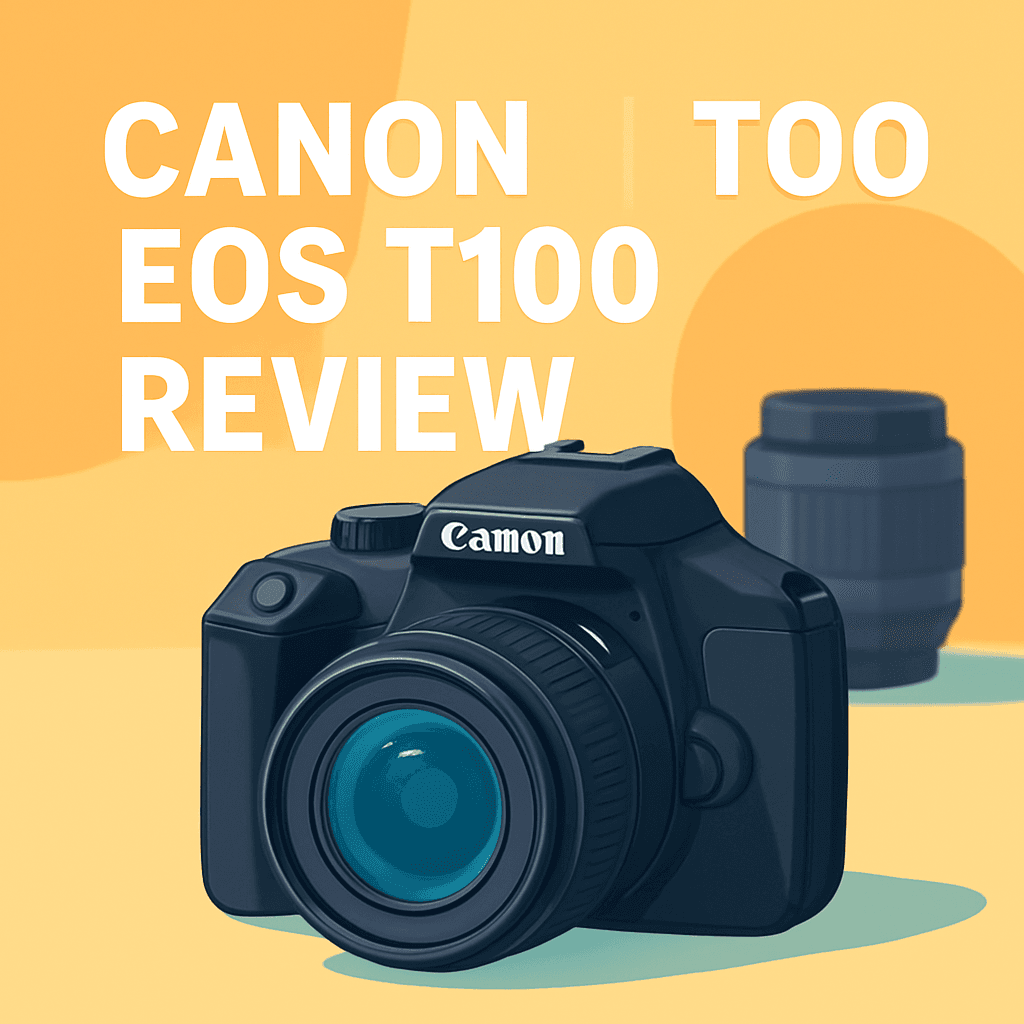
Want to know if the Canon EOS T100 Camera is the right step-up for your photos without adding complexity you don’t need?
Also sold as the Rebel T100 or 4000D, this little Canon aims to deliver classic DSLR handling, an optical viewfinder, and easy access to Canon’s EF/EF-S lenses. Having shot with one in real-world conditions, I looked for how those promises pay off when you’re actually out shooting.
If you like a lightweight body, straightforward controls, and the option to grow with lenses, this will interest you; if you need the latest autofocus or a flip screen, you’ll want to know the trade-offs. Make sure to read the entire review as I unpack where it shines and where it doesn’t—keep reading.

Canon EOS T100 Camera
Compact, beginner-friendly DSLR with a large APS-C sensor capturing detailed images and smooth Full HD video. Simple controls, built-in Wi-Fi, and creative filters make learning photography enjoyable.
Check PriceThe Numbers You Need
| Spec | Value |
|---|---|
| Sensor | 18 MP APS-C CMOS |
| Image Processor | DIGIC 4+ |
| Lens Mount | Canon EF/EF-S |
| Autofocus | 9-point AF system |
| ISO Range | 100–6400 (expandable to 12800) |
| Continuous Shooting Speed | 3 fps |
| Video Recording | 1080p Full HD at 30 fps |
| Display | 2.7-inch fixed LCD, 230,000 dots |
| Viewfinder | Optical pentamirror, approx. 95% coverage |
| Built-in Flash | Yes |
| Storage | SD/SDHC/SDXC card compatible |
| Battery Life | Approx. 500 shots per charge (CIPA standard) |
| Connectivity | USB 2.0, HDMI output |
| Dimensions | Approx. 129.0 × 101.3 × 77.6 mm |
| Weight | Approx. 436 g (including battery and memory card) |
How It’s Built
In my testing the Canon EOS T100 feels like a proper little DSLR — compact and lightweight, so it’s easy to carry all day without shoulder pain. The small grip is comfortable with a kit lens, but I quickly learned to support the lens with my left hand when I swapped to longer glass. That means it’s great for travel and learning, but you’ll want a steady hand for big lenses.
The fixed LCD is very basic and I found myself relying on the optical viewfinder more than the screen. The viewfinder shows most of the scene, so composing with it feels natural and teaches you how to frame without obsessing over the LCD. For beginners that’s actually useful, but the tiny screen makes menu navigation and image review a little fiddly.
I liked that Canon included a built-in flash — it’s handy for quick fill or family shots when you don’t want to carry extra gear. There are simple ports for moving files or sending a live feed to a monitor, and it takes standard SD cards, so setup is straightforward and familiar for most people.
Button layout is straightforward, which lowers the learning curve for new shooters. One thing I’d change is the screen: a larger, higher-res or tilting display would make shooting and vlogging much easier for beginners.
In Your Hands
The AF is straightforward and favors the center point; single-point mode is the most consistent while auto-selection can wander in busy scenes. In low light it becomes hesitant, so patience or focus-and-recompose helps.
Burst capability is modest, suiting deliberate sequences rather than fast action. The buffer fills quickly, so pick moments instead of holding the shutter. Shutter response is snappy enough for general shooting.
Low-light shooting is usable with careful exposure but noise rises quickly, so I add light or accept softer shadows. Daylight and well-lit interiors deliver pleasing color and useful dynamic range for prints and web.
Video is fine for family clips, school projects and event highlights, but the fixed screen hampers selfie-style framing. The optical viewfinder is the real pleasure—steady and immediate—and live view works well for quick checks.
Wired file transfer and monitor-out are simple for trips and quick playback. The camera is a lightweight travel companion, a good hands-on teacher for optical-viewfinder shooting, and a reliable choice for indoor family gatherings with the built-in flash. Bringing a spare battery gives peace of mind on longer outings.
The Good and Bad
- Lightweight body (approximately four hundred thirty-six grams with battery and card)
- EF/EF-S lens mount compatibility for a broad lens ecosystem
- Full HD video at thirty frames per second suitable for basic clips
- Battery life rated at approximately five hundred shots (CIPA)
- Two point seven inch fixed LCD with two hundred thirty thousand dots — small, low resolution and not articulated
- Nine point AF system with basic coverage and limited sophistication
Ideal Buyer
Pick the Canon EOS T100 if you want a no-nonsense, lightweight DSLR that still feels like a proper camera in your hands. It’s perfect for beginners, students and travelers who want to learn exposure with an optical viewfinder and a simple control layout.
Owners who plan to grow into Canon’s EF/EF‑S lens ecosystem will appreciate the mount’s flexibility and the option to pair inexpensive primes or versatile zooms. If your priority is straightforward 1080p family video, quick weekend shoots and reliable built‑in flash fill, this camera covers those bases without fuss. Expect modest burst and AF, but solid results in daylight and well-lit interiors.
This is a great travel companion for day trips and a forgiving classroom tool for people learning manual exposure through an optical viewfinder. Its small, light body makes long walks painless and swapping lenses an easy way to learn craft and glass.
Don’t buy it if you shoot fast action, need advanced AF tracking or demand 4K, an articulated touchscreen, or top-tier high‑ISO performance for night work. Pros and enthusiastic videographers will outgrow the T100 quickly and should look elsewhere for modern live‑view AF and faster continuous rates.
Better Alternatives?
We’ve gone through the Canon EOS T100 Camera and what it does well in real shooting — the light weight, the optical viewfinder, the simple controls and the basics it covers for new DSLR users. If you like that simple DSLR feel but want something that answers a different need (more detail, longer days out, or easier sharing), there are a few nearby choices worth looking at.
Below I’ll point out three practical alternatives I’ve used in the field, what each one does better or worse than the T100 Camera, and who I think would prefer each. I’ll keep it focused on how they feel on a shoot rather than a list of numbers.
Alternative 1:

Nikon D3500 Camera
Lightweight entry-level DSLR featuring a 24MP APS-C sensor, exceptional battery life, and an intuitive Guide Mode for step-by-step shooting. Delivers crisp JPEGs, responsive autofocus, and great travel performance.
Check PriceThe Nikon D3500 felt like a step up from the T100 when I started shooting with it on day trips. Images look sharper straight from the camera and hold up better when I crop, so it’s easier to get a usable picture out of a tricky scene. On long outings the battery rarely ever worried me — I could shoot much longer before thinking about a spare cell, which is a real comfort compared with the T100.
Where the D3500 falls short against the Canon EOS T100 Camera is mainly in live-view work. When I switched to live view the autofocus became noticeably slower, so it’s not as pleasant for quick framing on the rear screen or for smooth live-view focusing. Also, if you have older lenses that need a camera-driven motor, you’ll find the D3500 won’t autofocus with them, so lens choices matter more than they do on the T100.
If you’re the kind of buyer who shoots lots of travel days, landscapes, or family events and wants cleaner files and long battery life without a heavier camera, the D3500 will probably suit you better than the T100. But if you want snappy live-view AF or to use older non-autofocus lenses without worry, you might stick with the T100 instead.
Alternative 2:

Canon EOS 2000D Camera
Affordable DSLR offering a 24MP APS-C sensor, simple menus, and reliable image processing for everyday shooting. Built-in Wi-Fi, optical viewfinder, and beginner presets help you create polished photos quickly.
Check PriceThe Canon EOS 2000D Camera feels like a solid next step for T100 owners who want more resolution and a nicer finish in the hand. I noticed a jump in detail and cleaner images when switching from the T100, and the built-in Wi‑Fi made sending quick photos to my phone easier when I was out with clients or family. The body also feels less toy-like and holds steadier when using longer lenses.
It doesn’t solve the things that make the T100 limited for some users. Autofocus coverage and burst speed are still aimed at beginners, so if you need fast action tracking you won’t get a big improvement. Also, the screen still doesn’t flip out for selfie-style shooting, which matters if you want a camera for vlogging or awkward-angle work — the T100 and 2000D are similar there.
Choose the 2000D if you want better image files for prints and easy sharing, but you still want a very simple DSLR that doesn’t force a learning curve. If you need advanced AF, faster shooting for sports, or a flip screen for video, the 2000D is only a small step up from the T100 and you might look higher up the lineup.
Alternative 3:
Canon EOS 2000D Camera
Great first DSLR that captures high-resolution stills and Full HD video with stable color and detail. User-friendly controls, interchangeable lenses, and wireless connectivity expand creative possibilities.
Check PriceUsing the Canon EOS 2000D Camera again in a different setting reinforced how reliable it is for everyday shooting. Color and skin tones come out pleasing straight from the camera, which makes it a good pick for family photos and portraits where you want good results fast. The menu and controls are friendly for beginners, so getting the shots you want without fuss is easy.
Compared to the Canon EOS T100 Camera, the 2000D brings better files and more solid handling, but it still shares the same basic autofocus limits and video ceilings. In the field I found video looks fine for casual use, but if you want advanced video features or fast subject tracking the 2000D won’t feel dramatically different from the T100.
This model is for the buyer who wants a dependable first DSLR that makes nicer-looking photos and is easy to share, without moving into the more expensive or complicated bodies. If you’re building a small kit for family, travel, or learning photography and don’t need pro-level AF or a flip screen, the 2000D is a sensible and forgiving choice.
What People Ask Most
Is the Canon EOS T100 good for beginners?
Yes — it’s a very affordable, easy-to-use DSLR with interchangeable lenses and a simple control layout that’s good for learning basics.
Is the Canon EOS T100 worth buying?
It’s worth buying if you want a cheap entry-level DSLR to learn on and access to Canon lenses, but it’s basic and lags behind newer cameras in speed, autofocus and features.
How does the Canon EOS T100 compare to the Canon EOS Rebel T7?
The Rebel T7 generally offers higher resolution and slightly better performance, while the T100 is the cheaper, more stripped-down option.
Does the Canon EOS T100 shoot 4K video?
No — the T100 records video up to 1080p Full HD only.
What is the image quality of the Canon EOS T100?
The 18MP APS-C sensor delivers good color and usable detail at low to medium ISOs, but dynamic range and high-ISO noise are limited compared with newer models.
Does the Canon EOS T100 have built-in Wi‑Fi or Bluetooth?
It has built-in Wi‑Fi for remote control and image transfer via Canon’s app, but it does not include Bluetooth.
Conclusion
The Canon EOS T100 is a straightforward, lightweight DSLR that delivers honest image capture, an optical viewfinder experience, built‑in flash and simple Full HD video. It does the basics cleanly without pretending to be a prosumer tool. For newcomers who want a traditional DSLR feel, it’s a practical, dependable choice.
Its strengths are simplicity, portability and access to Canon’s extensive EF/EF‑S lens ecosystem, which makes creative growth affordable. The optical finder and dependable center AF help you learn composition and exposure quickly. Solid battery life and easy handling make it a good companion for day trips and family shoots.
That said, the T100’s compromises are clear: a small fixed low‑res LCD, a basic AF array, modest burst capability and limited high‑ISO headroom. Video is serviceable but not advanced, and live‑view conveniences are minimal. If you shoot a lot of fast action, low light, or vlogging, you’ll notice the limits fast.
If you need more resolution, longer endurance, modern live‑view AF or a flip screen, stepping up to newer entry‑level models is worth the extra cash. Competitors and later Rebels add those upgrades while keeping a gentle learning curve. Shop those options if any of those features matter to you.
Overall, the EOS T100 is a value‑driven starter DSLR: ideal for learners who prioritize an optical‑finder platform and access to lenses. It earns a clear recommendation as an easy first camera, but plan to upgrade once your ambitions outgrow its pared‑down design.
Canon EOS T100 Camera
Compact, beginner-friendly DSLR with a large APS-C sensor capturing detailed images and smooth Full HD video. Simple controls, built-in Wi-Fi, and creative filters make learning photography enjoyable.
Check Price

0 Comments