
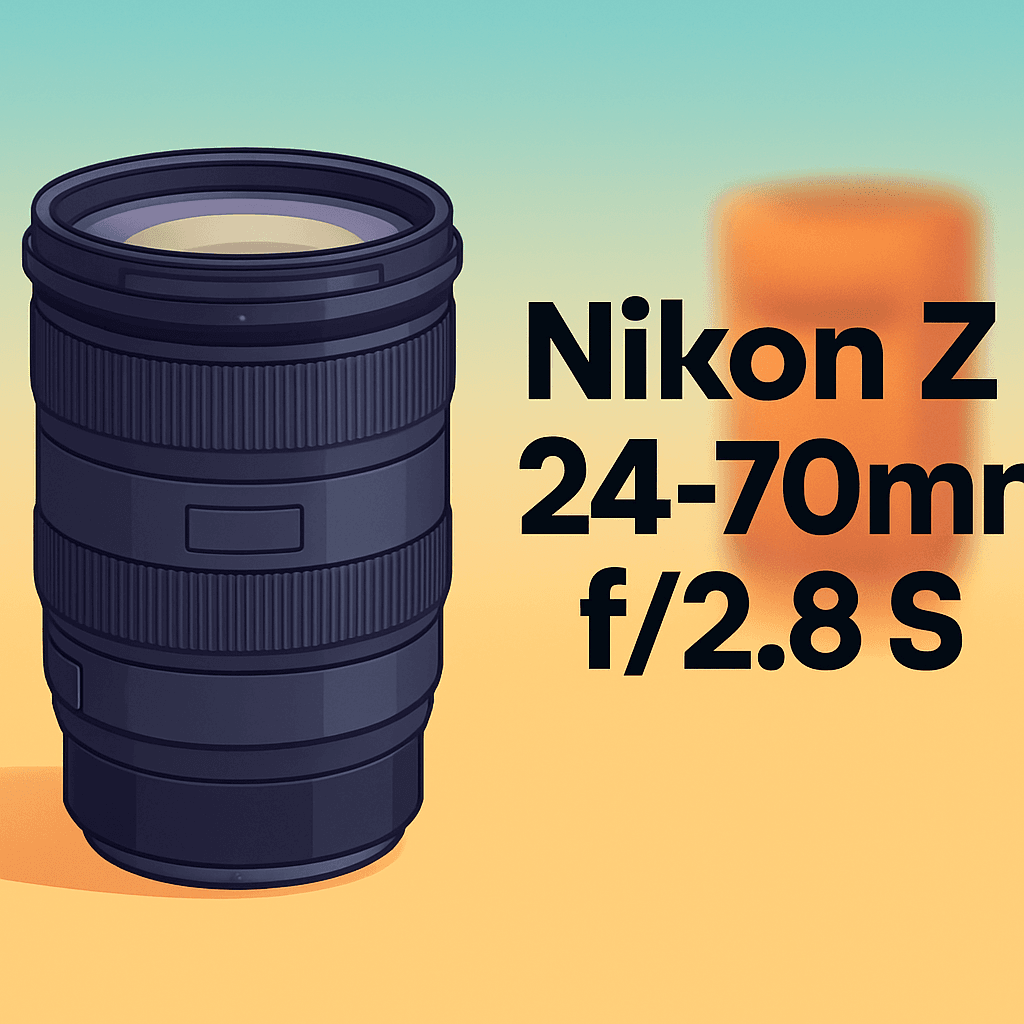
Curious if the Nikon Z 24-70mm f/2.8 S is the one zoom that can handle weddings, run‑and‑gun events, and video without compromise?
I’ve pushed this flagship Z‑mount standard zoom through low‑light gigs, portraits, and quick commercial shoots, and it feels purpose‑built: constant f/2.8, native FX/DX compatibility, pro weather sealing, and a stepless electronic diaphragm for video. It leans on your camera’s IBIS rather than in‑lens stabilization, which matters in real shoots.
This review will cover design and build, real‑world handling, corner sharpness, autofocus, who benefits most, and key alternatives so you can pick the right tool for your kit—keep reading.

Nikon Z 24-70mm f/2.8 S
Pro-grade standard zoom for mirrorless professionals. Bright constant aperture delivers shallow depth of field and excellent low-light performance. Exceptional edge-to-edge sharpness, silent autofocus, and robust weather sealing for location work.
Check PriceThe Numbers You Need
| Spec | Value |
|---|---|
| Focal length | 24–70 mm |
| Maximum aperture | f/2.8 (constant) |
| Mount type | Nikon Z-mount |
| Format compatibility | Full-frame (FX) and APS-C (DX) |
| Lens construction | 17 elements in 15 groups |
| Diaphragm blades | 9, rounded |
| Minimum focus distance | 0.21 m (8.3 in) |
| Maximum magnification ratio | 0.28× |
| Image stabilization | No (rely on camera body stabilization) |
| Autofocus | Silent Wave Motor (SWM) with stepping motor for Z lenses |
| Filter size | 82 mm |
| Dimensions (diameter × length) | Approx. 83 × 137 mm |
| Weight | Approx. 805 g (28.4 oz) |
| Weather sealing | Yes, dust- and moisture-resistant |
| Coatings | Nano crystal and ARNEO coating for flare and ghosting reduction |
How It’s Built
In my testing the Nikon Z 24-70mm f/2.8 S feels like a proper pro lens. The metal-and-high-grade-plastic finish gives you confidence when you’re out shooting all day. On Z bodies it sits balanced and comfortable instead of nose-diving forward.
I found the dust- and moisture-resistant sealing actually useful on gray mornings and dusty event venues. For beginners that means you can keep shooting in light rain or a windy field without panicking over a few drops. It won’t make the lens invincible, but it raises your confidence to work in rougher conditions.
Handling is straightforward—this isn’t a tiny walkaround optic. It has a larger filter thread, so filters and cases need more room, and the included locking bayonet hood snaps on solid to cut flare and protect the front. Nano Crystal and ARNEO coatings helped in backlit shots, keeping contrast up and stray highlights down.
The rounded diaphragm blades smooth highlights, and the stepless electronic aperture is a big win for video. I liked the video-friendly action; what could be better is the lack of in-lens stabilization, so you’ll rely on your camera’s IBIS or a tripod for steadier shots. Overall it feels built for serious use in the field.
In Your Hands
In the field the Nikon Z 24-70mm f/2.8 S delivers consistent, professional rendering across the zoom range at f/2.8, with noticeable improvement when stopped down. Colors are natural with good micro-contrast, and Nano Crystal plus ARNEO coatings keep flare and ghosting well controlled in backlit situations. That reliable contrast makes it easy to pull clean files for editorial and commercial work.
The nine rounded diaphragm blades produce smooth, rounded highlights and creamy out-of-focus areas that flatter portraits and product shots. The constant f/2.8 aperture gives clear benefits for shutter speed and ISO choices in low light, but remember the lens relies on body IBIS since there’s no in-lens stabilization. In practice this combination handles most handheld scenarios, though very slow-light video may demand support.
Close-focus capability and the 0.28x magnification let you capture environmental portraits and detail work without changing lenses, preserving background separation. Working distance is comfortable for tabletop and location shooting and the focus falloff looks natural for subject isolation. It isn’t a replacement for a dedicated macro, but it’s versatile for run-and-gun close work.
Video shooters will appreciate the smooth, stepless electronic diaphragm for exposure ramps and unobtrusive AF behavior for gentle focus pulls. The pro build, weather sealing and included locking hood inspire confidence in mixed conditions, while the 82mm filter size and heft are the practical trade-offs for f/2.8 performance.
The Good and Bad
- Constant f/2.8 aperture
- Native Nikon Z-mount; FX/DX compatibility
- Weather sealing (dust- and moisture-resistant)
- Electronic diaphragm with smooth, stepless control for video
- No optical image stabilization (relies on camera IBIS)
- Size and weight: approx. 83 x 137 mm; approx. 805 g
Ideal Buyer
The Nikon Z 24-70mm f/2.8 S is aimed at working photographers who need a fast, reliable standard zoom for events, weddings, editorial shoots and commercial work. Its constant f/2.8 and native Z ergonomics make it a go-to on Z bodies when you can rely on in‑body stabilization. FX/DX compatibility keeps it useful across full-frame and crop Z systems.
Hybrid shooters who move between stills and video will appreciate the stepless electronic diaphragm and consistent handling across the range. The S-line build and weather sealing give confidence on jobs where reliability matters. On long assignments the lens’s balance and controls help reduce fatigue.
Portrait and low-light shooters who value subject separation, close-focus versatility and creamy highlights will find the lens rewarding. Just plan for the 82 mm filter footprint and the size and weight of a pro f/2.8 zoom. You should be comfortable leveraging camera IBIS for the best handheld results.
This is not the right pick for photographers who need in‑lens stabilization or the smallest, lightest travel kit. If weight, filter size or built‑in VR are priorities, consider the thinner f/4 Z or VR‑equipped alternatives. It rewards photographers who prioritize native Z performance and optical quality.
Better Alternatives?
We’ve gone through the Nikon Z 24-70mm f/2.8 S in detail — its pro build, constant f/2.8, and how it behaves on Z bodies. That lens is a great all-round pro zoom, but it’s not the only option depending on your needs and budget.
Below are a few real-world alternatives I’ve used in the field. I’ll note what each one does better or worse than the Z 24-70 f/2.8 S and who would most likely choose it.
Alternative 1:

Nikon Z 24-70mm f/4 S
Compact, lightweight standard zoom designed for travel and everyday shooting. Constant moderate aperture ensures consistent exposure; delivers crisp, high-resolution images with fast, accurate autofocus and excellent flare control.
Check PriceI’ve used the Z 24-70mm f/4 S on trips and as a daily walkaround lens. Compared to the Z f/2.8 S, it’s noticeably smaller and lighter, so you’ll carry it longer without getting tired. In good light it produces very sharp images and the autofocus feels just as quick and confident on Z bodies.
Where it falls short is low-light and subject separation. The f/4 max aperture means you’ll need higher ISO or slower shutter speeds than the f/2.8 S, and you don’t get the same creamy background blur at longer focal lengths. For events or fast-moving subjects in dim venues, you’ll feel that limitation.
This lens is for shooters who want a compact, high-quality zoom for travel, landscapes, and everyday work and who rarely need f/2.8. If you value lighter weight and lower cost over the extra speed and shallow depth of field, the f/4 S is a practical pick.
Alternative 2:
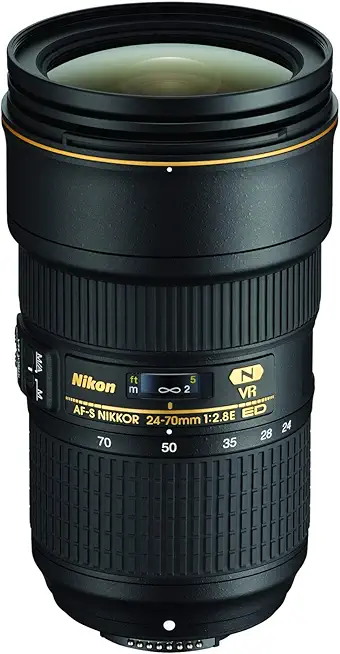
Nikon F 24-70mm f/2.8E AF-S VR
Professional-class standard zoom built for full-frame SLRs. Bright constant aperture and image stabilization enable sharp handheld shots in low light. Robust metal construction, fast quiet autofocus, and dependable weather protection.
Check PriceI’ve shot with the F 24-70mm f/2.8E VR on DSLRs and on Z bodies using the FTZ adapter. The big advantage over the Z f/2.8 S is the built-in VR — it helps a lot for handheld low-light stills on cameras without IBIS and can be a lifesaver when you can’t push ISO. The rendering is solid and it handles rough use well.
On the downside, it’s heavier and you’ll feel it on long shoots. When mounted via adapter on a Z body it doesn’t balance as naturally as a native Z lens, and you miss the Z lens’ newer coatings and slightly crisper corners in my experience. Autofocus works well, but it’s not as seamless or snappy as a native Z mount lens.
Choose this if you need in-lens stabilization or already own the F-mount version and don’t want to invest in a native Z lens. It’s a good option for shooters who value VR for handheld work or who want to save by buying used or sticking with their DSLR kit.
Alternative 3:
Nikon F 24-70mm f/2.8E AF-S VR
Studio-grade optics with advanced coatings minimize ghosting and flare while delivering edge-to-edge resolution. Smooth zoom action, tactile controls and reliable performance tailored for wedding, event, and commercial photographers.
Check PriceUsing the same F 24-70mm in studio and event settings showed me why some pros still stick with it. The physical controls and built-like-a-tank feel give confidence in demanding shoots. Its VR and reliable performance make it easy to hand to a second shooter or to use on older DSLR bodies where IBIS isn’t available.
Compared to the Z 24-70 f/2.8 S, the studio-focused F version can feel a step behind in coatings and the slightly newer optical refinements. In really contrasty backlit scenes I noticed the Z S handled flare and micro-contrast a touch better. Also, using the F lens on a Z body means dealing with adapter quirks instead of the smooth integration you get from native Z glass.
This variant suits photographers who already work with F-mount systems, those who need built-in VR for handheld studio or event work, or teams that pass gear between DSLR and mirrorless bodies. If you need the absolute best native Z performance, you’ll lean toward the Z 24-70 f/2.8 S, but the F version still earns its place for stability and rugged, studio-ready use.
What People Ask Most
Is the Nikon Z 24-70mm f/2.8 S worth the price?
Yes — it’s expensive but delivers pro-level build, consistent f/2.8 performance and top-tier image quality that justifies the cost for working photographers.
Is the Nikon Z 24-70mm f/2.8 S weather-sealed?
Yes, it has robust dust- and moisture-resistant sealing designed for professional use in challenging conditions.
Does the Nikon Z 24-70mm f/2.8 S have image stabilization (VR)?
No, the lens itself doesn’t have optical VR, but most Nikon Z camera bodies include in-body stabilization that covers this lens.
How sharp is the Nikon Z 24-70mm f/2.8 S?
Very sharp — excellent center sharpness wide open with very good edge/corner performance when stopped down.
Is the Nikon Z 24-70mm f/2.8 S good for portraits and weddings?
Yes, its fast f/2.8 aperture, versatile focal range and smooth bokeh make it a go-to for portraits and wedding work.
How does the Nikon Z 24-70mm f/2.8 S compare to the Nikon 24-70mm f/2.8 G/E (F-mount)?
The Z version is optically and ergonomically improved with better coatings and autofocus on Z bodies, offering cleaner images and modern features compared to the older F-mount variants.
Conclusion
The Nikon Z 24-70mm f/2.8 S is a resolute pro-standard zoom that delivers the kind of speed, build and control demanding shooters expect. Its constant f/2.8 aperture, robust weather sealing and advanced coatings give it real-world reliability and attractive rendering. The stepless electronic diaphragm and close-focus flexibility make it a strong hybrid tool for both stills and video.
No lens is without trade-offs, and this one is clear about them. There’s no optical stabilization, so you’ll depend on body IBIS and shooting technique. The professional 82 mm filter size and the overall size and weight are part of the package that buys performance but limits travel convenience.
Choose this lens if native Z performance, f/2.8 speed and pro handling matter more than minimal weight or in-lens VR. If travel light or in-lens stabilization is a priority, the Z 24-70mm f/4 S, the DSLR 24-70 VR or Sigma Art variants deserve consideration. Those alternatives balance cost, size or stabilization differently.
From my testing, the Z 24-70mm f/2.8 S is a keeper for event, editorial and commercial shooters who demand consistency and control. It earns its place in a kit when image quality, weather resistance and video-ready features are priorities. Skip it only if compactness or built-in VR are non-negotiable for your work.
Nikon Z 24-70mm f/2.8 S
Pro-grade standard zoom for mirrorless professionals. Bright constant aperture delivers shallow depth of field and excellent low-light performance. Exceptional edge-to-edge sharpness, silent autofocus, and robust weather sealing for location work.
Check Price


0 Comments