
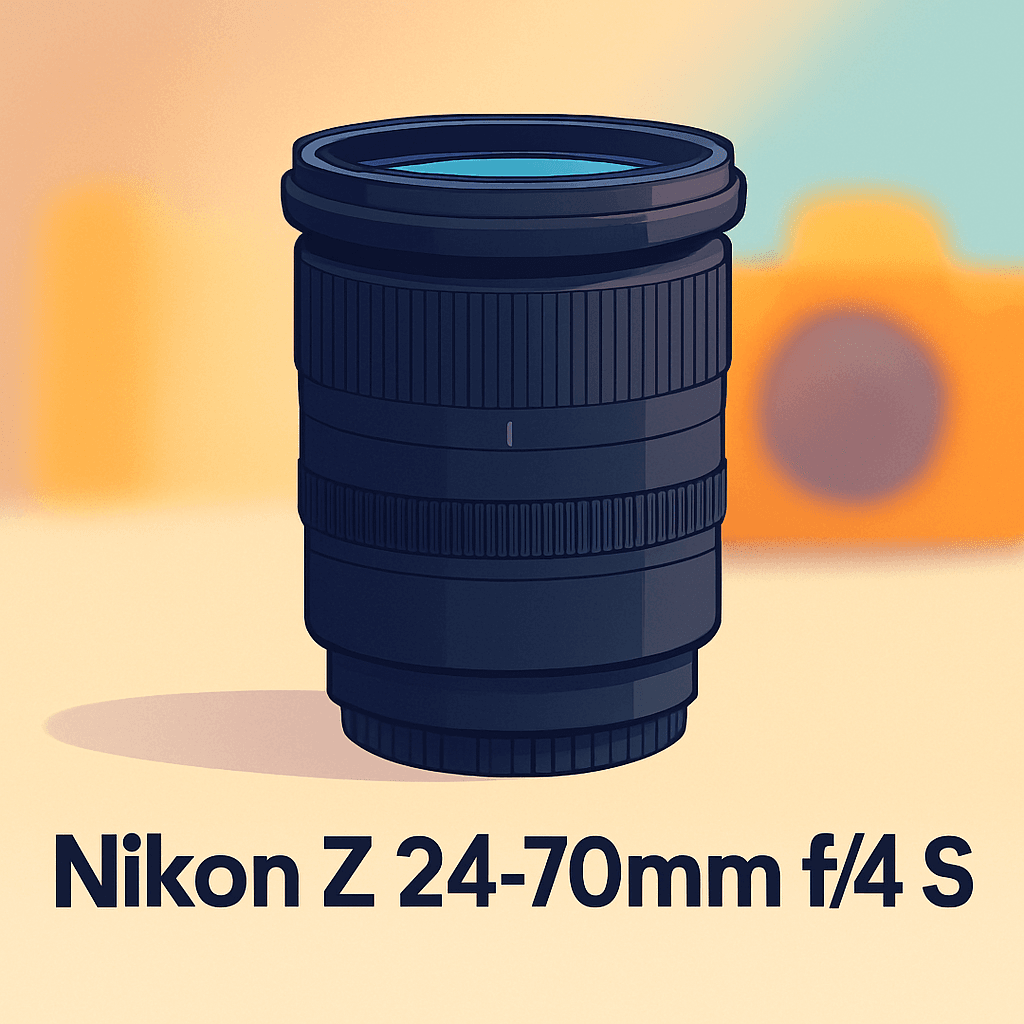
Want a single lens that handles travel, portraits, and landscapes without weighing you down? The NIKKOR Z 24-70mm f/4 S is Nikon’s full-frame, constant-f/4 standard zoom for Z-mount bodies, built for everyday versatility.
It’s balanced for portability, weather resistance, and consistent exposure across the zoom range, and it leans on in-body stabilization for steady handheld work. I’ve taken one into the field on real shoots, so you’ll get practical observations, not just lab notes.
This review will walk through build and handling, sharpness, autofocus behavior, close-up utility and real-world pros and cons — and who should choose it over an f/2.8 or a longer zoom. Make sure to read the entire review as you decide if this could be your go-to travel and walkaround lens — keep reading.

NIKKOR Z 24-70mm f/4 S
Slim, lightweight constant-aperture zoom delivers edge-to-edge sharpness, fast autofocus, and durable weather-sealed construction—perfect for travel, street, and everyday shooting when portability and consistent image quality matter.
Check PriceThe Numbers You Need
| Spec | Value |
|---|---|
| Focal Length | 24–70mm |
| Maximum Aperture | f/4 (constant) |
| Lens Mount | Nikon Z-mount |
| Format Compatibility | Full-frame |
| Optical Construction | 14 elements in 11 groups |
| Minimum Focus Distance | 0.3 m (1 ft) |
| Maximum Reproduction Ratio | 0.24× |
| Image Stabilization | No (relies on in-camera stabilization) |
| Aperture Blades | 7 (rounded) |
| Autofocus | Stepping motor (STM) |
| Filter Size | 62 mm |
| Dimensions (Diameter × Length) | Approx. 76 × 88 mm |
| Weight | Approx. 500 g |
| Weather Sealing | Yes (dust- and moisture-resistant) |
| Minimum Aperture | f/22 |
How It’s Built
In my testing the NIKKOR Z 24-70mm f/4 S feels like a friendly, no-nonsense lens you can grab for an outing without thinking twice. It’s compact and light enough to carry all day, so I actually found myself leaving heavier gear at home. For beginners that means less fatigue and more shooting time.
After using it for a while I appreciated the weather-resistant build. I shot in light rain and dusty parks and never worried about a little moisture or grit, which makes it a great travel companion without carrying a bunch of extra protection.
The controls are straightforward and the stepping motor keeps autofocus smooth and quiet, which I liked for both stills and video. The focus ring has a nice, damped feel for manual tweaks, and the rounded aperture blades give pleasing out-of-focus highlights wide open, though those highlights become more defined stopped down.
One thing that could be better is that the lens doesn’t have built-in stabilization, so it leans on Nikon bodies’ in-camera stabilization. In practice that means you’ll want to be mindful of shutter speed in low light or use a tripod—simple to manage, but worth knowing up front.
In Your Hands
The NIKKOR Z 24-70mm f/4 S gives very consistent exposure and depth-of-field across the zoom, which simplifies both stills and video workflow. Its STM autofocus is quiet and smooth for handheld shooting, and focus transitions are gentle; breathing is present but modest enough not to ruin documentary-style pulls.
On mid-size and larger Z bodies the lens balances beautifully and becomes an easy all-day companion that encourages more spontaneous shooting. The compact, weather-resistant build means you can leave it on for travel or rain-swept walks without a second thought.
Close-focus performance is impressively usable for food, product shots and environmental detail, delivering convincing texture and background separation without needing a specialist macro lens. Bokeh is generally smooth and non-distracting, lending images a pleasing subject pop at the longer end.
In low light you’ll lean on your camera’s stabilization to squeeze the most from the lens’s constant aperture, and handheld results are solid in many dim situations though it won’t match faster glass for extreme low-light work. For travel, street, landscape and casual portrait work it strikes a practical, consistent balance that keeps your camera ready for whatever shows up.
The Good and Bad
- Compact and relatively lightweight for a full-frame standard zoom
- Constant f/4 aperture simplifies exposure across the zoom range
- Weather-sealed build suitable for travel and outdoor work
- 0.24x maximum reproduction and 0.3 m minimum focus distance enable credible close-up capability
- No optical VR; relies solely on in-body stabilization
- f/4 limits low-light headroom and subject separation compared to f/2.8 options
Ideal Buyer
If you prize a travel-ready full-frame standard zoom, the NIKKOR Z 24-70mm f/4 S is made for you. Its compact weight, weather sealing and constant f/4 make it an ideal daily carry for Z-mount shooters. It’s the lens you grab when balance and reliability beat maximum speed.
Landscape, street and documentary photographers will appreciate how it performs stopped down in good light. IBIS-equipped Z bodies pair with it naturally, since the lens relies on in-body stabilization rather than optical VR. Videographers who want consistent exposure through zooms will also find it dependable.
Creators who value quiet autofocus, practical close-focus (0.3 m / 0.24×) and a 62mm filter thread will find this lens extremely useful. It’s a sensible one-lens solution for travel, food, product detail and everyday portraiture at moderate separation. The handling and build make long days out in the field comfortable and secure.
It’s not the right choice for low-light event shooters who need f/2.8 headroom or for photographers who require long tele reach without swapping glass. If extreme bokeh, faster shutter-stopping power or extended reach are priorities, look to a 24–70 f/2.8 or a longer-range zoom. For most generalists wanting portability, weather resistance and consistent results, the 24–70mm f/4 S is a practical, well-balanced pick.
Better Alternatives?
We’ve gone through the Nikon Z 24-70mm f/4 S and what it brings to the table: light weight, weather sealing, constant f/4, and a very useful everyday zoom range. It’s a clean, practical lens for travel and daily work, but it’s not the only path forward—there are clear trade-offs if you want more speed or more reach.
Below are lenses I’ve used in the field that people grab instead of the 24-70 f/4 S. I’ll point out where they shine compared to the f/4, where they fall short, and the kind of shooter who’ll want each one.
Alternative 1:

NIKKOR Z 24-70mm f/2.8 S
Professional-grade bright-aperture zoom produces beautiful bokeh, outstanding low-light performance, and rich contrast with precise AF and rock-solid build—designed for weddings, events, and demanding commercial work.
Check PriceThe NIKKOR Z 24-70mm f/2.8 S is the go-to when you need more light and a shallower depth of field. I’ve used it at weddings and indoor events where f/4 just didn’t cut it—moving to f/2.8 gets noticeably cleaner shots in dim rooms and helps separate subjects from busy backgrounds. The rendering feels punchier and the bokeh is creamier, so portraits and subject isolation look more professional right out of camera.
That extra stop of brightness does come with costs. The f/2.8 is heavier and bigger on a Z body, and you’ll feel it after a long day of shooting. It’s also much more expensive. Optically it’s superb, but for travel or long walks the 24-70 f/4 is easier to carry and less tiring to use.
Choose the f/2.8 if you shoot weddings, events, low-light documentary work, or commercial jobs where shallow depth and a “clean” look matter. If you value light weight and want a smaller kit for travel, stick with the f/4 version instead.
Alternative 2:

NIKKOR Z 24-120mm f/4 S
Versatile long-reach standard zoom covers most shooting scenarios with uniform sharpness, smooth rendering, and a robust, weather-resistant design—ideal for travel photographers who need flexibility without swapping lenses.
Check PriceThe NIKKOR Z 24-120mm f/4 S is about reach and convenience. I’ve taken it on trips where I didn’t want to change lenses—being able to zoom to 120mm means you can pull frames from farther away without moving. For travel, events, and run-and-gun shoots it’s a real timesaver because you cover wide to short tele without swapping glass.
Compared to the 24-70 f/4, you get more framing options but a slightly bigger package. In my experience the 24-120 holds its own in the center sharpness and overall rendering, but at the long end you can see softer corners and a small drop in micro-contrast versus the tighter 24-70 optics. It doesn’t help low-light either since it keeps the same f/4 aperture.
Pick the 24-120 f/4 S if you want a single, flexible lens for travel, events, or photojournalism where swapping lenses is a hassle. If you prioritize the smallest, lightest kit or the highest-edge-to-edge detail at 70mm, the 24-70 f/4 is still the better daily carry.
Alternative 3:
NIKKOR Z 24-120mm f/4 S
All-in-one travel zoom offers extended framing flexibility, reliable autofocus, and consistent optical performance across the range, making it an excellent choice for run-and-gun shooters and hybrid photo-video workflows.
Check PriceUsing the 24-120mm for mixed photo and video work is something I do often. The zoom range lets you reframe quickly during a shoot, and autofocus is steady for both stills and clips. For hybrid shooters who need to react fast, the extra tele helps get flattering portrait crops and compressed backgrounds without changing lenses.
Where it loses to the 24-70 f/4 is in pure compactness and a hair of optical purity. The 24-70 is a touch smaller and a smidge sharper at some focal lengths, especially for edge detail. The 24-120 trades a little bit of that edge performance for far greater flexibility in framing and in-the-moment shooting freedom.
Go for the 24-120 f/4 if you’re a traveler, vlogger, or documentarian who values one lens that does nearly everything. If you shoot landscapes or studio work where you want the maximum sharpness from 24–70mm and prefer a lighter bag, stick with the 24-70 f/4 S.
What People Ask Most
Is the Nikon Z 24-70mm f/4 S a good lens?
Yes — it’s a well-built, versatile standard zoom that delivers consistently high image quality for everyday and travel use.
How sharp is the Nikon Z 24-70mm f/4 S across the zoom range?
Very sharp in the center at all focal lengths with good corner performance stopped down; there’s a mild softness near 70mm but images remain usable and detailed.
Does the Nikon Z 24-70mm f/4 S have image stabilization (VR)?
No — the lens has no optical VR and relies on in-body stabilization in Nikon Z cameras for shake reduction.
Is the Nikon Z 24-70mm f/4 S weather-sealed and durable?
Yes — it has dust- and moisture-sealing and a solid metal build that holds up well for regular outdoor and professional use.
How does the Nikon Z 24-70mm f/4 S compare to the Z 24-70mm f/2.8 S?
The f/2.8 is faster with better low-light and bokeh performance but is heavier and more expensive; the f/4 is lighter, cheaper, and still very sharp for most shooting situations.
Is the Nikon Z 24-70mm f/4 S good for portraits and travel photography?
Yes — it’s ideal for travel thanks to its compact size and focal range, and it works well for portraits though it won’t give as much background blur as an f/2.8 or prime lens.
Conclusion
The NIKKOR Z 24-70mm f/4 S is the kind of lens that makes easy decisions for everyday shooters: compact, weather-resistant, and engineered for consistent results on Z bodies with stabilization. It delivers predictable exposure, quiet AF, and useful close-focus capability, which makes it an excellent travel and walkaround tool. Its trade-offs are clear — the f/4 ceiling and lack of lens-based stabilization limit low-light headroom and the smoothest subject separation compared with faster alternatives.
In practice this lens shines where portability and reliability matter most. Street, landscape, and documentary shooters will appreciate the balance of size, handling, and image quality, while hybrid photo/video creators benefit from the constant aperture and steady focus behavior. If you prioritize buttery bokeh or shooting deep into dusk without cranking ISO, you’ll notice where this design concedes to faster, heavier options.
If you need more speed, move to the Z 24-70mm f/2.8 S; if you want reach, consider the Z 24-120mm f/4 S or the 24-200mm f/4–6.3 with VR and its compromises. Choose by the simple triangle of priorities — speed, reach, or compact balance — and the NIKKOR Z 24-70mm f/4 S will be the right call for anyone who values the last option.
NIKKOR Z 24-70mm f/4 S
Slim, lightweight constant-aperture zoom delivers edge-to-edge sharpness, fast autofocus, and durable weather-sealed construction—perfect for travel, street, and everyday shooting when portability and consistent image quality matter.
Check Price


0 Comments