
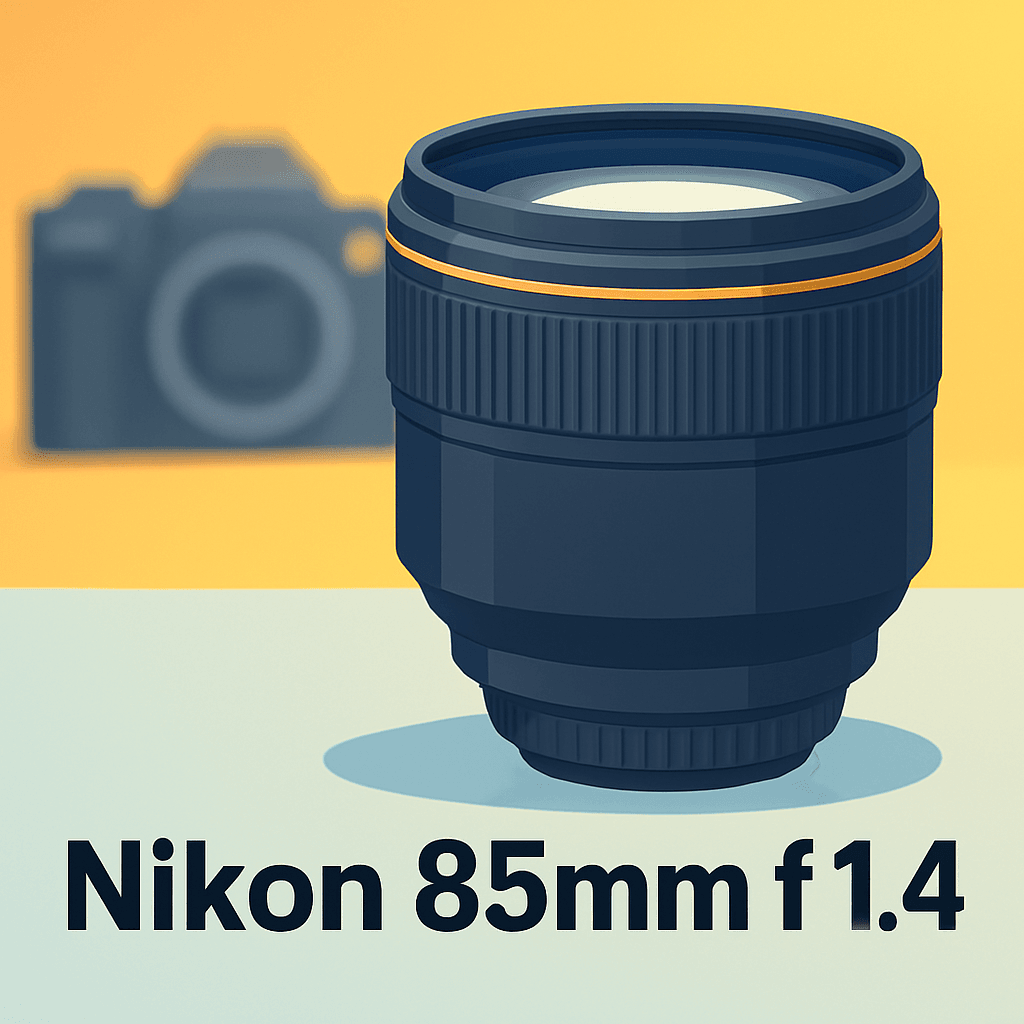
Want to know if a fast 85mm can instantly improve your portraits and low‑light work? The Nikon AF-S NIKKOR 85mm f/1.4G is the classic candidate most Nikon shooters reach for.
I’ve field‑tested this lens across portraits, weddings, and dimly lit events, so you’ll get a real‑world take rather than just lab numbers. We’ll look at handling, AF behavior, wide‑open sharpness, bokeh character, and practical trade‑offs.
This review’s for Nikon F‑mount portrait shooters, wedding and event photographers, and anyone who wants creamy subject separation with native AF convenience. The lens’ f/1.4 look and smooth rendering are its strongest real‑world payoffs.
I’ll also put it in context against the 85/1.8 option and popular rivals from Sigma and Zeiss to help you choose what fits your kit — keep reading.

Nikon AF-S NIKKOR 85mm f/1.4G
Fast 85mm portrait lens delivering creamy bokeh, sharp central detail, and confident low-light autofocus. Solid build and smooth, beautiful rendering for professional portraiture and event photography.
Check PriceThe Numbers You Need
| Spec | Value |
|---|---|
| Focal length | 85mm |
| Aperture | f/1.4 |
| Lens mount | Nikon F |
| Lens type | Autofocus (AF-S) |
| Compatibility | Nikon FX (full-frame) and DX (APS-C) DSLRs |
| Lens elements | 9 elements in 10 groups |
| Minimum focus distance | 85 cm |
| Maximum magnification | 0.12x |
| Diaphragm blades | 9 (rounded) |
| Focus motor | Silent Wave Motor (SWM) |
| Focus type | Internal focusing |
| Optical stabilization | No |
| Filter size | 77mm |
| Weight | 595 g |
| Diameter | 86.5 mm |
How It’s Built
In my testing the Nikon AF-S NIKKOR 85mm f/1.4G feels like a proper photographer’s lens — solid in the hand with a reassuring metal mount and a bit of real-world heft. It balances beautifully on larger Nikon bodies and sits a touch forward on smaller, compact DSLRs, which means you’ll notice it after a long wedding day. For day-to-day shooting that heft translates to steady framing, but plan your bag and shoulder straps accordingly.
The focus ring is smooth and nicely damped, so manual tweaks feel natural when I want to fine-tune focus for a portrait. The internal focusing and Silent Wave Motor mean the front element doesn’t turn and autofocusing is quiet — a big plus when using polarizers and shooting in quiet ceremony spaces. One thing I really liked was how the lens handled filters; the common filter size makes swapping polarizers and ND filters painless in the field.
After using it for a while I noticed Nikon kept the controls simple — no busy switches in awkward places — which is great for beginners who want to learn without fuss. I didn’t find obvious weather sealing on my sample, so I’d bring cover in light rain or dusty venues. One area that could be better is the overall size; it’s chunkier than some modern alternatives, which matters on long handheld shoots.
Overall the build inspires confidence and the handling choices make practical sense for portrait shooters. If you value a nicely weighted lens with quiet AF and non-rotating front glass, this one delivers. Just be prepared for the extra bulk and protect it in bad weather.
In Your Hands
In the field the AF-S NIKKOR 85mm f/1.4G locks confidently in good light and delivers repeatable hits for posed and candid work. In low light it can slow and hunt a bit, and continuous tracking handles gentle motion rather than fast action. The focus motor is discreet and quiet for most shooting scenarios.
Internal focusing means the front element doesn’t rotate, so polarizers and screw filters are straightforward to use. The focus ring is smoothly damped and predictable, encouraging precise manual tweaks when desired. Close-focus is fine for headshots but not for extreme close-ups.
Without optical stabilization you’ll balance shutter speed and ISO more deliberately when shooting handheld in dim venues. For weddings and receptions it proves practical with slightly faster shutter choices or simple support. The shallow depth of field at portrait distances demands careful focus and exposure discipline.
I reached for this lens constantly for natural-light headshots, environmental portraits and candid event moments— it renders skin tones and backgrounds in a filmic, pleasing way. Backlit scenes are manageable with careful placement; contrast holds up well unless you deliberately chase extreme flare.
My sample showed consistent behavior and dependable AF across bodies; occasional cameras may need subtle micro-adjustment but I found nothing systemic. For working photographers who value attractive rendering and native autofocus integration, it’s a dependable, everyday portrait tool.
The Good and Bad
- f/1.4 aperture for low light and shallow depth of field
- AF-S Silent Wave Motor with internal focusing for a non-rotating front element
- 9 rounded aperture blades
- Compatible with Nikon F-mount on FX and DX bodies
- No optical stabilization
- Wide-open resolution and microcontrast lag behind Sigma 85/1.4 Art and Zeiss Otus
Ideal Buyer
The Nikon AF-S NIKKOR 85mm f/1.4G is for Nikon F‑mount portrait shooters who crave that creamy f/1.4 look, strong subject separation, and shallow depth‑of‑field control. It’s the lens wedding photographers pull for low‑light vows, natural‑light headshots, and editorial portraits. Fast aperture and classic 85mm perspective trump pixel‑level sharpness on most buyers’ lists.
Pick this lens if you value smooth, flattering bokeh and reliable AF integration more than chasing the absolute wide‑open resolution benchmarks set by newer rivals. Event and wedding shooters who work handheld, rely on ambient light, and need quick, repeatable focus will appreciate the SWM and internal focusing. If you shoot on FX or DX DSLRs and want a familiar 85mm field of view and handling, it sits comfortably on a range of Nikon bodies.
Skip it if you live for maximum detail at f/1.4, need stabilization for slow‑shutter work, or prioritize ultimate corner‑to‑corner microcontrast. Otherwise, the 85/1.4G is ideal for photographers wanting a classic portrait signature — creamy background separation, responsive AF, and the practical ergonomics of a native Nikon prime. It’s a choice made with images and workflow in mind, for shooters who favor mood, speed, and native integration over laboratory numbers.
Better Alternatives?
We’ve already gone through how the Nikon AF-S NIKKOR 85mm f/1.4G behaves in the real world — its focus feel, bokeh character, and where it shines for portraits and events. If you like that look but want something sharper, more characterful, or are fine with manual focus, there are a few easy alternatives worth considering.
Below I’ll point out three lenses I’ve used on shoots that give different results from the Nikon 85/1.4G. For each I’ll say what it does better and worse in real shooting, and what kind of photographer would pick it.
Alternative 1:

Sigma 85mm f/1.4 DG HSM Art Canon EF
High-performance 85mm prime offering exceptional resolution, modern optical corrections, and near-silent HSM autofocus. Outstanding micro-contrast and control at wide apertures make it ideal for studio and on-location portraits.
Check PriceI’ve used the Sigma 85mm f/1.4 Art on weddings and studio shoots, and the first thing you notice is how much crisper it looks wide open compared with the Nikon AF-S NIKKOR 85mm f/1.4G. Faces, hair, and fine details hold together better at f/1.4, so if you need tack-sharp eyes and hair detail while keeping a shallow plane, the Sigma delivers.
Where it’s worse is handling and the look of the blur. The Sigma is larger and a bit heavier, so it changes how a camera balances on smaller bodies. Its bokeh can be a bit busier in high-contrast backgrounds compared to the Nikon’s creamier out-of-focus areas. I’ve also had to check AF fine-tune on older bodies — autofocus is usually fast and quiet, but it’s more dependent on camera/firmware than the Nikon’s native AF-S feel.
Choose the Sigma if you want the cleanest, most modern-looking portraits and don’t mind the extra size. It’s great for studio portrait shooters and anyone who values wide-open resolution more than the last bit of silky bokeh or the smallest, lightest package.
Alternative 2:

ZEISS Planar ZF.2 T* 85mm f/1.4 Nikon F
Legendary Planar optics produce velvety bokeh, exquisite micro-contrast, and striking color rendition. Manual-focus precision and durable construction reward photographers seeking characterful, cinematic portraits and fine-art imagery.
Check PriceThe Zeiss Planar ZF.2 is a very different tool than the Nikon AF-S NIKKOR 85mm f/1.4G because it’s manual focus only. On controlled shoots I loved the Zeiss for its colour, contrast, and the way subjects seem to “pop” from the background. The bokeh and tonality feel more painterly and three-dimensional than the Nikon’s more modern rendering.
On the downside, using the Zeiss at a busy wedding or fast editorial job is tougher. You give up autofocus, and that slows you down when people move. Also, you won’t get the quick reflex AF tracking that the Nikon gives you in run-and-gun situations. If you need speed and absolute convenience, the Nikon still wins.
If you’re a studio portrait photographer, fine-art shooter, or a filmmaker who doesn’t need AF, the Zeiss is awesome. Pick it if you want characterful images and you’re comfortable focusing manually — it rewards careful composition and slow, deliberate shooting.
Alternative 3:
ZEISS Planar ZF.2 T* 85mm f/1.4 Nikon F
Classic 85mm manual lens with anti-reflective coating for superior contrast and flare suppression. Smooth focus action and rich tonality create timeless, three-dimensional portraits with surgical sharpness.
Check PriceThis same Zeiss model deserves a second mention because, in practice, it feels like a different lens depending on how you shoot. On a tripod or in a quiet studio it gives very controlled contrast and excellent resistance to flare — I’ve used it in window light and found the images have a clean, rich look that the Nikon 85/1.4G doesn’t quite match.
Where it falls short vs the Nikon is obvious in fast-paced work: no AF, and you sacrifice the Nikon’s internal focus convenience. Also, in low light when you need to grab a quick keeper, the Nikon’s AF-S system will usually bank more shots for you. The Zeiss wins when you can slow down and fine-tune focus and composition.
Buy the Zeiss again if you shoot portraits as a craft and want ultimate color and contrast control, or if you work in a studio or for editorial where manual focus is fine. It’s for photographers who put image character and hands-on control above autofocus speed and run-and-gun flexibility.
What People Ask Most
Is the Nikon 85mm f/1.4 good for portraits?
Yes — its focal length and wide aperture give flattering subject isolation and creamy bokeh that make it a portrait photographer’s favorite.
How sharp is the Nikon 85mm f/1.4 at f/1.4?
Center sharpness is strong wide open, but edges and corners are softer at f/1.4 and become noticeably sharper when stopped to f/2–f/2.8.
Nikon 85mm f/1.4 vs 85mm f/1.8 — which is better?
The f/1.4 gives shallower depth of field and smoother bokeh, while the f/1.8 is smaller, lighter, cheaper and often equally sharp stopped down; choose based on budget and how much you value that extra blur.
Is the Nikon 85mm f/1.4 worth the price?
Yes for professionals and enthusiasts who need the wide aperture look and low-light performance, but casual shooters may prefer the cheaper 85mm f/1.8 for similar results in most situations.
Does the Nikon 85mm f/1.4 work on Nikon Z cameras (with or without an adapter)?
Yes — it works on Z bodies with the FTZ adapter and retains autofocus, though autofocus speed and handling won’t match native Z lenses.
How is the autofocus performance of the Nikon 85mm f/1.4?
On Nikon DSLRs the AF-S version is generally fast and reliable for portraits, and on Z bodies via adapter it performs well but can be a bit slower or less responsive than modern native Z glass.
Conclusion
The Nikon AF-S NIKKOR 85mm f/1.4G remains a classic F‑mount portrait lens, marrying a fast f/1.4 look with native autofocus behavior and a rendering many shooters find flattering. In the field it’s predictably easy to use and makes portraits that read emotionally rather than clinically. That character defines its appeal.
Its strengths are obvious: creamy out-of-focus backgrounds, confident AF integration, and the low-light latitude that only an f/1.4 optic delivers. Its compromises are equally clear — no in-lens stabilization, a size and heft that matter during long days, and optical rivals that out-resolve it wide open if pixel-peeping is your priority. In short, it trades absolute technical perfection for a pleasing, usable signature.
Buy it if you shoot Nikon DSLRs and want native AF, immediate bokeh character, and a lens that performs reliably across weddings, headshots and ambient-light work. If you demand the last word in wide-open sharpness or need stabilization, test your primary body with a Sigma or Zeiss before committing. Base your decision on how its AF behavior, wide-open rendering and handling feel on the camera you actually use.
For many working photographers it hits the sweet spot between personality and practicality, delivering images that feel natural and flattering without fuss. It’s an investment in a look more than benchmark-winning numbers. Try it on your kit and you’ll know if that signature suits your work.
Nikon AF-S NIKKOR 85mm f/1.4G
Fast 85mm portrait lens delivering creamy bokeh, sharp central detail, and confident low-light autofocus. Solid build and smooth, beautiful rendering for professional portraiture and event photography.
Check Price



0 Comments