
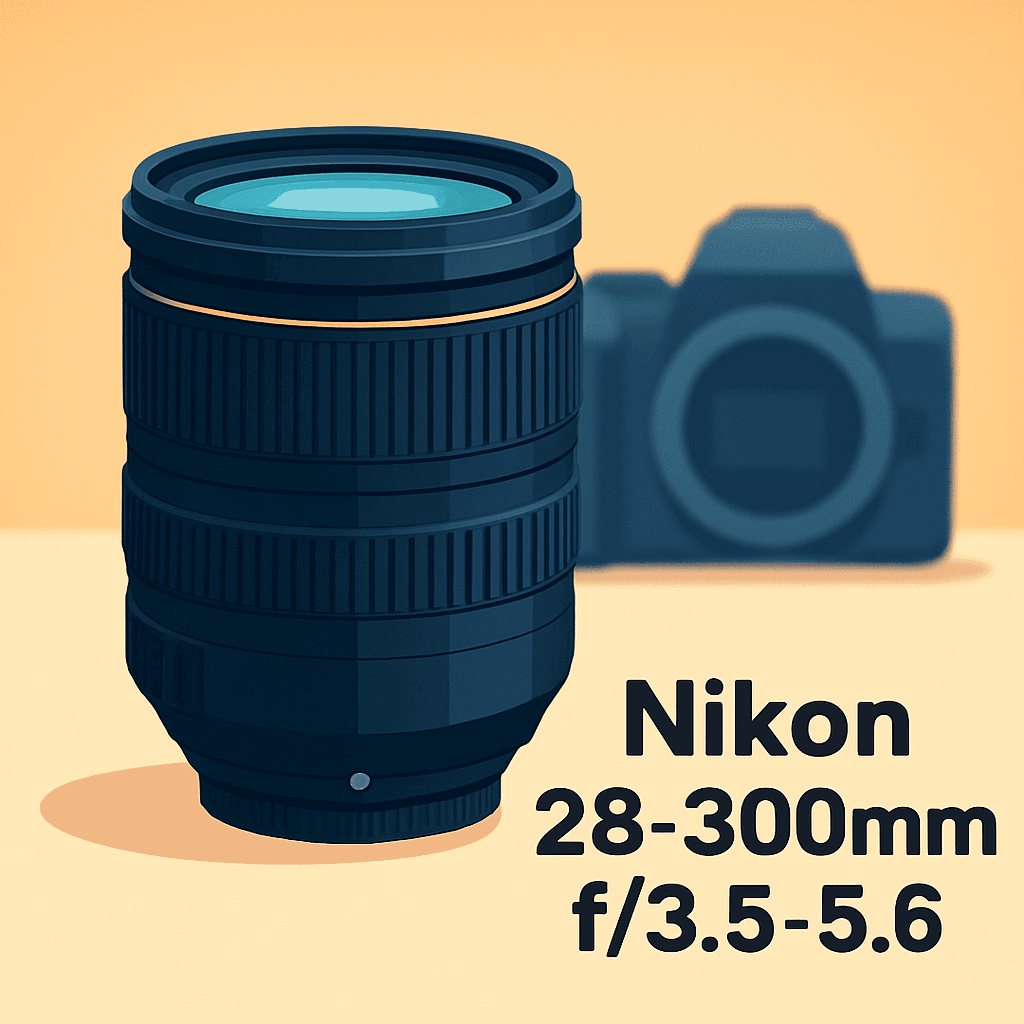
Want one lens that covers wide scenes, portraits, and distant subjects so you can travel lighter without missing shots?
I field-tested the Nikon AF-S FX NIKKOR 28-300mm f/3.5-5.6G ED on multi-day trips and city shoots. It promises huge reach, vibration reduction for steadier handheld shots, and quiet AF, with coatings to help control flare.
This review is for travelers, walkaround shooters, and anyone who values one-lens convenience over a bag of primes. Make sure to read the entire review as I unpack the real-world trade-offs and whether it’s worth your kit—keep reading.

Nikon AF-S FX NIKKOR 28-300mm f/3.5-5.6G ED
All-in-one full-frame superzoom delivering versatile wide-to-tele reach with ED glass and quiet SWM focusing, offering reliable sharpness and color rendition for travel, events, and everyday shooting without changing lenses.
Check PriceThe Numbers You Need
| Spec | Value |
|---|---|
| Focal length | 28–300mm |
| Maximum aperture | f/3.5–5.6 |
| Minimum aperture | f/22–38 |
| Lens construction | 19 elements in 14 groups |
| Special elements | 2 ED glass, 3 aspherical |
| Nano Crystal Coat | Yes |
| VR (Vibration Reduction) | Yes |
| AF-S (Silent Wave Motor) | Yes |
| Minimum focus distance | 0.5 m (1.64 ft) |
| Maximum magnification | 0.32× |
| Diaphragm blades | 9 (rounded) |
| Filter size | 77 mm |
| Weather sealing | No |
| Length | Approx. 114.5 mm (4.51 in) |
| Weight | Approx. 800 g (1.76 lb) |
How It’s Built
In my testing the Nikon AF-S FX NIKKOR 28-300mm felt solid and purposeful in the hand. It has a reassuring heft that helps the lens feel like a serious tool rather than a toy. On a full-frame Nikon body it balances well for most shots, so you won’t feel undergunned while traveling.
I found the optical treatments like the Nano Crystal coating and special glass do real work in bright, backlit scenes. The rounded diaphragm blades give highlights a pleasing shape, so out-of-focus areas look smoother than you might expect from a superzoom. For a beginner that means fewer headaches chasing flare and nicer background blur without fuss.
The zoom and focus rings are smooth with a bit of firm resistance, so you don’t get accidental zoom changes while shooting. Manual focusing is usable when you need it, though the lens does get a bit front-heavy when pushed to the long end. That balance shift is easy to manage if you brace against your body or use a monopod.
What I really liked was the one-lens convenience and the feeling of build quality that held up day after day. What could be better is weather protection and the large front element that requires big filters and caps—so be cautious in rain or dusty conditions. After using it for a while I’d happily recommend it for travel shooters who want one reliable all-purpose lens.
In Your Hands
The lens lives up to its promise as a true all-in-one, shifting effortlessly from broad environmental frames to tight, telephoto compression. In the wide-to-normal zone it feels at home for travel and street work, mid-tele ranges render flattering perspective for portraits, and the longest reach lets you isolate distant subjects without changing position. That one-lens convenience transforms how you shoot on the move.
Vibration Reduction meaningfully expands handheld possibilities across the zoom range, stabilizing the viewfinder and making slower shutter decisions more confident. At the longest focal lengths I still favored bracing or support for absolute sharpness, and VR shines most with static subjects while moving targets still rely on shutter speed and technique. Overall it turns borderline handheld shots into keeper opportunities more often than not.
The variable maximum aperture asks you to be deliberate indoors and in soft light; I compensated with higher ISO and steadier technique rather than hunting for wider glass. VR softens the compromise, but it can’t replace a faster aperture for motion or extremely shallow depth of field. In practical terms the lens is versatile enough for casual event and travel low-light work if you accept those trade-offs.
Close-focusing feels genuinely useful for semi-macro and detail work, offering a comfortable working distance and pleasing subject isolation when you get in close. Background blur benefits from the rounded diaphragm, producing smooth highlights at longer focal lengths even if it won’t rival dedicated short‑focus optics. It’s a handy option for table-top, floral, and documentary detail shots.
Carry-wise the lens is substantial enough to be noticed on long walks or hikes, but its balance on standard full-frame bodies keeps handling predictable during day-long shoots. For quick street patrols it’s unobtrusive once mounted, though extended handheld use will fatigue you sooner than a pancake zoom. It’s the kind of lens you appreciate for convenience but respect for long-haul comfort.
In the field I treated it like a workhorse: avoid wet, dusty extremes without extra protection and mind the extended barrel when zoomed toward the long end. The zoom throw is smooth and predictable, and focus transitions are quiet and reliable for most scenarios, though you’ll feel the front-end shift as you reach for tighter framing. For everyday travel and general-purpose shooting it’s a practical, confidence-boosting tool so long as you honor its operational trade-offs.
The Good and Bad
- Extremely versatile 28–300mm focal range in one lens
- VR (Vibration Reduction) for handheld shooting
- AF-S for quiet autofocus operation
- Nano Crystal Coat to help control flare and maintain contrast
- Variable maximum aperture f/3.5–5.6 limits light-gathering and depth-of-field control
- No weather sealing—added caution needed in challenging environments
Ideal Buyer
If you want one lens that does almost everything on a Nikon FX body, this is the kit to consider. The Nikon AF-S FX NIKKOR 28-300mm f/3.5-5.6G ED is built for photographers who hate swapping glass mid-journey. It’s the practical, grab-and-go choice for trips where reach and flexibility beat micro-optimizations.
Travel shooters, documentary photographers, and family chroniclers will love the 28–300mm convenience. VR and AF‑S make handheld shooting and quiet focusing more reliable across a wide range of subjects. The 0.5 m minimum focus distance and decent magnification also let you do semi-close-up detail work without changing lenses.
This lens suits people who accept practical trade-offs for versatility. If you’re comfortable with a variable f/3.5–5.6 aperture, roughly 800 grams of gear, and no weather sealing, you get huge focal coverage in a single package. That balance favors convenience and coverage over ultimate low‑light performance or featherweight carry.
Skip it if you demand constant wide apertures, the lightest possible kit, or pro-level weather resistance. Otherwise, think of it as the everyday workhorse for trips, street days, and mixed assignments where one lens must do the job of many.
Better Alternatives?
We’ve already gone through the Nikon 28–300mm and what it offers: a true one-lens solution with a lot of reach and reliable VR and AF-S operation. That combo makes it a great travel and walkaround lens, but it isn’t the only way to solve the “one lens for everything” problem.
Below are three real alternatives I’ve used in the field. Each one trades different things — weight, cost, reach, or image quality — so I’ll point out where they beat the Nikon and where they fall short, and the type of shooter who’ll prefer each option.
Alternative 1:

Tamron 28-300mm F/3.5-6.3 Di VC PZD Nikon FX
Compact, vibration-compensated superzoom with rapid PZD autofocus and effective stabilization, enabling crisp handheld shots across the focal range. Ideal for travel photographers seeking lightweight versatility and low-light confidence.
Check PriceIn the real world the Tamron’s biggest win over the Nikon 28–300 is size and weight. It feels noticeably lighter on a camera and packs down smaller, which makes a difference on long walks or flights. The PZD AF is quick enough for casual shooting and Tamron’s VC does a good job stabilizing handheld frames at moderate shutter speeds.
Where it falls behind is image confidence at the long end and in low light. The Tamron’s max aperture drops to f/6.3 at 300mm, so you end up pushing ISO or slowing shutter speeds more than with the Nikon. I also found the edges and corners softer at 200–300mm and the lens can show a little more chromatic aberration in high-contrast scenes. Build feels a touch more consumer-grade, so I’d be cautious in wet or dusty conditions.
This lens suits travelers who care about keeping weight down and want one-lens convenience on a budget. If you prioritize comfort, packing space, and don’t need the sharpest long-end performance for big prints, the Tamron is a sensible trade.
Alternative 2:

Sigma 28-300mm f/3.5-6.3 DG Macro Aspherical Nikon AFD
A superzoom with macro-friendly close-focus and aspherical optics for minimized aberrations, delivering detailed reproduction and consistent sharpness across the frame—built for photographers who need one-lens flexibility and fine close-ups.
Check PriceThe Sigma is the budget champ — if you want full 28–300 reach for the lowest cost, it’s a go-to. In the field it gave me the reach I needed for travel and wildlife glimpses without killing my wallet. The “macro” close-focus is handy for grabbing small subjects when you don’t want to switch lenses.
However, using it side-by-side with the Nikon showed the compromises. The Sigma is generally softer, especially at the long end and in the corners, and its autofocus and stabilization aren’t as sure-handed. In backlit or high-contrast situations I saw more fringing and flare that needed correction. It’s fine for web use or casual travel shots, but less reliable when you need clean, crisp results straight out of camera.
Pick the Sigma if price and having the full zoom range matter most. It’s for hobbyists, beginner travelers, or anyone who wants reach and close-focus flexibility and can accept weaker image fidelity and slower AF at the extremes.
Alternative 3:

Nikon AF-S FX NIKKOR 28-300mm f/3.5-5.6G ED
Travel-ready full-frame zoom combining extended focal coverage with ED elements and smooth internal focusing. Balanced optical performance and color fidelity make it perfect for landscapes, portraits, and everyday versatile shooting.
Check PriceThis is the lens we reviewed — so compared to the Nikon 28–300 itself there isn’t a different performance to list: it’s the baseline. From hands-on use I can say the Nikon version gives the most consistent autofocus, solid VR performance, and generally better control of flare and contrast than the similarly ranged third-party options.
Compared to the Tamron and Sigma it’s heavier and a bit bulkier, and it costs more. But in return you get steadier AF-S focusing, slightly better sharpness at the long end, and coatings that hold up better in bright, backlit scenes. It still lacks full weather sealing though, so it’s not a perfect “go anywhere” build.
Choose the Nikon if you want the most reliable all-in-one experience on a Nikon FX body — better AF confidence, more consistent image quality across the zoom range, and the peace of mind that comes from the manufacturer match. If weight, price, or absolute maximum sharpness at a given focal length are your top priorities, then one of the other options might fit you better.
What People Ask Most
Is the Nikon 28-300mm f/3.5-5.6 a full-frame (FX) lens?
Yes — it’s an F‑mount FX lens made for full‑frame Nikons and will also work on DX bodies with the crop factor applied.
Is the Nikon 28-300mm f/3.5-5.6 a good lens?
It’s a very useful all‑in‑one for convenience and travel, but it’s a compromise lens that won’t match the sharpness or low‑light performance of primes or faster zooms.
How sharp is the Nikon 28-300mm f/3.5-5.6?
Center sharpness is decent when stopped down in the mid focal range, but corners and the long 300mm end are noticeably softer.
Does the Nikon 28-300mm f/3.5-5.6 have Vibration Reduction (VR)?
Yes — this model includes Nikon’s Vibration Reduction to help stabilize handheld shots at slower shutter speeds.
Is the Nikon 28-300mm f/3.5-5.6 good for travel photography?
Yes — the huge focal range makes it ideal for travel when you want one lens for everything, though you’ll trade some image quality and carry more weight.
What cameras are compatible with the Nikon 28-300mm f/3.5-5.6?
It fits Nikon F‑mount DSLRs (both FX and DX), and can be used on Z‑mount mirrorless bodies with Nikon’s FTZ adapter.
Conclusion
The Nikon AF-S FX NIKKOR 28-300mm f/3.5-5.6G ED is the kind of lens that solves a common travel dilemma: carry one capable optic or haul a bag of glass. Its real-world strength is the sheer convenience of uninterrupted reach combined with reliable stabilization and quiet AF that let you shoot more and fuss less. For everyday travel and walkaround work it delivers exactly that—practical, go-anywhere versatility.
That convenience carries clear compromises you should accept up front. The lens asks you to trade low-light speed, compactness, and weather hardiness for coverage, so it won’t satisfy shooters who need the last stop of sharpness or the light-gathering of faster optics. In mixed or demanding conditions you’ll notice those limits, and sometimes a smaller dedicated zoom or a constant-aperture alternative will be the smarter choice.
Bottom line: if you value one-lens freedom on an FX Nikon and prioritize reach and flexibility over ultimate optics or featherweight packing, this lens is a strong, defensible choice. If peak image quality, lighter carry, or rugged weather sealing top your list, look at the alternatives mentioned earlier. This lens earns its place in a travel kit by solving more problems than it creates.
Nikon AF-S FX NIKKOR 28-300mm f/3.5-5.6G ED
All-in-one full-frame superzoom delivering versatile wide-to-tele reach with ED glass and quiet SWM focusing, offering reliable sharpness and color rendition for travel, events, and everyday shooting without changing lenses.
Check Price


0 Comments