
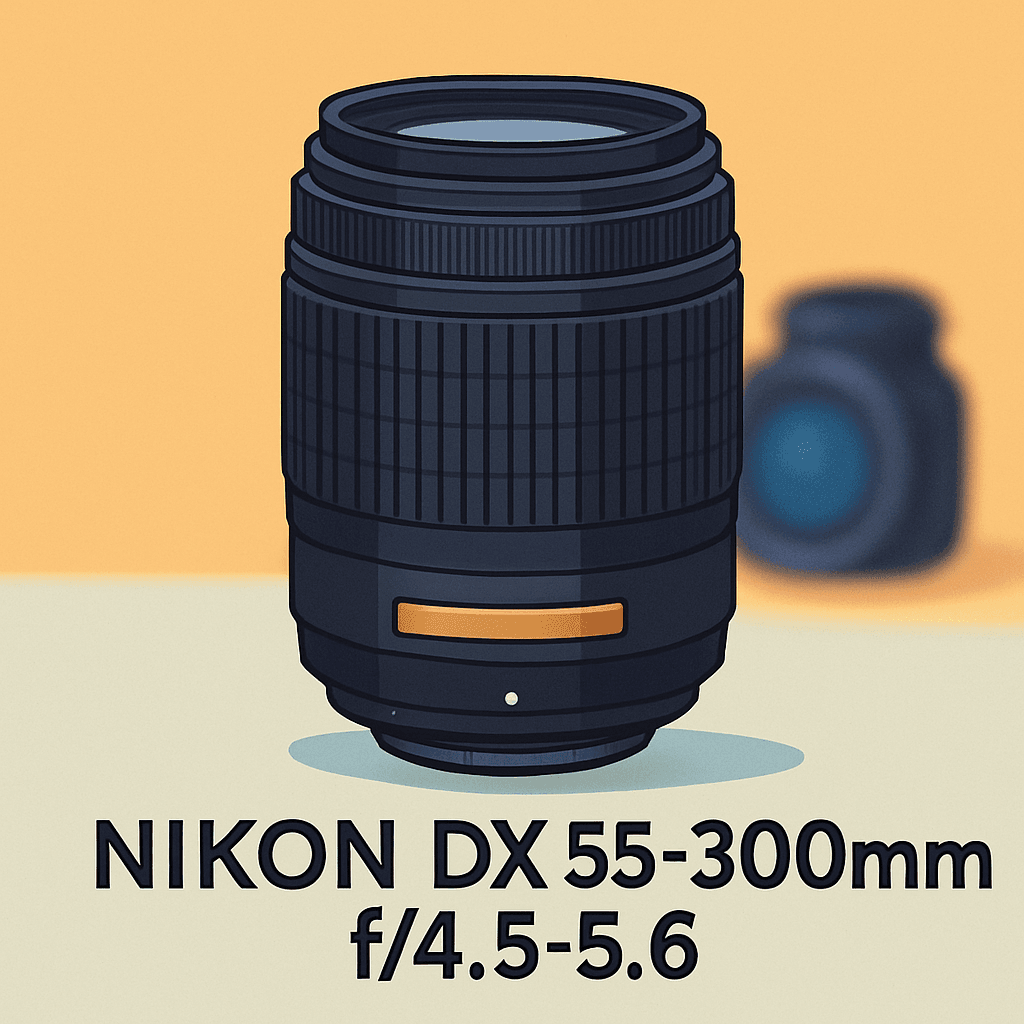
Want a single telephoto zoom that actually gets you closer to wildlife, sports and travel subjects without weighing you down?
After a few outings with the Nikon AF-S DX NIKKOR 55-300mm f/4.5-5.6G ED VR, I focused on real-world handling, stabilization and how usable the reach really is.
I’ll outline who benefits most, where the compromises show up, and how it stacks against common alternatives — Make sure to read the entire review as I break down hands-on findings and field comparisons, keep reading.

Nikon AF-S DX NIKKOR 55-300mm f/4.5-5.6G ED VR
Portable telephoto ideal for APS-C shooters seeking reach from moderate to long distances. Smooth vibration reduction, sharp ED elements and quiet autofocus deliver crisp wildlife and sports images with reliable performance.
Check PriceThe Numbers You Need
| Spec | Value |
|---|---|
| Focal length | 55-300mm |
| Maximum aperture | f/4.5-5.6 |
| Lens mount | Nikon F (DX format) |
| Sensor format compatibility | APS-C (DX) |
| Optical stabilization | Vibration Reduction (VR) |
| Lens construction | 14 elements in 10 groups |
| Special elements | Extra-low Dispersion (ED) glass |
| Minimum focus distance | 1.4 m (4.6 ft) |
| Maximum reproduction ratio | 0.24x (close-up capability) |
| Autofocus | Silent Wave Motor (AF-S) |
| Filter size | 58 mm |
| Aperture blades | 7 (rounded) |
| Zoom type | Telephoto zoom |
| Weight | Approximately 530 g (1.17 lbs) |
| Dimensions | About 80 mm diameter × 143 mm length |
How It’s Built
In my testing the Nikon AF-S DX NIKKOR 55-300mm f/4.5-5.6G ED VR felt like what you’d expect from a practical tele zoom for DX cameras. It mounts cleanly and balances nicely on smaller Nikon bodies. That balance makes it easier to point and frame distant subjects without fighting the lens.
The build is mostly plastic but it doesn’t feel flimsy when shooting. The zoom and focus rings turn smoothly, with just enough resistance so you don’t nudge them by accident. The ED glass elements are there, and I saw the benefit in cleaner colors and restrained highlights.
Size and weight are easy to live with during a full day of shooting. Beginners will appreciate that it won’t wear you out and fits in most camera bags. The filter thread is a common size, so grabbing a polarizer or ND on the fly is straightforward.
VR is built in and in my hands it makes composing at long reach noticeably steadier. The rounded aperture blades give a pleasant out-of-focus look when you stop down a touch. That steadiness and rendering are helpful for walk-around wildlife and event shooting.
What I really liked was the reach and portability — you can get close to distant action without hauling a tripod. What could be better is the overall feel; there’s a little flex and slight creep if you point it down. After using it for a while I suggest testing your copy for any creep before buying.
In Your Hands
The 55–300mm range is where this lens shines: it gives a lot of reach in a compact package and makes distant subjects feel much closer, with the familiar compression that flatters portraits of wildlife and isolates subjects at outdoor events. Framing is flexible enough for landscapes with distant detail or for picking out a subject in a crowd, and the zoom covers the everyday telephoto needs of most DX shooters without constant lens swapping. On smaller bodies the balance feels natural, so handheld long-reach shooting is comfortably practical for day trips.
The variable aperture means you’ll be making exposure trade-offs as you crank toward the long end—low-light tele work often forces higher ISOs or slower shutters, and that’s where VR earns its keep. In daylight the combination keeps shots usable without contortions, but in dim, fast-action situations the lens asks you to prioritize shutter speed over shallow depth of field. AF remains reliable for stills, though the lens’s light-gathering limits show up when light drops.
Center sharpness is consistently pleasing through much of the range, while corners and edge contrast soften noticeably at the extreme tele end unless you stop down a bit. Microcontrast and color are generally true to Nikon’s rendering, and the ED elements help control fringing, although high-contrast edges can still show minor color fringing. The rounded aperture blades lend a friendly, creamier out-of-focus quality for background highlights, especially when you’re a little way from the subject.
The close-focus ability is handy for larger details and tight portraits of distant subjects, though it doesn’t replace a true macro. VR makes composing and handheld shooting at long focal lengths far less nerve-wracking, and it’s effective for steadying the viewfinder and rescuing shots in softer light; it won’t, however, freeze very fast motion in dim conditions. In bright sun the lens rewards with punchy images; on overcast days or indoors you’ll find yourself stopping down to tighten edges or nudging ISO upward to keep shutters fast enough for action.
The Good and Bad
- Versatile 55–300mm telephoto range in a relatively compact DX package
- Built-in VR for handholding at longer focal lengths
- AF-S autofocus works across Nikon DX DSLRs
- ED glass and 7 rounded blades for smoother out-of-focus rendering
- DX-only — no native full-frame upgrade path
- Variable f/4.5–5.6 aperture, requiring more light or higher ISO at the long end
Ideal Buyer
If you shoot on a Nikon DX body and want simple, single‑lens reach, this is for you. The Nikon AF-S DX NIKKOR 55-300mm f/4.5-5.6G ED VR delivers a wide tele range with built‑in VR that makes handheld stills practical without carting multiple primes or big pro glass.
Think travel photographers, backyard wildlife chasers, and parents shooting outdoor sports who value portability and framing flexibility more than ultra‑low‑light speed. It’s a solid one‑lens solution for days when you need reach, light weight, and usable image stabilization over top-tier low‑light aperture performance.
If you rely heavily on live view or want whisper‑quiet, cinema‑style autofocus for video, this lens isn’t the best fit. The AF‑S motor is competent for stills and general tracking, but AF‑P alternatives are noticeably smoother and quieter in live view and video work.
Also avoid it if you plan to upgrade to full‑frame soon or need close‑up, low‑light performance without pumping ISO. For the pragmatic DX shooter who wants straightforward compatibility, affordable reach, and reliable VR for handheld tele work, this lens hits the sweet spot.
Better Alternatives?
We’ve looked closely at the Nikon AF-S DX NIKKOR 55-300mm f/4.5-5.6G ED VR and what it gives you: good reach, built-in VR, and a light, travel-friendly feel for DX shooters. If you want something a bit different—quieter autofocus for video, a full-frame option, or a different feel at the long end—there are a few real-world alternatives worth trying.
Below are three lenses I’ve actually used in the field alongside the 55-300. I’ll tell you what each one does better and where it gives up ground, and who I think would prefer each choice. I’ll keep it practical and based on shooting, not just the numbers.
Alternative 1:

Nikon AF-P DX NIKKOR 70-300mm f/4.5-6.3G ED VR
Lightweight travel telephoto offering quiet, fast stepping-motor autofocus and effective vibration reduction. High-quality ED glass yields sharp, contrasty results across the tele range, perfect for sports, wildlife and spontaneous outdoor shots.
Check PriceI found the AF-P 70-300 to be noticeably quieter and smoother than the 55-300 when I switched to live view or shot video. That stepping motor means autofocus doesn’t hunt loudly, which helped when I was filming a local soccer game and didn’t want the lens noise picked up by the camera mic. In normal stills shooting it also feels a touch faster and more confident at grabbing subjects out at 200–300mm.
Where it trades off is low-light reach: the long end is f/6.3 instead of f/5.6, so in dim conditions you’ll need higher ISO or slower shutter speeds compared to the 55-300. Also, some older Nikon bodies don’t fully support AF-P lenses, so you can run into compatibility problems—this isn’t an issue with the 55-300’s AF-S motor. If your camera supports AF-P, though, the everyday shooting experience is quieter and more modern.
Who should pick this: shooters who use live view and video or who want a lighter, more modern-feeling telephoto for travel and wildlife on a DX body. Avoid it if you rely on older Nikon DSLRs or need every bit of low-light autofocus performance at 300mm.
Alternative 2:

Nikon AF-S NIKKOR 70-300mm f/4.5-5.6G ED VR
Versatile long-range zoom built for full-frame and crop bodies, combining silent AF, powerful stabilization and ED elements to produce detailed, high-contrast images for portraits, action and distant subjects.
Check PriceThe AF-S 70-300 is the most like a step up from the 55-300 in everyday shooting. In my hands it felt more solid, the focus was reliable across a range of bodies, and the images often had a bit more punch and contrast at the long end when stopped down. The big practical win is that this lens is FX-capable, so it will still be useful if you move to a full-frame body later.
It does give up the newer AF-P smoothness for live view video—the AF-S motor is quiet for stills but not as seamless in video AF. It’s also a little heavier and larger than the DX 55-300, so it’s less convenient for long hikes. But on the plus side, there are no compatibility headaches with older Nikon DSLRs and the handling on big bodies feels better for sports or birding through the viewfinder.
Who should pick this: someone who wants a robust, no-surprises telephoto that works on both DX and FX cameras, especially if you might upgrade to full-frame. It’s a good choice for street, travel, and action shooters who prioritize solid feel and broad camera compatibility over the newest AF tech.
Alternative 3:
Nikon AF-S NIKKOR 70-300mm f/4.5-5.6G ED VR
Robust, travel-friendly optic offering reliable stabilization and accurate autofocus for fast subjects. Outstanding telephoto compression and color rendition make distant landscapes, birding and sports look remarkably sharp and vibrant.
Check PriceUsed in the field, the AF-S 70-300 often gave me nicer color and a crisper look at distance compared to the 55-300, especially for landscapes and distant birds. The way it renders mid-to-long tele compression made backgrounds fall away in a pleasing way, which helped create cleaner subject isolation for portraits and sports from the sidelines.
The downside is it won’t match the modern AF-P’s quiet live-view feel, and it’s a touch heavier than the 55-300, so carrying it all day is a bit more tiring. Also, if you mostly shoot video or need the absolute lightest setup, the AF-P variant will be nicer. Still, for straight-up stills work through an optical viewfinder the 70-300 AF-S is a workhorse.
Who should pick this: photographers who shoot mainly stills, want strong telephoto rendering and plan to keep the lens if they upgrade to full-frame. It’s a solid option for birders, landscape shooters, and sports fans who want dependable VR and colors that pop out of the camera.
What People Ask Most
Is the Nikon DX 55-300mm f/4.5-5.6 a good lens?
Yes — it’s a solid, budget-friendly telezoom for DX cameras that gives long reach and decent image quality for hobbyists, though it’s not pro-level glass.
Is the Nikon 55-300mm f/4.5-5.6 VR worth buying?
If you want affordable reach and steadier handheld shots for birding or travel on a DX body, the VR version is worth it; skip it if you need top sharpness or fast apertures.
Does the Nikon 55-300mm f/4.5-5.6 have vibration reduction (VR)?
Yes — the VR model includes Nikon’s vibration reduction to help with handheld shooting and low-light stability.
Is the Nikon 55-300mm f/4.5-5.6 compatible with full-frame (FX) Nikon cameras?
It can be mounted on FX bodies but it’s a DX lens, so you’ll get heavy vignetting or the camera will switch to crop mode — it’s best used on DX cameras.
How sharp is the Nikon 55-300mm f/4.5-5.6?
Center sharpness is decent stopped down and at mid telephoto, but corners and wide-open performance are softer, especially at the long end.
What is the minimum focus distance and magnification of the Nikon 55-300mm f/4.5-5.6?
The lens focuses as close as about 1.4 meters (4.6 feet) and offers roughly 0.3x magnification at the long end, good for distant subjects but not true macro work.
Is the Nikon 55-300mm f/4.5-5.6 good for wildlife or sports photography?
It’s fine for casual wildlife and daytime sports on a budget thanks to its reach and VR, but its slow aperture and modest AF performance limit action and low-light results.
Conclusion
The Nikon AF-S DX NIKKOR 55-300mm f/4.5-5.6G ED VR is a pragmatic telephoto zoom that gives DX shooters dependable reach, effective vibration reduction, and the tried‑and‑true AF‑S compatibility that works across Nikon DSLRs. It’s compact enough for travel and field use and handles real‑world shooting reliably. The tradeoffs are evident in lower-light aperture limits, less-refined live‑view/video AF compared with newer designs, and a tendency toward softer rendering at the extreme long end.
If you prioritize smooth, quiet live‑view AF and the latest motor tech, an AF‑P 70–300 will feel noticeably more modern—assuming your body supports it. If you want an upgrade path to full‑frame and a more substantial feel, the AF‑S 70–300 IF‑ED is the stronger long‑term play. Budget third‑party 70–300 options push price down but bring compromises in autofocus consistency and long‑end sharpness.
In short, this lens suits the photographer who values single‑lens reach, portability, and reliable AF‑S stills performance over cutting‑edge video AF or the ultimate corner‑to‑corner resolution. Try it on your camera to judge AF responsiveness, VR steadiness, and far‑end rendering before you buy.
It isn’t the most glamorous telezoom, but for many DX shooters it is a pragmatic, good‑value choice that delivers usable reach and solid everyday performance. Buy it if those strengths align with your shooting needs and tolerance for its compromises.
Nikon AF-S DX NIKKOR 55-300mm f/4.5-5.6G ED VR
Portable telephoto ideal for APS-C shooters seeking reach from moderate to long distances. Smooth vibration reduction, sharp ED elements and quiet autofocus deliver crisp wildlife and sports images with reliable performance.
Check Price



0 Comments