
Want to know if a fast 24mm lens can truly transform your low‑light, documentary, or environmental portrait work?
The Nikon F 24mm f/1.4G AF-S is a wide, fast prime built for full‑frame F‑mount shooters, and I field‑tested it in dim venues, night streets, and landscapes to see how it performs where it matters. You’ll see how its speed, handling, and optical character play out in real shoots rather than lab numbers.
If you shoot events, documentary, or environmental portraits on Nikon DSLRs, this review will show who benefits most, what tradeoffs to expect, and how it stacks up against modern rivals. Make sure to read the entire review as I break down the real‑world wins and caveats—keep reading.
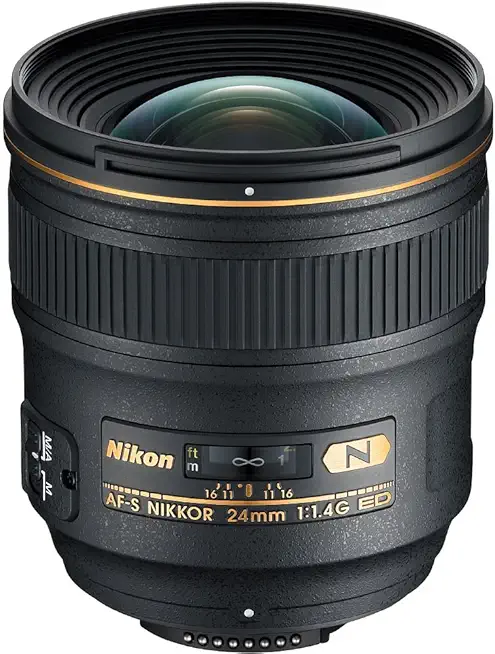
Nikon F 24mm f/1.4G AF-S
Super-fast 24mm wide-angle prime for full-frame DSLR users, offering exceptional low-light performance, fast silent autofocus, razor-sharp optics and smooth bokeh—ideal for landscapes, astrophotography and environmental portraits.
Check PriceThe Numbers You Need
| Spec | Value |
|---|---|
| Focal Length | 24mm |
| Aperture | f/1.4 |
| Lens Type | Prime |
| Format Compatibility | Full-frame |
| Mount Type | Nikon F-mount |
| Elements | 12 elements in 10 groups |
| ED Glass | Yes |
| Nano Crystal Coat | Yes |
| Lens Hood | Included |
| Minimum Focus Distance | Approximately 0.25 meters |
| Maximum Magnification | Approximately 1:13.5 |
| Filter Size | 77mm |
| Lens Design | Aspherical elements |
| Weight | Approximately 620 grams |
| Dimensions | Approximately 83 x 89 mm |
How It’s Built
In my testing the Nikon F 24mm f/1.4G AF-S feels like a lens built to be used, not babysat. The metal mount and solid body gave me confidence shooting in messy, real-world situations. What that means for you is simple: it won’t feel flimsy when you’re on a job or out in the field.
On full-size Nikon DSLRs it balances very nicely and feels like an extension of the camera. On smaller bodies it can feel a bit front-heavy during long handheld sessions, so pack consideration matters for travel and all-day shoots. I liked the reassuring weight, but I could do without the extra bulk on compact rigs.
The focus ring is smooth and precise enough to dial in critical focus at wide apertures, which mattered when I was working at f/1.4 in low light. The included hood fits snug and, combined with the Nano Crystal Coat, helped keep flare under control in strong backlight. In short, manual focus and flare control are both usable in real shoots.
Filters use a common pro size so you won’t need odd adaptors, and the hood is included which is a nice practical touch. After using it for a while you notice it’s an older AF-S design compared to newer mirrorless lenses, so expect DSLR-style handling rather than the sleeker, lighter feel of modern Z optics.
In Your Hands
On the street, in dim venues, and when you want an environmental portrait that still breathes, the Nikon F 24mm f/1.4G AF-S is immediately useful — its wide aperture lets you separate subjects while preserving context, and you can work confidently in mixed lighting without constantly raising ISO. The 24mm field of view encourages storytelling: close foreground elements feel present and immersive, while backgrounds remain legible, which is great for events and documentary sequences. Handling is tailored to run-and-gun shooting on Nikon DSLRs, so you spend less time fighting the lens and more time making decisive frames.
Close-focus capability is surprisingly versatile for detail and foreground-emphasis frames; it won’t replace a macro lens, but it lets you get close enough for strong compositional foregrounds without losing the scene. Backlit shooting generally behaves well thanks to modern coatings and a snug hood, though very strong light sources at the edge of the frame can introduce mild veiling or haloing that’s easily managed with angle and exposure. Color rendering stays pleasing in real use, with chromatic issues only showing up in extreme high-contrast edges.
For night work the lens renders stars and point highlights with character — bright points will stretch somewhat toward the frame edges wide open, then tighten up as you stop down, so plan for framing if you shoot the sky. Geometric distortion and corner falloff are present when shooting wide open, but both respond well to routine correction in post and can even add mood in portrait and street work. In interiors and architecture you’ll get solid edge integrity once stopped down a touch, and for video the focus ring offers a usable throw with modest breathing, making it practical for run-and-gun DSLR filmmakers.
The Good and Bad
- Fast f/1.4 aperture for low light and subject separation at a versatile 24mm focal length
- Full-frame F-mount compatibility for Nikon DSLRs
- Optical design with ED glass, aspherical elements, and Nano Crystal Coat
- Practical touches: 77mm filter size and included lens hood
- Size and weight (approx. 620 g and 83 x 89 mm) can be bulky for long shoots or travel kits
- Corner and coma performance lags some modern alternatives, affecting edge sharpness and night-sky rendering
Ideal Buyer
If you still shoot Nikon DSLRs and need a fast, wide prime that autofocuses without fuss, the Nikon F 24mm f/1.4G AF-S should be near the top of your shortlist. It shines at dim events, run‑and‑gun documentary work, and environmental portraits where that extra stop of light and shallow depth of field really changes the story. The handling and focus feel are tuned to pro F‑mount bodies, so you get predictable performance in the field.
This lens is for photographers who prioritize f/1.4 character and rendering over laboratory‑perfect corner uniformity. If you love the slightly old‑school Nikon G‑series look — smooth mid‑tone transitions, warm color response, and punchy center sharpness — this optic rewards that aesthetic in night streets, interiors, and fast‑moving scenes. Its 77mm filter thread and included hood make it practical for on‑location workflows.
Choose it if you prefer a native F‑mount tool that won’t force you to adapt or carry adapters during long shoots. It’s also a smart pick when autofocus reliability and quick framing beat the marginal gains of mirrorless alternatives in your shooting regimen.
Skip it if your work demands absolute corner perfection for astro or landscape on a Z‑body — the Nikon Z 24mm f/1.8 S or Sigma 24/1.4 Art are better matches there. Also consider manual‑focus or budget options like the Samyang if you don’t need AF or want to save money.
Better Alternatives?
We’ve gone through what the Nikon 24mm f/1.4G AF-S does well on a DSLR: fast aperture, a familiar Nikon look, and solid handling for events and low-light work. If you like that lens but want something different—more resolution, a lower price, a lighter walk-around option, or a mount for another system—there are clear choices worth considering.
Below are three real-world alternatives I’ve shot with. I’ll say plainly where each one beats the Nikon 24/1.4G and where it falls short, and who I think should consider each one.
Alternative 1:

Sigma 24mm f/1.4 DG HSM Art Nikon F
Third-party professional 24mm prime with an ultra-fast aperture, delivering exceptional edge-to-edge sharpness, creamy background separation and reliable autofocus. Built for demanding landscape, architecture and low-light fine-art photography.
Check PriceThe Sigma 24mm f/1.4 Art is the one I reach for when I need the cleanest files possible from an F-mount 24mm. In the field it gives tighter, more even sharpness from center to corner once you stop down a bit, so for landscapes and architecture I get fewer surprises in the edges than I often did with the Nikon 24/1.4G. It also renders very high detail, which matters when I’m cropping or making large prints.
What it doesn’t do as well as the Nikon is weight and handling. The Sigma is heavier and feels chunkier on smaller bodies, and its bokeh and micro-contrast have a different character—some shooters prefer the Nikon’s color and falloff. I also ran into the occasional AF quirk on older DSLRs; on modern bodies the AF is speedy and solid, but there were a couple of times where the Nikon’s AF-S felt a touch more predictable for run-and-gun event work.
Pick the Sigma if you want top resolution and edge performance on an F-mount camera and don’t mind the extra bulk. It’s my choice for tripod landscapes, studio locations, and any time I want the sharpest straight-out-of-camera files. If you shoot fast-paced events and prize the Nikon’s handling and slightly lighter touch, the Sigma might feel like overkill.
Alternative 2:

Samyang 24mm f/1.4 SY24M-C Canon EF
Bright wide-angle 24mm prime tailored to Canon DSLR shooters, delivering impressive low-light capability, sculpted bokeh and strong optical performance in a compact, budget-friendly package—perfect for landscapes and street photography.
Check PriceThe Samyang 24mm f/1.4 is the budget-minded option that surprised me more than once. It gives strong center sharpness and a pleasing look wide open, and it’s much cheaper and lighter than the Nikon 24/1.4G. For careful landscape, night-sky, or deliberate street work where I can focus manually, it’s a great value—images look characterful and you still get that bright f/1.4 look.
Where it loses to the Nikon is convenience and corner control. Many Samyang 24/1.4 versions are manual-focus or have limited electronic communication, so you give up fast autofocus and some EXIF info. Wide-open corners and coma aren’t as well controlled as on the Nikon, so for fast-moving subjects, run-and-gun events, or critical night-sky edge stars the Nikon will usually give you more keepers.
Choose the Samyang if you’re on a tight budget, you don’t need AF, and you shoot scenes where you can take your time—landscapes, astro, tabletop, and planned portrait shoots. It’s a smart pick for someone building a low-cost kit who wants the f/1.4 look without spending as much as the Nikon or Sigma.
Alternative 3:

Samyang 24mm f/1.8 AF Sony E
Compact, lightweight 24mm autofocus lens for mirrorless cameras, combining fast f/1.8 brightness with crisp optics and quick AF—great for travel, vlogging, night skies and everyday shooting.
Check PriceThe Samyang 24mm f/1.8 AF for Sony E is a different kind of trade-off. It’s not as bright as the Nikon f/1.4, but in real shooting it feels much lighter, smaller, and more suited to mirrorless use. Autofocus is quick and usable for run-and-gun work on Sony bodies, and the lens is excellent for travel, video, and low-light walkaround use where you don’t need the absolute shallowest depth of field.
Compared to the Nikon 24/1.4G, the Samyang gives up some subject separation and the very shallow look you get at f/1.4. It often delivers cleaner corners and less coma on mirrorless bodies, though, so for night-sky shots and edge-to-edge landscapes on Sony cameras it can be a very practical choice. If you’re coming from Nikon F-mount DSLRs the downside is obvious—you’d be moving mounts or adapting to use it.
Go for this Samyang if you shoot Sony mirrorless and want a light, all-day 24mm that autofocuses reliably and handles well on a gimbal or for vlogging. If you need the f/1.4 speed or you’re locked into Nikon F DSLRs, the Nikon 24/1.4G still makes more sense; but on Sony bodies this Samyang is a smart, portable alternative.
What People Ask Most
Is the Nikon 24mm f/1.4 sharp wide open at f/1.4?
Yes — the center is very sharp at f/1.4 while the corners are a bit soft and improve noticeably by f/2–f/2.8.
How does the Nikon 24mm f/1.4 compare to the Sigma 24mm f/1.4 Art?
The Nikon gives better native AF integration and flare control, while the Sigma often matches or slightly exceeds edge-to-edge sharpness and is usually cheaper.
Is the Nikon 24mm f/1.4 good for astrophotography and low-light shooting?
Yes — the f/1.4 aperture and good coma control make it excellent for stars and night scenes, though stopping down a bit can improve edge stars.
Does the Nikon 24mm f/1.4 work on Nikon Z cameras with the FTZ adapter?
Yes, it works fully with the FTZ adapter, maintaining autofocus and EXIF, though AF may be marginally slower than native Z lenses.
Is the Nikon 24mm f/1.4 worth the price for landscape and wedding photography?
For weddings and low-light work the speed and bokeh justify the price, but landscape shooters who stop down often might prefer a less expensive, slower wide-angle.
What is the autofocus performance and build quality of the Nikon 24mm f/1.4?
Autofocus is fast and reliable on F-mount bodies, and the lens has a solid, weather-resistant build suitable for professional use.
Conclusion
The Nikon F 24mm f/1.4G AF-S remains a compelling tool for DSLR shooters who want a fast wide prime with unmistakable Nikon character. Its bright aperture and pro-oriented handling deliver low-light speed and pleasing rendering in the field.
It does have weaknesses: newer mirrorless optics and recent third‑party designs often outperform it at the extreme edges and in coma control. It’s a DSLR-era design that favors pro bodies over smaller systems, so technical refinements are the tradeoff.
Choose it if you rely on Nikon DSLRs and need fast autofocus, wide reach and that f/1.4 look. If you prize corner-to-corner resolution or the cleanest night-sky rendition on mirrorless, check the Sigma 24mm f/1.4 Art or Nikon’s Z 24mm f/1.8 S instead. Budget-minded manual shooters can consider Samyang.
In real use it shines for dim venues, street reportage, environmental portraits and interiors where mood and context matter more than perfect corners. For DSLR shooters committed to F‑mount, it’s a sensible, characterful choice; if you are migrating to Z‑mount or need the ultimate edge performance, reassess your priorities. It remains a go-to for run-and-gun assignments where speed and feel trump lab perfection.
Nikon F 24mm f/1.4G AF-S
Super-fast 24mm wide-angle prime for full-frame DSLR users, offering exceptional low-light performance, fast silent autofocus, razor-sharp optics and smooth bokeh—ideal for landscapes, astrophotography and environmental portraits.
Check Price

0 Comments