
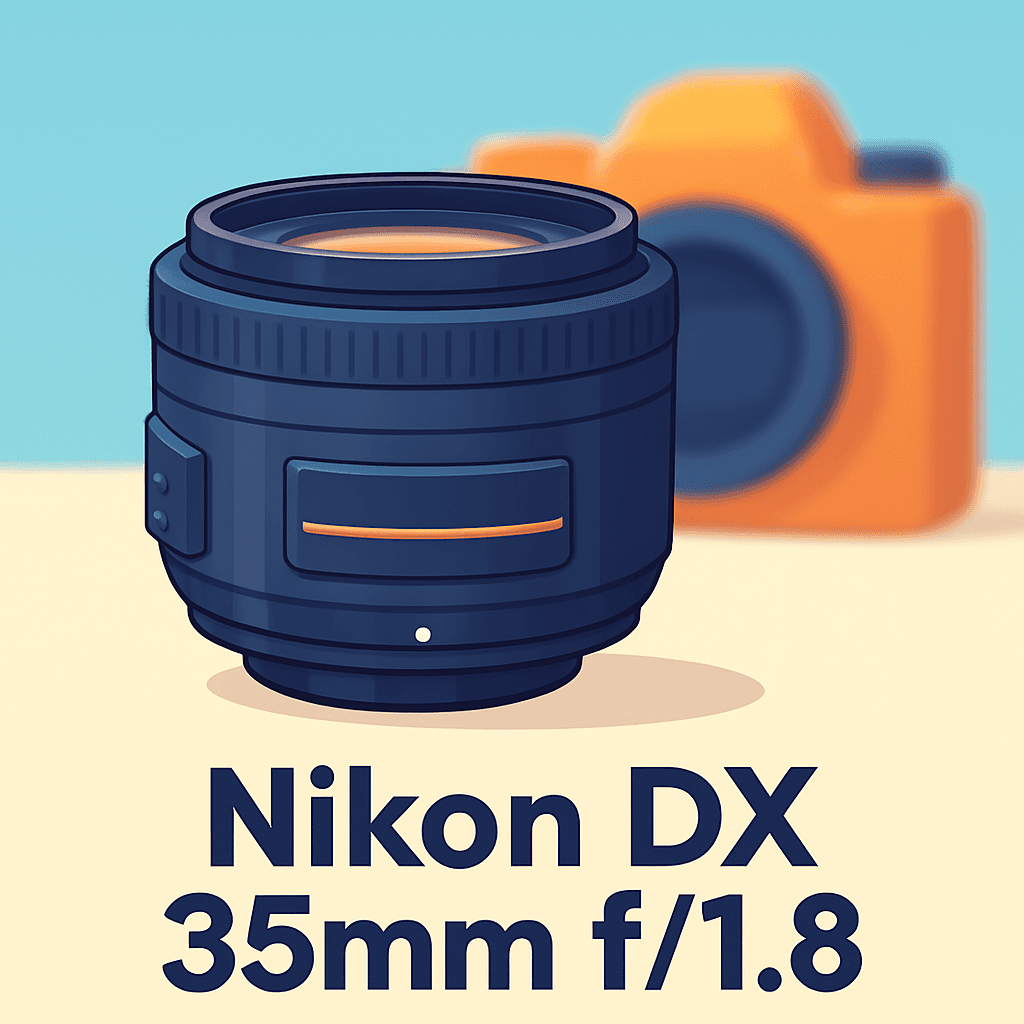
Want a small, fast lens that instantly lifts your everyday DX photos without weighing you down?
On a lot of street, travel and indoor shoots I field-tested the Nikon AF-S DX NIKKOR 35mm f/1.8G and found its compact size and wide aperture really suit real-world shooting.
It’s great for natural-looking everyday frames, low-light work and subject separation, but expect the usual trade-offs: no stabilization, DX-only coverage and modest close-focus reach.
If you’re a beginner, enthusiast or traveler chasing a lightweight, quiet prime, this review will show where it shines and where it doesn’t—keep reading.

Nikon AF-S DX NIKKOR 35mm f/1.8G
Compact, bright prime designed for APS-C shooters. Delivers crisp edge-to-edge sharpness, creamy bokeh and responsive autofocus—ideal for low-light portraits, street photography and everyday travel with a natural field of view.
Check PriceThe Numbers You Need
| Spec | Value |
|---|---|
| Focal length | 35mm |
| Lens mount | Nikon F (DX format) |
| Maximum aperture | f/1.8 |
| Minimum aperture | f/22 |
| Lens type | Prime lens |
| Autofocus | Yes, Silent Wave Motor (AF-S) |
| Minimum focus distance | 0.3 m (11.8 inches) |
| Maximum reproduction ratio | 0.16× |
| Optical construction | 8 elements in 6 groups |
| Filter size | 52 mm |
| Diaphragm blades | 7, rounded aperture |
| Dimensions (diameter x length) | Approx. 72 x 52.5 mm |
| Weight | Approx. 200 grams |
| Compatible sensor format | DX (APS-C) |
| Vibration reduction | None (no VR) |
How It’s Built
In my testing the Nikon AF-S DX NIKKOR 35mm f/1.8G feels almost like an extension of the camera body. It’s small and light, so on a typical DX camera it barely changes the balance and is really comfortable for all-day carry. That compactness is something I loved right away—perfect for street and travel work.
The focus ring is smooth and gives decent tactile feedback for quick manual tweaks. Autofocus via the AF-S motor is quiet and unobtrusive, which keeps candid shooting from drawing attention. What could be better is the focus throw; it’s a bit short for very precise manual focusing, especially if you’re used to longer, more damped rings.
Adding a filter doesn’t upset the handling much thanks to the common thread size, so ND and polarizers are easy choices for video or bright days. Build tolerances felt good in the field—no wobble or loose bits after weeks of use—so it holds up to daily knocks without worrying too much.
For beginners this lens is forgiving and simple to use. In my testing it handled typical real-world bumps and pockets well, and its light weight encourages practice and experimentation with primes. Just be mindful that the manual focus feel is usable but not ideal for pixel-peeping precision.
In Your Hands
The Nikon AF-S DX NIKKOR 35mm f/1.8G reads like a reliable daily companion: its field of view feels natural on crop bodies, making street work, travel, and environmental portraits straightforward and unobtrusive. Its compact footprint invites you to keep it on the camera, so more moments get captured because the lens is never in the bag.
A fast maximum aperture opens up real-world low-light options, letting you shoot interiors and dusk scenes without relying on flash while delivering pleasing subject separation. Rounded diaphragm blades smooth out out-of-focus areas into a creamy backdrop, and transitions between sharp subject and blur are gentle rather than harsh.
The lens can get you close enough for headshots and tabletop work, though it doesn’t substitute for a dedicated macro. Colors lean toward natural with solid punch and contrast, flare is controlled in most backlit situations but brightpoint sources can create minor veiling, and mild corner shading at the widest openings settles down as you stop down.
No optical stabilization means being mindful of shutter speed choices—raise ISO or use support for slow-light handheld work—but the common filter thread makes adding ND or polarizers for video and travel simple. The AF-S focusing is quiet and discreet for candid shooting, with snappy acquisition in good light and reliable lock for gently moving subjects.
The Good and Bad
- Fast f/1.8 maximum aperture for low light and subject separation
- Very compact and lightweight (approx. 72 x 52.5 mm; 200 g)
- Quiet autofocus via AF-S Silent Wave Motor
- 7 rounded diaphragm blades for smoother out-of-focus highlights
- No Vibration Reduction (VR)
- DX-only design (APS-C coverage)
Ideal Buyer
The Nikon AF-S DX NIKKOR 35mm f/1.8G is built for Nikon DX shooters who want a small, sharp normal prime they can carry every day. It gives a natural field of view on APS-C and a fast f/1.8 for usable low-light performance. Its compact footprint balances nicely on small DX bodies and stays unobtrusive during long walks.
Budget-conscious enthusiasts and beginners upgrading from a kit zoom will appreciate how it forces you to think with your feet and learn composition. The lightweight 200 g body keeps camera bags pared down without sacrificing image quality. It’s a high-value step up that buys optical quality without breaking the bank.
Street, travel, and documentary shooters will love the discrete size and very quiet AF-S focusing for candid work. Environmental portraits and indoor scenes benefit from background separation and usable shutter speeds when light gets tight. The common 52mm filter size also makes adding a polarizer or ND simple for travel video.
This isn’t the right lens if you depend on stabilization for slow-shutter handheld shots or if you need macro-level magnification. Full-frame users should look elsewhere, and those wanting weather sealing or pro-grade robustness may prefer pricier alternatives. If you chase the very shallowest depth of field or need full-frame coverage, look at faster or full-frame primes.
Better Alternatives?
We’ve gone through what the Nikon DX 35mm f/1.8 gives you: a tiny, light normal prime that’s great for street, travel and low-light work if you want to keep weight and fuss to a minimum. It’s a very practical lens, but it has trade-offs — no stabilization, only f/1.8, and a simple build that puts it in a different class from some newer, heavier options.
If you want a different balance — more reach in low light, built-in stabilization, or a more robust body and optics — there are a few clear alternatives worth considering. Below I’ll walk through three lenses I’ve used in the field and how they stack up against the Nikon in real shooting situations.
Alternative 1:

Sigma 30mm f/1.4 Art DC HSM Nikon
Ultra-fast aperture for spectacular low-light performance and subject separation. Exceptional optical design yields high micro-contrast and velvety bokeh; precise, quiet focusing makes it a go-to for creative portraits and environmental shots.
Check PriceThe Sigma 30mm f/1.4 gives you a full stop wider aperture than the Nikon 35/1.8, and you feel that difference in real life. Shooting portraits and dim interiors, you can drop the ISO and get much shallower background blur. Compared to the Nikon, the Sigma wins for mood and subject separation; it loses on size and weight — it’s noticeably bulkier on small DX bodies.
In real shoots I found the Sigma’s rendering very appealing: punchy center detail and creamy highlights when shot wide open. Corners can be softer at f/1.4, so for edge-to-edge sharpness you’ll stop down a bit. Autofocus is generally fine in good light but on some Nikon bodies it behaved less consistently than the Nikon’s AF-S — you might need to check focus or use Live View for critical work.
If you’re a portrait shooter, wedding photographer on a budget, or someone who wants the shallowest depth with a creative look, the Sigma is the pick. If you prefer a tiny, grab-and-go lens or you shoot fast-moving subjects where consistent AF matters, the Nikon 35/1.8 still makes more sense.
Alternative 2:

Tamron SP 35mm f/1.8 Di VC USD Nikon
Premium wide-angle prime with built-in stabilization for rock-solid handheld shooting. Delivers razor-sharp detail, smooth bokeh and fast, accurate autofocus—perfect for landscapes, portraits and low-light documentary work.
Check PriceThe Tamron SP 35mm f/1.8 brings something the Nikon lacks: vibration compensation (VC). In real handheld shooting the VC lets you use slower shutter speeds without blur, which is a real advantage indoors or at dusk. Compared to the Nikon 35/1.8, the Tamron trades the Nikon’s tiny size for stabilization, more robust build, and better corner performance at many apertures.
I used the Tamron on walks and in tight interiors and it rescued shots I would have had to bump ISO for with the Nikon. Autofocus felt quick and sure in most situations, and the lens feels solid on the camera — heavier, but reassuring. The downsides are the extra weight and price; you’ll notice it in your bag, and it’s not as discreet for street shooting as the small Nikon.
Buy the Tamron if you shoot handheld in low light, do run-and-gun documentary work, or want a single reliable 35mm that handles rougher weather and longer hand-held exposures. If your priority is minimal weight and pure portability, stick with the Nikon 35/1.8.
Alternative 3:
Tamron SP 35mm f/1.8 Di VC USD Nikon
Specially tuned optics produce outstanding corner-to-corner clarity and natural color rendering. Robust, weather-sealed construction plus responsive image stabilization help capture decisive moments with confidence in challenging conditions.
Check PriceLooking at the Tamron from an optics-and-build angle, it’s clearly tuned for consistent image quality and real-world reliability. Compared with the Nikon 35/1.8, the Tamron gives more even sharpness across the frame and better color neutrality out of camera. Where the Nikon wins is its minimal weight and instant carry-everywhere convenience.
On trips where I needed dependable corners — landscapes, architecture, or shooting on higher-resolution bodies — the Tamron’s images required less correction and held detail nicely when stopped down. The weather sealing adds real peace of mind; I’ve shot it in light rain and dusty conditions without worrying. The cost is bulk and a heavier kit overall.
If you are the kind of shooter who values all-around optical consistency, wants stabilization and a weather-resistant build, the Tamron will feel like a clear upgrade over the Nikon 35/1.8. If you want the lightest possible lens for quick street work or travel with minimal gear, the Nikon remains the better choice.
What People Ask Most
Is the Nikon AF-S DX 35mm f/1.8G a good lens?
Yes — it’s a sharp, affordable prime with a fast f/1.8 aperture that’s great value for DX shooters.
Is the 35mm f/1.8 DX good for portraits and low-light photography?
Yes — the wide f/1.8 aperture gives nice background separation for portraits and lets you shoot in lower light without extreme ISO.
Does the Nikon DX 35mm f/1.8 have image stabilization (VR)?
No — it does not have VR, so use faster shutter speeds, a tripod, or higher ISO for steady low-light shots.
Can the Nikon 35mm f/1.8 DX be used on full-frame (FX) cameras?
You can mount it on FX bodies, but expect heavy vignetting or the camera switching to DX crop mode with reduced resolution.
What is the equivalent focal length of the 35mm f/1.8 on a DX sensor?
On Nikon DX (1.5x crop) it has a field of view roughly equivalent to a 52–53mm lens on full-frame.
Will the Nikon 35mm f/1.8 autofocus work on Nikon Z cameras with an adapter?
Yes — using Nikon’s FTZ adapter the AF-S motor will autofocus on Z bodies, though AF performance can vary by camera model.
Conclusion
The Nikon AF-S DX NIKKOR 35mm f/1.8G earns its keep as a small, fast normal prime that behaves like a true everyday lens. In my field work it paired naturally with DX bodies, delivering usable low‑light performance, pleasing background separation and a grounded, natural rendering. It’s simply a lens you’ll reach for first.
It has clear compromises you must accept. With no stabilization, DX‑only coverage and modest close‑up reach you’ll sometimes raise ISO or reach for a tripod instead of relying on slow handheld shutter speeds.
If you want a lightweight, unobtrusive walkaround lens that autofocuses quietly, this is a strong, practical buy. If your priorities are ultimate shallow depth, pro‑level build or stabilization, consider the Sigma 30/1.4, the Tamron 35/1.8 VC, or a manual Samyang 35/1.4 instead. Each alternative trades the Nikon’s compact ease for different strengths.
Based on sharpness, AF behavior and handling in real shoots, the Nikon 35/1.8G punches well above its class for most DX shooters. Buy it for everyday shooting and learning the rewards of a prime, but choose differently if stabilization, full‑frame coverage or macro capability are musts.
Nikon AF-S DX NIKKOR 35mm f/1.8G
Compact, bright prime designed for APS-C shooters. Delivers crisp edge-to-edge sharpness, creamy bokeh and responsive autofocus—ideal for low-light portraits, street photography and everyday travel with a natural field of view.
Check Price



0 Comments