
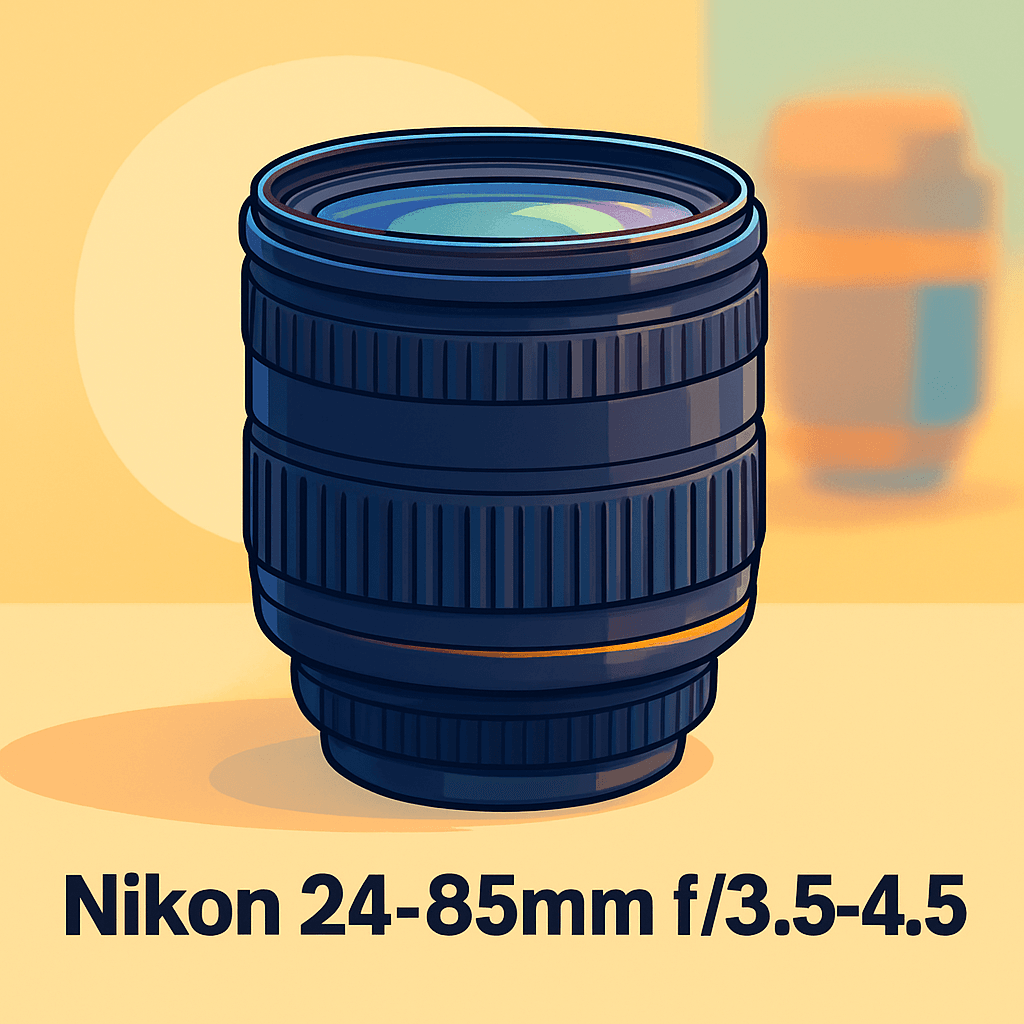
Want one lens to cover most day-to-day shooting without weighing you down?
The Nikon FX 24-85mm f/3.5-4.5G Nikkor is Nikon’s compact full-frame standard zoom that aims to do exactly that.
I’ve taken it into the field on several shoots. You’ll get straight-up, real-world impressions rather than spec sheets.
This one’s for Nikon full-frame shooters who want a light walkaround zoom — practical versatility, quiet AF, and close-focus flexibility over a fast constant aperture.
There are trade-offs, like no built-in stabilization and a variable aperture, but the everyday payoff can be big — make sure to read the entire review as you keep reading.

Nikon FX 24-85mm f/3.5-4.5G Nikkor
Versatile standard zoom for full-frame shooters, delivering sharp optics from wide-angle to short telephoto. Compact, lightweight design ideal for travel, portraits, and everyday shooting with reliable autofocus performance.
Check PriceThe Numbers You Need
| Spec | Value |
|---|---|
| Focal Length | 24-85mm |
| Aperture | f/3.5-4.5 |
| Lens Type | Standard Zoom |
| Format | Full-frame (FX) |
| Mount | Nikon F-mount |
| Stabilization | None |
| Auto Focus | AF-S (SWM) |
| Elements/Groups | 16/11 |
| ED Glass | Yes |
| IF Design | Yes |
| Minimum Focus Distance | 1.2 ft (0.38 m) |
| Maximum Magnification | 1:4 (0.25x) |
| Filter Size | 72mm |
| Diameter | 3.9 in (99 mm) |
| Weight | 16.4 oz (465 g) |
How It’s Built
In my testing the Nikon FX 24-85mm f/3.5-4.5G Nikkor felt compact and nicely balanced on full-frame bodies. It’s small enough for travel and won’t pull on your shoulder after a long day shooting.
Build-wise it’s solid with internal focusing, so the front element doesn’t extend or spin during use. The AF-S motor is quiet and unobtrusive, and the ED glass helps keep colors looking natural in real shots.
Zoom and focus rings are easy to work with; the zoom has just the right resistance for quick framing. The focus ring has a short, slightly damped throw, so you can make quick tweaks but it’s not ideal for ultra-smooth video focus pulls.
Because the front element doesn’t rotate, polarizers and other filters behave predictably, which is handy out in the field. One thing I really liked was how lightweight and grab-and-go this lens is, and one thing that could be better is the lack of image stabilization, so you’ll need to brace, raise ISO, or use a tripod more often.
For beginners that means an easy-to-handle lens that teaches good shooting habits, but be mindful of shutter speed when handholding. After using it for a while I found it a friendly everyday zoom that’s simple to live with.
In Your Hands
The focal sweep here covers everything from a roomy wide perspective for landscapes and interiors, through the classic standard range for street and everyday work, to a short tele that lets you tighten composition without changing your footing. That versatility makes it a true grab-and-go lens when you need to travel light and react quickly.
Because the aperture opens and closes as you zoom, exposure and depth-of-field shift subtly while composing, so I often compensate with shutter speed or ISO as I reframe. With no built‑in stabilization, handheld shooting benefits from bracing, faster shutter speeds, or bumping ISO to preserve crisp results at the long end.
The lens gets surprisingly close for product, food, and detail shots, letting you isolate subjects and render backgrounds pleasantly out of focus at longer focal positions. Internal focusing keeps the front element from turning, so polarizers behave predictably and close-focus workflows stay unhindered.
Rendering is balanced and natural — colors lean neutral with good midtone contrast straight out of camera, though strong backlight can soften microcontrast and invite mild flare. Corners are a bit friendlier when you stop down, centers remain reliable across the range, and focus breathing is present but not intrusive for most run‑and‑gun video.
In the field it packs small and light for day-long hauls and fits easily in a travel setup, making it a dependable all-day companion. Use a single polarizer when needed and avoid stacking heavy filters on wide compositions to minimize corner shading.
The Good and Bad
- Lightweight and compact for an FX standard zoom (465 g; 99 mm diameter)
- Versatile 24–85 mm range for everyday shooting
- AF-S with internal focusing; quiet operation and non-rotating front element
- Close focus to 0.38 m with 0.25× magnification
- No VR — limits handheld low-light shutter speeds
- Variable aperture f/3.5–4.5 — less consistent exposure and depth-of-field control across the zoom
Ideal Buyer
If you shoot Nikon full-frame and want a true grab-and-go lens, the Nikon FX 24-85mm f/3.5-4.5G Nikkor is built for you. It’s a compact, balanced standard zoom that covers everyday framing from 24 to 85mm. Weight and size make it friendly for long walks and travel.
Choose this lens if you prioritize portability and practical versatility over a fast constant aperture. Daylight shooters, street photographers, and travelers who shoot a lot handheld will appreciate its range and manageable footprint. It’s an easy one-lens solution for general-purpose work.
Buy it if you’re comfortable managing camera motion with technique, a tripod, or higher ISO, since it lacks VR. You’ll still get AF-S silent focusing, internal focusing that keeps filters steady, and a close focus of 0.38 m with useful 0.25× magnification. The common 72mm filter size is a practical bonus.
Skip this lens if you routinely need low-light stabilization or a constant aperture for subject isolation. Professionals and event shooters who require VR or consistently shallow depth of field will want to look at VR or constant-aperture alternatives. For everyday Nikon FX users on the move, though, it’s a smart, light choice.
Better Alternatives?
We’ve already gone through what the Nikon 24–85mm f/3.5–4.5 brings to the table: a light, compact FX walkaround zoom that’s easy to carry and handles well on Nikon full‑frame bodies. It’s a good everyday lens if you don’t need stabilization or a constant aperture and you’re happy to work with slightly higher shutter speeds or ISO when light gets low.
If you find yourself wanting a bit more keepers in low light, more reach, or a lens that behaves the same across the whole zoom range, there are a few clear alternatives. Below I list the ones I’ve used and tell you what they do better or worse than the non‑VR 24–85, and which kind of shooter each one suits.
Alternative 1:

Nikon FX 24-85mm f/3.5-4.5G AF-S VR Nikkor
All-in-one travel zoom featuring vibration reduction and a quiet AF motor for steady handheld shooting. Smooth focal range covers landscapes to portraits with improved low-light stability and crisp rendering.
Check PriceI’ve shot with the VR version of the 24–85 a lot, and the main difference you notice in the field is steadier handheld shots. The image stabilization really helps when I’m squeezing the shutter at slower speeds or when I’m on a walk and don’t want to boost ISO every time the light drops. Optically it feels very close to the non‑VR version—same color and contrast, same focal range—so you’re getting the same look but with more usable frames in low light.
The trade‑off is weight and a touch more bulk. The VR model sits a bit heavier on the camera and you’ll feel it if you carry it all day. It doesn’t give you more reach or a faster aperture, so it won’t replace a fast prime or a longer zoom, but for day trips and family shoots where keeping shots sharp matters more than squeezing every last ounce of portability, it’s a better fit than the non‑VR 24–85.
If you’re someone who wants the same easy focal range but finds yourself often shooting indoors or at dusk without a tripod, this VR 24–85 is the sensible upgrade. If you prize the absolute lightest carry or already use a tripod/very high ISO, you might stick with the non‑VR for the weight savings.
Alternative 2:

Nikon FX 24-120mm f/4G AF-S VR Nikkor
Constant f/4 walkaround zoom offering extended reach, image stabilization, and fast silent autofocus. Excellent for events, travel, and documentary work where consistent exposure and dependable sharpness matter.
Check PriceThe 24–120mm f/4 is one I reach for when I need more reach and consistent exposure across the zoom. In real use the constant f/4 makes life simpler when lighting changes—no need to rethink exposure as you zoom—and the VR means more keepers at the long end. On weddings and travel days I found I could get tighter portraits and distant scenes without changing lenses, which is a big convenience over the 24–85.
Expect it to be noticeably bigger and heavier than the 24–85. That extra reach and the constant aperture come with size and weight, and it’s more of a “serious walkaround” than a pocketable one. Optically it often feels a hair sharper at longer focal lengths compared to the 24–85, and the AF behavior is solid in real shooting—reliable and quiet—so it’s a good step up if you want one lens to cover most situations.
This lens is for shooters who want versatility and consistency: event photographers, travel shooters who want reach for portraits and details, or anyone who dislikes changing lenses mid‑day. If you care most about keeping weight down for long hikes or minimalist travel, the 24–85 will still be the better choice.
Alternative 3:
Nikon FX 24-120mm f/4G AF-S VR Nikkor
Professional full-frame zoom combining wide-to-tele coverage with effective stabilization and dependable AF-S focusing. Built for photographers who demand consistent sharpness, quick handling, and versatile performance in varied lighting.
Check PriceComing at the same 24–120mm from a pro angle, this lens feels built for longer, tougher days. The handling is nicer on larger bodies and the finish feels a bit more solid than the small 24–85. In real shoots I appreciated the stable focus and consistent sharpness from wide to tele; it’s the kind of lens you can hand to a second shooter and expect predictable results, something the lighter 24–85 can’t always match under heavy use.
What you give up is compactness and absolute lightness. Compared to the 24–85, you’ll notice shoulder fatigue sooner and it takes up more room in your bag. It’s also pricier. But for pros who need one reliable lens that covers most assignments and who want stabilization and a steady aperture, that trade‑off is worth it more often than not.
Choose this version if you’re a working photographer or an enthusiast who wants a single, do‑everything lens with pro feel and consistent results. If your priority is the smallest, lightest everyday zoom and you can live without VR and a constant aperture, the original 24–85 remains the better grab‑and‑go option.
What People Ask Most
Is the Nikon 24-85mm f/3.5-4.5 a full-frame (FX) lens or for crop (DX) cameras?
It’s designed for full-frame (FX) cameras and will also work on DX bodies with the usual crop factor applied.
Is the Nikon 24-85mm f/3.5-4.5 a good lens for general photography and portraits?
Yes — it’s a useful, versatile walkaround zoom for general shooting and casual portraits, but the f/3.5-4.5 aperture limits low-light performance and creamy background blur compared with faster lenses.
Does the Nikon 24-85mm f/3.5-4.5 have vibration reduction (VR) or image stabilization?
Many older 24-85 f/3.5-4.5 versions do not have VR; some later AF-S variants added VR, so check the exact model before buying.
How sharp is the Nikon 24-85mm f/3.5-4.5 across the zoom range?
Center sharpness is decent stopped down, but it’s softer wide-open and the corners can be weak at both 24mm and 85mm compared with higher-end zooms.
What is the filter thread size and weight of the Nikon 24-85mm f/3.5-4.5?
It commonly uses a 72mm filter thread and typically weighs around 400–500 grams depending on the specific version.
Is the Nikon 24-85mm f/3.5-4.5 worth buying used or is it discontinued?
Many versions are discontinued and available used; they’re a good budget pick if you’re okay with some optical compromises and no fast aperture or advanced features.
Conclusion
The Nikon FX 24-85mm f/3.5-4.5G Nikkor is a clear-minded pick for photographers who want an unobtrusive, do-it-all full-frame zoom that stays out of the way. It pairs a sensible everyday range with quiet AF and internal focusing, and its optical tweaks keep color and contrast engaging without calling attention to themselves. For travel, street, and family work it strikes the right balance between capability and carry comfort.
But it’s not without compromise: there’s no built-in stabilization and the aperture changes as you zoom, so low‑light shooting and deliberate background separation demand either higher ISO, faster shutter speeds, or a tripod. If you prize steadiness in hand or need a constant, faster aperture, look toward the VR and constant‑aperture zooms that trade compactness for performance. For shooters who accept those trade‑offs, this lens rewards with dependable handling and usable image quality.
Bottom line: choose the 24–85 if you want a lightweight, versatile walkaround that emphasizes portability and practical optics. If stabilization or a constant aperture are non‑negotiable, opt for the VR 24–85, the longer 24–120/4 VR, or a constant‑f/4 third‑party alternative instead.
Nikon FX 24-85mm f/3.5-4.5G Nikkor
Versatile standard zoom for full-frame shooters, delivering sharp optics from wide-angle to short telephoto. Compact, lightweight design ideal for travel, portraits, and everyday shooting with reliable autofocus performance.
Check Price



0 Comments