
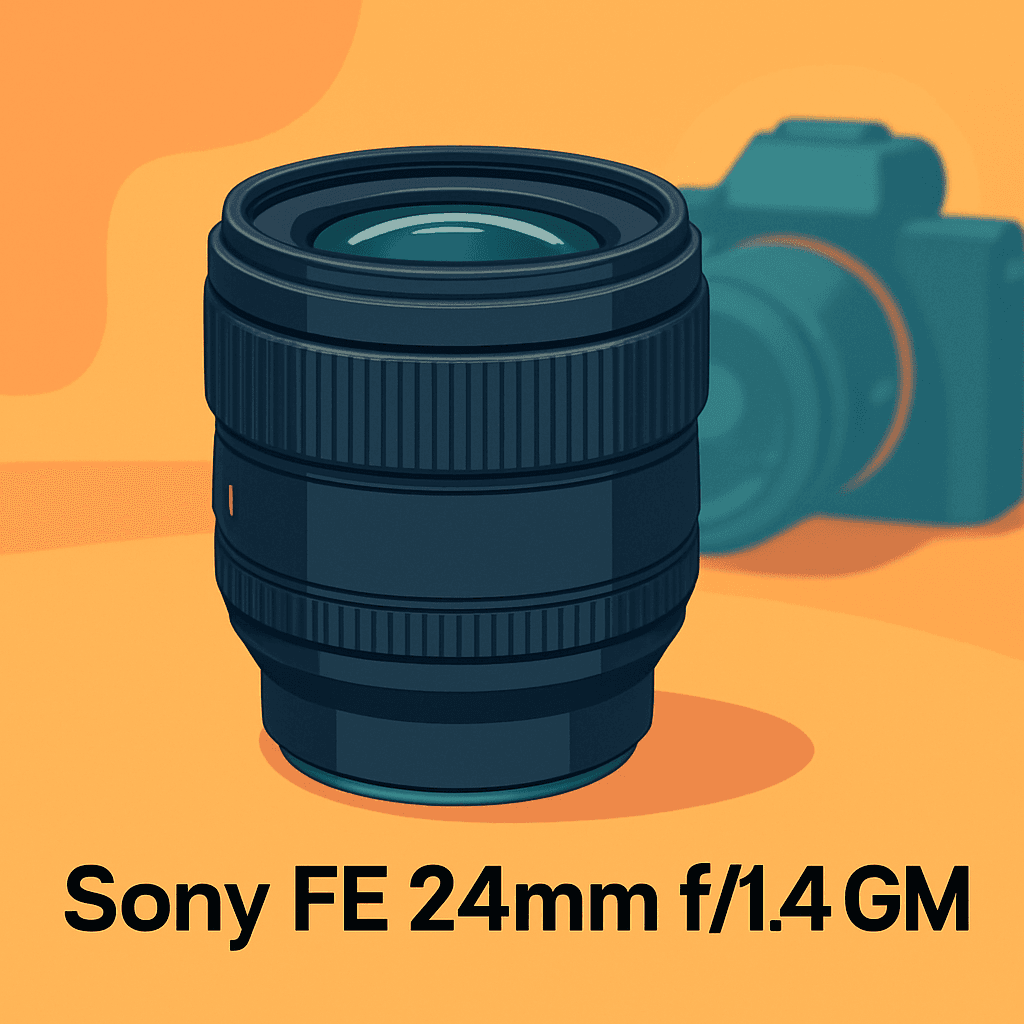
Want to know if the Sony FE 24mm f/1.4 GM will upgrade your wide-angle work?
I tested it in city nights, landscapes, and environmental portraits to see how it behaves in real shoots.
If you shoot full-frame Sony, you’ll care about low-light reach, subject separation at 24mm, and versatility for landscapes or portraits.
I’ll evaluate handling, sharpness, autofocus, and flare in everyday conditions — make sure to read the entire review as I break down whether it’s worth the investment; keep reading.

Sony FE 24mm f/1.4 GM
Professional-grade wide-angle prime delivering edge-to-edge sharpness, silky bokeh, and superb low-light performance. Rugged, weather-resistant construction and lightning-fast autofocus make it ideal for landscapes, astrophotography, and portraits.
Check PriceThe Numbers You Need
| Spec | Value |
|---|---|
| Lens Mount | Sony E-mount (FE full-frame) |
| Focal Length | 24mm |
| Maximum Aperture | f/1.4 |
| Lens Type | Wide-angle prime |
| Format Compatibility | Full-frame |
| Optical Design | 13 elements in 10 groups |
| Aperture Blades | 11 (rounded) |
| Minimum Focus Distance | 0.24 m (9.45 in) |
| Maximum Magnification Ratio | Approximately 0.17x |
| Autofocus | Yes, with linear motor |
| Image Stabilization | No (relies on camera body stabilization) |
| Filter Size | 77mm |
| Dimensions (Diameter x Length) | Approx. 78 x 97.5 mm |
| Weight | Approx. 445 g |
| Special Features | Nano AR Coating II; ED glass elements; XA element for high resolution and bokeh quality |
How It’s Built
In my testing the Sony FE 24mm f/1.4 GM feels like a proper pro lens in the hand. It sits nicely on Sony full-frame bodies and strikes a confident balance that makes handheld shooting comfortable for long stretches. The focus and control rings are smooth and predictable, which I appreciated during fast shoots.
The build comes across as solid without being bulky, and I noticed weather sealing where it counts when I used it in damp conditions. What I liked most was that reassuring, well-built feel—like it can handle a real day of work. One thing that could be better is the lack of in-lens stabilization, which means you’ll depend on your camera’s stabilization or faster shutter speeds in low light.
Filter use is easy because the front accepts common filter sizes, so adding an ND or polarizer is straightforward for landscapes and video. I tested harsh backlight and bright suns; the special coatings and glass mostly keep flare and ghosting under control, though extremely strong sources can still create subtle artifacts.
For beginners this is simple to live with: it’s easy to carry, easy to focus, and gives predictable results. After using it for a while I found it reliable for walkaround work, but remember to plan for stabilization in very slow-light situations.
In Your Hands
With its fast aperture this lens excels in low light, making dim interiors and evening streets usable. You can push exposures and still retain usable shadow detail without harsh noise. Highlights stay controlled, so color and texture hold up in tough light.
At this focal length the lens delivers surprising subject separation, letting you isolate people while keeping the scene. Transitions from sharp to soft are smooth thanks to the optical design and rounded aperture. Bokeh is creamy in midtones and behaves predictably.
In backlit scenes the Nano AR coating keeps contrast high and tames most veiling flare. I noted occasional starbursts from intense points but no distracting ghosting. Overall color and micro-contrast are pleasing and lift textures.
Stopped down, landscapes and architecture gain clear corners; wide open the edges are softer but usable for many frames. Field curvature is modest and easy to work around in typical compositions. Close environmental shots and food/detail work resolve very well without being a macro lens.
The barrel balances nicely on modern Sony bodies, comfortable for handheld walks and gimbal use over long sessions. Because the lens lacks optical stabilization you’ll depend on in-body systems for the slow-shutter handheld work I often do.
The Good and Bad
- Very fast maximum aperture for low light and subject separation at wide angle
- Rounded aperture blades contributing to smooth bokeh
- XA element and ED glass for high resolution and refined rendering
- Advanced Nano AR coating to reduce flare and improve contrast
- No optical image stabilization and relies on in-body stabilization
- Physical size and weight to consider for long carry or compact kits
Ideal Buyer
If you own a full-frame Sony E-mount body and crave a fast wide-angle prime, the Sony FE 24mm f/1.4 GM is aimed at you. It blends a bright f/1.4, creamy rendering and pro-grade optics in a surprisingly manageable package.
Event and documentary shooters will love the low-light reach and shallow depth-of-field at 24mm. Environmental portraitists can isolate subjects while keeping context. Street photographers working at dusk or under mixed lighting will find its speed forgiving and flexible.
Landscape and travel photographers who demand high resolution and controlled flare will appreciate the XA/ED elements and Nano AR coatings. Astro and night shooters seeking a bright, wide field will find the focal length compelling, though careful field testing for coma and corner performance is wise. Wider scenes gain micro-contrast and detail when stopped down.
Hybrid creators switching between stills and video benefit from dependable linear-motor AF and a 77mm filter thread that makes ND and polarizers easy to use. Its weight and balance sit nicely on A7/A9 bodies for handheld and gimbal work. Keep in mind it relies on in-body stabilization rather than built-in OSS.
This lens is less compelling if you need built-in stabilization or true macro magnification. If absolute compactness or the lowest price is your priority, consider other 24mm options instead of the Sony FE 24mm f/1.4 GM.
Better Alternatives?
We’ve already dug into what makes the Sony FE 24mm f/1.4 GM a strong choice: fast aperture, lovely rendering, and very sharp results. But no single lens fits every photographer’s needs, so it helps to look at other lenses that trade one thing for another—price, size, or a slightly different image character.
Below are a few real-world alternatives I’ve used in the field. I’ll point out where each one beats the Sony, where it falls short, and the kind of shooter who’ll get the most from it.
Alternative 1:

Sigma 24mm f/1.4 Art DG DN Sony E
Renowned Art-series optics produce exceptional resolution, micro-contrast, and smooth background separation. Precision metal build, close focusing, and quiet, accurate autofocus deliver pro-level results for studio, street, and night-sky shooters.
Check PriceThe Sigma 24mm f/1.4 Art feels like the closest rival to the Sony in everyday shooting. In my hands it gives almost the same center sharpness wide open and cleans up at the edges quickly when you stop down. Where it really wins is value—you get that strong resolution and pleasing background separation for a lot less money than the GM.
What it doesn’t do as well as the Sony is the last bit of micro-contrast and the very smoothest bokeh transitions. In high-contrast backlit scenes I noticed a touch more flare and slightly different highlight rendering than the GM, and the Sigma is a bit heavier and chunkier on a small body.
If you want near-GM image quality without the GM price, the Sigma is your pick. It’s great for landscape, night sky, and event shooters who want strong sharpness and reliable autofocus but don’t need the absolute top-end Sony look or the lightest carry weight.
Alternative 2:
Sigma 24mm f/1.4 Art DG DN Sony E
High-value wide prime offering striking center-to-corner clarity and controlled chromatic aberration for demanding scenes. Compact yet solidly built, it balances fast performance and an affordable price for travel and landscape work.
Check PriceUsed on a few shoots, the Sigma also showed strong control of chromatic aberration and very usable corners when stopped a bit—so for landscape or architecture it’s a real workhorse. Its autofocus felt accurate and quiet for stills and video; I rarely had to hunt for focus in normal light.
Compared to the Sony GM you’ll give up a slightly finer rendering in tricky lighting and the ultimate creamy character in out-of-focus areas. The Sigma is solid, but if you demand the absolute smoothest highlight roll-off or the smallest, most subtle differences in contrast, the GM still has the edge.
Pick the Sigma 24/1.4 if you shoot a lot but don’t want to stretch your budget—wedding second-shooters, landscape photographers on a budget, or anyone who wants high resolution without carrying the premium price tag. It’s also a good choice if you don’t mind a little extra weight for better value.
Alternative 3:

Samyang 24mm f/1.8 AF Sony E
Compact, lightweight wide-angle with quick autofocus and impressive sharpness for its price. Bright aperture and minimal distortion make it a travel-friendly choice for street, landscape, and low-light photography.
Check PriceThe Samyang 24mm f/1.8 is a very different trade: smaller, lighter, and much cheaper. In the field I liked how easy it was to carry all day—on a hike or city walk it made the kit feel almost invisible. Center sharpness is good for the price, and autofocus is quick enough for casual shooting and run-and-gun video.
Where it falls short against the Sony GM is obvious: the slower f/1.8 aperture gives you less low-light reach and less subject separation, and corners and micro-contrast aren’t as strong, especially wide open. I also saw more color fringing and a bit more coma on bright points at the edges when shooting stars or harsh backlights.
Choose the Samyang if you want a compact, budget-friendly wide prime for travel, street, or casual low-light work. It’s perfect for photographers who care more about weight and cost than squeezing every last stop of light or getting the silkier bokeh and micro-contrast that the Sony delivers.
What People Ask Most
How sharp is the Sony FE 24mm f/1.4 GM?
Extremely sharp in the center even at f/1.4, with edges improving by f/2–f/2.8 and peak overall sharpness around f/4.
Is the Sony FE 24mm f/1.4 GM good for astrophotography?
Yes — the f/1.4 aperture and excellent coma control make it a very strong choice for stars and the Milky Way.
Is the Sony FE 24mm f/1.4 GM weather-sealed?
Yes, it has dust- and moisture-resistant sealing, but it’s not fully waterproof or submersible.
How does the Sony FE 24mm f/1.4 GM compare to the Sigma 24mm f/1.4 DG DN?
The Sony generally edges the Sigma on autofocus, build quality and flare control, while the Sigma delivers nearly comparable sharpness at a lower price.
Is the Sony FE 24mm f/1.4 GM worth the price?
Yes if you want top-tier optics, fast AF and professional build; if you’re budget-conscious, the Sigma is a very compelling alternative.
Does the Sony FE 24mm f/1.4 GM have fast and reliable autofocus?
Yes — autofocus is fast, accurate and quiet on Sony bodies, making it excellent for stills and usable for video tracking.
Conclusion
After weeks of shooting stills and video, the Sony FE 24mm f/1.4 GM stands out as a purposeful, professional optic: its bright aperture and glass design deliver the kind of subject separation, micro-contrast and creamy out-of-focus transitions that justify the GM badge. Autofocus driven by a linear motor is quick, quiet and dependable for both handheld photography and hybrid video work. The trade-offs are clear and tangible — a substantial physical presence for long carries and reliance on in-body stabilization rather than built-in OSS — plus the practical need for large front filters when you want control over polarizers or NDs.
If you prioritize ultimate low-light reach, editorial landscapes, environmental portraits or astro work and you shoot on Sony full-frame bodies, this lens is a top-tier choice. If budget, pack weight or a slightly different image character matter more, the Sigma option offers exceptional value, the Samyang serves travelers and casual shooters, and the Zeiss Batis favours compactness and distinctive micro-contrast.
My verdict: for photographers who demand fast wide-angle performance and the finest rendering from a 24mm perspective, the Sony FE 24mm f/1.4 GM earns a clear recommendation. For those balancing cost, carry or built-in stabilization, look to the alternatives; but if image quality and reliable AF are non-negotiable, this lens is worth the investment.
Sony FE 24mm f/1.4 GM
Professional-grade wide-angle prime delivering edge-to-edge sharpness, silky bokeh, and superb low-light performance. Rugged, weather-resistant construction and lightning-fast autofocus make it ideal for landscapes, astrophotography, and portraits.
Check Price


0 Comments