
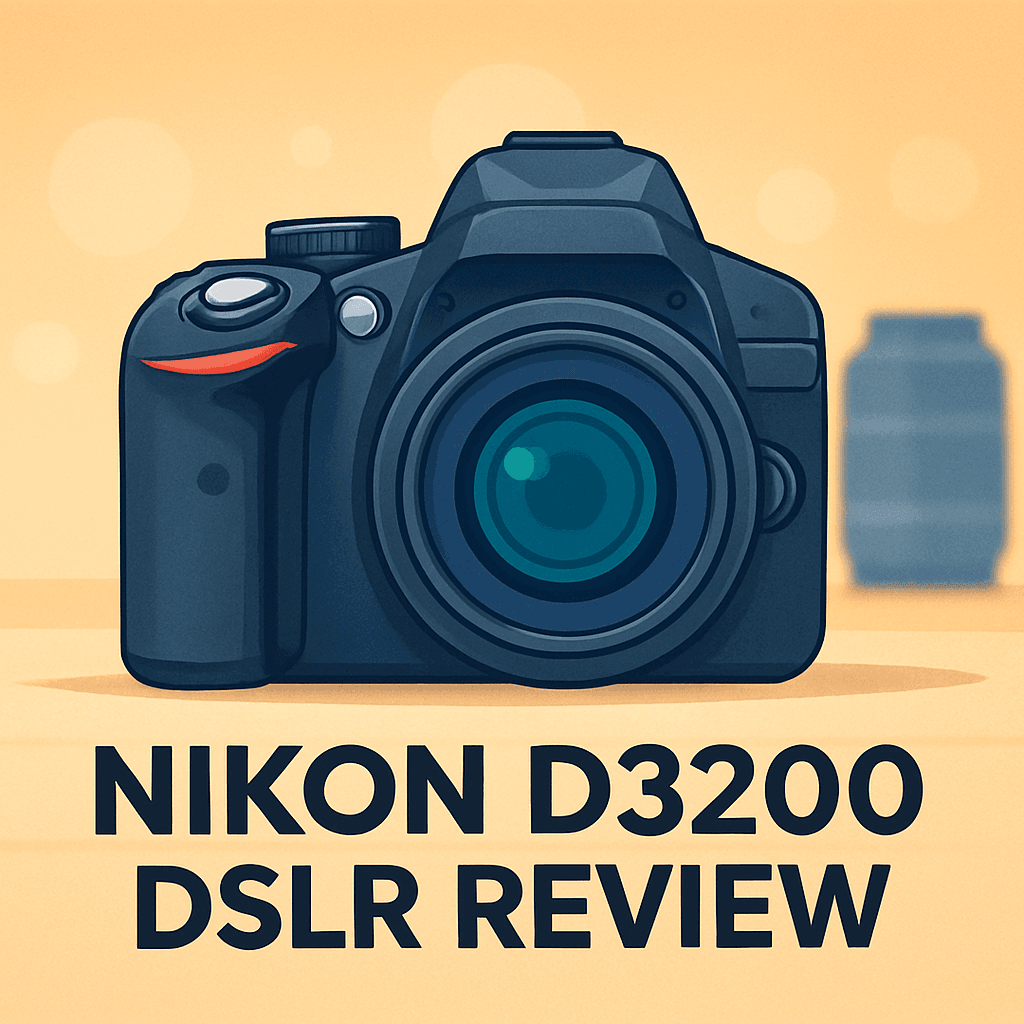
Want better-looking photos without a steep learning curve?
Curious if the Nikon D3200 Camera’s the right step up? I’ve got a hands-on review to help.
I spent a few field days with the D3200 shooting family moments, landscapes and travel scenes, so you’ll get real-world impressions, not just lab numbers.
It’s ideal for beginners and hobbyists who want high-resolution stills and an optical viewfinder, though you’ll trade modern conveniences like an articulated screen, in-body stabilization and built-in wireless — keep reading.

Nikon D3200 Camera
Lightweight entry-level DSLR featuring a high-resolution 24-megapixel sensor and intuitive controls, delivering sharp images and Full HD video for beginners who want reliable performance and simple creative results.
Check PriceThe Numbers You Need
| Spec | Value |
|---|---|
| Sensor | 24.2 MP APS-C |
| Lens Mount | Nikon F-mount |
| Video Resolution | Full HD |
| ISO Range | 100-6400 |
| Continuous Shooting | 4 fps |
| Autofocus Points | 11 AF points |
| Display | 3 inches LCD |
| Viewfinder | Optical |
| Card Slot | SD/SDHC/SDXC |
| Battery Life | Approx. 540 shots |
| Weight | Approximately 455 grams |
| Dimensions | 125 x 96 x 76.5 mm |
| White Balance | Auto (12 types) |
| Image Stabilization | Not built-in |
| Connectivity | USB, HDMI |
How It’s Built
In my testing the Nikon D3200 feels like a true entry-level DSLR — small, light, and easy to carry. At its size and weight it balances nicely with a kit zoom or a small prime, never feeling front-heavy. That makes it a great grab-and-go camera for walks and family events.
The grip is comfy for longer shoots and I could reach most controls without stretching. The optical viewfinder is crisp and bright, which I liked for quick framing in daylight. The 3-inch rear screen is clear but fixed, so you can’t tilt it for low or high angles.
In my testing the single SD card slot and the USB/HDMI ports are easy to access, though the card door can be awkward on some tripods. Battery life is solid — I got through a full day of shooting, but I still carry a spare for longer trips. No in-body stabilization means you’ll want a steady hand or a stabilized lens.
What I really liked was the simple, reassuring DSLR feel and the optical viewfinder that makes composing fast and intuitive. What could be better is the fixed screen and the lack of built-in stabilization and wireless, so plan on cables or a card reader. For beginners, that means learning to hold steady and packing an extra battery and card.
In Your Hands
Turn it on and the Nikon D3200 feels ready rather than rushed: menus are straightforward, shutter feedback is satisfyingly mechanical, and most settings are reachable without hunting. It doesn’t pretend to be instant like higher-end bodies, but everyday responsiveness never gets in the way of grabbing a moment. For a working photographer used to quick decision-making, the camera’s operation is predictably reliable and simple to navigate.
The modest burst rate and eleven-point AF array set realistic expectations for action work: you’ll capture casual bursts of kids running or pets at play, but prolonged sports sequences or fast-moving subjects need a more aggressive setup. The OVF AF point layout encourages pre-visualizing composition and planting your subject within a reachable focus zone rather than relying on dense tracking. In practice this means you shoot with intention—aim, anticipate, and fire—more than you spray-and-pray.
Battery life comfortably carries you through a full day of family outings or travel shoots without constant swaps, and file transfers are a straightforward affair via cable or card reader since there’s no built-in wireless. That workflow is predictable and secure, though it adds a step if you regularly want instant sharing from the field.
Live-view and video autofocus remain the camera’s weakest link; continuous AF can hunt and feels slow compared with modern mirrorless systems, so vlogging or handheld moving-subject video benefits from prefocusing, manual focus, or a stabilized lens. For daylight landscapes, portraits, and indoor events with some ambient light the D3200 delivers consistent, repeatable results—low-light restaurant scenes and fast sideline sports expose the limitations of the AF grid and frame rate, but sensible technique keeps most everyday shots usable and satisfying.
The Good and Bad
- 24.2 MP APS-C sensor for detailed stills
- Optical viewfinder shooting experience
- Approx. 540-shot battery life
- Lightweight, compact body (approx. 455 g; 125 x 96 x 76.5 mm)
- No in-body image stabilization
- Live-view and video autofocus struggles
Ideal Buyer
The Nikon D3200 is tailor-made for first-time DSLR owners who want a pure, tactile shooting experience with an optical viewfinder and straightforward controls.
Its 24.2MP APS‑C sensor delivers high-resolution stills that reward learning composition more than advanced video features do.
If you value clean stills and simple operation over live‑view autofocus and wireless conveniences, this camera is familiar and forgiving.
Family photographers, travel enthusiasts, and hobbyists will appreciate the D3200’s light weight and long battery life for full days out shooting.
It handles kit zooms and primes well for landscapes, portraits, and street work, though you’ll rely on stabilized lenses or faster shutter speeds in low light.
Plan on file transfers via cable or card reader and a photo‑first workflow rather than smartphone-style instant sharing.
This isn’t the camera for vloggers or fast‑action shooters who need smooth live‑view AF, an articulating screen, or built‑in wireless transfer.
The modest 11‑point AF and 4 fps burst rate are fine for everyday moments but limited for complex tracking or sports.
For Nikon users seeking an approachable, affordable body with access to the F‑mount lens ecosystem, it’s a smart starting point; just verify older lenses for AF‑motor compatibility.
Better Alternatives?
We’ve gone through the Nikon D3200 and what it gets right as a simple, capable DSLR for stills. If you read that and thought “I like the image quality but wish the camera did X or Y,” there are a few close choices that shift the balance toward battery life, live‑view usability, or more creative control.
Below I’ll run through three real alternatives I’ve used in the field, saying plainly what each one does better and where it falls short compared to the D3200, and who I’d recommend each for.
Alternative 1:

Nikon D3500 Camera
Compact, user-friendly DSLR with exceptional battery life and ergonomic handling, offering impressive low-light performance and crisp 24-megapixel images—ideal for budding photographers seeking dependable portability and long shooting sessions.
Check PriceWhat it does better than the D3200: the D3500 surprised me with much longer battery life and slightly cleaner files at higher ISO in everyday shooting. It’s lighter in the hand and has a helpful Guide mode that makes getting a shot easier when you don’t want to fiddle with settings. Bluetooth transfer (SnapBridge) is handy for quick phone sharing when you’re traveling and don’t want to pull a card every time.
What it does worse than the D3200: you give up a few direct controls and physical buttons compared with some older Nikons, so if you like to change settings by feel while shooting, it can slow you down. Autofocus behavior and lens compatibility feel very much like the D3200 — no magic AF boost — so it won’t track fast action better than the D3200.
Who should pick this: I’d hand this to a beginner who wants a truly grab‑and‑go DSLR, or someone who shoots long days and hates swapping batteries. It’s great for travel, families, and new shooters who want good image quality without a heavier, more complex camera.
Alternative 2:

Nikon D5600 Camera
Versatile mid-range DSLR with a tilting touchscreen, seamless wireless sharing, and rich color reproduction; perfect for enthusiasts who want creative control, responsive autofocus, and compact travel-friendly performance.
Check PriceWhat it does better than the D3200: the D5600 is noticeably more flexible in real shooting. The tilting touchscreen and better live‑view autofocus make composing from odd angles and shooting video or selfies much less painful than on the D3200. Autofocus feels more reliable when subjects move, so I got more keepers shooting kids and pets without as many missed frames.
What it does worse than the D3200: it’s a bit larger and pricier, and for someone who only wants simple point‑and‑shoot DSLR use the extra features can feel unnecessary. Battery life isn’t as dramatic a step up as the D3500’s, so if long day shoots without spare batteries are your top concern, the D3500 still wins.
Who should pick this: pick the D5600 if you want a camera that grows with you — an enthusiast who wants a touch screen, better live‑view behavior for video, and stronger AF for action. It’s my go‑to choice when I need a lightweight but capable body for travel, street work, or casual video.
Alternative 3:
Nikon D5600 Camera
Creative-focused DSLR pairing a flexible articulating LCD with advanced exposure controls, reliable autofocus, and robust image quality—great for vloggers and photographers who demand versatile shooting angles and vivid detail.
Check PriceWhat it does better than the D3200: thinking of the D5600 as a creative tool, its articulating screen and touch controls let you shoot low, high, or waist‑level with ease — I often use it for product shots and tight portrait angles where bending or lying down would be a pain on the D3200. The camera’s menus and extra features (interval shooting, wireless sharing) also make it easier to experiment without extra kit.
What it does worse than the D3200: all those extra options mean more menus and more to learn. It’s also not dramatically faster in burst shooting than the D3200, so if you’re after pure frame rate for sports the gain is modest. And like the D3200 it still relies on lens stabilization and doesn’t have in‑body stabilization.
Who should pick this: this version of the D5600 is for vloggers and creative shooters who want flexible framing and easier live‑view performance. If you like shooting video or need a camera that helps with unusual angles and quick composition changes, the D5600 will feel like a real step up from the D3200.
What People Ask Most
Is the Nikon D3200 a good camera?
Yes — it delivers very good image quality for an entry-level DSLR and is a solid choice if you want sharp photos without spending much.
Is the Nikon D3200 good for beginners?
Yes — it’s lightweight, easy to use with a helpful Guide Mode, and affordable, making it a great learning camera for new photographers.
What are the key specs of the Nikon D3200?
It has a 24.2MP APS-C sensor, EXPEED 3 processor, 11-point AF, ISO 100–6400 (expandable), about 4 fps continuous shooting, and a 3″ LCD.
Can the Nikon D3200 record Full HD video?
Yes — it records Full HD 1080p video (frame rates depend on region, typically up to 30fps).
How does the Nikon D3200 compare to the Nikon D3300?
The D3300 is a modest upgrade with a newer processor, slightly better low-light performance and faster shooting, but both share the same basic handling and image quality.
Is the Nikon D3200 worth buying?
For a used or budget buy it’s worth it if you want DSLR image quality and manual controls, but consider newer models if you need better low-light performance or modern features like Wi‑Fi.
Conclusion
The Nikon D3200 Camera is a no-nonsense DSLR that delivers on the fundamentals most shooters care about: strong stills, a satisfying optical viewfinder experience, and rock-solid reliability in everyday situations. Its design favors simplicity and long days in the field, and the camera plays nicely with the wide Nikon lens lineup. For a beginner or hobbyist who wants straightforward results without a pile of settings, it’s an easy camera to live with.
That said, this is a product of an earlier DSLR era and it shows where modern conveniences matter. Live-view and video autofocus are limited, the rear screen doesn’t articulate, there’s no in-body stabilization, and wireless transfer isn’t built in. Those compromises make it a poor fit for vloggers, fast-action shooters, and anyone who demands seamless on-the-go connectivity.
Bottom line: the D3200 Camera offers compelling stills performance and classic DSLR handling at its core, but asks you to accept older workflow habits and a conservative feature set. If your priority is image quality, optical shooting, and learning the basics, it’s a very sensible, value-conscious pick.
If you need modern live‑view AF, an articulating touchscreen, or wireless convenience, look at newer bodies; otherwise the Nikon D3200 remains a durable, capable entry point into Nikon glass and DSLR shooting.
Nikon D3200 Camera
Lightweight entry-level DSLR featuring a high-resolution 24-megapixel sensor and intuitive controls, delivering sharp images and Full HD video for beginners who want reliable performance and simple creative results.
Check Price

0 Comments