
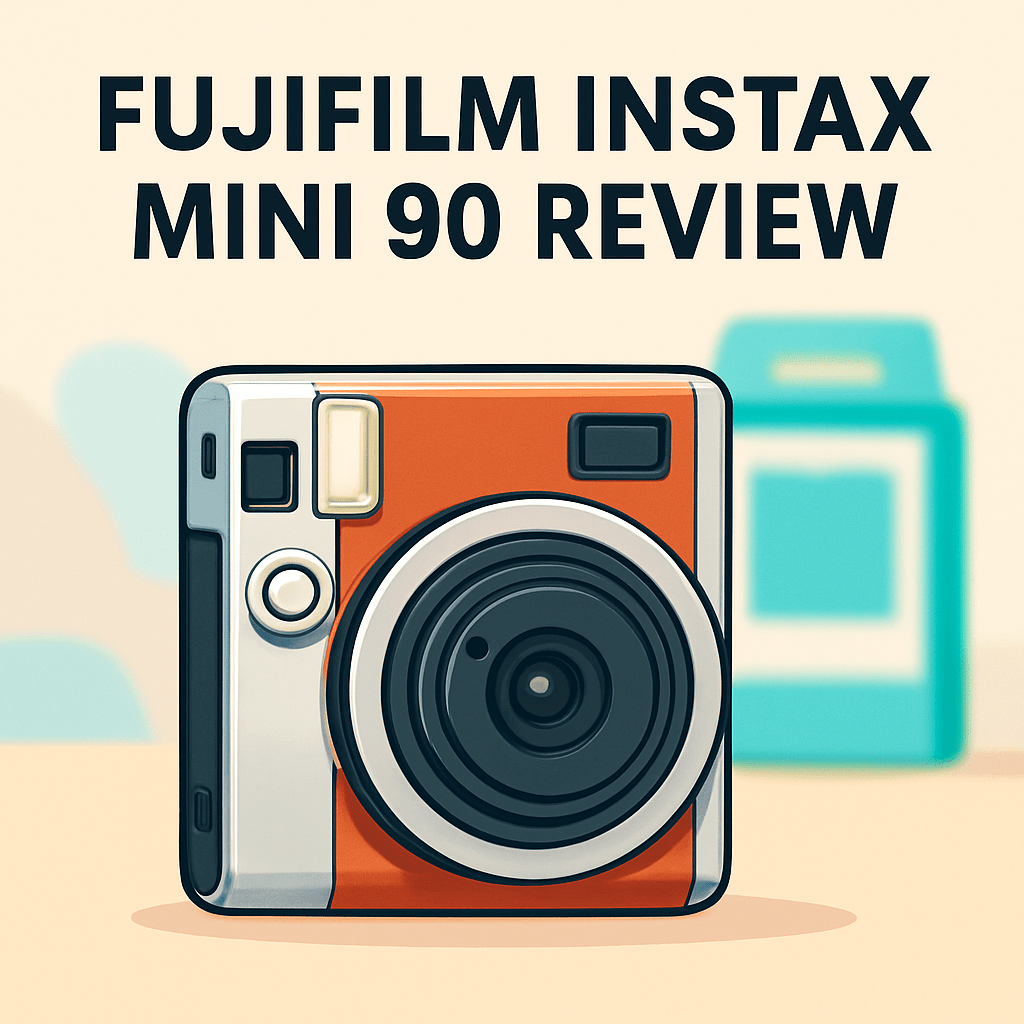
Want an instant camera that’ll give you more creative control than a basic point‑and‑shoot?
The Fujifilm Instax Mini 90 Camera is a fully analog instant that uses credit‑card sized Instax Mini film and aims at photographers who want to experiment beyond simple snaps.
I spent a few field sessions with it, focusing on the bulb and double‑exposure modes and testing the built‑in automatic flash, rechargeable battery, and optical viewfinder with parallax marks.
If you want a compact, carryable camera that lets you play with long exposures, overlays, and exposure nudges, this review’s for you. Make sure to read the entire review as I break down hands‑on performance, mode‑by‑mode results, and real‑world payoffs — keep reading.

Fujifilm Instax Mini 90 Camera
Retro-inspired instant camera featuring multiple exposure modes, rechargeable battery and manual controls. Includes tripod socket and creative settings to produce rich, nostalgic small-format prints with professional-feel versatility.
Check PriceThe Numbers You Need
| Spec | Value |
|---|---|
| Film type | Instax Mini instant film (credit-card size) |
| Film size | 54 × 86 mm; image size 46 × 62 mm |
| Lens | 60 mm f/12.7 fixed lens |
| Shutter speed | 1/2 to 1/400 seconds |
| Exposure modes | Automatic, bulb, double exposure |
| ISO | Fixed ISO 800 film sensitivity |
| Flash | Built-in automatic flash with red-eye reduction |
| Focus range | 0.3 m to infinity (macro mode from 0.3 m) |
| Power | Rechargeable lithium-ion battery (NP-45S) |
| Viewfinder | Optical viewfinder with parallax correction marks |
| Exposure control | Programmed AE with exposure compensation ±2 EV |
| Self-timer | 10 seconds |
| Dimensions | Approx. 113.4 × 91.9 × 57.2 mm |
| Weight | Approx. 296 g (including battery and film) |
| Connectivity | No digital interface (fully analog instant camera) |
How It’s Built
In my testing the Fujifilm Instax Mini 90 feels like a grown-up instant camera you actually want to carry. It’s compact and solid without being heavy, so I slipped it into a bag and shot all day without fuss. For beginners that means it won’t get in the way when you’re out and about.
The fixed lens gives the prints that classic instant look, but it also means you’ll lean on the built-in flash more in darker rooms. The optical viewfinder has parallax marks, which I used every time I shot up close to avoid cropping half a face. I liked how those simple marks made composing close-ups easy even when you don’t yet trust the framing.
The controls are straightforward and tactile—mode dial, a few buttons, and clear switches—so swapping into bulb or double exposure felt natural in the moment. I found the layout friendly for learning creative modes, though the viewfinder is small and can be fiddly for precise framing at very close distances.
Film loading and the rechargeable battery made real shoots painless; in my testing I appreciated not hunting for disposable cells. The trade-off is that it’s fully analog with no digital preview, so every frame counts—great for thoughtful shooting, but less forgiving if you want instant confirmation.
In Your Hands
On the street and in tricky lighting the Instax Mini 90’s metering feels steady and predictable, favoring balanced midtones over extremes. The camera’s automatic exposure gives a reliable baseline while a readily accessible exposure control lets you brighten or darken scenes when backlight or contrast would otherwise fool the meter. That nudgeable control makes backlit portraits and high-contrast interiors far less hit-or-miss than simpler instant cameras.
The built-in flash is the workhorse—automatic with a red‑eye reduction routine—so indoor party shots tend to retain subject detail without crushing background information. In daylight it serves well as a subtle fill to lift faces, though I often switch it off in very bright conditions to preserve atmosphere. For low‑light creative work you’ll decide whether the flash helps or whether a long‑exposure approach better serves the mood.
The fixed lens is forgiving across most shooting distances and the close‑focus mode invites tight detail work and thoughtful tabletop compositions. Be mindful of framing when working close; deliberate composition reduces the small framing shifts that can crop a subject unexpectedly.
The optical viewfinder with parallax marks becomes indispensable up close—align the marks and you’ll avoid chopped heads or missed detail. At normal distances it’s quick and intuitive, keeping the shooting rhythm fast for street snaps and social moments.
The rechargeable battery makes multi‑hour sessions practical, but I still top up before a long night to keep cadence steady. Favorite real‑world uses include daylight street snaps, arm’s‑length portraits with natural catchlights, lively indoor party frames and deliberate bulb exposures on a stable surface. When you choose slow exposures, plan for support or embrace motion blur as a creative element rather than a flaw.
The Good and Bad
- Creative modes (bulb, double exposure) enable experimentation beyond basic Instax shooting
- Exposure compensation ±2 EV gives control in tricky lighting
- Built-in flash with red-eye reduction for indoor versatility
- Rechargeable lithium-ion battery (NP-45S) and compact, pocketable form factor
- Fully analog with no digital interface or preview — every frame counts
- Fixed ISO 800 film and f/12.7 lens increase reliance on flash indoors
Ideal Buyer
The Fujifilm Instax Mini 90 Camera is for shooters who want a tactile, creative instant experience rather than a point-and-shoot novelty. Fully analog operation and credit-card prints demand intentionality and reward thoughtful composition. Bulb and double-exposure modes, plus ±2 EV exposure compensation, give you in-camera control while the optical viewfinder with parallax marks and a rechargeable battery keep it compact and dependable.
Ideal buyers are enthusiast photographers, analog experimenters, and travelers who like to hand out physical keepsakes. Use it for long-exposure light trails, layered double exposures, close-up macro work from 0.3 m, or stylized high-key portraits that benefit from exposure nudges. The camera shines when you want to slow down, craft an image and accept that every frame costs something.
It’s not a fit if you need instant digital previews, Bluetooth phone printing, or a built-in screen to vet shots before you print. Casual users who prefer a fully automatic, fuss-free point-and-shoot will find fewer rewards here than with simpler Instax models. Choose the Mini 90 only if you enjoy learning modes and embracing analog limits.
Avoid it if your priority is larger instant formats or sheer shooting throughput at crowded events. For those buyers, a hybrid or simpler Instax will likely be a better match.
Better Alternatives?
We’ve gone through the Instax Mini 90 and what makes it special: the creative modes, the analog feel and the control it gives you. If you like experimenting with bulb or double exposure, the Mini 90 is a great choice. But it isn’t the only way to get those little credit-card prints.
Below are a few alternatives that trade some of the Mini 90’s creative control for other benefits: simpler use, hybrid digital convenience, or extra printing features. I’ve used all of them in real shoots, so I’ll point out what each does better and where it falls short in day-to-day shooting.
Alternative 1:

Fujifilm Instax Mini 11 Camera
Compact, beginner-friendly instant shooter with automatic exposure and selfie-optimized mode. Lightweight, pocketable design plus easy-to-use shutter delivers flattering, spontaneous prints perfect for parties, travel and everyday snapshots.
Check PriceThe Instax Mini 11 is the simplest route to the same credit-card prints. I’ve taken it to parties and weekend walks when I wanted fast, no-fuss results — point, press, and the camera handles exposure and flash for you. That makes it better than the Mini 90 for casual shooters who just want consistent snaps without thinking about modes.
Where the Mini 11 falls short compared to the Mini 90 is control. You lose the bulb and double-exposure tricks, and there’s less room to tweak exposure for mood. The Mini 11 also feels more plasticky and is geared to quick selfies and group shots rather than creative experiments. In mixed or low light it tends to rely on the flash more, which is fine for parties but not great if you want long exposures or subtle ambient light.
If you’re a beginner, a party photographer, or someone who wants a light, pocketable camera for travel, the Mini 11 is likely the better pick. If you want to play with long exposures, overlays, or finer exposure control, stick with the Mini 90.
Alternative 2:

Fujifilm Instax Mini LiPlay Camera
Hybrid digital-to-instant device with LCD preview, Bluetooth mobile printing and voice-tag capability. Capture, edit with filters and frames, then print or share photos quickly for personalized, multimedia keepsakes.
Check PriceThe Instax Mini LiPlay brings a small LCD and digital brain to the instant format. I liked being able to preview shots and pick the best frame to print — that alone saves a lot of film. Editing with simple filters and frames before printing also means you can get the look you want without guessing and wasting prints.
Compared to the Mini 90, the LiPlay is better when you want selective printing and phone connectivity. But it’s worse if you love the pure analog workflow: you lose the immediate, in-camera exposure decisions and the tactile feel of the Mini 90’s modes. The menu and screen slow you down a bit when you want spontaneous shooting, and battery life can feel shorter if you’re using Bluetooth and the screen a lot.
This is the camera for someone who shoots a mix of digital and instant — think scrapbookers, people who like to add filters or voice tags to prints, or anyone who wants to print a phone photo quickly. If you want full hands-on instant control or long-exposure creativity, the Mini 90 still has the edge.
Alternative 3:
Fujifilm Instax Mini LiPlay Camera
Pocketable multimedia printer that stores images on removable memory, prints directly from smartphone or camera, and adds playful stickers, filters and recorded audio tags for fun, customizable physical memories.
Check PriceUsed as a pocket printer, the LiPlay shines in a different way. I’ve loaded it with photos from a phone or a compact camera and printed right away — it’s great for events where guests want to take home a customized print. Storing images on removable memory or printing directly from your phone means you can plan layouts and avoid surprises before the print comes out.
Against the Mini 90, this printing-first approach is better for saving film and creating curated sets of prints, and for adding stickers or recorded audio tags that the Mini 90 can’t do. It’s worse if you’re after the joy of shooting on film and watching the exact exposure play out — the LiPlay’s digital steps make it feel less like classic instant photography and more like a small printer with a camera built in.
Choose the LiPlay-as-printer if you care about control over what you print, want to bring phone photos into the physical world, or host events where customization matters. If your priority is experimenting with in-camera effects and true analog instant shooting, the Mini 90 is still the better tool.
What People Ask Most
Is the Fujifilm Instax Mini 90 worth buying?
Yes if you want a stylish, feature-rich instant camera with real exposure control and better consistency than basic Instax models; skip it if you just need a cheap, simple party camera.
How good is the image quality on the Fujifilm Instax Mini 90?
Image quality is limited by Instax Mini film—soft, grainy, and high-contrast—but the Mini 90’s improved exposure control and lens give more reliable, better-exposed results than the entry-level Minis.
What features and shooting modes does the Fujifilm Instax Mini 90 have?
It includes automatic and manual exposure, bulb/long exposure, double exposure, macro/close-up, high-key, party/indoor and landscape modes, plus a built-in flash and tripod socket for creative shooting.
How does the Fujifilm Instax Mini 90 compare to the Instax Mini 8/9/11?
The Mini 90 offers more manual control, creative modes and a higher-quality build, while the Mini 8/9/11 are simpler, cheaper point-and-shoots aimed at casual users.
How long does the battery last and is it rechargeable on the Fujifilm Instax Mini 90?
The Mini 90 uses a rechargeable battery and will typically deliver dozens of prints per charge, though actual life depends on flash use and long-exposure shots.
Can the Fujifilm Instax Mini 90 do double exposure and other creative effects?
Yes—this model supports double exposure, bulb/long exposures, high-key mode and close-up shooting for in-camera creative effects.
Conclusion
The Fujifilm Instax Mini 90 Camera is the most accomplished analog Instax for photographers who want more control than the entry-level options. Creative tools like bulb and double exposure, exposure compensation and a close-focus mode let you craft memorable, tactile images rather than spray-and-pray prints. The trade-off is obvious: its fully analog workflow and fixed-lens nature demand care and intention with each frame.
In real shoots the Mini 90 rewards experimentation and thoughtfulness, producing characterful results once you learn its quirks. The built-in flash and viewfinder aids make everyday indoor and portrait work reliable, but low light and motion still require planning. If you prize convenience over control, this camera can feel fiddly.
Buy it if you want hands-on instant photography with creative options that go beyond simple point-and-shoots. Pass if you need digital preview, phone connectivity, or a totally automatic experience.
If you want simplicity, the Mini 11 is the better call; if you want hybrid preview and phone printing try the LiPlay; and the Mini 40 offers style with fewer controls. Overall, the Instax Mini 90 is an easy recommendation for analog-minded shooters who value creativity and compact portability; everyone else should weigh the alternatives against how they plan to use their Instax prints.
Fujifilm Instax Mini 90 Camera
Retro-inspired instant camera featuring multiple exposure modes, rechargeable battery and manual controls. Includes tripod socket and creative settings to produce rich, nostalgic small-format prints with professional-feel versatility.
Check Price




0 Comments