
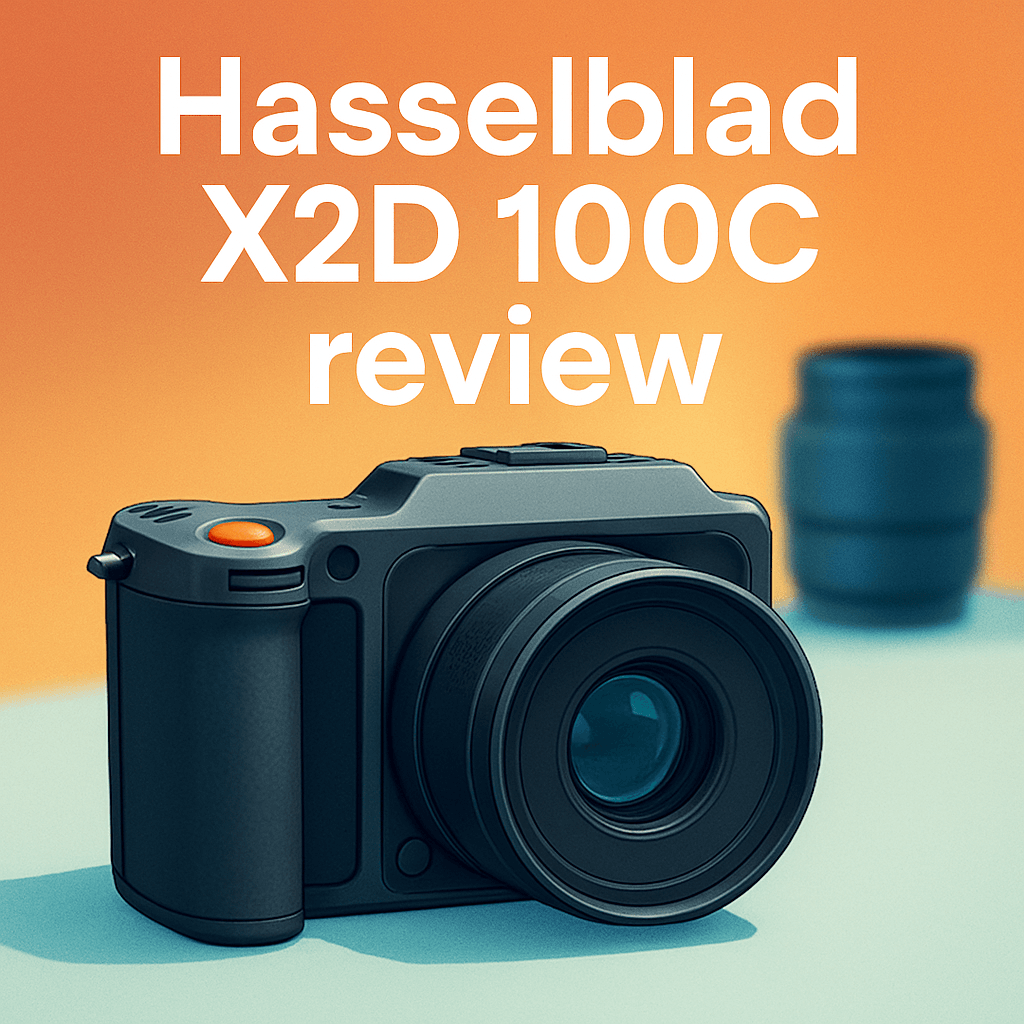
hasselblad x2d 100c review: wondering if this camera will elevate your image quality and workflow?
It’s a compact, modern medium-format body with a 100 MP BSI CMOS sensor and sensor-shift stabilization, built mainly for stills with premium build and image quality. I’ve spent days shooting with it in studio and on location.
This review walks through handling and build, autofocus and stabilization, shutter behavior, image quality and dynamic range, video basics, and workflow including the internal 1TB SSD and CFexpress. You’ll get practical takeaways, not just specs.
I’ll test handheld versus tripod, controlled light and mixed light, studio portraits and product, landscape and architecture details, and low-light interiors to show real-world payoffs for portrait, studio, and landscape shooters. Make sure to read the entire review as we put it through real-world tests—keep reading.

Hasselblad X2D 100C Camera
Experience exquisite medium-format 100MP image quality, buttery tonal rendering, and precise shutter control in a surprisingly portable body—engineered for studio and landscape professionals who demand ultimate color fidelity and detail.
Check PriceThe Numbers You Need
| Spec | Value |
|---|---|
| Sensor | 100 MP medium format BSI CMOS |
| Sensor size | 43.8 x 32.9 mm |
| ISO range | 64–25600 |
| Image stabilization | Sensor-shift image stabilization |
| Autofocus | Phase detection (294 points) |
| Shutter | Leaf shutter (electronic and mechanical) |
| Shutter speed | 60 min – 1/4000 sec (mechanical), 1/25000 sec (electronic) |
| Video | 4K up to 30 fps; 1080p up to 60 fps |
| LCD | 3.6″ tilt touchscreen (2.36M dots) |
| Viewfinder | 5.76M-dot EVF |
| Card slots | 1x CFexpress Type B; internal 1TB SSD |
| Battery | Rechargeable Li-ion (up to 420 shots per charge) |
| Body | Weather sealed, magnesium alloy |
| Weight | 895 g (with battery) |
| Connectivity | Wi-Fi, USB-C, HDMI, Bluetooth |
How It’s Built
In my testing the Hasselblad X2D 100C feels like a real step up in build quality. The magnesium-alloy shell and weather sealing give a solid, confident feel you notice as soon as you pick it up. That means you can shoot in light rain or dusty locations without constant worry.
Grip and controls are thoughtful and comfortable for long stills sessions. I found it balances well with Hasselblad lenses for portraits and landscapes, though very long lenses can pull the nose down a bit. For beginners that means it’s easy to hold steady, but you may want a strap for full-day handheld work.
The electronic viewfinder is sharp and honest, and the tilt touchscreen is responsive and useful for low and high angles. In my testing the EVF made composing in bright light painless, while the screen can reflect more than I’d like at certain angles. I liked the clarity of the EVF a lot.
The internal SSD changed how I work for the better — I could shoot tether-free, offload quickly, and keep a fast backup without juggling cards. Wireless transfers and the app mostly worked smoothly in the field, but the single card slot and the overall heft are things that could be better. Overall the camera feels built to last and usable for beginners and pros alike.
In Your Hands
Autofocus on the Hasselblad X2D 100C felt purposeful and dependable in typical shoot scenarios — portraits, product work and slow-moving subjects are captured with reassuring precision. In mixed or low light the system slows and requires more patience, especially when working with extremely shallow depth of field, but it rarely misses a critical frame when framed and focused carefully.
The in-body stabilization noticeably expanded handheld possibilities, letting me hold exposures comfortably longer than my instincts would allow and keeping detail crisp across longer lenses. That said, for the most demanding high-resolution landscape or pixel-level studio work a tripod remains the safer bet; the IBIS is a practical bridge between studio and location shooting rather than a complete replacement.
Shutter options give useful flexibility: the silent electronic mode is a boon for discreet or quiet environments, while the mechanical option feels solid and predictable for critical timing. I did observe some electronic-mode rolling artifacts during very fast pans, so I switch to mechanical when subject motion is less forgiving.
Continuous shooting is intentionally modest and suits methodical workflows more than fast-action sports; paired with the internal SSD and a fast card the buffer clears efficiently, making steady multi-frame captures painless. Video serves as a capable supplementary tool for basic clips, but the camera’s personality clearly favors stills-first users.
Battery life in the field varied with heavy EVF/LCD use and stabilization on, so I treated spare power as standard kit for long days. Connectivity and the internal storage transform tethering and in-field backup into a seamless, reliable routine with no frustrating lockups or alarming heat in regular shooting sessions.
The Good and Bad
- 100 MP medium-format BSI CMOS sensor for extremely high detail
- Sensor-shift image stabilization for improved handheld shooting
- Phase-detect AF with 294 points
- Internal 1TB SSD plus CFexpress Type B for fast, robust storage
- 3.3 fps continuous shooting is modest for action
- Single CFexpress card slot may not satisfy redundancy needs
Ideal Buyer
If you prioritize maximum detail and medium-format rendering for stills, the Hasselblad X2D 100C Camera is designed for you. Studio, portrait, product, architecture and landscape photographers who work methodically will appreciate its image quality and tonal rendition.
Creators who care about streamlined in-camera workflows will like the internal 1TB SSD paired with CFexpress for fast capture, backup and tethering. That setup speeds studio days and location shoots where file security and fast offload matter.
Handheld shooters benefit from sensor-shift stabilization that makes low-shutter, high-detail shooting more feasible. But at 895 g with battery and with a modest 3.3 fps, this camera truly shines when used tripod-centrically or on deliberate handheld assignments rather than fast-paced run-and-gun work.
Avoid this if you need high burst rates, advanced video features, or redundant multi-card workflows; pros who prioritize speed, long continuous shooting or video will find more suitable options elsewhere. Battery considerations and the single CFexpress slot also mean planning for longer days is important.
If your work is editorial, fine-art, commercial studio or large-format print production where color fidelity and resolution directly affect the bottom line, the X2D is a compelling tool. For fast-action, event or video-heavy shooters, look to faster alternatives that trade some of the X2D’s signature image character for speed and versatility.
Better Alternatives?
In this hasselblad x2d 100c review we dug into how the camera handles, how it feels in the hand, and how it performs across portraits, landscapes, and studio work. We looked at image quality, stabilization, autofocus behavior, and the real-life trade-offs of a compact medium-format body built for stills. Now that we’ve covered the X2D’s strengths and limits, it’s useful to look at other cameras that give you 100MP class image quality but with different balances of speed, handling, and price.
Below are three real-world alternatives I’ve used in the field. Each one brings something different to the table compared with the X2D—more value, more speed, or more portability—and I’ll point out what each does better and where it falls short so you can decide which fit your shooting style.
Alternative 1:

Fujifilm GFX 100S Camera
Compact medium-format body with a high-resolution 102MP sensor, in-body stabilization, and intuitive controls—ideal for travel, portrait, and fine-art photographers seeking rich tonal gradation and incredible dynamic range.
Check PriceHaving shot the GFX100S on location and in the studio, I can tell you it often beats the X2D on value and everyday usability. It gives that same kind of very high-resolution look, but in my hands it felt easier to carry for long handheld shoots thanks to its balanced build and strong in-body stabilization. Fuji’s color and JPEG output also saves time; I often delivered client proofs straight from the camera in a way I didn’t with the X2D.
Where it loses to the X2D is in the feel and the Hasselblad color signature. The X2D has a slightly more refined tactile layout and a distinct color and tone many clients request. The GFX100S is excellent, but if you want that specific Hasselblad look and the unique ergonomics of the X2D, you’ll notice the difference. Also, workflow features like the X2D’s internal SSD and some Hasselblad workflow touches aren’t matched by the Fuji.
If you’re the kind of buyer who wants medium-format detail without spending extra for the Hasselblad badge, the GFX100S is for you. It suits portrait and landscape shooters who move between studio and location and who value a broader, more affordable lens ecosystem and hands-on speed in the field.
Alternative 2:

Fujifilm GFX100 II Camera
Next-generation medium-format powerhouse with enhanced autofocus, faster processing, and refined ergonomics—delivering stunning 100+ megapixel detail, expanded dynamic range, and reliability for demanding studio and field work.
Check PriceThe GFX100 II felt like a step up from the older Fuji in handling and speed when I used it for event and documentary work. Autofocus and subject tracking are noticeably more confident, and the camera processes files faster so you spend less time waiting between bursts. For fast-paced assignments where I still wanted medium-format detail, this Fuji made the job easier than the X2D’s slower continuous frame rate would.
That said, the X2D still wins in raw single-shot feel and its particular Hasselblad color science. The Fuji’s color is lovely and flexible, but some clients ask specifically for the “Hasselblad look.” The GFX100 II can also be a bit bulkier on long handheld days, and it won’t give you the same internal SSD backup that changes how you work when you’re tethered or need instant backups in the field.
This camera is aimed at pros who need top-tier image quality but also need speed and reliable AF for events, editorial shoots, or weddings. If you want medium-format detail plus the ability to track moving subjects better than the X2D can, the GFX100 II is a strong choice.
Alternative 3:
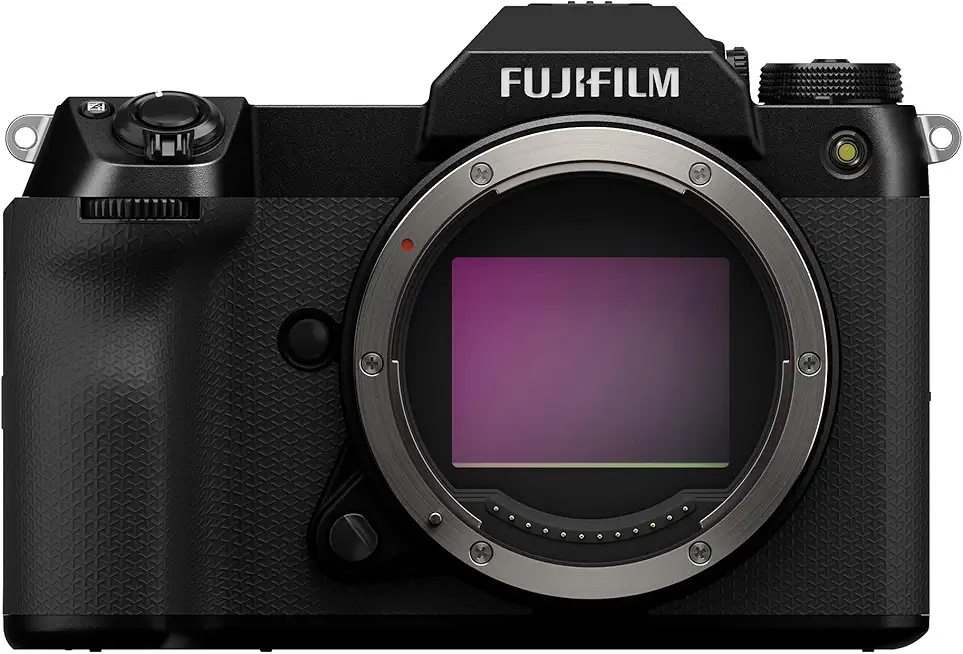
Fujifilm GFX100S II Camera
Ultra-portable medium-format update combining exceptional resolution with nimble handling, long battery life, and advanced autofocus—perfect for professionals who need studio-grade image quality on location and seamless workflow.
Check PriceOut on location the GFX100S II feels built for travel. I used it for extended landscape and editorial days and appreciated how lightly it carried compared to full studio rigs. Battery life and autofocus improvements mean I could shoot longer without swapping batteries or missing fleeting moments, which is something the X2D can struggle with during marathon shoots.
On the downside, the GFX100S II’s handling and color still read as Fuji rather than Hasselblad. If you love the X2D’s unique shutter feel, button layout, or color rendering, switching to the Fuji will change your results and the way clients perceive your work. The X2D can also feel more premium in how it handles certain studio tasks and some tethering workflows.
This model is best for traveling pros and location shooters who need near-studio image quality with less weight and longer run times. Pick the GFX100S II if you prioritize portability and a long day of shooting over the X2D’s specific ergonomics and Hasselblad color signature.
What People Ask Most
Is the Hasselblad X2D 100C worth the price?
If you need top-tier resolution, color fidelity, and dynamic range for studio, landscape, or fine-art work, yes — it delivers class-leading image quality; if you shoot fast action or need a broader lens ecosystem, a high-end full-frame may be better value.
How does the Hasselblad X2D 100C compare to the X1D II 50C and other medium-format or full-frame cameras?
It offers higher resolution, better dynamic range and IBIS versus the X1D II 50C, but with larger files and slower write speeds; compared to full-frame it outresolves most models but trades off shooting speed, autofocus tracking, and lens selection.
What are the main improvements of the X2D 100C over previous Hasselblad models?
Main upgrades are a 100MP sensor, in-body image stabilization, faster autofocus and processor, improved EVF/touchscreen, and refined ergonomics.
How good is the image quality and dynamic range of the X2D 100C?
Outstanding — the 100MP medium-format sensor delivers exceptional detail, color accuracy, and very wide dynamic range that outperforms most full-frame cameras.
How does the autofocus and overall performance of the X2D 100C perform for handheld and action shooting?
Autofocus and IBIS are much better than past Hasselblads and make handheld shooting easier for portraits and landscapes, but it still trails flagship full-frame bodies for fast sports or wildlife tracking.
What is the battery life, ergonomics, and usability like on the X2D 100C?
Ergonomics and controls are excellent for extended studio and field use, but battery life is modest so plan to carry spare batteries for long days of shooting.
Conclusion
If your work is about making still images where ultimate detail, color and craft matter, the Hasselblad X2D 100C Camera is one of the most compelling medium-format options I’ve used. It rewards careful shooting and a deliberate workflow rather than chasing high-speed action.
Its sensor delivers the kind of tonal fidelity and microdetail that lifts portraits, products and landscapes into a different league, while the in-body stabilization and rock‑solid build make handheld sessions far more practical than older medium-format bodies. The bright EVF, usable tilt touchscreen and the internal SSD-plus-CFexpress workflow shave real friction from professional shoots.
That pedigree comes with trade-offs: continuous frame rates are modest, redundancy is limited by a single card slot, video capability is clearly secondary, and the camera’s mass and battery habits mean you’ll plan for spares on long days. These are practical compromises, not fatal flaws.
Choose the X2D when ultimate still-image quality, Hasselblad color science and a streamlined pro workflow matter more than burst speed or video versatility. For studio, portrait, product and landscape pros who shoot methodically, my recommendation is clear: the X2D is worth the investment.
Hasselblad X2D 100C Camera
Experience exquisite medium-format 100MP image quality, buttery tonal rendering, and precise shutter control in a surprisingly portable body—engineered for studio and landscape professionals who demand ultimate color fidelity and detail.
Check Price



0 Comments