
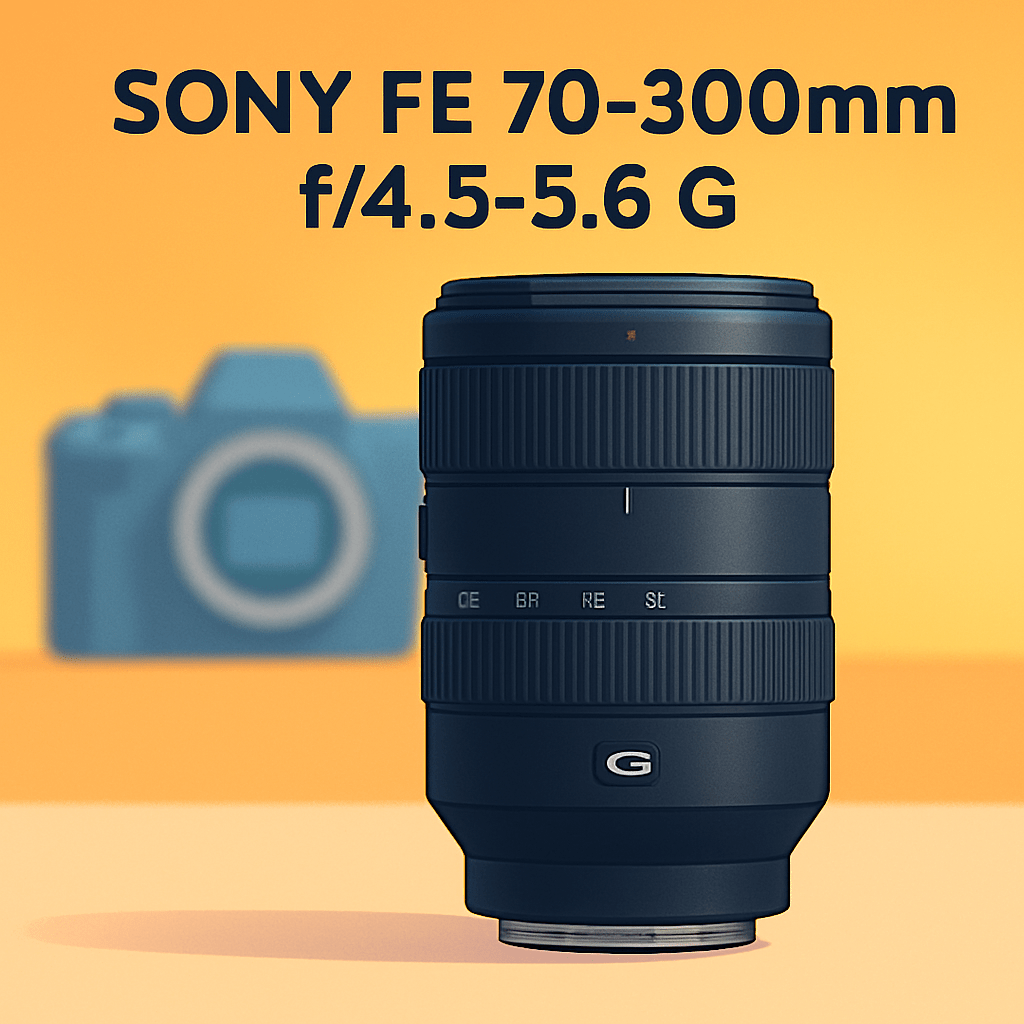
Want to extend your reach without lugging a monster lens everywhere?
I field-tested the Sony FE 70-300mm f/4.5-5.6 G across wildlife, sports, and travel shoots to see how it performs in real-world conditions.
It’s aimed at Sony E-mount shooters who want stabilized tele reach, dependable optics, and weather resistance for on-the-go shooting.
In practice it delivers steady handheld shots, reliable autofocus, and useful close-focus for detail work you’ll actually use in the field.
I’ll unpack handling, sharpness, AF behavior and alternatives so you can decide. Make sure to read the entire review as you’ll want the full context—keep reading.

Sony FE 70-300mm f/4.5-5.6 G
A compact, high-resolution telephoto for enthusiasts and pros seeking extended reach, crisp corner-to-corner sharpness, and reliable autofocus. Smooth rendering and responsive handling make distant subjects come alive.
Check PriceThe Numbers You Need
| Spec | Value |
|---|---|
| Lens type | Telephoto zoom |
| Mount type | Sony E-mount (full-frame) |
| Focal length range | 70–300mm |
| Maximum aperture range | f/4.5–f/5.6 |
| Optical image stabilization | Yes (OSS) |
| Minimum focusing distance | 0.9 m (at 70mm) |
| Maximum magnification ratio | 0.31× |
| Filter thread diameter | 67mm |
| Aperture blades | 9 (rounded) |
| Lens construction | 18 elements in 13 groups |
| Dimensions | Approximately 78mm (diameter) × 143mm (length) |
| Weight | Around 854 g |
| Autofocus system | Double linear motors |
| Weather sealing | Dust and moisture resistant |
| Compatible sensor size | Full-frame and APS-C |
How It’s Built
In my testing the Sony FE 70-300mm f/4.5-5.6 G feels like a proper G-series tele zoom for Sony E-mount shooters. The metal-and-plastic mix gives a solid, refined feel without being overbearing. It has built-in stabilization and rounded aperture blades that help make backgrounds look pleasing.
Mounted on smaller mirrorless bodies it can feel a bit front-heavy at first, but the balance settles once you find a hand position. I found the zoom and focus rings smooth and precise, easy for beginners to learn on. One thing I really liked was how the stabilization lets you shoot handheld more confidently.
After using it in light drizzle and dusty trail conditions I didn’t worry about getting a few drops on it. The weather resistance isn’t a free pass for a storm, but it held up better than many lenses in this price range. What could be better is overall bulk — it’s not the easiest lens to carry all day.
For travel or a full day of shooting the lens is perfectly usable, especially with stabilization reducing the need for a tripod. I kept reaching for it when I needed extra reach without changing lenses. Beginners will appreciate the reassuring build and simple handling while learning telephoto work.
In Your Hands
In the field the lens’ optical stabilization is the real enabler — it keeps images steady at the long end so handholding becomes a practical choice rather than a compromise. Keeper rates improved noticeably during my shoots, and the stabilization buys you breathing room with shutter speeds that would otherwise produce blur. The trade-off is the variable aperture, which means exposure and background separation shift as you zoom, so low-light work and ultra-shallow depth of field feel more constrained than with a constant-aperture tele.
Close-focusing surprised me: you can get in tight and render fine detail without swapping to a dedicated macro, and out-of-focus areas smooth out nicely thanks to the rounded diaphragm design. That near-focus capability makes the lens versatile for flowers, perched birds and product detail, offering pleasing subject isolation and compression even if it won’t match a true macro for extreme magnification.
Handling in the field is pragmatic — the lens balances well on mid-sized Sony bodies and feels solid in mixed conditions, though its mass shows during long handheld days. Weather resistance inspired confidence in drizzle and dusty environments, and the effective reach becomes even more useful on crop bodies for distant subjects. Threaded filters are straightforward to fit, which helps with polarizing and long-exposure control when shooting at tele distances.
The Good and Bad
- Versatile 70–300mm telephoto range
- Built-in OSS for handheld stability
- Double linear motors for fast, precise AF
- Dust and moisture resistant
- Variable f/4.5–5.6 aperture limits low-light performance and subject isolation
- Size and weight (around 854g; 143mm length) may be tiring for long handheld sessions
Ideal Buyer
The Sony FE 70-300mm f/4.5-5.6 G is for E‑mount shooters who need true tele reach with built‑in stabilization and weather resistance. It’s a go‑to when 300mm matters but you still want a lens you can use in mixed outdoor conditions.
Landscape, wildlife and event photographers who prize sharp G‑series optics and fast, confident AF will appreciate this lens. They must be comfortable with a variable f/4.5–5.6 aperture and a lens that carries a bit of heft for long handheld days. It pairs well with mid‑size Sony bodies for balanced handling and reliable AF tracking.
Photographers who want one versatile lens for distant subjects and decent close‑ups will like the 0.31× magnification and 0.9 m minimum focus. It’s handy for field detail work, environmental portraits and travel days when hauling a macro isn’t practical. It’s a smart single‑lens choice for day trips when changing glass would be impractical.
Skip it if you want the absolute lightest or longest option — choose the Tamron for travel, the Sigma 100–400 for extra reach, or the Sony 70–200 F4 for a constant aperture and pro handling. For most E‑mount shooters chasing reach, weatherproofing and reliable AF, this G‑series tele zoom hits a solid sweet spot. If weight and absolute low‑light speed are priorities, consider other options.
Better Alternatives?
We’ve gone through what the Sony FE 70-300mm f/4.5-5.6 G does well — solid build, in-lens stabilization, reliable AF and a useful 300mm reach. That lens sits in a nice spot for shooters who want a weather‑resistant, all‑around tele zoom with good handling and steady results.
If that package isn’t exactly what you need, here are some real-world alternatives I’ve used that trade different things — weight, reach, price, or handling — so you can pick what matters most to your shooting style.
Alternative 1:

Tamron 70-300mm f/4.5-6.3 Di III RXD Sony E
Ultra-lightweight, travel-ready telezoom delivering surprising reach and snappy stepping-motor autofocus. Affordable, compact design with solid image quality and smooth focus transitions—ideal for hikers, street shooters, and run-and-gun wildlife.
Check PriceI use the Tamron 70-300 a lot when I’m hiking or traveling. It beats the Sony 70-300 on weight and size — you notice it after a few hours on your back. In the field it feels much easier to carry and move around with, which makes it great for long walks, casual wildlife and street work.
Where it loses to the Sony is stability and a touch of image punch at the far end. The Tamron doesn’t have lens stabilization so you depend on your camera’s in-body stabilization and steady hands; at the long end it can be a bit softer and the corners aren’t quite as strong as the Sony. Autofocus is quiet and generally quick, but in low light or fast action the Sony locks on more consistently.
Pick the Tamron if you want a light, affordable travel tele that won’t wear you out during long shoots — hikers, city shooters and anyone on a budget who still wants good reach will like it. If you often shoot handheld at 300mm in dim light, though, the Sony will give you steadier keepers.
Alternative 2:

Sigma 100-400mm f/5-6.3 DG DN OS Contemporary Sony E
Versatile super-telephoto with stabilized optics that tame camera shake across its long zoom. Delivers consistent sharpness, fast AF performance, and affordable professional-grade reach for birding and sports photography.
Check PriceThe Sigma 100-400 is my go-to when subjects are truly far away. Compared with the Sony 70-300, the Sigma gives you a big step in reach — that extra 100mm matters for birds, distant wildlife or when you can’t get closer. Its built-in stabilization is effective, so handheld shots at longer distances are a lot more usable than you might expect.
That extra reach comes with trade-offs. The Sigma is larger and heavier, so it’s more tiring to carry and handhold for long times. It also can be a touch slower to focus in fast action compared with the Sony G on some bodies, and wide open at 400mm you’ll see slightly softer edges. Still, the center sharpness and the ability to bring distant subjects closer are the main wins here.
Choose the Sigma 100-400 if you need reach first — birders, wildlife shooters and sports folks who can live with a bigger lens or who use a monopod/tripod will appreciate it. If you value lighter gear and quicker handling for travel, the Sony or Tamron might be better.
Alternative 3:
Sigma 100-400mm f/5-6.3 DG DN OS Contemporary Sony E
Compact yet powerful long-range zoom offering dependable optical stabilization and responsive focusing. Built for extended outdoor sessions with balanced handling, quiet operation, and impressive detail resolution in varied lighting conditions.
Check PriceI’ve also used the Sigma for long outdoor days and it surprised me how well it balances on mid-sized Sony bodies. Compared to the Sony 70-300, the Sigma can feel more front-heavy at times, but its handling is steady once you get used to it and the focus motor is quiet — nice when you’re stalking birds or shooting in quiet parks.
In real shoots the Sigma often delivers more usable frames at long distances because of that extra reach and its stabilization. Where it’s worse is sheer portability and sometimes autofocus consistency in chaotic, fast-moving scenes. The Sony wins for faster, snappier tracking and a slightly more refined build for rough weather work.
If your shoots are long, outdoors, and you need that extra reach while still wanting quiet focus and balanced handling, the Sigma is a great pick. If you prefer something lighter, or you rely on the fastest AF and weather sealing for pro work, stick with the Sony 70‑300 or consider a different constant-aperture option.
What People Ask Most
Is the Sony FE 70-300mm f/4.5-5.6 G worth buying?
Yes — it’s a great value if you want a lightweight, long-reach zoom with strong image quality for the price; skip it if you need constant f/2.8 speed or top-tier pro build.
How sharp is the Sony FE 70-300mm f/4.5-5.6 G across the zoom range?
Very sharp in the center across most focal lengths, with best performance around 100–200mm; expect some corner softness at the extreme ends that improves when stopped down.
Is the Sony FE 70-300mm f/4.5-5.6 G weather-sealed?
It has dust and moisture resistance but not full pro-level sealing, so it’ll handle light rain and dust but be cautious in heavy downpours.
Does the Sony FE 70-300mm f/4.5-5.6 G have built-in image stabilization (OSS)?
Yes — it includes Optical SteadyShot (OSS), which helps handheld shooting and pairs well with in-body stabilization on Sony bodies.
Is the Sony FE 70-300mm f/4.5-5.6 G good for wildlife and sports photography?
Yes for wildlife and casual sports where reach and portability matter, but the variable f/4.5–5.6 aperture and mid-level AF make it less ideal for fast action or low-light sports compared to pro telephotos.
What is the autofocus performance of the Sony FE 70-300mm f/4.5-5.6 G on Sony mirrorless bodies?
Autofocus is fast, accurate, and reliable on modern Sony bodies with good tracking and Eye AF support, though it’s not quite as snappy as the professional f/2.8 telephoto zooms in very fast or low-light situations.
Conclusion
The Sony FE 70-300mm f/4.5-5.6 G is a workhorse telephoto that delivers the kind of reach, stabilization and focus reliability most E‑mount shooters crave. With G‑series optical tuning, solid OSS and responsive AF it punches above its weight and produces consistently usable results in the field. It balances optical refinement and practical usability better than many rivals.
The trade-offs are real: a variable aperture and a chassis that isn’t the lightest make it less than ideal for extended low‑light work or ultra‑light travel kits. Still, the stabilization and weather resistance keep it practical for most outdoor assignments, and handling feels purposeful even when you push its limits. If you shoot handheld often and need dependable reach, those compromises are easy to accept.
In short, this is a confident, all‑round telephoto for photographers who prioritize reach and reliable AF in a weather‑sealed package. For travel‑ or budget‑minded shooters the Tamron is a sensible trade, the Sigma gives extra reach for distant subjects, and the Sony 70‑200 F4 remains the pick if a constant aperture and a more pro‑minded feel matter most. For me, the Sony FE 70-300mm f/4.5-5.6 G is the balanced choice for most shooters who want reach without sacrificing AF confidence or weather resilience.
Sony FE 70-300mm f/4.5-5.6 G
A compact, high-resolution telephoto for enthusiasts and pros seeking extended reach, crisp corner-to-corner sharpness, and reliable autofocus. Smooth rendering and responsive handling make distant subjects come alive.
Check Price

0 Comments