
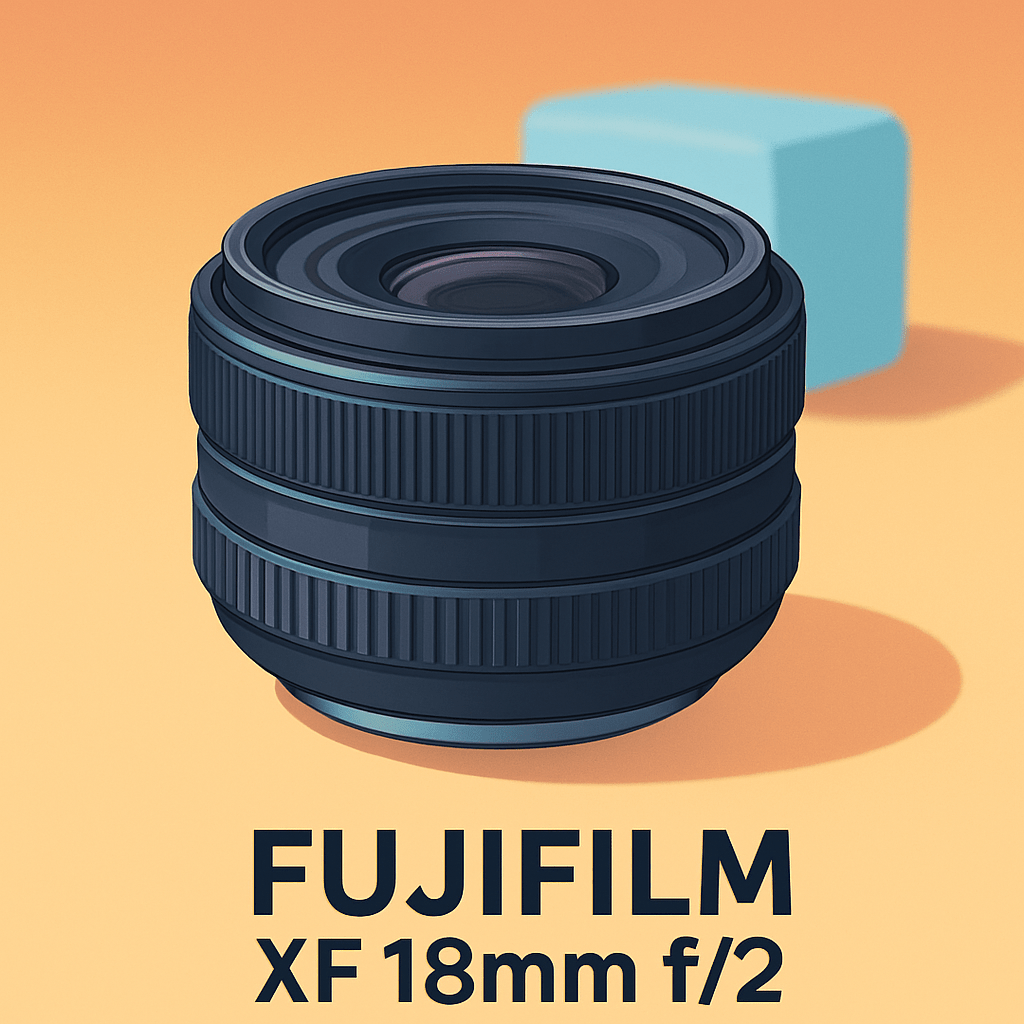
Want a compact wide-angle that makes street and travel shooting feel effortless?
The Fujifilm XF 18mm f/2 R is a tiny wide‑angle prime for Fujifilm X‑mount that gives you a roughly 27mm full‑frame perspective, and it’s aimed at walkaround, street, and documentary shooters.
It’s for photographers who prize low weight, discretion, and quick handling, and I took this little lens out on several shoots to judge how it performs in the real world.
This review digs into build, handling, real‑world performance, sharpness and autofocus, and what those factors mean for everyday use—make sure to read the entire review as I’ll show where the XF 18mm f/2 R truly shines and where it doesn’t, so you can decide if it belongs in your kit.

Fujifilm XF 18mm f/2 R
Compact, lightweight wide-angle prime delivering sharp images and reliable f/2 low-light performance. Fast AF and minimalist design ideal for street shooters and travel photographers seeking discreet, high-quality optics.
Check PriceThe Numbers You Need
| Spec | Value |
|---|---|
| Focal length | 18 mm |
| Maximum aperture | f/2 (maximum) |
| Lens mount | Fujifilm X-mount |
| Equivalent focal length (35mm) | 27 mm |
| Format compatibility | APS-C (Fujifilm X-series) |
| Lens type | Wide-angle prime |
| Optical construction | 10 elements in 7 groups |
| Diaphragm blades | 7 (rounded) |
| Minimum focusing distance | 18 cm |
| Maximum magnification | 0.15× |
| Filter thread size | 52 mm |
| Dimensions (approximate) | 60 mm diameter × 55 mm length |
| Weight | Approx. 116 g |
| Autofocus | Yes, with internal focusing mechanism |
| Weather sealing | No (not weather resistant) |
How It’s Built
The Fujifilm XF 18mm f/2 R is clearly built as a tiny, wide-angle prime that hugs the camera. In my testing it felt like a pancake lens made for discreet carry and quick shooting. That compactness meant I actually brought it more often than heavier lenses.
On smaller X bodies it balances beautifully and almost disappears in hand. On larger bodies it looks petite but still shoots comfortably. For street work that difference matters — you feel less noticed and more flexible with framing.
The controls are simple and honest when you handle it. I found the focus ring moves smoothly with tight tolerances, so nudging focus is predictable and not fussy. Beginners will appreciate that it won’t fight you while composing shots.
Because it focuses internally the front element doesn’t breathe or extend during AF. That makes using screw‑in filters easy and keeps the lens compact in a bag. In practical terms you get fewer surprises from dust or gear bumps while shooting.
The tradeoff is obvious: there’s no weather sealing. After using it in light drizzle I learned to carry a cover or avoid dusty beaches. If you plan to shoot in rough conditions you’ll need to protect it more than a weather‑resistant lens.
What I really liked was how often I reached for it — it’s light, discreet, and effortless to carry all day. One thing that could be better is the lack of weather protection, which limits rough use. For beginners this is a very friendly, portable lens as long as you mind wet and gritty situations.
In Your Hands
The XF 18mm f/2 R’s wide-but-not-too-wide perspective behaves like a natural walkaround view, excellent for street work, travel diaries, environmental portraits and squeezing more of a room into a frame. Its field of view encourages storytelling compositions where context matters as much as the subject, making it an easy go-to for documentary shooting. On wider landscapes you’ll still get useful coverage, though photographers seeking dramatic ultra-wide expanses will feel the limits.
That bright f/2 aperture pays real dividends in everyday shooting: it lets you hold lower ISO and faster shutter speeds under ambient light, and it produces modest subject separation that helps a face or detail pop from a busy background. Bokeh is pleasant and restrained thanks to rounded blades, with smooth transitions rather than aggressive swirly rendering—wide-angle geometry simply keeps out-of-focus areas more controlled than a longer lens would.
Close-focus capability is surprisingly handy for table-top detail and storytelling close-ups, but this isn’t a macro—expect useful tight shots rather than extreme magnification. A common filter thread makes adding an ND or polarizer straightforward for workflow-minded shooters, and the internal focusing keeps the barrel compact and predictable when you work close.
The lens’s tiny footprint and light weight mean you’ll reach for it more often, blending into the scene on the street and staying comfortable all day on travel shoots. The lack of weather sealing does require a little caution in rain or dusty environments—pack a cover or plan shoots around dry conditions. In practice it shines for daylight street/documentary runs, indoor ambient-lit scenes, and travel frames where a natural, contextual 27mm look is preferred.
The Good and Bad
- Very compact and lightweight (approx. 60 × 55 mm; 116 g)
- Wide-angle 18mm (27mm equivalent) suits street, travel, and environmental shooting
- f/2 maximum aperture for low light and moderate subject isolation
- Internal focusing design
- Not weather sealed
- f/2 aperture is slower than f/1.4 alternatives
Ideal Buyer
Anyone who prizes small size and stealth will love the Fujifilm XF 18mm f/2 R on an X-system body. That 18mm on APS‑C gives a 27mm-equivalent field that’s ideal for street, travel and environmental work. It’s the lens you reach for when discretion and effortless carry trump maximum aperture or weatherproofing.
Minimalist kit shooters and travelers who want a true walk‑around perspective will appreciate its pancake footprint. Mounted on a compact X body it balances beautifully and stays out of sight, encouraging more shooting. If you favor keeping weight and bulk to a minimum, this lens makes your camera feel like an extension of your pocket.
The f/2 aperture is useful for low‑light interiors and creating modest subject separation without bulky glass. Close focusing to roughly 18 cm lets you grab near‑subject detail and context shots, though it isn’t a macro. A standard 52 mm filter thread also makes adding ND or polarizers simple for travel workflows.
It’s less suited to shooters who work regularly in rain or dusty conditions because it lacks weather sealing. If you need the ultimate low‑light reach or very shallow depth of field, faster f/1.4 lenses are a better choice. Also avoid this if you require high magnification for dedicated close‑up work; the 0.15x limit is modest.
Better Alternatives?
We’ve already walked through what makes the Fujifilm XF 18mm f/2 R a handy, tiny wide-angle for everyday shooting. It’s light, discreet, and gives a useful 27mm‑equivalent view that’s great for street, travel, and quick environmental shots.
If you find yourself wanting a different field of view, more low‑light power, or weather sealing, there are a few clear alternatives that change how you shoot day to day. Below are the most realistic swaps I’ve used and how they compare to the 18mm in real life.
Alternative 1:

Fujifilm XF 23mm f/2 R WR
Classic 35mm-equivalent field of view in a weather-sealed, portable prime. Crisp rendering, smooth bokeh, and quick autofocus make it perfect for documentary, street, and everyday low-light shooting.
Check PriceThe 23mm f/2 gives a tighter, more classic 35mm look compared to the 18mm’s wider 27mm feel. In practice that means portraits and single‑subject street shots sit better in the frame without having to get so close, and subject separation looks nicer at the same f/2 because of the slightly longer reach.
Where it beats the 18mm: it’s weather sealed, so you can shoot in light rain or dusty places without worrying as much. Autofocus feels a touch snappier and the rendering often looks punchier in everyday scenes. Where it loses to the 18mm is simple — you give up some of that sweeping wide view. If you love the extra context the 18mm gives for interiors or environmental work, 23mm can feel a bit cramped.
Who should pick this: street and documentary shooters who want a classic 35mm field of view, and anyone who needs a small but weather‑resistant walkaround prime. If you care more about staying compact than getting the widest view, this is a very sensible swap.
Alternative 2:

Fujifilm XF 16mm f/1.4 R WR
Super-bright ultra-wide prime with f/1.4 aperture for dramatic low-light scenes and shallow depth control. Robust weather sealing and sharp optics excel for landscapes, astrophotography, and creative wide-angle portraits.
Check PriceThe 16mm f/1.4 is a very different tool: much wider and much faster. In real shooting that extra width makes interiors and dramatic landscapes feel more immersive, and the f/1.4 gives real low‑light reach so you can shoot at lower ISOs or capture night scenes without lugging a tripod.
Compared to the 18mm, the 16mm wins for low light, shallow depth of field effects, and overall image punch — you’ll notice more separation and cleaner results at wide apertures. The trade‑offs are obvious in the field: it’s bigger and heavier, so you lose the stealth and pocketability of the 18mm pancake, and composing faces up close takes more care because of the wider angle.
Who should pick this: people who shoot a lot in low light, landscapes, interiors, or night sky work and don’t mind the extra bulk. It’s for shooters who want the best look and low‑light performance from a wide lens and are willing to carry a larger lens for it.
Alternative 3:
Fujifilm XF 16mm f/1.4 R WR
Ultra-fast wide-angle lens offering exceptional resolution and breath-taking out-of-focus separation at large apertures. Durable build and reliable autofocus handle interiors, environmental portraits, and night-sky photography with ease.
Check PriceTo add a different practical angle on the same 16mm: it’s a lens that changes how you approach a shoot. Where the 18mm invites you to be unobtrusive and quick, the 16mm pushes you to think about dramatic foregrounds and wide compositions. For astrophotography and dramatic environmental portraits, the 16mm’s speed and angle make a big visual difference.
In day‑to‑day use the 16mm outclasses the 18mm when you need crisp stars, bright interiors, or strong subject separation. But if your day is mostly walking around city streets with a small camera, you’ll miss the 18mm’s size and the way it slips into pockets — the 16mm feels heavier and more deliberate on small X bodies.
Who should pick this version: advanced amateurs and pros who prioritize image quality and low‑light ability in a wide lens — especially if you shoot landscapes, night sky, or creative wide portraits. If you value discretion above everything, stick with the little 18mm; if you want visual power and don’t mind the weight, the 16mm is a clear upgrade.
What People Ask Most
Is the Fujifilm XF 18mm f/2 a good lens for street photography?
Yes — its compact size, wide-ish field of view and f/2 aperture make it excellent for unobtrusive street shooting and working in low light.
How sharp is the Fujifilm XF 18mm f/2 at f/2 and stopped down?
Center sharpness is good at f/2 with mild softness in the corners; stopping to f/4–f/8 yields noticeably better edge-to-edge sharpness.
How does the Fujifilm XF 18mm f/2 compare to the XF 23mm f/2 and XF 16mm f/2.8?
The 18mm sits between them: wider than the 23mm for environmental shots and a bit faster than the 16mm, while the 23mm is more classic for portraits and the 16mm gives a much wider angle.
Is the Fujifilm XF 18mm f/2 weather-sealed or dust/splash resistant?
No, the XF 18mm f/2 is not weather-sealed, so use caution in wet or dusty conditions or add protection.
What is the full-frame equivalent focal length of the Fujifilm XF 18mm f/2 on an X-series camera?
On Fujifilm APS-C bodies the 18mm behaves like about a 27mm full-frame equivalent (1.5x crop factor).
Does the Fujifilm XF 18mm f/2 have fast and reliable autofocus for video and stills?
Yes, it focuses quickly and quietly on modern X-series bodies and performs well for both stills and run-and-gun video.
What is the filter size and closest focusing distance of the Fujifilm XF 18mm f/2?
It takes 52mm filters and focuses down to about 0.18 meters (18 cm).
Conclusion
The Fujifilm XF 18mm f/2 R is a tiny, purpose-built wide-angle prime that excels when discretion and portability matter. Its compact, pancake-like presence, useful field of view and practical maximum aperture make it an ideal partner for street, travel and everyday shooting.
Image rendering is pleasing and the lens punches above its size for sharp, usable results in most real-world situations. Close-focus flexibility and smooth out-of-focus transitions are welcome bonuses that extend its utility beyond pure landscapes. It never pretends to be a creative bokeh monster or a macro tool.
Compromises are real and deliberate. There’s no weather sealing and the aperture cadence falls behind larger, faster rivals, so you surrender top-end low-light headroom and all‑weather confidence for the size savings. If you work in rain, dust or demand very shallow depth-of-field, this won’t be your first pick.
My call: buy the XF 18mm f/2 R if you prize stealth, lightness and a flexible wide‑angle perspective more than absolute speed or ruggedness. If your priorities are weather resistance or extreme low‑light performance, look to the alternatives. For the right shooter it’s one of Fuji’s most useful everyday lenses.
Fujifilm XF 18mm f/2 R
Compact, lightweight wide-angle prime delivering sharp images and reliable f/2 low-light performance. Fast AF and minimalist design ideal for street shooters and travel photographers seeking discreet, high-quality optics.
Check Price



0 Comments