
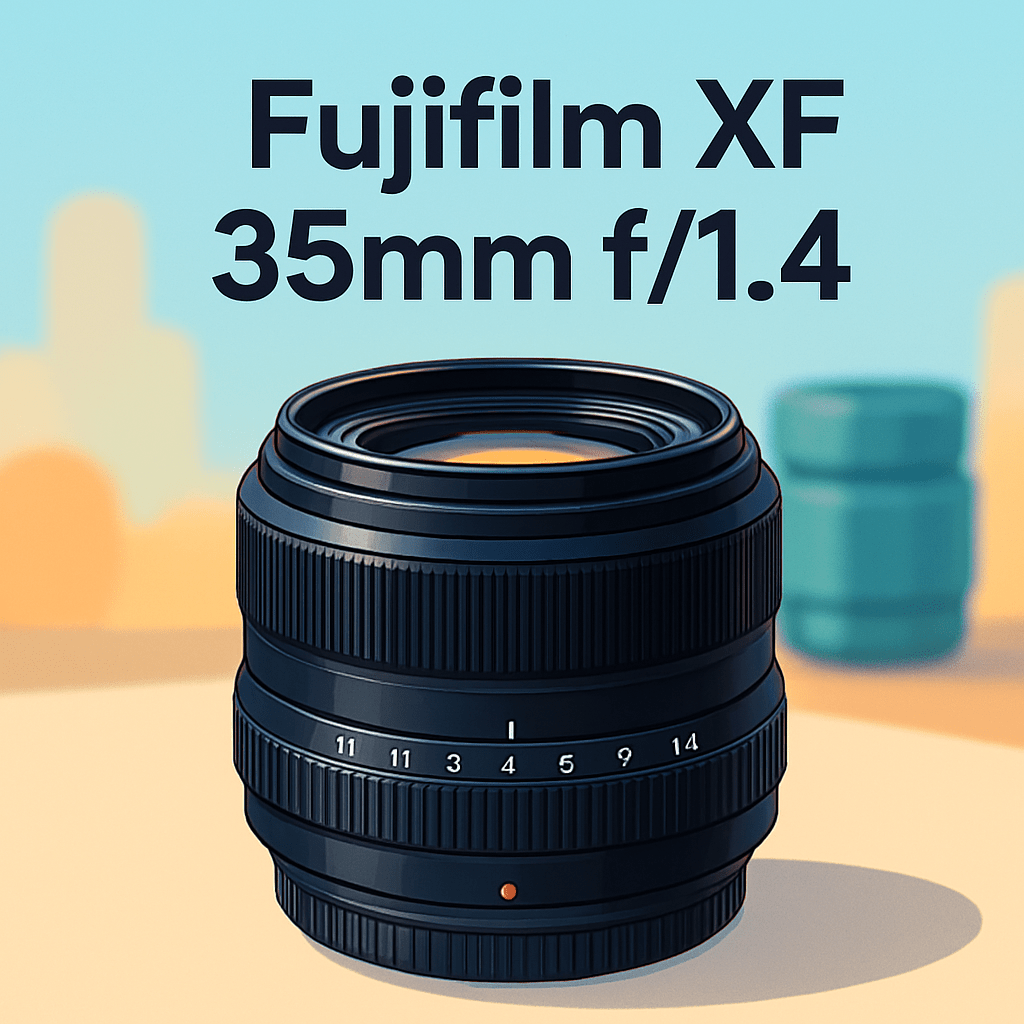
Want a lens that’ll noticeably improve your images in low light and give you creamy subject separation?
The Fujifilm XF 35mm f/1.4 R is a fast normal prime for Fujifilm X cameras, and it’s prized for shallow depth and that classic “normal” perspective on APS‑C bodies.
I took one into real shoots to see how that promise holds up in everyday use. This review covers design, handling, AF behavior, real-world image quality, sharpness, vignetting, pros and cons, and practical alternatives—you’ll want to keep reading.

Fujifilm XF 35mm f/1.4 R
Bright, characterful prime delivering creamy bokeh, punchy colors and excellent low-light performance. Smooth rendering and tactile controls make it a go-to for portraits, street shooting, and expressive shallow-depth images.
Check PriceThe Numbers You Need
| Spec | Value |
|---|---|
| Aperture | f/1.4 |
| Focal Length | 35mm |
| Format | APS-C |
| Equivalent | ~53mm |
| Lens Mount | Fujifilm X |
| Minimum Focus Distance | 28 cm |
| Maximum Magnification | 0.17x |
| Filter Size | 52 mm |
| Elements/Groups | 8/6 |
| Aperture Blades | 7 (rounded) |
| Weight | 187 g |
| Length | ~65 mm |
| Maximum Diameter | ~65 mm |
| Optical Design | Non-stabilized |
| Lens Construction | Metal, high-quality |
How It’s Built
In my testing the Fujifilm XF 35mm f/1.4 R feels like a proper tool — mostly metal, nicely finished, and built to last without being bulky. That premium feel translates to confidence when you’re out shooting all day. I really liked how solid and well-made it feels in the hand.
It’s surprisingly compact and balances really well on typical X-series bodies, so it doesn’t tip the camera forward or feel awkward on a strap. After using it for a while I found it easy to carry around for street work or casual walks. Beginners will appreciate that it won’t wear you out by the end of a shoot.
The aperture ring has good, clear clicks that make changing exposure fast and intuitive without diving into menus. Manual focus is smooth and quick to grab, which is great for candid shots, but the focus throw is a bit short if you’re trying to nail critical focus wide open. That’s the one thing I’d like to see improved for precise portrait work.
The included square hood does a great job cutting flare and protecting the front element on the go. It’s plastic, so it’s light and practical, though not quite as premium as the metal lens body. Also note there’s no optical stabilization, so you’ll want steady hands or a body with IBIS for slower shutter speeds.
In Your Hands
On the Fujifilm XF 35mm f/1.4 R I found autofocus to be confident and repeatable for stills, snapping to subjects with reassuring regularity across typical shooting scenarios. For casual video work the linear AF motor is workable but you’ll notice a bit more mechanical character than the ultra‑quiet, cinema‑style focusing of modern lenses; it’s fine for run‑and‑gun clips but not ideal for dialogue-heavy productions.
The lens’s wide aperture really changes the shooting rhythm in dim interiors and night scenes, with a bright viewfinder image and a shallow plane of focus that makes subject separation effortless. Wide open the rendering feels “creamy” enough to flatter portraits while still preserving texture where it matters, so you can dial in expressive backgrounds without losing subject detail.
Because the design lacks optical stabilization, handheld work rewards steady technique—braced positions, deliberate shutter timing and a forgiving IS or faster shutter on the camera help keep images sharp. Close‑focus capability is useful for everyday detail shots and table‑top work, but it behaves like a close‑up normal rather than a true macro, so you’ll still step back for most environmental portraits.
In routine field use the common filter size makes ND and polarizers convenient to carry, and the supplied square hood does a solid job of taming flare while protecting the front element. Focus accuracy at the widest aperture is generally excellent, with an audible but unobtrusive motor whir and only modest focus breathing—real‑world performance that rewards careful composition and deliberate shooting.
The Good and Bad
- Fast f/1.4 maximum aperture for low light and shallow depth of field
- Compact and lightweight for an f/1.4 (187 g; ~65 mm length/diameter)
- Metal, high-quality construction
- Autofocus with linear AF motor
- Non-stabilized optical design (no OIS)
- 0.17x magnification is not macro-level close focus
Ideal Buyer
If you shoot Fujifilm X and want a classic normal field of view with a fast aperture, the Fujifilm XF 35mm f/1.4 R is made for you. It’s the lens for people who want a roughly 53mm equivalent for everyday shooting with a pleasing, natural perspective.
Portrait shooters, street photographers and low-light shooters who crave subject separation will love the f/1.4 look and bright viewfinder. The metal build and compact footprint make it an easy companion on long days. It excels in dim interiors and city nights.
You’ll appreciate the snappy AF in a lightweight package if you prefer speed and responsiveness over optical stabilization. If you’re comfortable handholding at sensible shutter speeds and using a 52mm filter or the supplied hood, it fits most real-world workflows. Its close-focus ability covers everyday detail shots without being a macro.
Avoid this lens if you need weather sealing or built-in stabilization, but pick it if you prize creamy rendering, tactile controls and an all-round normal prime that feels premium on an X body. It’s especially rewarding for shooters who favor character over sterile clinical sharpness.
Better Alternatives?
We’ve already walked through what the Fujifilm XF 35mm f/1.4 offers: a compact, metal-bodied normal prime that gives you good subject separation and low-light reach. If that lens fits your shooting style, great — but not everyone needs the exact look, size, or handling it provides.
Below are three real-world alternatives I’ve used. I’ll point out what each one does better or worse than the 35/1.4, and who I think should pick them based on real shooting experience — not just specs.
Alternative 1:

Fujinon XF 35mm f/2 R WR
Compact, weather-sealed prime offering crisp optics and quick autofocus in a pocketable package. Ideal for travel and street photographers seeking reliable performance, consistent contrast, and dependable low-light capability.
Check PriceI’ve shot with the 35mm f/2 a lot when I wanted something small, light, and worry-free in bad weather. Compared to the 35/1.4, it’s the easier lens to carry all day — it’s noticeably more compact, and the weather sealing actually lets you keep shooting in drizzle or dusty streets without stressing about the gear.
Where it’s better: faster and quieter autofocus on modern X bodies and much more practical for travel and street work. Where it’s worse: you lose some of the shallow depth and the creamier look of the f/1.4 at wide open apertures, and you can feel that the image character is a bit more neutral. In low light it still performs well, but you’ll need to nudge ISO or shutter speeds sooner than with the f/1.4.
Pick this if you want a daily-carry lens that won’t hold you back in light rain, if you prefer quick, quiet AF for run-and-gun shooting, or if you value a small, unobtrusive setup for street and travel photography.
Alternative 2:

Sigma 30mm f/1.4 DC DN X Mount
Ultra-fast APS-C prime with extraordinary low-light reach and beautiful background separation. Delivers high sharpness, pleasing color rendition and cinematic character—perfect for portraits, vlogging, and creative shallow-depth work.
Check PriceThe Sigma 30mm f/1.4 is a go-to when I need extra light and a very shallow look without spending Fuji lens money. Compared with the Fuji 35/1.4, the Sigma gives you that same creamy background feel but with a touch more low-light headroom and punchy center sharpness.
Where it’s better: faster aperture for lower light and stronger subject separation, which is great for portraits and video. It also often feels like better value for the image quality you get. Where it’s worse: it’s a little heavier and doesn’t match Fuji’s native handling — no weather sealing and on some bodies I’ve had the autofocus be a touch less consistent than Fuji glass, so you may need to double-check focus in critical shoots.
If you’re a portrait shooter, vlogger, or anyone who shoots a lot in dim places and wants that f/1.4 look without paying Fuji prices, this Sigma is a strong pick. Just be ready to accept a bit more bulk and to test focus behavior on your camera before a paid job.
Alternative 3:
Sigma 30mm f/1.4 DC DN X Mount
Fast, compact third-party prime engineered for mirrorless camera users; combines a wide aperture, smooth bokeh and strong center sharpness with solid build quality—versatile for storytelling, documentary, and everyday shooting.
Check PriceComing at the Sigma from a storytelling angle, I often chose it for run-and-gun documentary days where I needed strong subject separation and reliable sharpness in the frame center. The 30mm framing feels just slightly wider than a 35mm and that can be useful when you want more of the scene without stepping back.
Where it’s better than the Fuji 35/1.4: it gives a bit more versatility in tight spaces thanks to the slightly wider view and the bright aperture helps freeze moments in low light. Where it’s worse: it won’t match the Fuji’s metal build and native feel on X bodies, and it still lacks weather sealing — I was careful with it in rough weather. Also, out-of-the-box bokeh character and rendering are different from the Fuji’s classic look, so test if you like its “feel.”
Choose this Sigma if you want a fast, go-anywhere prime for storytelling, documentary, or everyday work where low-light performance and a smooth background are important, but you don’t need weather sealing or the exact Fuji color and handling. It’s a practical, image-first option for creative shooters on a budget.
What People Ask Most
Is the Fujifilm XF 35mm f/1.4 worth buying?
Yes—if you want classic image quality, strong low-light performance and creamy bokeh on Fuji bodies, it’s a keeper; skip it if you need the smallest size or fastest AF.
How sharp is the Fujifilm XF 35mm f/1.4?
Very sharp in the center wide open with peak sharpness around f/2–f/5.6, and corners improve noticeably when stopped down.
How does the Fujifilm XF 35mm f/1.4 compare to the XF 35mm f/2?
The f/1.4 offers shallower depth of field and better low-light reach, while the f/2 is smaller, lighter and has faster, quieter autofocus with similar stopped-down sharpness.
What is the Fujifilm XF 35mm f/1.4 equivalent focal length on APS-C?
On Fuji’s APS-C cameras it behaves like about a 53mm lens on full-frame, giving a standard/short-portrait field of view.
Is the Fujifilm XF 35mm f/1.4 good for portraits and low-light photography?
Yes—the f/1.4 aperture excels at low light and subject separation, making it excellent for head-and-shoulders portraits and ambient-lit scenes.
Does the Fujifilm XF 35mm f/1.4 have autofocus and how fast/accurate is it?
It has autofocus but uses an older AF system that is accurate for stills yet slower and noisier than newer Fuji lenses, and can struggle with fast continuous tracking.
Conclusion
The Fujifilm XF 35mm f/1.4 R is a fast, characterful normal prime for X-mount shooters who put image quality and tactile build ahead of headline features. It pairs a classic rendering and a solid metal feel with reliable autofocus, trading modern extras for photographic personality.
What it does best is deliver subject separation and low‑light capability with an organic look that remains flattering for portraits and street work. Drawbacks are pragmatic: no optical stabilization and a rendering that favors character over clinical edge when you stop down.
If you prize compact, weather‑sealed convenience and fuss‑free AF, the XF 35mm F2 R WR makes more sense. If value, slightly wider framing and punchy modern contrast matter, the Sigma 30mm f/1.4 is a compelling alternative, while the Zeiss Touit suits those after a distinct tonal signature and stopped‑down crispness.
For buyers who prioritize aperture speed, creamy bokeh and a robust metal build this lens remains my pick; it feels purposeful in the hand and in the frame. If your priorities tilt toward stabilization, ultimate autofocus quietness or maximum value, choose the alternative that matches that priority instead.
Fujifilm XF 35mm f/1.4 R
Bright, characterful prime delivering creamy bokeh, punchy colors and excellent low-light performance. Smooth rendering and tactile controls make it a go-to for portraits, street shooting, and expressive shallow-depth images.
Check Price


0 Comments