
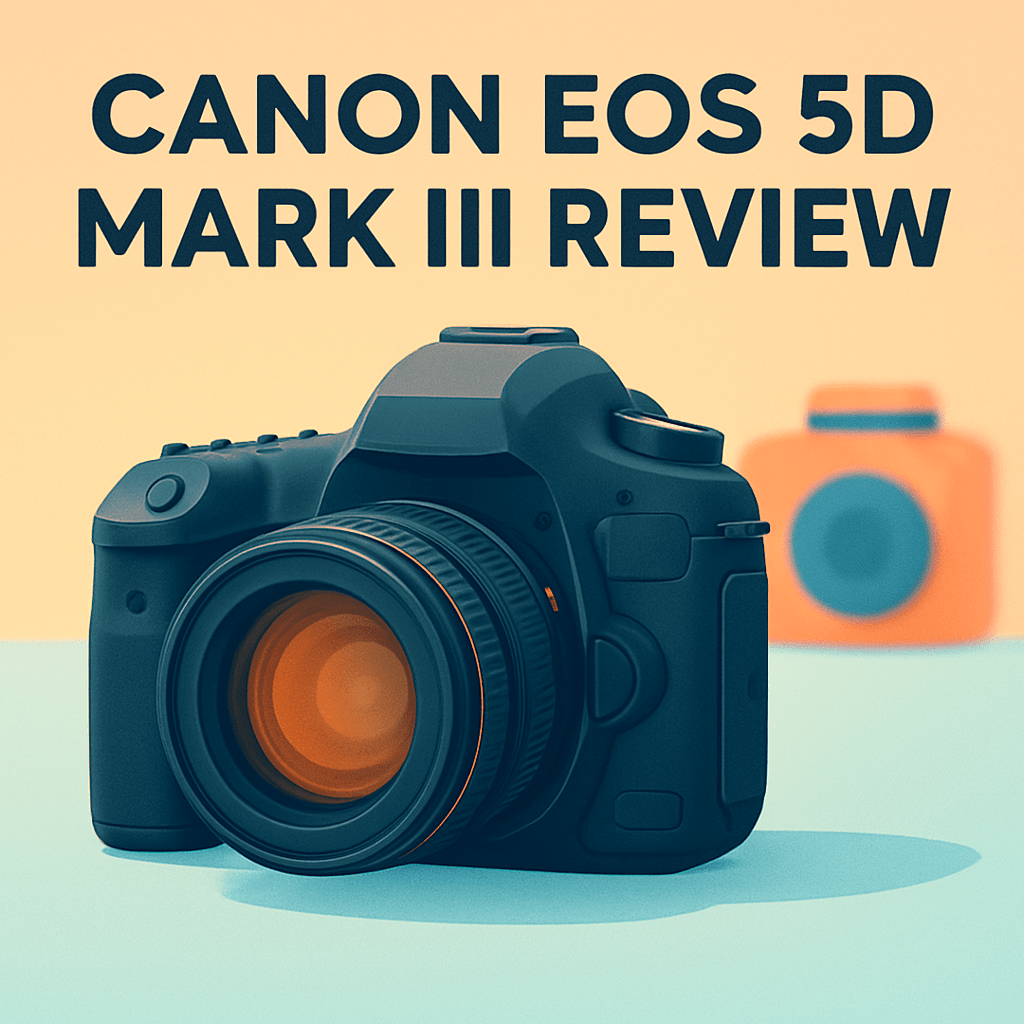
Looking to boost your image quality and trust your gear when the stakes are high?
In this canon eos 5d mark iii review I take a hands-on, photographer-focused look at what this full-frame workhorse really delivers — after field-testing it on weddings, landscapes, and busy events. You’ll get practical takeaways, not just lab numbers.
If you shoot portraits, events, or travel and need reliable AF, long battery life, weather-sealed durability, and dual-card peace of mind, this review’s for you. I’ll cover design, real-world performance, image quality, autofocus, pros and cons, and how it stacks up against rivals — make sure to read the entire review as I reveal when this body truly shines, so keep reading.

Canon EOS 5D Mark III Camera
Reliable full-frame DSLR delivering exceptional image quality and dynamic range for professionals, fast 61-point autofocus, robust build, and dependable performance for demanding studio, wedding, and landscape assignments.
Check PriceThe Numbers You Need
| Spec | Value |
|---|---|
| Sensor | 22.3 MP full-frame CMOS |
| ISO range | 100–25,600 (expandable to 50–102,400) |
| Autofocus | 61-point AF system (41 cross-type points) |
| Continuous shooting | 6 fps |
| Shutter speed | 1/8000–30s; bulb |
| Viewfinder | 100% coverage, pentaprism |
| LCD monitor | 3.2-inch, 1040k dots |
| Dual card slots | CF and SD |
| Video | Full HD 1080p up to 30 fps |
| Weather sealing | Yes |
| Build | Magnesium alloy body |
| Weight (body only) | 950 g |
| Dimensions (WxHxD) | 152 × 116 × 76 mm |
| Battery life | Approx. 950 shots |
| Silent shooting mode | Yes |
How It’s Built
In my testing the Canon EOS 5D Mark III Camera feels built to be used hard. Magnesium-alloy body and weather sealing meant I didn’t worry about light rain or dust on location. That makes it easy to focus on shooting instead of worrying about gear.
It’s solid and a bit heavy, so you feel it after long days. With a big lens it balances well but expect some arm fatigue on long walks. Beginners should try a neck strap and short breaks to avoid fatigue.
The optical viewfinder gives a bright, accurate view so framing is dead-on and satisfying. The rear screen is sharp enough to check focus and exposure, though it can be tough in bright sun. For newcomers this means you can learn to nail focus and composition with minimal fuss.
Dual card slots were one thing I really liked — instant backup and easy file separation made weddings much less stressful. One thing that could be better is the overall size; it’s a professional tool that can feel bulky for casual travel.
Buttons and dials fall under your fingers quickly, which matters when moments are fleeting. After using it I trusted the build to hold up during tough shoots and heavy use. It’s the kind of body that inspires confidence when a job can’t fail.
In Your Hands
In the field the 5D Mark III feels responsive, waking quickly and delivering a steady burst rate that handled wedding sequences and moderate action. The shutter is decisive and flexible — fast for bright-aperture shooting and capable of long exposures for night or creative blur.
Its multi-zone metering proved dependable in mixed lighting, rarely needing large exposure corrections in backlit or high-contrast scenes. In tricky light I still used spot checks and exposure compensation, but the system offered consistent, predictable results.
Battery life is one of those comfort features you notice midway through a long day; it easily powered full-day assignments with conservative power management and left room for extra shooting after a quick card swap. I still recommend carrying a spare and using the camera’s dual-card workflow for peace of mind during critical jobs.
Silent-shooting mode is genuinely useful during ceremonies and quiet moments, letting you stay unobtrusive without sacrificing focus or timing. The quiet option is a practical tool for documentary and editorial work where discretion matters.
For video this body delivers solid full-HD performance suited to interviews, behind-the-scenes work and web delivery, though it’s not aimed at high-end cinema. Combined with weather sealing and redundant card slots, the camera inspires confidence when conditions or stakes are unpredictable.
The Good and Bad
- Full-frame 22.3 MP CMOS for versatile stills work
- 61-point AF with 41 cross-type points for precise focusing
- Dual CF + SD card slots for redundancy and flexible workflow
- Weather-sealed magnesium alloy body for durability in the field
- Video limited to 1080p/30 (no 4K capture)
- Heavier body at ~950 g compared with some full-frame options
Ideal Buyer
If you prize dependable full-frame stills and a tactile, optical viewfinder experience, the Canon EOS 5D Mark III Camera is built for you. It’s a photographer-first tool that rewards careful composition with consistent color and detail from its 22.3MP sensor and time-tested 61-point AF array. Choose it if framing confidence, precision focusing, and an OVF that gives you 100% coverage are priorities in your work.
This body excels for pro and enthusiast shooters covering weddings, portraits, corporate and editorial assignments, and travel where durability matters. Weather-sealed magnesium construction, dual CF/SD card slots, and long battery life mean you can shoot full days with client-safe redundancy. Silent mode and a 6 fps burst rate make it practical for ceremonies, events and controlled-action sequences.
Skip it if modern 4K, mirrorless ergonomics, or ultra-high burst rates are central to your workflow; shooters who need run-and-gun video AF or the lightest travel kit may prefer newer bodies. But if you want a balanced, field-ready full-frame DSLR that prioritizes consistency, backup options and robust build for demanding shoots, the 5D Mark III remains a compelling, workhorse choice.
Better Alternatives?
We’ve already dug into the Canon EOS 5D Mark III in that canon eos 5d mark iii review — its solid build, reliable AF, full-frame look, and long battery life make it a camera many pros still reach for. But no single body fits every job or every photographer’s workflow, so it’s worth looking at a few nearby choices before you decide.
Below are three real-world alternatives I’ve used in the field. I’ll point out where each one wins or falls short compared to the 5D Mark III, and who I think would prefer each option based on how they shoot day to day.
Alternative 1:

Canon EOS 5D Mark IV Camera
Advanced full-frame shooter with high-resolution sensor, 4K video, fast continuous shooting, Dual Pixel autofocus, and built-in connectivity — ideal for professional photographers and hybrid photo/video creators.
Check PriceI’ve shot a lot with both the 5D Mark III and the Mark IV. The Mark IV gives you more resolution and, importantly for everyday shooting, Canon’s Dual Pixel AF in live view. That makes focusing when you’re using the screen — and shooting video — much easier and more reliable than the 5D III. For portraits and landscapes the extra detail is immediately useful; for weddings or run-and-gun work the better live view AF saves time and stress.
What the Mark IV trades off is file weight and workflow complexity. The bigger files eat more card space and slow my laptop during tethered sessions, so you’ll need faster cards and more storage. The Mark IV also pushed me to rethink heats and 4K workflow — it adds capability, but also extra steps and larger exports compared to the simpler 5D III setup. And if you value the exact same feel and proven rugged simplicity of the 5D III, the Mark IV’s changes can be more of an adjustment than an obvious upgrade.
If you shoot both stills and video, or you want higher resolution for large prints and cropping, you’ll like the Mark IV. I recommend it for hybrid shooters, portrait photographers who want cleaner, sharper files, and pros moving into more video work. If you care most about a tried-and-true, straightforward stills workflow or need the lightest post-process load, the 5D III still holds its ground.
Alternative 2:

Nikon D750 Camera
Versatile FX-format camera offering impressive low-light sensitivity, expressive dynamic range, and fast continuous shooting—perfect for wedding, portrait, and travel photographers seeking reliable handheld performance and image clarity.
Check PriceThe Nikon D750 is a camera I’ve carried on long travel and wedding days when weight and low-light performance mattered. Compared to the 5D Mark III, the D750 feels lighter in the hand and lets you stay on your feet longer without the same fatigue. In dimly lit receptions and late-night streetscapes I found the D750’s files cleaner in the shadows and easier to pull back without nasty grain, which can be a real time saver in post.
Where the D750 loses to the 5D Mark III is in professional workflow features that some pros count on. The 5D III has dual card slots for instant backup or overflow — the D750 has a single slot — and many will miss that insurance at higher-stakes shoots. The D750’s autofocus and overall feel are excellent for most work, but if you rely on the 5D III’s exact button layout, weather sealing, and long-term ruggedness you might miss those familiar touches.
Pick the D750 if you’re a travel, wedding, or portrait shooter who values lighter gear, great high-ISO files, and comfortable handling over long days. It’s also a smart choice if you want strong image quality without stepping into heavier, more complex files or workflows. I’ve reached for it when I needed to move fast and keep noise under control.
Alternative 3:
Nikon D750 Camera
Compact, ergonomic full-frame body with a tilting LCD, responsive autofocus, and excellent ISO performance for on-the-go creatives who prioritize comfort, fast operation, and stunning color reproduction.
Check PriceSeen from another angle, the D750’s tilting screen and ergonomics make it a very pleasant camera for run-and-gun shooting. I used it on street assignments and small commercial jobs where a quick, comfortable camera helped me stay nimble. Its color rendering and the way it handles midtones made skin and natural scenes look pleasing straight out of camera, which cut down my time in editing compared with some workflows on the 5D III.
That said, the D750 isn’t a perfect one-for-one swap for the 5D Mark III. If you rely heavily on dual-card redundancy, or need the same weather toughness and long track record some pros favor in the Canon body, the 5D III still pulls ahead. Also, if you’re already invested in Canon glass and Canon-only accessories, switching to Nikon adds transition costs that aren’t about image quality but do matter in a working setup.
I’d recommend this version of the D750 for on-the-go creatives who want comfort, fast operation, and great color without the bulk. It’s a great alternative for photographers who place mobility and low-light strength above absolute professional backup features — think travel shooters, documentary photographers, and small-studio creatives who need a reliable, pleasant camera to shoot with all day.
What People Ask Most
Is the Canon EOS 5D Mark III still worth buying?
Yes — it’s still a solid value on the used market for photographers who want a rugged full-frame body and great image quality, but newer models offer better autofocus, resolution and modern features.
How good is the Canon 5D Mark III for video?
It records clean 1080p video and delivers good color, but it lacks 4K, modern AF like Dual Pixel and some video conveniences, so it’s limited for heavy video work.
What are the differences between the Canon 5D Mark III and 5D Mark IV?
The Mark IV adds a 30MP sensor, 4K video, Dual Pixel AF, touchscreen and built‑in Wi‑Fi/GPS with improved high‑ISO performance, while the Mark III is 22MP and missing those modern features.
How many megapixels does the Canon 5D Mark III have?
The 5D Mark III has a 22.3‑megapixel full‑frame sensor.
Which lenses are best for the Canon 5D Mark III?
Pick full‑frame L‑series lenses like the 24‑70mm f/2.8 II for general use, 70‑200mm f/2.8 for portraits/action, and fast primes (50mm/1.4 or 85mm/1.8) for low light and portraits.
What is the battery life of the Canon 5D Mark III?
With the LP‑E6 battery it’s rated around 950 shots (CIPA); expect roughly 800–1,200 shots in real use depending on LCD, AF and flash usage.
Conclusion
The Canon EOS 5D Mark III Camera remains a rock‑solid workhorse for photographers who put reliability and image quality first. Its character is obvious: dependable autofocus, a reassuringly rugged, weather‑sealed build, dual‑slot workflow and an optical viewfinder that keeps you connected to the moment. In practice the body simply delivers consistent results when it matters most.
That practicality comes with trade‑offs you should acknowledge before buying. The camera is on the heavier side and its video and live‑view capabilities lag behind more recent hybrid models. If your priorities are cutting‑edge video formats or the lightest carry, you’ll notice the limitations.
This is a camera for shooters who value durability, steady AF and a proven stills tool that won’t quit on long assignments. Wedding, event and commercial photographers will appreciate the redundancy, battery stamina and confident handling during marathon shoots. Fans of an optical viewfinder and tactile controls will feel right at home.
My recommendation is direct: choose the Canon EOS 5D Mark III Camera if you need a balanced, field‑ready DSLR built around stills performance and reliability. Consider newer alternatives only if you require higher resolution, stronger live‑view/video autofocus or 4K workflows. For many pros who prioritize dependability over bells and whistles, this body still represents honest value today.
Canon EOS 5D Mark III Camera
Reliable full-frame DSLR delivering exceptional image quality and dynamic range for professionals, fast 61-point autofocus, robust build, and dependable performance for demanding studio, wedding, and landscape assignments.
Check Price


0 Comments