
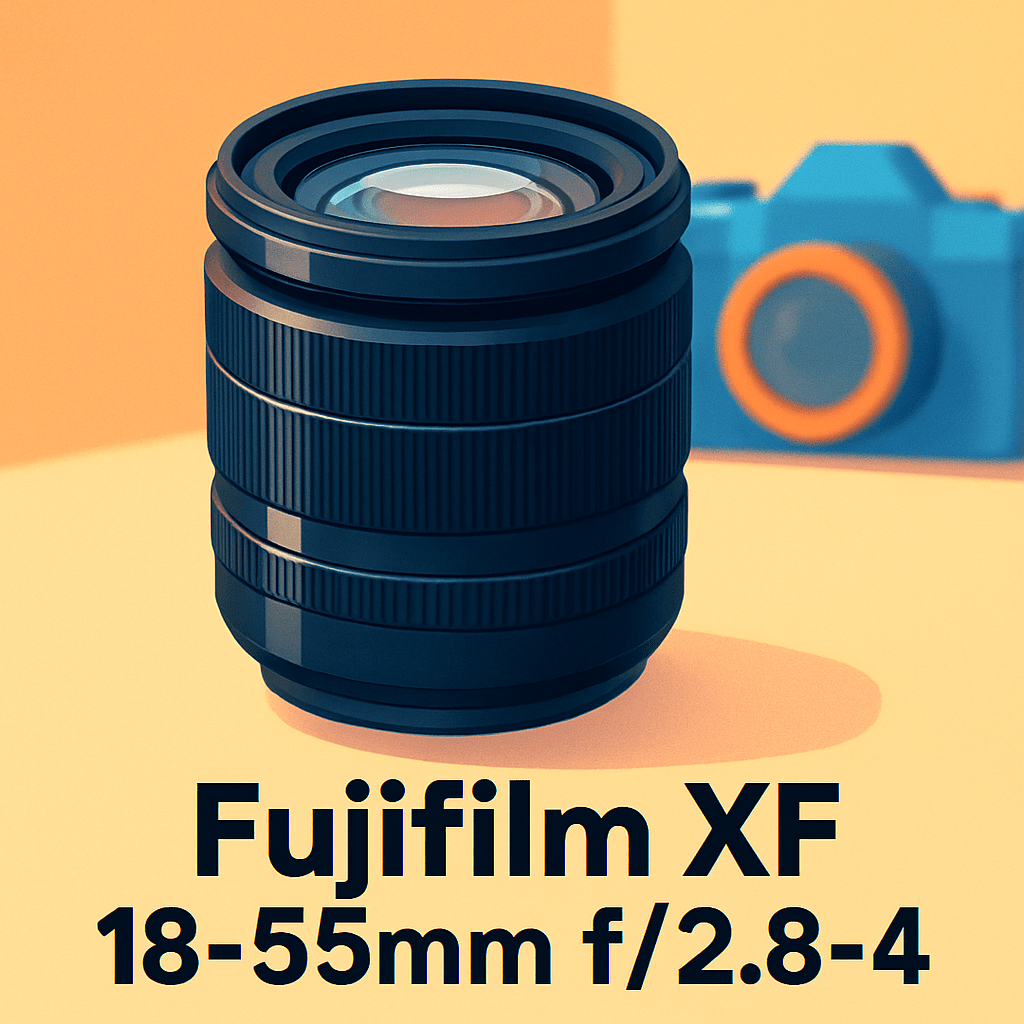
Looking for one lens that’ll cover street shots, travel snaps, and everyday portraits without dragging your bag down?
The Fujifilm XF 18-55mm f/2.8-4 R is Fujifilm’s compact, stabilized standard zoom for X-mount APS‑C bodies, and I’ve put it through its paces in the field to see how it performs where it matters.
It’s built for photographers who want a versatile, lightweight walkaround lens with image stabilization and pleasing background rendering, though it isn’t weather sealed and makes some trade-offs for size. Make sure to read the entire review as I dig into handling, real-world performance, sharpness, autofocus, and whether it’s the right everyday lens for you — keep reading.

Fujifilm XF 18-55mm f/2.8-4 R
Compact standard zoom offering bright variable aperture for excellent low-light performance and shallow depth of field. Ideal for travel and portraits, with sharp optics, responsive autofocus, and durable metal construction.
Check PriceThe Numbers You Need
| Spec | Value |
|---|---|
| Focal length | 18–55 mm |
| Maximum aperture | f/2.8–4 |
| Lens mount | Fujifilm X-mount |
| Format compatibility | APS-C (crop factor ≈ 1.5×) |
| Optical image stabilization | Yes (OIS) |
| Autofocus motor | Linear motor (LM) |
| Minimum focusing distance | 0.3 m (11.8 in) |
| Maximum magnification | 0.15× |
| Number of aperture blades | 7 |
| Lens construction | 12 elements in 9 groups |
| Filter thread size | 58 mm |
| Dimensions (approx.) | 68.4 mm diameter × 69.4 mm length |
| Weight | 310 g (approx.) |
| Aperture type | Rounded diaphragm (smooth bokeh) |
| Weather sealing | No (not weather resistant) |
How It’s Built
In my testing the Fujifilm XF 18-55mm f/2.8-4 R feels like a friendly, well-balanced walkaround lens. It’s compact and light on typical X-series bodies, so it doesn’t make your camera feel front-heavy or awkward to carry around for a full day.
The zoom and focus rings have a pleasantly predictable resistance — not too stiff, not floppy — and I didn’t notice any annoying play while zooming. The front element doesn’t extend wildly, so using a 58mm filter is straightforward and practical for everyday filters like NDs and polarizers.
What I really liked was the built-in stabilization and the overall small size, which made handheld shooting easier and more relaxed. One thing that could be better is the lack of weather sealing, so I avoided shooting in heavy mist or rain during my tests.
For beginners this means less bulk in your bag and easier handling on city walks or family outings. Just remember to pack a small rain cover if you expect bad weather, and buy common 58mm filters once you want to experiment with creative effects. Overall, it’s an approachable, well-made lens that’s easy to live with.
In Your Hands
The 18–55mm range proves to be an excellent everyday companion, shifting easily from roomy wide-angle scenes to short-tele framing that flatters environmental portraits and street work. In practice it covers landscapes, walkaround reportage, and close-in details without calling attention to itself, making it a go-to when you want one lens to handle most day-to-day situations.
Built-in stabilization changes the shooting equation: handheld shots feel noticeably steadier and you can push shutter speeds lower than you’d otherwise try without feeling like every frame is a gamble. For panning or deliberate motion work you’ll want to experiment with the stabilizer on versus off, but for steady handheld landscapes and candid portraits OIS is a real practical benefit.
The variable maximum aperture means exposure and depth of field shift as you zoom, so low-light strategy and background separation are more effective at the wider end. On APS-C bodies the field of view sits squarely in the wide-to-short-tele realm, so working distances are comfortable for street shooting and mid-length portraits but the lens won’t substitute for a dedicated portrait or macro optic.
Close-focus capability lets you get pleasing detail shots and tight compositions without changing lenses, though it stops short of true macro magnification. The rounded diaphragm contributes to smooth foreground-to-background transitions and a generally pleasing bokeh character that keeps subjects isolated without harsh rings.
In challenging backlit scenes the design tames flare and ghosting more often than not, so you can push contrast without losing much detail. Expect mild vignetting or a touch of distortion near the extremes in real-world frames, but these are unobtrusive in most handheld use and easy to work with during editing if you need perfect geometry.
The Good and Bad
- Optical image stabilization (OIS)
- Linear Motor autofocus
- Compact and lightweight: ~310g; 68.4 x 69.4mm
- Versatile focal range: 18–55mm (APS-C)
- Not weather resistant
- Variable maximum aperture f/2.8–4 (not constant across the zoom)
Ideal Buyer
The Fujifilm XF 18-55mm f/2.8-4 R is perfect for photographers who want one lens to handle most days and every common assignment. Its compact weight and OIS make it a true walkaround on Fujifilm X APS-C bodies, with a versatile roughly 27–82.5mm full-frame equivalent reach. Linear-motor AF keeps things quick and unobtrusive for street, travel, family work, and casual event shooting.
Choose this zoom if you prioritize a light, stabilized package over a heavy pro zoom or a constant aperture, and if you value everyday versatility more than ultimate low-light speed. The 0.3m close-focus and rounded 7‑blade diaphragm give pleasing background separation and practical near-detail shots without needing a separate macro or fast portrait lens. If you routinely shoot in driving rain or need a consistent f/2.8 across the range for subject isolation, look elsewhere.
It’s an excellent upgrade for kit-lens users or travelers who want noticeably better handling and image quality than the smallest pancake alternatives, while still keeping a pocketable profile. Hybrid shooters — stills-first vloggers and everyday documentarians — will like the balance of focal range, OIS, quiet AF and subtle bokeh for mixed photo and video days. Professionals who demand weather sealing, extreme low-light reach, or high magnification should consider the more specialized options that sacrifice weight and convenience for performance.
Better Alternatives?
We’ve gone over what the Fujifilm XF 18-55mm f/2.8-4 R does well — it’s light, stabilized, and a solid everyday zoom for Fujifilm X bodies. It’s a great walkaround lens that balances size, sharpness, and convenience for most shooters.
If you need something different—more constant low-light speed, much more reach, or an all-in-one travel lens—there are clear alternatives. Below are three lenses I’ve used in the field that cover those needs, with honest notes on where each wins and where it gives up compared to the 18-55.
Alternative 1:

Fujifilm XF 16-55mm f/2.8 R
Pro-grade constant-aperture zoom delivering consistent f/2.8 brightness across the range for outstanding edge-to-edge sharpness. Built for demanding work—fast focus, robust handling, and reliable performance in varied conditions.
Check PriceThe XF 16-55mm f/2.8 is the one I reach for when I need the absolute best image quality and consistent low-light performance. Compared to the 18-55, it gives you a constant f/2.8 across the zoom, so exposure and background separation stay predictable as you zoom. In real shoots that matters: shooting events or portraits, you get cleaner shots and shallower backgrounds without bumping ISO.
Where it loses to the 18-55 is size and convenience. The 16-55 is noticeably bigger and heavier, and it doesn’t have built-in OIS, so handheld low-light work needs either a stabilized body or faster shutter speeds. I’ve felt the trade-off: tack-sharp results for a heavier kit and less forgiving handholdability.
If you’re a pro or an enthusiast who shoots events, portraits, or anything where constant f/2.8 and edge-to-edge sharpness matter, you’ll prefer the 16-55. If you want a light, stabilized daily lens instead, stick with the 18-55.
Alternative 2:

Fujifilm XF 18-135mm f/3.5-5.6 R
Versatile all-in-one zoom covering wide to telephoto for travel, street, and wildlife. Long reach eliminates frequent lens changes, offering reliable sharpness, smooth autofocus, and compact handling for grab-and-go shooting.
Check PriceThe XF 18-135mm is my go-to when I want one lens to do everything on a trip. Compared to the 18-55, the biggest win is reach: you suddenly have a lot more framing options without swapping glass. That makes it fantastic for travel, street, and casual wildlife where carrying two lenses is a pain.
You give up some things for that convenience. The 18-135 is slower at the long end, so low-light and shallow depth-of-field shots won’t be as punchy as with the 18-55 at its wide end. It’s also a bit larger and, in my experience, slightly softer near the long end — still usable, but not as crisp as the 18-55 in the short range.
If you’re a traveler, parent, or content creator who wants one-lens simplicity and the ability to reach distant subjects, choose the 18-135. If you value lighter weight and the faster wide end of the 18-55 for portraits and low light, you might prefer to keep the 18-55 as your primary walkaround.
Alternative 3:
Fujifilm XF 18-135mm f/3.5-5.6 R
One-lens solution with a broad focal range ideal for families, vacations, and video. Delivers balanced image quality, steady framing, quiet focusing, and convenient portability for uninterrupted creative exploration.
Check PriceI’m repeating the 18-135 here because it really covers two common use cases: travel stills and run-and-gun video. In video work it’s nice that focus is smooth and framing doesn’t change because you don’t need to swap lenses. Against the 18-55, the 18-135 lets you capture distant moments without breaking flow — useful for family events or one-person shoots.
The downside again is image speed and ultimate sharpness. When I need the nicer background blur or to work in dim light handheld, the 18-55 feels more capable at the wide end thanks to the f/2.8–4 range and slightly better handling. The 18-135 trades that for convenience and reach, and that trade-off makes sense for many casual shooters.
Pick the 18-135 if you want a single, flexible lens for vacations, family days, or videos where you don’t want to change glass. Pick the 18-55 if you prefer a lighter, stabilized zoom with a brighter wide end for portraits and low-light shooting.
What People Ask Most
Is the Fujifilm XF 18-55mm f/2.8-4 a good lens?
Yes — it’s widely regarded as an excellent kit zoom with sharp optics, fast autofocus and a very useful focal range.
Is the Fujifilm XF 18-55mm f/2.8-4 weather-sealed?
No, the XF 18-55mm is not weather-sealed, so avoid heavy rain or use extra protection in harsh conditions.
Does the Fujifilm XF 18-55mm f/2.8-4 have image stabilization?
Yes, it features built-in optical image stabilization (OIS) that helps with handheld low-light shooting.
What is the equivalent focal length of the Fujifilm XF 18-55mm f/2.8-4 on APS-C?
On Fujifilm’s APS-C bodies the 1.5x crop gives an equivalent field of view of about 27–82.5mm in 35mm terms.
How sharp is the Fujifilm XF 18-55mm f/2.8-4?
Very sharp in the center across the range and improves when stopped down; edges are slightly softer wide open but still excellent for most uses.
What filter size does the Fujifilm XF 18-55mm f/2.8-4 use?
It uses a 58mm filter thread.
Conclusion
The Fujifilm XF 18-55mm f/2.8-4 R is the sort of standard zoom that earns its keep every day. It combines in-lens stabilization with a responsive linear-motor autofocus in a compact, walkaround-friendly package. That blend makes it immediately useful for shooters who value mobility and reliability.
In the field it consistently delivers practical performance: steady handheld framing, quick AF acquisition, and pleasing background rendering that keeps subjects distinct without theatrical separation. Sharpness is honest where it matters for streets, portraits and landscapes. The optical character is versatile rather than attention-grabbing, which is exactly its intent.
There are clear trade-offs to accept; it lacks weather sealing, the maximum aperture varies as you zoom, and close-focus capabilities are modest compared with dedicated macro or pro telezoom options. It won’t satisfy photographers who insist on constant wide apertures or rugged, weatherproof construction. For routine daily work those concessions feel reasonable and well judged.
Bottom line: this is the balanced, handheld-friendly zoom I reach for when I want one lens to cover most jobs without fuss. If you need pro-grade low-light or build toughness, consider the 16–55; if reach or all-in-one convenience matters, the 18–135 is the alternative, and the XC 15–45 remains the smallest compromise. For its target audience the Fujifilm XF 18-55mm f/2.8-4 R is excellent value and a smart daily driver.
Fujifilm XF 18-55mm f/2.8-4 R
Compact standard zoom offering bright variable aperture for excellent low-light performance and shallow depth of field. Ideal for travel and portraits, with sharp optics, responsive autofocus, and durable metal construction.
Check Price

0 Comments