
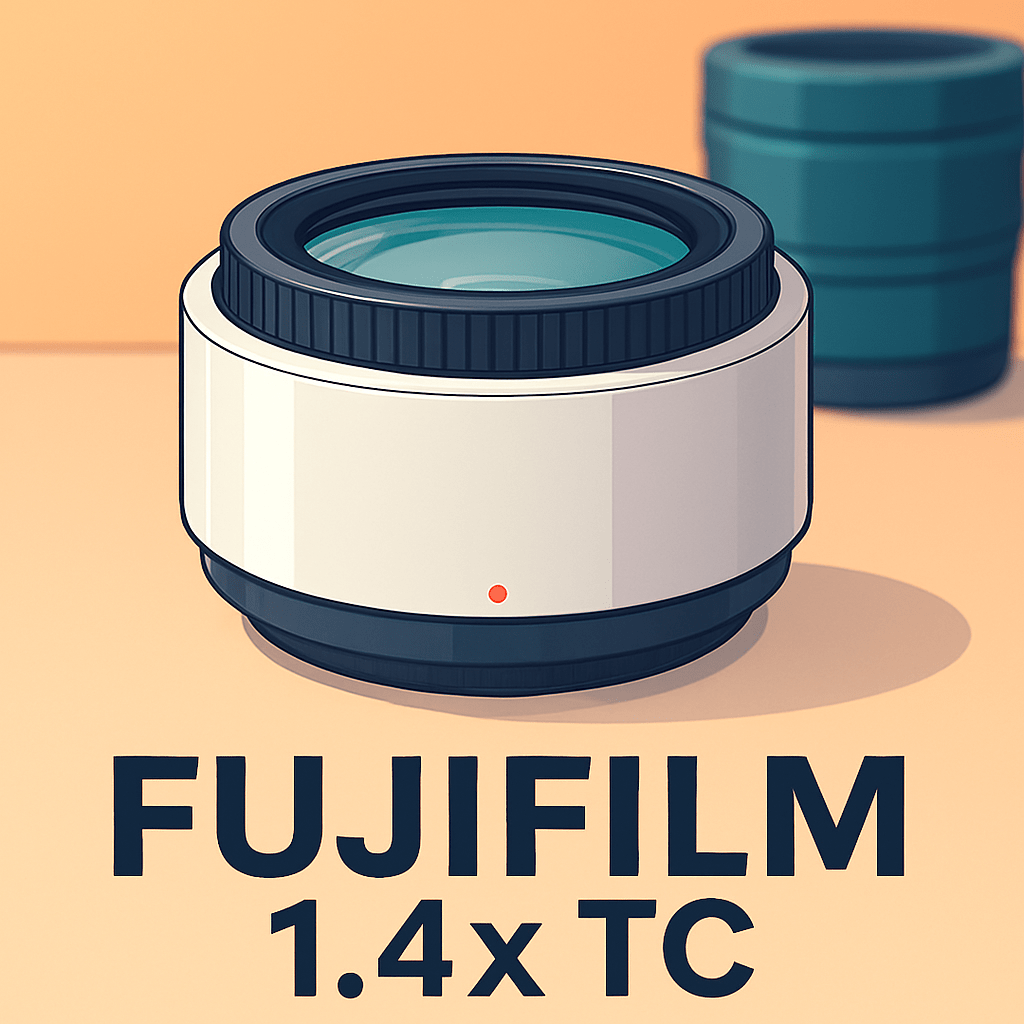
Want a little extra reach without lugging a longer lens?
The Fujifilm XF 1.4x TC promises that boost in a tiny, weather-ready package.
I’ve taken it into the field on wildlife and travel shoots, and it’s clearly aimed at photographers who want modest reach, portability, and dependable handling.
There are trade-offs: about a one-stop light loss, possible AF slowdown, and slight sharpness loss.
They matter in low light or fast action, but aren’t dealbreakers for many shoots.
I’ll walk through real-world performance, handling, and when this converter makes sense for your kit; you’ll want to keep reading.

Fujifilm XF 1.4x TC
Compact teleconverter boosts focal length by 1.4x for X-series cameras, preserving sharpness and contrast with multi-coated optics; ideal for wildlife and sports when you need extra reach without changing lenses.
Check PriceThe Numbers You Need
| Spec | Value |
|---|---|
| Product type | Teleconverter |
| Magnification factor | 1.4× |
| Compatibility | Fujifilm X-mount lenses |
| Mount type | Metal bayonet mount |
| Weather resistance | WR (Weather Resistant) |
| Aperture change | Reduces maximum aperture by 1 stop |
| Autofocus support | Supports autofocus with compatible lenses |
| Impact on sharpness | Minimal to moderate reduction possible |
| Optical design | Multi-element glass optics |
| Coatings | Anti-reflective coatings for flare/ghosting reduction |
| Size | Compact and lightweight |
| Weight | Approximately 120 grams |
| Operating temperature range | Suitable for typical outdoor conditions |
| Build quality | Robust, weather-sealed construction |
| Intended use | Extends focal length without needing longer lenses |
How It’s Built
In my testing the Fujifilm XF 1.4x TC feels like a proper outdoor tool. Its weather-sealed body gave me real confidence shooting in drizzle and dusty trails without panicking over a single drop.
The metal bayonet mount clicks home snugly and felt precise on every lens I tried. For beginners that means less fuss and fewer worrisome wobbles when mounting or removing gear.
The glass elements have coatings that cut down flare and ghosts. When I shot into the sun I saw cleaner contrast and fewer stray highlights than I expected.
It’s compact and light, so it doesn’t turn a telephoto into a front-heavy monster. I used it on a few common XF long lenses and the balance stayed natural for handheld work.
What I really liked was how rugged and weather-ready it felt in the field. What could be better: on one camera body I noticed a tiny bit of play during very fast swaps, so be mindful when changing lenses quickly.
For beginners that means you can add reach without bulk and still trust your gear outdoors. After using it for a while it became one of those small accessories I grabbed for most shoots.
In Your Hands
Mounted on a mid-tele prime, the Fujifilm XF 1.4x TC feels like an honest extension of the lens rather than an attachment, adding meaningful reach without upsetting balance or turning your kit into a tripod-only setup. Its weather-resistant construction translated to confidence shooting in mist and dust, and the metal bayonet sits firm with no perceptible play when panning for birds or follow-focus sports sequences. In practice the combination stays light enough for long handheld stints, which is exactly where this converter earns its keep.
Autofocus performance is very usable in good light—continuous tracking acquires and holds moving subjects with a smoothness that kept me on target during field sports and active wildlife sessions. In lower light the system shows a touch more hesitation and occasional hunting, particularly with slower zooms, so expect a small drop in snap-to-focus speed rather than an outright failure. Paired with faster primes the slowdown is less noticeable, and AF consistency depends on the lens/body pairing more than the converter alone.
The TC reduces available light, so you’ll often lean on higher ISO or slightly slower shutter choices; handheld usability remains practical thanks to in-camera stabilization and steady technique, though the margin for blur narrows. Stabilization still helps, but you feel that the system needs a little more care to keep shots perfectly sharp compared with shooting the bare lens. For run-and-gun shooting I found subtle operational quirks—effective aperture reporting in metadata reflects the converter and focus breathing is barely noticeable—but nothing that interfered with getting the images I wanted in real conditions.
The Good and Bad
- 1.4× reach without major size/weight penalty
- Weather-resistant, robust build for outdoor work
- Compact and lightweight (~120 g)
- AF supported on compatible lenses
- 1-stop light loss impacts exposure flexibility
- AF performance may slow or become less consistent in low light or with certain lenses
Ideal Buyer
The Fujifilm XF 1.4x TC is ideally suited to X-series shooters who want a meaningful reach boost without buying bigger glass. It adds 40% more focal length with only a one‑stop light penalty, so you keep much of the original lens character.
Wildlife and field sports photographers will appreciate the extra reach and weather‑resistant construction when working outdoors. Travel and landscape shooters who prize low weight and compact packing will like its roughly 120‑gram footprint and metal bayonet fit. For handheld situations it’s an elegant compromise between reach and manageability.
If you prioritize system integration, reliable AF on supported lenses, and rugged build over squeezing every millimeter of reach, this teleconverter is a natural choice. It’s made for photographers who need a dependable, field‑ready tool rather than a budget stopgap.
Skip it if you need full 2× reach, zero light loss, or absolute clinical sharpness at the longest distances. Also consider alternatives if you rely on unsupported lenses or want the lowest possible price, because third‑party options cost less but trade off sealing and AF predictability.
In short, buy the XF 1.4x TC if you shoot action in mixed conditions and want a compact, reliable way to extend reach. It’s the sweet spot for serious amateurs and pros who favor performance and portability over headline numbers.
Better Alternatives?
We’ve already gone through the Fujifilm 1.4× TC and what it brings to an X-system kit — a reliable way to gain reach with a small weight penalty and mostly solid AF and image quality on supported lenses. It’s a strong, weather-sealed option if you shoot outdoors and need a modest boost without hauling a longer lens.
If you want more reach, a cheaper option, or need a converter for a different mount, there are sensible alternatives. Below I list a true Fujifilm 2× option and a couple of Kenko teleconverters you might consider, with real-world notes on how they stack up against the Fujifilm 1.4× TC.
Alternative 1:

Fujifilm XF 2x TC
Double length converter extends reach by 2x for X-series primes, engineered to preserve autofocus and image quality with precision-coated optics; a portable solution for distant subjects like wildlife and sports photography.
Check PriceThe Fujifilm XF 2× TC gives you twice the focal length, which is the simplest way to get much closer to birds and distant sports without buying a new super-tele. I’ve used it when reach mattered more than every last bit of sharpness — it lets you sit further away and still fill the frame. Compared to the 1.4× TC, the reach gain is huge, but so is the cost: you lose two stops of light, so you’ll need faster shutter speeds or higher ISO in the field.
In real shooting the 2× shows more softness and lower contrast than the 1.4× on many lenses, especially at wide open apertures. Autofocus can be slower and less reliable in low light or on smaller, slower-focusing lenses — I’ve had to back off to single-shot AF or use higher ISO to keep tracking stable. The 2× is built well and integrates with Fuji bodies, but expect a bigger hit to image quality and low-light performance than the 1.4×.
This is the pick for photographers who need maximum reach from their X-mount primes and accept the trade-offs: wildlife shooters who can tolerate higher ISO or who use it in good light, and anyone who would rather pay for a converter than step up to a much heavier long lens. If you want the cleanest image and best AF in tough light, the 1.4× is the gentler choice.
Alternative 2:

Kenko Teleplus Pro 300 1.4x DGX Canon EF
Durable 1.4x teleconverter adds reach to your EF-mount lenses while balancing weight and performance; multi-layer coatings reduce flare, and reliable mounting keeps alignment for consistent sharpness at longer focal lengths.
Check PriceThe Kenko Teleplus Pro 300 1.4× DGX is a budget-friendly teleconverter that gives the same nominal reach as the Fujifilm 1.4×, but it’s made for Canon EF mount (so it’s for Canon shooters or users with adapters). I’ve used the Kenko on longer Canon zooms and primes — it’s light, inexpensive, and it gets you extra reach with a small hit to image quality. Compared to the Fujifilm 1.4×, Kenko is usually softer wide open and doesn’t have weather sealing.
In the field the Kenko holds up well for casual or occasional use. Autofocus works on many lens/body combos, but it can be slower or struggle in low light compared to the Fujifilm unit — I saw this on fast-moving subjects when light dropped. Coatings help with flare, but micro-contrast and fine detail aren’t as nice as the Fujifilm 1.4× on high-resolution bodies.
Buy the Kenko if you’re on a budget or need a teleconverter for Canon lenses and don’t plan to shoot in nasty weather all the time. It’s a good tool for hobbyist wildlife or travel shooters who want more reach without buying big glass. If you need rock-solid AF and weather sealing for pro outdoor work, the Fujifilm 1.4× is the safer choice on X-mount bodies.
Alternative 3:
Kenko Teleplus Pro 300 1.4x DGX Canon EF
Pro-grade teleconverter increases focal length by 1.4x without heavy bulk, preserving contrast and color rendition with advanced glass; ideal for sports and wildlife shooters seeking extra reach from existing telephoto lenses.
Check PricePutting the Kenko again emphasizes that there are multiple Kenko variants and that the company targets shooters who want a no-nonsense reach boost. In my hands the Pro 300 line gives usable images and lets you squeeze more life out of a tele lens at a fraction of the cost of a new prime. Versus the Fujifilm 1.4×, it feels less refined — colors and contrast can be a touch flatter, and the edges are usually a bit softer.
When shooting sports or wildlife handheld, you’ll notice the Kenko’s light weight helps keep balance good, but AF tracking can be the weak link compared with Fuji’s own TC on X bodies. I’ve had sessions where the Kenko handled well in bright sun but labored once clouds moved in. For long sequences of fast action in mixed light, the Fujifilm 1.4× gave me higher keeper rates.
This is for photographers who want solid reach without spending much and who accept some compromises in low-light AF and ultimate sharpness. It’s a practical choice for enthusiasts, second kits, or travelers who need a light, cheap teleconverter. If you’re shooting pro jobs in bad weather or need the tightest image quality and best AF on an X system, stick with the Fujifilm 1.4× TC.
What People Ask Most
What lenses is the Fujifilm 1.4× TC compatible with?
It works with select Fujifilm XF telephoto primes and zooms — not every lens is supported, so check Fujifilm’s official compatibility list for exact models.
How does the Fujifilm 1.4× TC affect autofocus performance?
Autofocus usually remains accurate but can be slightly slower and less sensitive in low light, especially on older bodies; modern X-series cameras handle it well for most shooting.
Does the Fujifilm 1.4× TC reduce image quality or sharpness?
There’s a small hit to contrast and edge sharpness, but center sharpness on high-quality lenses remains very good and the loss is far less than with a 2× TC.
How much light does the Fujifilm 1.4× TC lose — does it change the effective aperture?
Yes — it costs one stop of light, so an f/2.8 lens becomes effectively f/4 and you’ll need to compensate with ISO or shutter speed.
Is the Fujifilm 1.4× TC weather-sealed and durable?
Yes — the 1.4× TC WR is weather-resistant and built to be rugged, but you should still avoid prolonged immersion or extreme abuse.
Is the Fujifilm 1.4× TC worth buying for sports and wildlife photography?
Often yes — it gives useful extra reach with modest IQ loss and is a better trade-off than cropping for many shooters who need more reach without buying a heavier longer lens.
Conclusion
After extended field use, the Fujifilm XF 1.4x TC proves itself as a practical, no‑nonsense way to gain extra reach without trading away the portability of an X‑system kit. It’s a purposeful tool that favors reliability and handling over headline‑grabbing specs.
The converter’s weather‑resistant construction and solid metal mount inspire confidence in messy conditions. Autofocus remains dependable on supported lenses, and the optical coatings keep flare and contrast losses modest in most real‑world scenes. Put simply, it lengthens your glass while keeping your shooting flow intact.
The trade‑offs are real and predictable. You’ll see reduced available light and a subtle softening at the extreme margins, and some lens/body combinations can show slower AF in low light. Those limitations mean it won’t replace a longer lens when peak edge‑to‑edge resolution or maximum low‑light performance is the priority.
Use the Fujifilm XF 1.4x TC when you need a compact, field‑ready boost for wildlife, sports, or travel work and want dependable AF and sealing. Keep the bare lens for dim scenes or pixel‑peeping demands, and step up to a larger teleconverter only when extra reach outweighs image‑quality compromises. For most X shooters seeking balanced performance and rugged build, it’s a smart, professional‑minded addition to the bag.
Fujifilm XF 1.4x TC
Compact teleconverter boosts focal length by 1.4x for X-series cameras, preserving sharpness and contrast with multi-coated optics; ideal for wildlife and sports when you need extra reach without changing lenses.
Check Price


0 Comments