
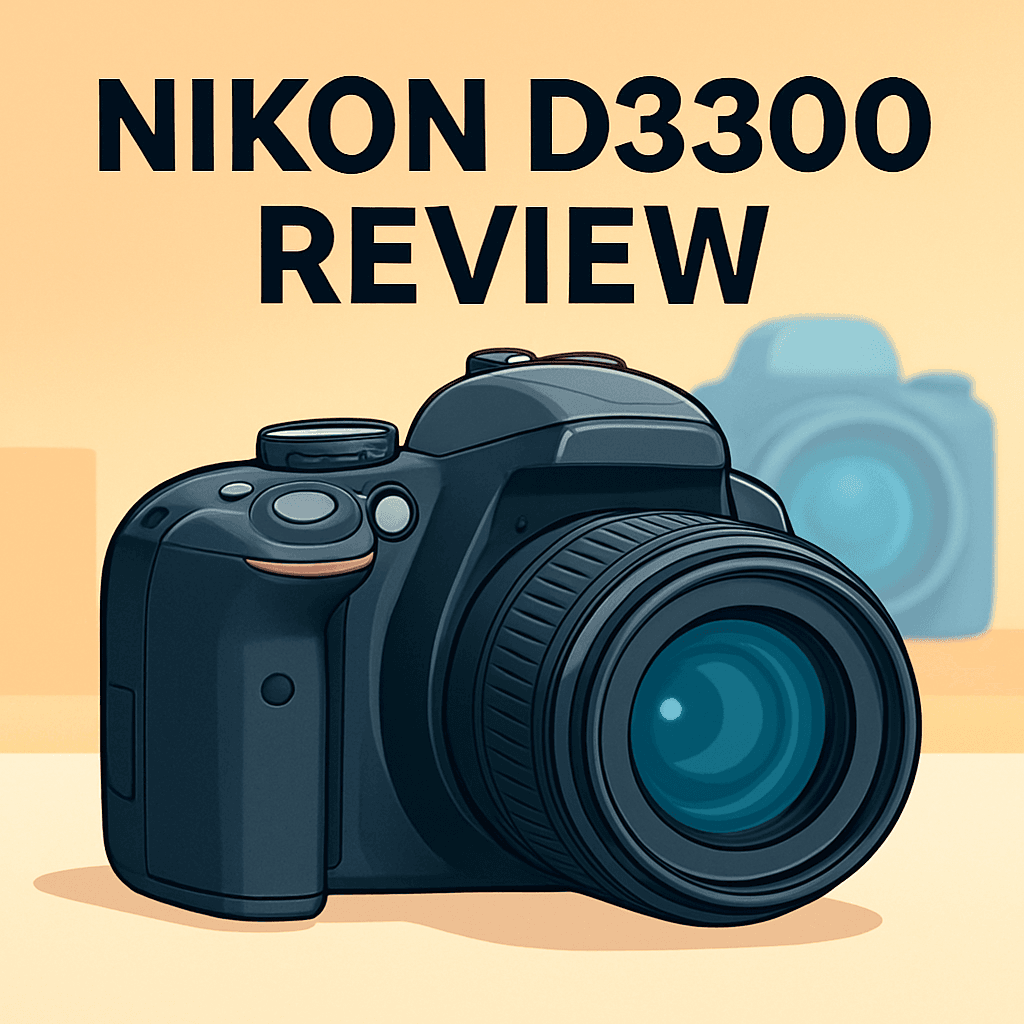
Want to improve your images without a steep learning curve or lugging around heavy gear?
I’ve taken the Nikon D3300 Camera into real shoots to see how it performs day-to-day, and it’s aimed at beginners, family shooters and travel photographers who want detailed stills and long battery life without fuss.
I’ll cover handling, autofocus behavior, image quality across shooting conditions, video usability, battery endurance and how it stacks up against common step-up options — Make sure to read the entire review as I’ll separate what’s genuinely useful from what’s just marketing, so keep reading.

Nikon D3300 Camera
Compact DSLR with a 24.2MP sensor and efficient image processor delivering crisp photos, impressive low-light performance, full HD video, beginner-friendly controls, and long battery life for extended shoots.
Check PriceThe Numbers You Need
| Spec | Value |
|---|---|
| Sensor | 24.2 MP DX-format |
| Image Processor | Expeed 4 |
| ISO Range | 100–12800 (expandable to 25600) |
| Autofocus Points | 11-point |
| Continuous Shooting | 5 fps |
| Video Resolution | Full HD 1080p (60 fps) |
| LCD Screen | 3.0-inch, 921k-dot |
| Viewfinder | Optical pentamirror, 95% coverage |
| Weight (Body Only) | 430 g |
| Dimensions | 124 x 98 x 75 mm |
| Storage | SD/SDHC/SDXC |
| Connectivity | USB 2.0, HDMI mini |
| Battery Life | 700 shots per charge |
| Built-in Flash | Yes |
| Lens Mount | Nikon F-mount |
How It’s Built
In my testing the Nikon D3300 feels like a friendly tool rather than a fragile toy. The plastic body is light but solid enough for everyday shooting and learning, so you don’t have to treat it like it’s made of glass. After using it for a while I found it holds up well for travel and casual work, just avoid rough drops and heavy rain.
The small size makes it easy to carry all day. I walked around with a compact prime and a kit zoom and could shoot one-handed for quick moments without feeling weighed down. I really liked how comfortable it was to bring everywhere — it keeps you shooting instead of complaining about the bag.
The optical viewfinder is clear but doesn’t quite show the very edges of the frame, so I double-check important shots in playback. The rear screen is sharp and detailed enough for checking focus and menus, but it’s fixed and won’t flip or touch to simplify tricky angles. That limited viewfinder coverage and non‑articulating screen is the one thing I’d improve for beginners learning composition.
Everyday controls are straightforward and ports are exactly what you need for offload and playback, plus the built-in flash is handy for quick fill or emergencies. The battery easily gets you through a full day of mixed stills and video in my experience, and the F‑mount gives a clear path to better lenses as you learn.
In Your Hands
Out of the bag the Nikon D3300 feels eager — it wakes and frames quickly, and shutter lag is minimal in typical shooting. Menus and controls are straightforward, so you spend more time composing than wrestling settings, which is exactly what I want on a shoot.
The camera’s burst capability is solid for everyday action; it catches the decisive moment when kids or pets are on the move and won’t punish you for a quick sequence. Expect the buffer to slow sooner shooting RAW than JPEG, so plan your rhythm around what you’ll edit later.
Battery performance is one of the camera’s quiet strengths; on a long walkabout, a short event, or a weekend jaunt it comfortably carries me through a day of mixed stills and family clips. I’ve only needed a single spare on marathon shoots, so it’s easy to travel light.
For file workflow I usually pull the card into a reader for the fastest transfers, though a direct USB offload works when I’m on the road. HDMI lets you monitor on larger screens, but live tethering is basic compared with modern studio setups and benefits from an external recorder for serious jobs.
Video feels friendly for hobbyists — motion is smooth for home movies and B-roll, and mild rolling-shutter artifacts show up only during very fast pans. The onboard audio is usable for casual recording, but demanding projects will benefit from separate sound capture and careful framing.
In daily use the card door and ports feel durable and rarely get in the way, though access can be fiddly when the camera’s tripod-mounted. Overall reliability is reassuring for learners and working shooters who want a dependable, no-nonsense tool.
The Good and Bad
- 24.2 MP DX-format sensor with EXPEED 4 for detailed stills
- Full HD 1080p at up to 60 fps for smooth motion capture
- 5 fps burst for casual action and candid sequences
- Strong rated battery life at 700 shots per charge
- 11-point AF system provides basic coverage and tracking compared with denser systems
- Lacks wireless connectivity and is limited to USB 2.0 and HDMI mini for transfers
Ideal Buyer
The Nikon D3300 is tailor-made for photographers taking their first deliberate steps beyond phone cameras. Its straightforward controls, sturdy learning curve, and punchy 24.2MP stills make it forgiving and rewarding during day-to-day shooting. You’ll learn exposure and composition without menu clutter.
As a working-photographer I’ve leaned on the D3300 for road trips and family sessions where detail, dependable 1080p/60p video, and battery life matter more than flashy features. At 430 grams it carries all day, and the 700-shot rated battery keeps you shooting through events without a second pack. The built-in flash and F-mount compatibility mean quick fill light and room to grow lenses.
Travelers and parents will appreciate its compact footprint and forgiving ergonomics with small primes and kit zooms. It’s a pragmatic, low-stress companion for kids’ sports, vacations, and candid portraits where image quality and stamina trump advanced AF. You get excellent files for prints and social sharing with minimal fuss.
If your work depends on rapid subject tracking, dense AF coverage, or seamless smartphone transfer, look to a step-up body. Cameras like the D5600 or Canon T7i add autofocus sophistication and wireless conveniences that the D3300 intentionally omits. Consider the D3300 when you want pure photographic fundamentals in a compact, durable package.
Better Alternatives?
We’ve already dug into the Nikon D3300 — what it does well, where it falls short, and how it behaves in real shoots. It’s a great starter DSLR: light, sharp files, long battery life, and simple controls. But a few small changes in autofocus, screen, or wireless can make a big difference day to day.
Below are three cameras I’ve shot with enough to know how they compare in the field. I’ll point out what each one does better or worse than the D3300 and who I’d recommend it to, so you can match the camera to the way you actually shoot.
Alternative 1:

Nikon D3400 Camera
Lightweight entry DSLR featuring a 24.2MP sensor, Bluetooth image transfer for effortless sharing, enhanced battery life, strong low-light capability, and an intuitive guide mode to help new photographers grow.
Check PriceThe D3400 feels very familiar if you’ve used the D3300 — same sensor, same color, and the same image quality in real shoots. Where it stands out is battery life and phone pairing: I’ve shot full days on a single battery more often with the D3400, and the Bluetooth connection makes getting images to my phone painless for quick social posts. If you care about longer days without a spare battery and easy phone sharing, the D3400 is the simple upgrade.
What the D3400 doesn’t fix is autofocus or burst speed. In real life the 11-point AF and 5 fps rate behave just like the D3300, so you won’t see better tracking of kids or pets. It also still lacks a mic input and an articulating touchscreen, so video and creative live-view shooting remain basic compared to newer models.
If you’re a casual shooter or a beginner who values long battery life and fast phone transfers more than advanced AF, the D3400 is a smart pick. If you need better subject tracking or video tools, you’ll want to look higher up the line instead.
Alternative 2:
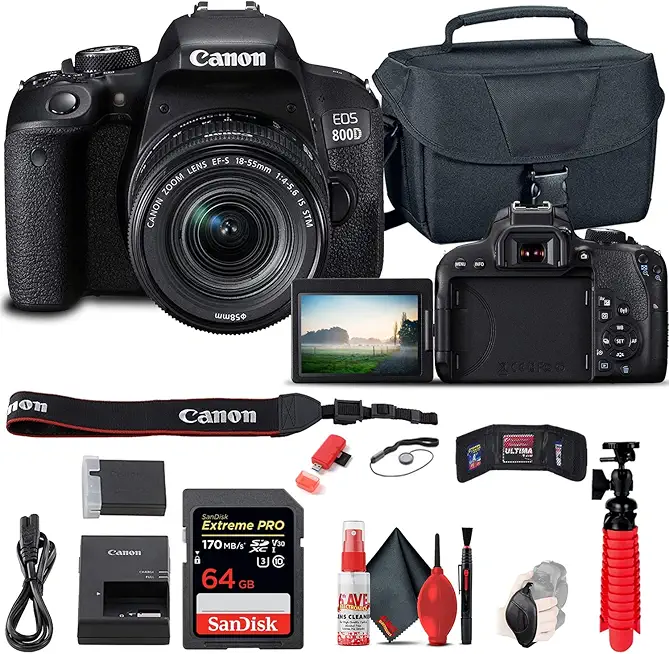
Canon EOS Rebel T7i Camera
Advanced APS-C body with responsive 45-point autofocus and dual-pixel live AF for smooth video and accurate tracking, 24MP detail, an articulating touchscreen, and built-in wireless connectivity for easy sharing.
Check PriceThe Canon T7i is a clear step up from the D3300 when it comes to autofocus and live-view use. In real shoots I trusted the T7i to grab moving subjects faster and more reliably, especially in live view and video thanks to Dual Pixel AF. The flip-out touchscreen makes awkward angles and video framing so much easier than fixed screens on the D3300.
On the downside, the T7i is a bit heavier and its battery won’t last as long as the D3300 in my experience, so you may need a spare for long days. It’s also more complex: the menus and extra features are great once you want them, but they can feel like overkill if you just want a simple point-and-shoot DSLR.
Choose the T7i if you make a lot of live-view or video work, need fast, reliable AF for kids, pets, or casual action, or want a touch-screen that really helps with composition. If you prize the D3300’s battery life and pure simplicity, stick with Nikon or a D3400 instead.
Alternative 3:
Canon EOS Rebel T7i Camera
Ideal for creators: ergonomic handling with customizable controls, crisp JPEG and RAW capture, fast continuous shooting for action, dependable battery life, and broad lens compatibility to expand creative options.
Check PriceLooking at the T7i again but from a handling angle, the camera’s grip, button layout, and customizable controls make it more pleasant to shoot with for long sessions than the D3300. I found I could change settings faster without digging through menus, and the camera’s JPEG colors out of the box felt very usable straight to clients or friends.
Where it loses to the D3300 is simple endurance: the D3300’s battery life still beats it in marathon shooting days. Also, if you’re invested in Nikon glass, switching systems to Canon means weighing lens costs and adapters. The T7i gives you great shooting tools, but there’s a cost in battery stamina and system change.
The T7i will suit creators who want a more grown-up control layout, faster burst handling for action, and a touchscreen-driven workflow. If you want the lightest, longest-lasting DSLR for travel or family outings, the D3300 or D3400 remain better fits.
What People Ask Most
Is the Nikon D3300 a good camera?
Yes — it’s a solid entry‑level DSLR with a 24MP sensor that delivers sharp images and good low‑light performance for its class.
Is the Nikon D3300 good for beginners?
Yes — simple controls, helpful auto modes, long battery life, and an affordable price make it a great camera for learning photography.
How does the Nikon D3300 compare to the D3400 or D3200?
The D3300 improved on the D3200 with better processing and no anti‑aliasing filter for slightly sharper images, while the D3400 adds modest battery and connectivity upgrades (SnapBridge) but similar image quality.
What are the pros and cons of the Nikon D3300?
Pros: excellent image detail, lightweight body, long battery life and low cost; Cons: no built‑in Wi‑Fi/Bluetooth, limited AF system, no touchscreen or advanced video features.
What is the image quality like on the Nikon D3300?
Image quality is very good for an entry DSLR — the 24MP sensor gives crisp, detailed photos and decent high‑ISO performance, though newer cameras outperform it in dynamic range and noise control.
Which lenses are compatible with the Nikon D3300?
All Nikon F‑mount lenses mount on the D3300, but autofocus requires lenses with built‑in motors (AF‑S or AF‑P); older screw‑drive AF lenses will only work in manual focus.
Conclusion
The Nikon D3300 Camera is still a clear winner if your priority is straightforward, dependable image quality and no-nonsense shooting. It delivers the essentials—clean stills, usable Full HD video, reliable burst shooting, an endurance-friendly battery and a genuinely pocketable body—so you spend more time making pictures and less time fiddling with menus.
That practicality comes with predictable trade-offs. The AF system is conservative, the optical viewfinder doesn’t quite show the whole scene, and modern wireless conveniences are absent, so it can feel limiting if you demand fast subject tracking or seamless smartphone workflows.
If you’re a beginner, travel shooter or parent who values simplicity, long run-times and a wide lens path for growth, the D3300 Camera remains an excellent, budget-minded choice. It’s forgiving, light to carry all day and gives you a solid platform to learn the craft without overwhelming complexity.
If you need stronger autofocus, touchscreen ergonomics or built-in connectivity, consider stepping up to nearby alternatives that trade the D3300’s simplicity for more advanced AF, smarter live‑view and wireless features. Match your decision to how often you chase fast action, rely on phone transfers, or demand a more comfortable handhold during longer shoots.
Nikon D3300 Camera
Compact DSLR with a 24.2MP sensor and efficient image processor delivering crisp photos, impressive low-light performance, full HD video, beginner-friendly controls, and long battery life for extended shoots.
Check Price


0 Comments