
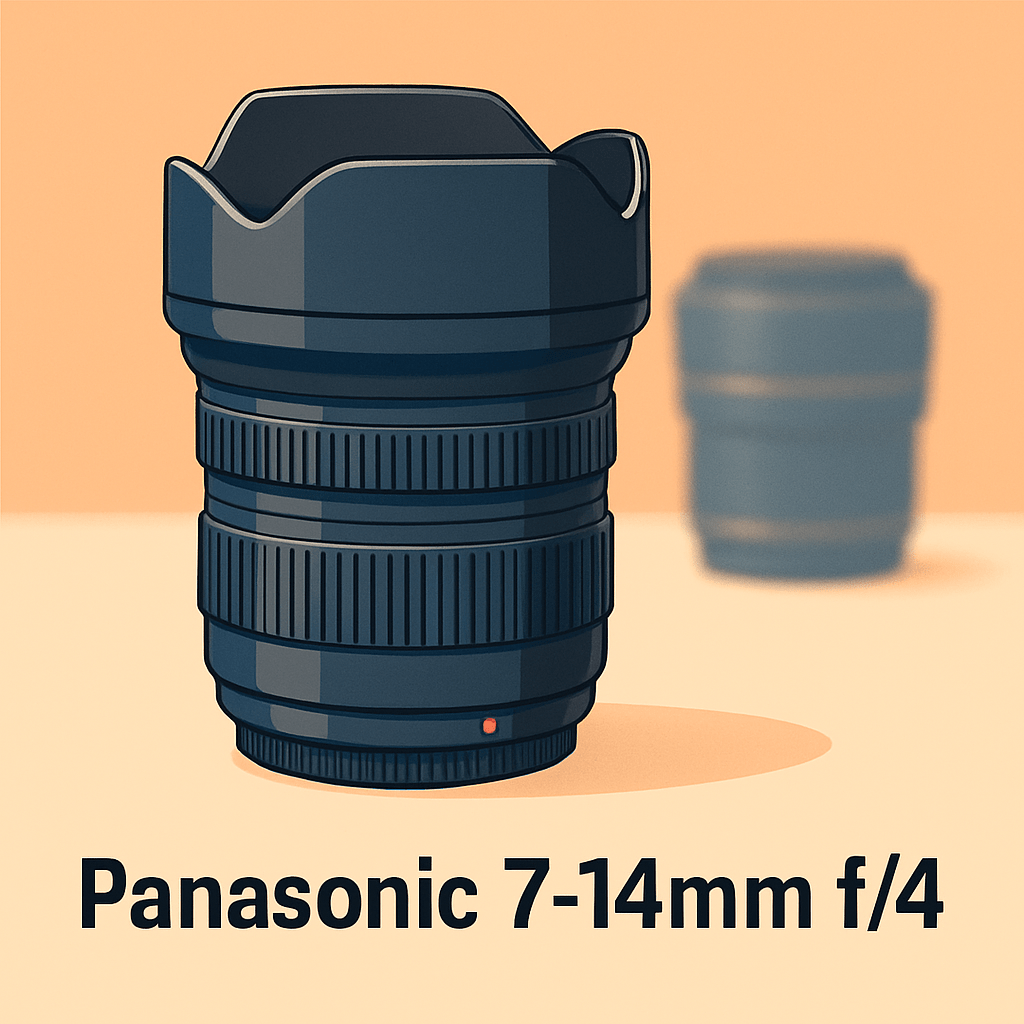
Want to make your wide-angle shots punchier and more dramatic without lugging heavy glass?
The Panasonic Lumix G Vario 7–14mm f/4 Micro Four Thirds (aka Panasonic 7–14mm f/4) is a compact, constant-aperture ultra-wide zoom that promises just that.
It’s aimed at landscape, architecture, interiors/real estate, cityscape and travel shooters who need a true 7mm wide end.
Having taken it into the field a few times, I was struck by its travel-friendly size, weather-resistant feel, autofocus and surprisingly clean geometry.
This review will focus on handling, optical performance, and everyday usability — the things that actually change your images in real shoots.
If you want practical answers about how it performs on a trip or in tight interiors, keep reading.
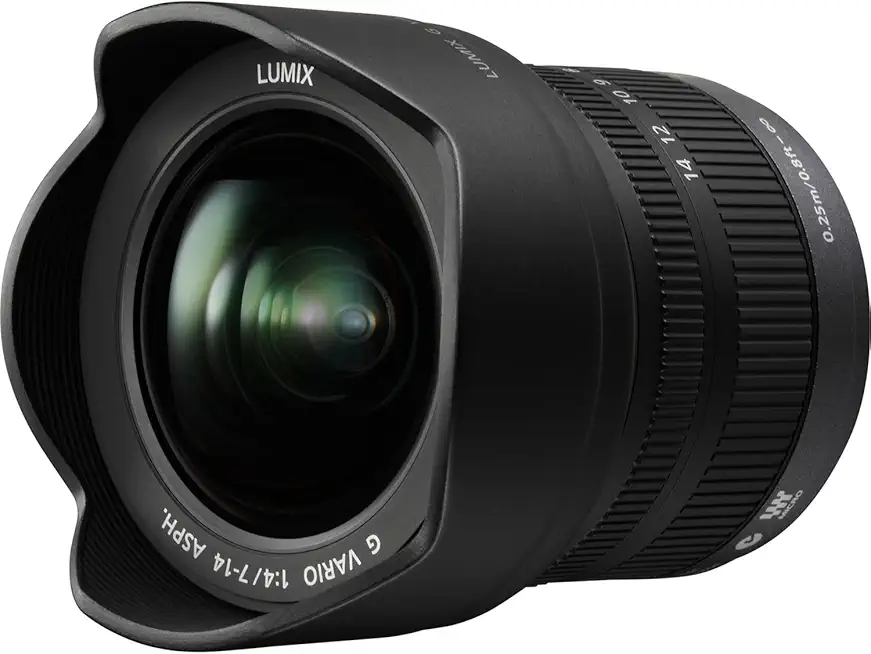
Panasonic Lumix G Vario 7-14mm f4 Micro Four Thirds
Super-wide zoom with constant f/4 delivers edge-to-edge sharpness and minimal distortion; lightweight, weather-sealed construction and smooth manual control make it ideal for landscapes, architecture and creative interiors.
Check PriceThe Numbers You Need
| Spec | Value |
|---|---|
| Focal length | 7–14mm (14–28mm full-frame equivalent) |
| Maximum aperture | f/4 (constant) |
| Lens mount | Micro Four Thirds |
| Lens construction | Multi-element, aspherical design |
| Autofocus | Yes |
| Image stabilization | No (relies on in-body stabilization) |
| Minimum focus distance | About 25 cm |
| Filter thread | None (bulbous front element) |
| Weight | Approximately 300 g |
| Dimensions | Compact, designed for travel |
| Angle of view | 114–75° diagonal |
| Weather-sealing | Yes, dust/splash resistant |
| Direct manual focus override | Yes |
| Aperture blades | 7 (rounded) |
| Hood | Built-in, retractable petal hood |
How It’s Built
In my testing the Panasonic Lumix G Vario 7–14mm f/4 Micro Four Thirds feels like a travel lens. It’s compact and light, slips on my small MFT bodies without weighing me down. That small size makes it easy to carry all day.
Build quality surprised me — it’s solid with dust and splash resistance that gave me confidence on wet coastal shoots. I liked the weather sealing; I kept shooting in drizzle without worrying. For beginners, that means less babying the lens outdoors and more time getting the shot.
The tradeoff is the bulbous front element and the built‑in petal hood. I found the hood great for flare control but annoying for filters and caps — there’s no standard screw‑in thread, so you’ll need special holders or adapters. That’s the one thing I’d change for easier long‑exposure or polarizer use.
Handling is simple and friendly: autofocus is quick and Direct Manual Focus lets you nudge focus fast. The lens has no image stabilization, so I leaned on my camera’s in‑body stabilization (IBIS) when shooting handheld and it worked fine in my tests. Overall it balances wonderfully on small bodies and feels made for travel, even if you might miss filter convenience.
In Your Hands
At the wide end the Panasonic Lumix G Vario 7–14mm f/4 delivers those dramatic, immersive perspectives that redraw foregrounds and make interiors feel expansive, while the long end pulls you back into more environmental and street-style framing. That sweeping angle forces more deliberate composition—watch how easily shoes, tripods or frame edges creep into scenes and adjust your stance accordingly.
The constant f/4 makes exposure predictable throughout the zoom, which is a practical boon when moving between shadowed alleyways and bright skies. On Micro Four Thirds the depth of field tends to keep more of the frame acceptably sharp, so using close foreground elements becomes a real creative advantage for scale and depth.
Autofocus is responsive for stills and mostly steady for video, snapping into focus without fuss in good light and letting you rely on DMF for fine-tuning when doing precise compositions. In low-contrast or very dim scenes the AF can be deliberate, but manual override gives you the control you need.
There’s no optical stabilization in the barrel, so you lean on the camera’s IBIS for handheld low-light work and smooth video; with that combination handheld shots are entirely practical but long, deliberate pans or very slow exposures benefit from a tripod or gimbal.
The close-focus capability is genuinely useful for dramatic foregrounds, though the integrated petal hood and bulbous front element impose a working-distance reality you learn to respect. Backlit scenes show both the virtue of the hood and a sensitivity to flare—careful angling and lens shading improve contrast and reduce ghosting.
Lightweight and weather‑resistant, this lens is a joy to carry all day and to use in real-world travel and architectural shoots. For run‑and‑gun video it offers breathtaking framing for establishing shots, but you’ll want to plan stabilization strategy for the smoothest results.
The Good and Bad
- Ultra‑wide 7–14mm range (14–28mm FF equiv.) with 114–75° diagonal FoV
- Constant f/4 aperture
- Compact and lightweight (~300 g); travel‑friendly
- Excellent distortion control for an ultra‑wide zoom
- No optical image stabilization; depends on in‑body stabilization
- No front filter thread; bulbous front complicates use of standard filters
Ideal Buyer
If you shoot Micro Four Thirds and crave true ultra‑wide reach, the Panasonic Lumix G Vario 7–14mm f/4 Micro Four Thirds is aimed squarely at you. It delivers a 7mm end that changes how you compose wide scenes and preserves geometry you can trust.
Landscape, architecture, interiors, real‑estate and cityscape photographers will get the most from its 14–28mm equivalent field of view and excellent distortion control. The constant f/4 simplifies exposure and autofocus keeps pace with run‑and‑gun shooting for client or editorial work.
Travel shooters will appreciate the lens’ compact, ~300 g footprint and weather‑resistant construction for all‑day carry in mixed conditions. The built‑in hood and Direct Manual Focus make it practical for creative foregrounds and quick precision nudges.
It’s less ideal for night‑owl astrophotographers or anyone who needs f/2.8 performance in dim light. Also plan for filter work and stabilization: there’s no front thread and no optical IS, so you’ll rely on camera IBIS or adapters for long exposures and video.
In short, if your priority is a lightweight, weather‑tough, truly ultra‑wide zoom with clean geometry for interiors and landscapes, this is the lens to pack. If fast apertures or hassle‑free screw‑in filters top your list, look to the faster or filter‑friendly alternatives instead.
Better Alternatives?
We’ve gone through what the Panasonic Lumix G Vario 7–14mm f/4 Micro Four Thirds does best: a true 7mm ultra‑wide view in a compact, weather‑resistant body with great control of distortion. That constant f/4, solid build and usable autofocus make it a very practical choice for landscapes, architecture and travel work.
If you want something with different strengths — faster glass for low light, a pro build, or easier use of filters and stabilization — there are a few lenses I’ve used that change the tradeoffs. Below are the ones I reach for when the Panasonic 7–14 f/4 isn’t the perfect fit.
Alternative 1:

Olympus M.Zuiko Digital ED 7-14mm f2.8 PRO Micro Four Thirds
Pro-grade ultra-wide zoom with bright f/2.8 throughout for low-light shooting and dramatic perspective; robust, splash-proof build, exceptional resolution and fast AF suit landscapes, astro and professional architectural work.
Check PriceI’ve used the Olympus 7–14mm f/2.8 PRO on trips where light faded fast and the Panasonic 7–14 f/4 started to struggle. The Olympus gives you a full stop brighter aperture across the range, so it handily beats the Panasonic Lumix G Vario 7–14mm f/4 Micro Four Thirds for low‑light shooting and nightscapes. Images feel a bit punchier wide open, and that extra speed makes it easier to keep shutter speeds up without raising ISO.
The tradeoff is size and weight. The Olympus is noticeably bigger and heavier than the Panasonic 7–14 f/4, so it’s less fun to carry all day or fit on a small travel bag. It also costs more and feels more “pro” in the hand — great if you need that toughness, less so if you want the lightest kit.
Who should pick it: photographers who shoot a lot in dim light, do pro architectural or night work, or simply want the best image quality at wide apertures. If you value speed and rugged build over pocketable weight, this is the one I’d choose over the Panasonic 7–14 f/4.
Alternative 2:

Panasonic Leica DG Vario Elmarit 8-18mm f2.8-4 Micro Four Thirds
Compact wide-to-ultrawide zoom with premium optics and variable f/2.8–4 brightness for versatile travel imaging; fast, quiet autofocus and stabilized performance produce crisp photos and cinematic video on the move.
Check PriceThe Panasonic Leica 8–18mm is the travel lens I pick when I want something small, fast to focus, and usable with filters — things the Panasonic 7–14 f/4 can’t offer because of its bulbous front. In real shooting I liked having a standard filter thread for polarizers and NDs, and the lens’ in‑body/Lens stabilization combo makes handheld twilight shots easier than the 7–14 f/4 alone.
What it loses compared to the Panasonic Lumix G Vario 7–14mm f/4 Micro Four Thirds is the ultra‑wide 7mm end. You give up a touch of dramatic wide‑angle reach for a more usable 8mm, which is still very wide but not as extreme. Also, the 8–18 has a variable aperture (f/2.8–4), so it’s not constant at longer focal lengths like the 7–14 f/4.
Who should pick it: travelers, vloggers, and landscape shooters who want filter use and a small, quiet lens for mixed photo/video work. If you value a compact package and the ability to use filters more than that extra 1mm of width, this is my go‑to over the Panasonic 7–14 f/4 for run‑and‑gun work.
Alternative 3:
Panasonic Leica DG Vario Elmarit 8-18mm f2.8-4 Micro Four Thirds
Travel-ready wide-angle zoom offering punchy contrast, smooth background separation at wide apertures and precise edge-to-edge correction; small footprint, responsive autofocus and optical stabilization make it perfect for vloggers and explorers.
Check PriceUsed differently, the 8–18mm shines when I want clean contrast and smooth rendering for video and social work. Compared to the Panasonic Lumix G Vario 7–14mm f/4 Micro Four Thirds, the 8–18 feels more refined for handheld moving shots — the combined stabilization and quiet AF make walking shots and talking‑to‑camera clips look nicer without extra gear.
On the downside, you still don’t get the extreme 7mm field that the 7–14 f/4 gives you, and at 18mm the aperture can be a stop slower than the wide end. For architectural work where the absolute widest angle and uniform f/4 across the range matter, the Panasonic 7–14mm f/4 will stay the better choice.
Who should pick it: vloggers, travel bloggers, and explorers who need a small, reliable wide zoom that handles video and stills well. If you want a lens that’s easy to carry, easy to stabilize handheld, and friendly to filters, reach for the 8–18 rather than the Panasonic 7–14 f/4.
What People Ask Most
Is the Panasonic 7-14mm f/4 a good lens?
Yes — it’s an excellent ultra-wide zoom for Micro Four Thirds with solid build and great image quality for landscapes, architecture and interiors, though f/4 isn’t the fastest aperture.
What is the full-frame equivalent focal length of the Panasonic 7-14mm f/4?
On Micro Four Thirds the 2x crop makes it roughly a 14–28mm equivalent on full-frame.
Is the Panasonic 7-14mm f/4 weather-sealed?
Yes, it is splash and dust resistant, but not fully waterproof, so it’s fine in light rain with common-sense precautions.
Does the Panasonic 7-14mm f/4 have image stabilization?
No, the lens has no optical stabilization, so you should rely on in-body stabilization or a tripod for stable shots.
Can you use screw-on filters with the Panasonic 7-14mm f/4?
No, the bulbous front element prevents standard screw-on filters; use rear gelatin filters or a specialty wide-angle filter holder instead.
How sharp is the Panasonic 7-14mm f/4?
Very sharp in the center across the zoom range, with slightly softer corners at the widest setting that improve when you stop down.
Conclusion
The Panasonic Lumix G Vario 7-14mm f4 Micro Four Thirds is the lens I reach for when I want the widest perspective without hauling pro glass. It pairs genuinely dramatic ultra-wide coverage with a travel-friendly footprint, weather resistance and reliable autofocus. For interiors, architecture and travel it’s a practical, often indispensable tool.
Optically it punches above its class: distortion is well controlled, edges hold up and the rendering keeps micro-contrast where it matters. Handling on small bodies feels balanced and intuitive, and the built-in hood with DMF makes quick adjustments painless in the field.
It isn’t without compromises. The lack of in-lens stabilization means you lean on your camera’s IBIS or a tripod in dim conditions, and the bulbous front rules out standard screw-in filters which complicates long exposures and polarizer work. The f/4 maximum aperture also limits low-light versatility compared with faster alternatives.
If you prize true 7mm reach, restrained geometry and a weather-ready, carry-all-day design, buy this lens without hesitation. If ultimate low-light speed or filter convenience is your priority, look to the alternatives. On balance—based on sharpness, distortion control, handling and manageable flare from my field testing—the Panasonic Lumix G Vario 7-14mm f4 Micro Four Thirds is a top choice for most Micro Four Thirds shooters who value portability and precise geometry over extreme low-light speed.
Panasonic Lumix G Vario 7-14mm f4 Micro Four Thirds
Super-wide zoom with constant f/4 delivers edge-to-edge sharpness and minimal distortion; lightweight, weather-sealed construction and smooth manual control make it ideal for landscapes, architecture and creative interiors.
Check Price



0 Comments