
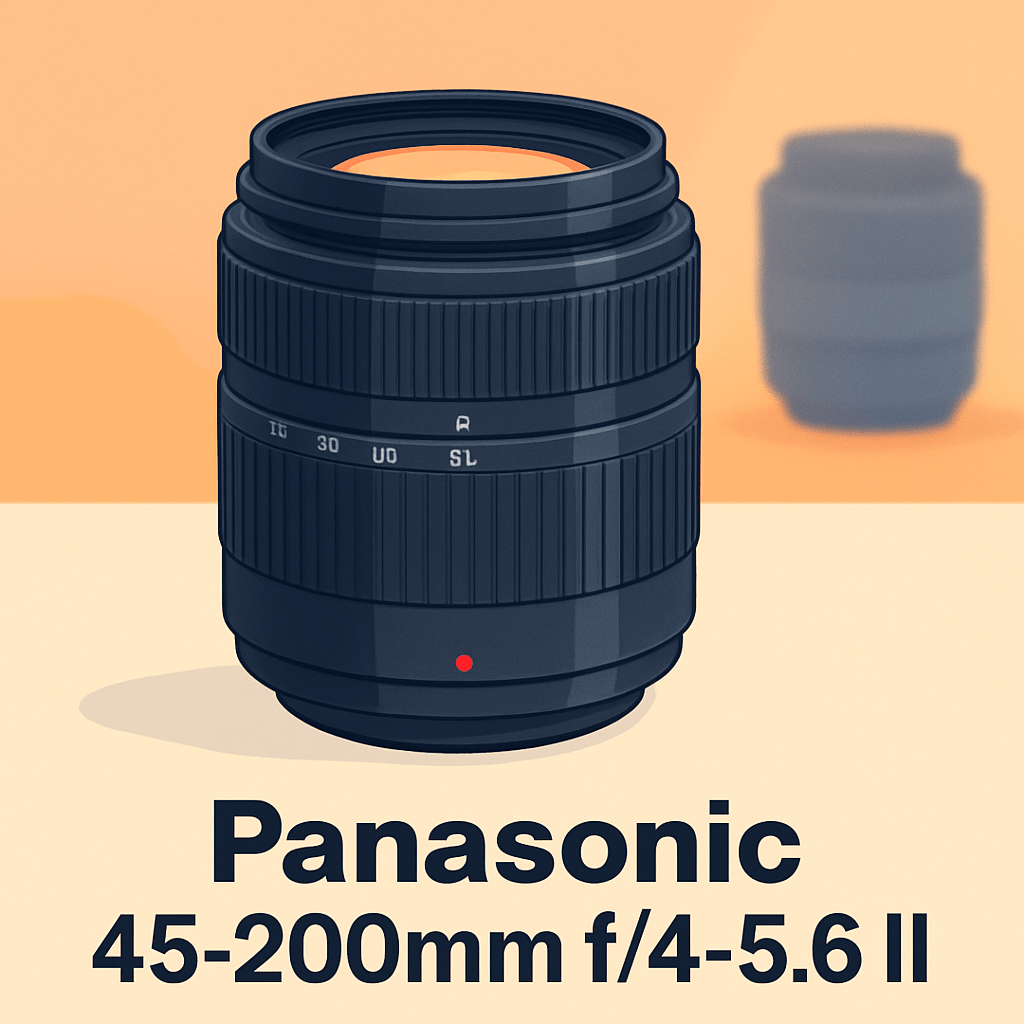
Want a compact telephoto that actually gets you closer without weighing you down?
The Panasonic Lumix G II Vario Micro Four Thirds 45-200mm f/4-5.6 promises meaningful reach and in-lens stabilization in a travel-friendly package, and it’s exactly the kind of lens I took into the field to test.
If you shoot Micro Four Thirds and need a lightweight option for wildlife, kids’ sports, or travel candids, this lens aims to deliver usable reach and steady handheld shots without a big bag of glass.
We’ll look at handling, stabilization, real-world optics, and how it stacks up to nearby rivals — make sure to read the entire review as I unpack what worked, what didn’t, and who should buy it; keep reading.

Panasonic Lumix G II Vario Micro Four Thirds 45-200mm f/4-5.6
Extended-range, lightweight telephoto zoom optimized for travel and wildlife. Delivers crisp contrast, reliable autofocus, and smooth zoom action—an affordable, portable solution for capturing distant subjects with confidence.
Check PriceThe Numbers You Need
| Spec | Value |
|---|---|
| Focal length | 45-200mm |
| Aperture | f/4.0-5.6 |
| Image stabilization | POWER O.I.S. (Optical Image Stabilizer) |
| Lens mount | Micro Four Thirds |
| Equivalent focal length (35mm format) | 90-400mm |
| Optical zoom | 4.4x |
| Minimum focus distance | 1.0 m |
| Lens construction | 13 elements in 10 groups |
| Angle of view | 27° to 6.2° |
| Filter thread size | 52 mm |
| Maximum aperture at 45mm | f/4.0 |
| Maximum aperture at 200mm | f/5.6 |
| Aperture diaphragm blades | 7 rounded blades |
| Dimensions (diameter x length) | approx. 63 x 107 mm |
| Weight | approx. 355 g |
How It’s Built
In my testing the Panasonic Lumix G II Vario felt like a proper travel tele: small and light enough that I actually took it out more often than bigger lenses. On compact Lumix bodies it balances neatly and stays unobtrusive, while on larger cameras it can feel a bit front-heavy during long walks. That compactness is my favorite part — it makes reaching for long shots painless.
The zoom and focus rings are predictable and smooth, with just enough resistance to avoid accidental moves. I did notice a little zoom creep when carrying the camera pointed down, so I’d keep a hand near the ring if you’re hiking or moving around a lot. That’s the one build quirk I’d like Panasonic to tighten up.
Construction leans practical rather than flashy, with materials that feel solid for everyday travel and family shoots. The aperture uses rounded blades, which in my shooting produced pleasant out-of-focus highlights — nice for beginner portraits without worrying about complicated settings. It held up to casual bumps and constant use without feeling flimsy.
For newcomers, the lens won’t let you get absurdly close to subjects, so plan your framing a bit differently and step back for tighter portraits. Controls remain easy to use with gloves or in quick changes, and I didn’t see any sticky behavior in cold or heat during my time with it. Overall it’s user-friendly and forgiving for people learning telephoto work.
In Your Hands
Used in the field, the Panasonic Lumix G II Vario 45-200mm feels like a compact long-tele option that lets you quietly chase subjects that would otherwise need a much bigger rig. It excels in daylight sports, backyard wildlife and on-the-go travel shooting where reach and portability matter more than blazing speed. On short tele focal lengths it’s easy to handhold for extended periods without fatigue, which encourages more shooting and experimentation.
The variable aperture shows its practical limits as you push to longer focal lengths or into dimmer light, forcing the usual ISO/shutter trade-offs; in bright conditions you’ll rarely notice, but indoor or late-afternoon action demands more attention to exposure. I found myself nudging ISO sooner than with faster glass or accepting slightly slower shutter speeds when composition outweighed absolute sharpness. Still, for most outdoor work it stays in the comfortable zone.
Autofocus is reliable and generally snappy in single-shot modes and competent in continuous tracking, though it tightens up a bit at the long end or under low light. The one-meter close-focus means you’ll compose portraits a little looser than a dedicated short-tele, and heat haze or atmospheric shimmer become factors on distant subjects—short bursts and waiting for steadier air help more than changing gear.
POWER O.I.S. is the practical highlight: handheld keepers at long reach are common if you steady your stance, and panning is smooth for following action. Video benefits from the stabilization, producing steady clips with only occasional micro‑jitter on quick moves, and the zoom and focus rings stay predictable even when shooting with gloves or swapping lenses in the field.
The Good and Bad
- 90–400mm equivalent reach in a compact, lightweight package (approx. 355 g; 63 x 107 mm)
- POWER O.I.S. for handheld telephoto shooting
- Broadly useful 4.4x zoom range from short tele to long tele
- 7 rounded blades for potentially pleasing out-of-focus highlights
- Variable maximum aperture f/4–5.6 limits low-light and action shooting
- Minimum focus distance of 1.0 m limits close-up capability
Ideal Buyer
If you need reach without lugging a big lens, the Panasonic Lumix G II Vario Micro Four Thirds 45-200mm f/4-5.6 is made for you. Its 90–400mm equivalent range and light 355 g footprint suit travel and hikes. It’s a go-to when portability matters more than a fast aperture.
Outdoor shooters will get the most from it. Wildlife, distant landscapes, backyard birds, youth sports and candid street moments all benefit from the extra reach. POWER O.I.S. makes handheld telephoto work practical on bodies that lack strong IBIS.
Enthusiasts upgrading from kit zooms will appreciate the range and stabilization for everyday tele tasks. Photographers on a budget who want usable long reach without a tripod will find it compelling. Its trade-offs are understandable for the size and weight.
Avoid it if you shoot low-light indoor action, need macro close-ups under 1.0 m, or crave ultra-shallow depth of field at tele lengths. In those cases a faster or specialized lens is the smarter choice.
Pair it with a compact Lumix body for the best balance and nimble handling. It also complements cameras with competent AF for tracking distant subjects. If you prioritize absolute speed or extreme low-light performance, look elsewhere.
Better Alternatives?
We’ve gone through the Panasonic 45-200mm II: where it shines, where it struggles, and who it’s best for. It’s a great compact tele zoom for getting into long reach without hauling a heavy kit. Still, every lens is a trade-off, and depending on what you shoot most you might want something a bit smaller, a bit lighter, or with a different balance of reach and stabilization.
Below are three real-world alternatives I’ve used. I’ll note what each one does better and worse than the 45-200, how they feel in actual shooting, and what kind of buyer would prefer them.
Alternative 1:

OM System M.Zuiko Digital ED Micro Four Thirds 40-150mm f/4-5.6 R
Compact mid-telephoto zoom balancing sharp optics and fast, quiet focusing for portraits and events. Smooth handling, consistent edge-to-edge clarity, and impressive value for everyday shooting needs.
Check PriceThe OM System 40-150mm is noticeably smaller and sits lighter on a camera than the Panasonic 45-200. In the field I found it easy to carry all day for events and portraits — it doesn’t draw attention and it balances nicely on small bodies. Optically it often looks a touch crisper across the frame at common shooting distances, so skin tones and mid-frame detail can appear a bit cleaner without fussing with corrections.
Where it loses to the Panasonic is reach and stabilization. The 40-150 simply doesn’t go as long, so if you need to reach far-off subjects you’ll feel the limitation. Also, this OM lens doesn’t have its own optical stabilizer, so on Panasonic bodies without in-body stabilization you’ll get fewer steady handheld frames than with the 45-200’s POWER O.I.S. In low light or at the longer end, that difference is obvious: I had to raise ISO or steady the camera more often with the 40-150.
Pick the 40-150 if you shoot portraits, events, or travel and you use an Olympus/OM body with good in-body stabilization. It’s for photographers who prioritize light weight and a refined look over maximum reach — think walkaround photographers, event shooters who move a lot, or anyone who dislikes lugging heavier glass.
Alternative 2:

Panasonic Lumix G Vario Micro Four Thirds 45-150mm f/4-5.6 ASPH
Versatile standard tele zoom offering reliable performance for enthusiasts: balanced reach, stabilized handling, and accurate autofocus produce pleasing bokeh and detailed images for travel, family, and casual sports.
Check PriceThe 45-150mm is a very handy little lens — smaller and more pocketable than the 45-200 — and it keeps MEGA O.I.S. in the barrel. In practical shooting I liked how quick it felt for everyday snaps: autofocus locks fast on faces, it’s easy to swing between focal lengths, and handheld shots stay usable thanks to the in-lens stabilization. For travel, family events, and street work it’s a top pick when you want dependable results without extra weight.
Compared to the 45-200, the obvious downside is reach. You lose the extra distance that makes the 45-200 so useful for distant wildlife or tight sports shots. I also found that at long focal lengths the 45-200’s POWER O.I.S. gives a tiny edge when trying to eke out steady frames — the 45-150 is stabilised and very good for most work, but that extra stability of the 45-200 matters when you’re pushing shutter speed limits.
Choose the 45-150 if you want the smallest, stabilized tele zoom that still covers most everyday needs. It’s the lens for parents, travelers, and hobbyists who shoot kids, vacations, and casual action and who prefer lighter gear over maximum reach.
Alternative 3:
Panasonic Lumix G Vario Micro Four Thirds 45-150mm f/4-5.6 ASPH
Everyday telephoto zoom combining compact design with solid optical quality. Fast, responsive focusing and smooth zooming make it ideal for street, outdoor portraits, and action at moderate distances.
Check PriceUsing the 45-150 again but looking at it from a different angle: it’s simply an easy lens to work with. The zoom action is smooth, focusing is snappy for still subjects, and it sits comfortably on small bodies for long periods. When shooting outside in changing light I appreciated how quickly I could recompose and get a keeper without fiddling — it’s a very practical, “shoot now” lens.
Where it falls short against the 45-200 is the top-end performance and background separation at the longest distances. If you’re trying to isolate a subject far away or need that extra compression for wildlife or distant sports, the 45-200 gives you more options. Also, when I pushed for shots at dusk or in dim gym light, the narrower reach plus the aperture behavior meant more ISO and more noise compared with using a faster or longer lens.
If your day-to-day work is street, outdoor portraits, or moderate action and you want something responsive and unobtrusive, the 45-150 is a smart choice. It’s for photographers who value quick handling and portability over long-distance reach — photo-walkers, casual portrait shooters, and anyone who shoots light, fast, and often.
What People Ask Most
Is the Panasonic 45-200mm f/4-5.6 II worth buying?
Yes if you want an affordable, lightweight telezoom with good reach for travel and hobby use; skip it if you need top-tier sharpness or low-light speed.
Is the Panasonic 45-200mm f/4-5.6 II compatible with Micro Four Thirds cameras?
Yes — it is a native Micro Four Thirds lens and works on all MFT bodies with full AF and exposure support.
Does the Panasonic 45-200mm f/4-5.6 II have optical image stabilization (OIS)?
Yes, this lens includes OIS which helps a lot for handholding at longer focal lengths.
How sharp is the Panasonic 45-200mm f/4-5.6 II at different focal lengths?
Center sharpness is good across the range, but corners soften and the long end is noticeably softer wide open, so stopping down improves overall detail.
How does the Panasonic 45-200mm f/4-5.6 II compare to the Olympus M.Zuiko 40-150mm?
The Olympus generally offers better build and sharper results (especially the PRO version) while the Panasonic is cheaper and lighter with similar reach.
Is the Panasonic 45-200mm f/4-5.6 II good for wildlife and sports photography?
It’s fine for casual wildlife and slower-action sports in good light thanks to its reach and OIS, but it struggles in low light and with fast-moving subjects compared to faster, pro telezooms.
Conclusion
The Panasonic Lumix G II Vario Micro Four Thirds 45-200mm f/4-5.6 is a compact telezoom that delivers meaningful reach and in‑lens stabilization to Micro Four Thirds shooters. It balances portability with practical performance for travel and outdoor work. Handling is straightforward and reassuring on compact Lumix bodies.
It shines on daylight wildlife, travel and sidelines sports where reach and handholdability matter. Low-light action and close-up portraiture expose its limits, so you’ll trade speed and macro flexibility for compact tele range. In practice that means careful exposure choices and some ISO compromise at the long end.
Against shorter 45–150 options it wins for reach, and against long 75–300 superteles it often wins for handheld usability thanks to POWER O.I.S. If your body already has strong IBIS the choice depends more on desired reach and handling than raw IQ. For many users the 45–200 sits as a sensible midground between portability and practical tele capability.
Buy it if you need a light, practical 90–400mm equivalent tele for outdoor subjects and travel and accept modest apertures. Pass if you routinely need fast glass or close-focus capability, but for many shooters it’s the sensible, affordable way to add long reach without heavy pro glass.
Panasonic Lumix G II Vario Micro Four Thirds 45-200mm f/4-5.6
Extended-range, lightweight telephoto zoom optimized for travel and wildlife. Delivers crisp contrast, reliable autofocus, and smooth zoom action—an affordable, portable solution for capturing distant subjects with confidence.
Check Price



0 Comments