
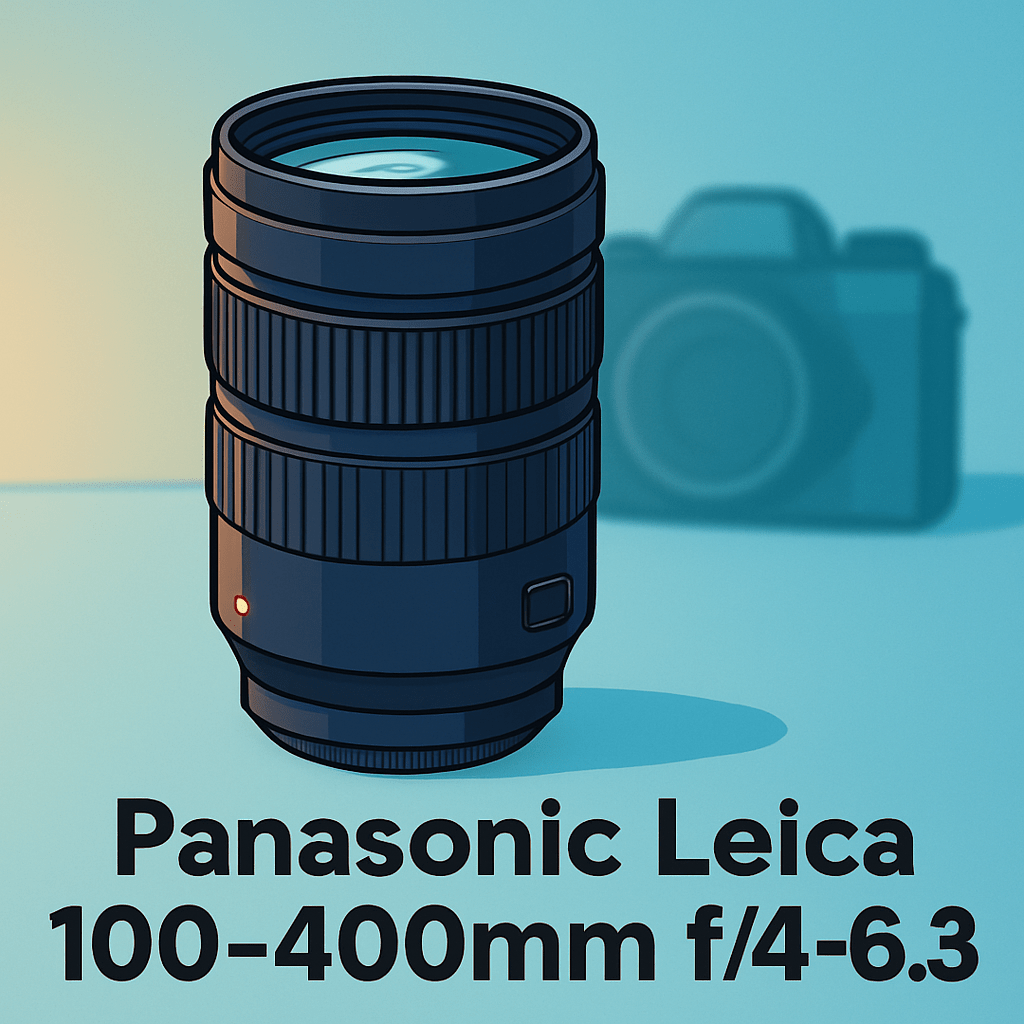
Want dramatic reach without hauling a giant lens?
The Panasonic Leica DG Vario Elmar 100–400mm f/4–6.3 (Micro Four Thirds) brings roughly 200–800mm full‑frame equivalent reach in a compact MFT package.
It pairs a variable aperture with built‑in POWER O.I.S. and weather resistance, which is great for birding, wildlife, field sports, and travel work.
After taking one into the field on birding and airshow shoots, I dug into real‑world handling, stabilization, sharpness, AF behavior, and practical trade‑offs.
If you’re an MFT shooter weighing reach versus size and light‑gathering, this review will help you decide. Make sure to read the entire review as I break down what actually matters in the field—keep reading.

Panasonic Leica DG Vario Elmar 100-400mm f/4-6.3 Micro Four Thirds
Premium Leica-tuned super-telephoto zoom offering impressive reach and crisp resolution. Lightweight, weather-resistant build with responsive autofocus—ideal for wildlife and sports shooters seeking portable long-range performance on MFT bodies.
Check PriceThe Numbers You Need
| Spec | Value |
|---|---|
| Focal Length | 100–400mm (Micro Four Thirds); 35mm equivalent: 200–800mm |
| Aperture | f/4.0–6.3 (variable) |
| Lens Mount | Micro Four Thirds |
| Image Stabilization | POWER O.I.S. (Optical Image Stabilizer) |
| Weather Sealing | Dust/splash/freeze resistant |
| Lens Construction | 20 elements in 13 groups (includes 2 ED, 1 UED, 3 ASPH. elements) |
| Minimum Focus Distance | 1.3 m |
| Maximum Magnification | 0.25× |
| Filter Size | 72 mm |
| Autofocus | High-speed linear motor |
| Blades | 9 diaphragm blades |
| Weight | Approx. 985 g |
| Length | Approx. 171 mm (retracted); 205 mm (extended) |
| Focus Limiter | 3 positions (full; 10 m–infinity; 2 m–infinity) |
| Tripod Collar | Removable |
How It’s Built
In my testing with the Panasonic Leica DG Vario Elmar 100-400mm f/4-6.3 Micro Four Thirds, the first thing that stood out was how solid it feels in the hand. The body has a reassuring, premium finish and the switches and rings have tight tolerances, so it doesn’t feel toy-like out in the field. That build quality means you can trust it on dusty trails and light rain without constantly worrying about cleanup.
I really liked the weather-resistant design and the built-in image stabilization — they let me keep shooting in less-than-perfect weather and still get usable handheld shots. One thing that could be better is the zoom behavior; on my sample it wanted to creep a bit when pointed up or down, so I found myself supporting the front more than I expected. For beginners that translates to: plan to use the collar or a monopod for long sessions to avoid arm fatigue.
The controls are smartly placed and useful in real use. The focus limiter ranges and the customizable function button saved me time when tracking birds and switching modes, and the removable tripod collar is smooth and practical for quick orientation changes. After using it for a while I found it easy to live with day after day, but pack a small support for long hikes.
In Your Hands
On the trail the Panasonic Leica DG Vario Elmar 100–400mm feels like a tele that simply lets you get closer without changing your shoes — its extended reach gives real framing flexibility for perched birds, distant wildlife and sideline sports, and I found myself regularly working at the far end of the zoom to isolate subjects against busy backgrounds. The variable aperture is a practical trade-off: you give up a touch of light and subject separation compared with faster glass, but gain a single, versatile tool that covers a huge range without swapping lenses.
Panasonic’s POWER O.I.S. proved unexpectedly steady in the field, turning handheld long-tele shooting into something I trusted for more frames than I thought possible; panning with moving subjects remained smooth and natural, while static subjects benefited from the system’s steadying influence. At the longest reach the margin for error tightens — good technique and a steady stance help — but the stabilization overall expands usable shooting windows.
The lens’ close-focus behavior is surprisingly useful for small wildlife and flowers, delivering pleasing subject separation and background compression near its minimum focus range. The removable tripod collar makes quick orientation changes painless and keeps vibration under control on sticks or a monopod, with the collar feeling well machined and practical for rapid adjustments.
In real-world scenarios — birding, early/late light wildlife work, and daytime sports or airshows — the focus limiter consistently reduced hunting and sped acquisition, while the weather-resistant build held up to damp, dusty conditions without drama. Ergonomically it’s a substantial piece to carry all day, but its packability and handling balance make it a reliable companion on long hikes and travel shoots when maximum reach matters most.
The Good and Bad
- 200–800mm equivalent reach in MFT
- Built-in POWER O.I.S. for handheld tele work
- Weather-resistant build for field reliability
- Removable tripod collar for support and balance
- Variable aperture f/4–6.3 (f/6.3 at 400mm limits light gathering and subject separation)
- Weight (~985g) can be fatiguing during long handheld sessions
Ideal Buyer
The Panasonic Leica DG Vario Elmar 100–400mm f/4–6.3 is aimed at Micro Four Thirds shooters who need serious reach without hauling full-frame glass. It gives a 200–800mm equivalent range that suits birding, distant wildlife and field sports. It’s the lens you grab when subjects won’t come closer.
Travelers and outdoor shooters who want long reach in a compact package will find the balance compelling. Built-in POWER O.I.S. and weather sealing mean you can shoot in rain, wind, and early-morning mist. It’s a practical alternative to larger formats when weight and packability matter.
If your workflow mixes handheld stalking with tripod work, the removable collar and focus limiter give real-world usefulness. The limiter trims hunting for perched birds, while the collar makes fast rotations and monopod use much less fiddly. Sports and airshow shooters will appreciate the reach and ergonomics when paired with a capable MFT body.
It’s not for every photographer — if you need constant f/4 low-light speed or the ultimate prime-level sharpness, a fast prime may be better. But for those who value one versatile, weather-resistant telezoom that stays relatively portable, the Panasonic Leica 100–400mm is a rare practical compromise. Buy it when reach, stabilization, and field durability top your priority list.
Better Alternatives?
We’ve already gone through the Panasonic Leica DG Vario Elmar 100–400mm f/4–6.3 and what it brings to the field: serious reach, solid stabilization, and weather resistance that make it a go-to for birding and distant action. It’s a very practical tele-zoom for Micro Four Thirds shooters, but nothing is perfect and some shooters will prefer different trade-offs.
Below are three lenses I’ve used in the real world that are commonly compared to the Panasonic Leica 100–400. I’ll point out where each one beats the 100–400, where it falls short, and what kind of photographer will be happiest with each choice.
Alternative 1:

OM System M Zuiko Digital 100-400mm f/5-6.3 Micro Four Thirds
Versatile long-focus zoom delivering sharp contrast and steady handling in a compact package. Fast, quiet focusing and robust sealing make it excellent for birding and distant action photography on MFT systems.
Check PriceI’ve used the OM System 100–400 on long field days and it feels very solid. Compared to the Panasonic Leica 100–400, the OM tends to give slightly crisper images at similar focal lengths on OM bodies — I noticed a touch more micro-contrast and edge detail when shooting birds on overcast days. If you’re already in the OM/OM-D ecosystem, its stabilization and body pairing can feel a bit more seamless in practice.
Where it loses to the Panasonic Leica is mainly in cross-system behavior and handling on Lumix bodies. On my Panasonic body the OM 100–400 can feel a hair slower to settle on fast birds in flight, and the ergonomics aren’t as naturally balanced as the Leica when handheld for long stretches. It’s also not a huge weight or size win — both are hefty zooms — but the Panasonic’s focus limiter and some handling details give it an edge for quick action work.
Who should pick the OM 100–400? If you shoot on OM bodies or want that slightly crisper look and rock-solid weather sealing, this is a great choice. It’s for birders and nature shooters who prioritize image feel and pair well with OM body stabilization, even if it trades a touch of AF snappiness on some non-OM cameras.
Alternative 2:

Panasonic Lumix G Vario 100-300mm f/4-5.6 Micro Four Thirds
Compact travel telephoto providing dependable reach with balanced sharpness and smooth zoom control. Affordable and lightweight with effective stabilization—perfect for on-the-go wildlife and sports shooting with MFT gear.
Check PriceThe 100–300mm is a very different tool in real life. Compared to the Panasonic Leica 100–400, the 100–300 wins on size, weight and comfort — I could hike all day with it and not feel tired the way I did after long handheld sessions with the 100–400. It’s easier to carry and easier to shoot handheld in rough terrain or travel situations.
What you lose is reach and a bit of outright resolving power at distance. The 100–300 can make great images of nearby wildlife and casual sports, but when the subject is truly far away the extra 100mm (200mm on a full-frame equivalent) of the Leica matters. I also found the 100–300’s AF and stabilization are perfectly fine for slower-moving subjects, but less confident than the 100–400 for birds-in-flight and fast sideline sports.
If you’re a travel shooter, hiker, or someone who wants a light, affordable lens for occasional wildlife and sports, the 100–300 is a smart pick. Choose it if you value portability and lower weight over getting the maximum reach in your kit.
Alternative 3:
Panasonic Lumix G Vario 100-300mm f/4-5.6 Micro Four Thirds
Everyday telephoto that extends creative reach: crisp optics, steady handling, and quick autofocus for distant subjects. Slim profile and responsive performance make it a practical, go-anywhere companion for MFT users.
Check PriceWriting again about the 100–300 lets me highlight a different side: its everyday usability. In real shoots the 100–300 is the lens I’d grab for a day of mixed shooting — festivals, family sports, and casual birding — because it doesn’t slow you down. Compared with the Panasonic Leica 100–400, it simply makes more sense when you don’t need extreme reach and you want something fast to sling on the camera and forget about.
On the downside, the 100–300 won’t match the Leica’s control at very long distances or the Leica’s slightly better corner performance at the longest zooms. If you frequently need to pull distant subjects close or you work in tough lighting and need the extra options the 100–400 gives you, the 100–300 will feel limiting. It’s a compromise toward convenience, not ultimate reach.
Who buys this one? Photographers who want a small, reliable tele that won’t weigh them down — parents shooting youth sports, travelers who still want tele reach, and casual birders. It’s the practical, everyday telephoto when the Panasonic Leica 100–400 is overkill for the day’s work.
What People Ask Most
Is the Panasonic Leica 100-400mm f/4-6.3 worth buying?
Yes — it’s a well-built, lightweight long zoom with excellent reach and image quality for wildlife and tele work, though it’s not ideal if you need very fast low-light performance.
How sharp is the Panasonic Leica 100-400mm f/4-6.3?
Very sharp in the center throughout the zoom range, with good edge performance stopped down and some softness at the extreme long end.
Does the Panasonic Leica 100-400mm f/4-6.3 have image stabilization?
Yes — it features Panasonic POWER O.I.S. and pairs very well with in-body stabilization for steady handheld shooting.
Is the Panasonic Leica 100-400mm f/4-6.3 weather-sealed?
Yes — it offers splash and dust resistance for field use, though it isn’t rated for full submersion.
How good is the autofocus on the Panasonic Leica 100-400mm f/4-6.3?
Autofocus is fast and reliable for birds and wildlife on modern bodies, with solid tracking though it can struggle a bit in very low light.
Is the Panasonic Leica 100-400mm f/4-6.3 compatible with Micro Four Thirds cameras?
Yes — it’s a native Micro Four Thirds lens and works seamlessly on both Panasonic and Olympus cameras with full functionality.
Conclusion
The Panasonic Leica DG Vario Elmar 100–400mm f/4–6.3 Micro Four Thirds is a pragmatic long‑reach telezoom that delivers the kind of reach and field‑ready reliability MFT shooters want. Its built‑in stabilization, weather resistance and user‑centric controls make it an easy primary choice for birding, wildlife and sidelines work.
In practice the lens punches above its weight for detail and autofocus in most daylight scenarios, but the inherent trade‑offs are real. The variable aperture and overall heft temper low‑light performance and subject separation compared with faster primes.
Compared with lighter, shorter zooms it wins on reach and versatility, and against big primes it wins on convenience and coverage. If you value flexibility and stabilized tele reach without jumping to a larger format, this sits in the sweet spot.
My bottom line: buy it if you need maximal, practical reach in one weatherproof, stabilized zoom for outdoor action. Opt for a prime or a smaller zoom if you regularly shoot in dim light, chase ultimate sharpness, or must shave every ounce from your pack.
Panasonic Leica DG Vario Elmar 100-400mm f/4-6.3 Micro Four Thirds
Premium Leica-tuned super-telephoto zoom offering impressive reach and crisp resolution. Lightweight, weather-resistant build with responsive autofocus—ideal for wildlife and sports shooters seeking portable long-range performance on MFT bodies.
Check Price



0 Comments