
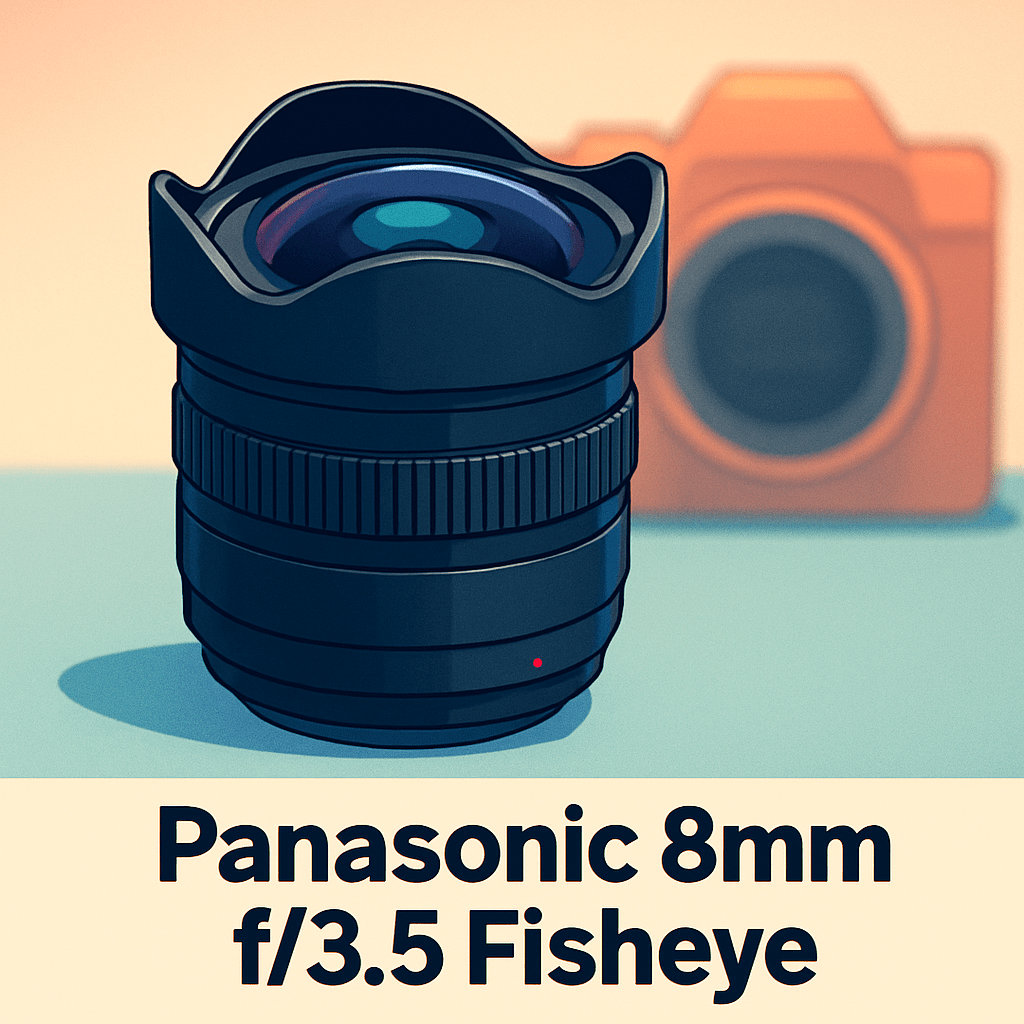
Want to squeeze a jaw‑dropping 180° perspective out of your Micro Four Thirds camera? The Panasonic Lumix G Micro Four Thirds 8mm f/3.5 Fisheye H-F008 promises that dramatic look in a tiny, easy-to-carry package.
After spending time with it in the field, I’m excited to show who this lens really helps: travel shooters, interior and architecture photographers, and anyone who loves exaggerated perspective and close-focus creativity without lugging heavy glass.
I’ll walk through how its compact size, autofocus convenience, and wide fisheye view affect real-world shooting, plus the trade-offs you’ll notice in low light and handling. Make sure to read the entire review as I break down handling, sharpness, and real-use comparisons—keep reading.

Panasonic Lumix G Micro Four Thirds 8mm f/3.5 Fisheye H-F008
Pocket-sized ultra-wide fisheye delivering immersive 180-degree perspective and playful distortion for creative landscapes, architecture, and action. Lightweight, easy to carry, produces punchy colors and reliable sharpness throughout.
Check PriceThe Numbers You Need
| Spec | Value |
|---|---|
| Focal Length | 8mm |
| Aperture | f/3.5 |
| Lens Mount | Micro Four Thirds |
| Field of View | 180° |
| Lens Construction | 11 elements in 8 groups |
| Angle of View Correction | Not supported |
| Closest Focusing Distance | 20 cm |
| Manual Focus | Supported |
| Image Stabilization | Not integrated |
| Autofocus | Supported |
| Maximum Magnification | 0.14x |
| Filter Thread | None |
| Weight | 165g |
| Dimensions (Diameter × Length) | 60.0 × 52.8 mm |
| Minimum Aperture | f/22 |
How It’s Built
In my testing the Panasonic Lumix G 8mm f/3.5 fisheye felt like a natural fit on small Micro Four Thirds bodies. It’s very compact and light, so I could walk around all day without neck strain. That portability means it’s an easy grab-and-go lens for travel and street work.
I found the focus options straightforward — autofocus works and you can switch to manual when you need fine control. What I really liked was how the tiny barrel balances on a camera and focuses quickly for playful wide-angle shots. One thing that could be better is the lack of a front filter thread, which makes adding ND or polarizing filters awkward in the real world.
Inside you’ve got a tightly packed optical design that delivers the full fisheye look with a huge field of view. Angle-of-view correction isn’t built in, so the camera won’t straighten that heavy curve for you; you either embrace the fisheye or fix it later in software. After using it for a while I appreciated the bold perspective and the reminder that composition matters more than ever with this kind of glass.
In Your Hands
The Panasonic Lumix G 8mm fisheye delivers that unmistakable dome-like sweep that forces you to rethink composition; edges become part of the story and the horizon demands deliberate placement to avoid a chaotic frame. Work the distance to your subject—step in for exaggerated foreground drama or back off to let entire rooms or skies breathe—and be mindful that the lens will happily include unintended objects (or even the shooter) if you don’t frame with care.
Autofocus on modern Micro Four Thirds bodies is generally responsive and accurate for everyday use, locking quickly on contrast-rich subjects and tracking well in handheld scenarios. When you need surgical control—macro-like foregrounds or precise hyperfocal landscapes—switching to manual focus is satisfying and predictable thanks to a forgiving focus throw.
With a moderate maximum aperture, the lens asks you to balance ISO and shutter speed more actively than faster glass, especially in dim interiors or dusk scenes. Because stabilization lives in the camera body rather than the optic, handheld low-light work benefits from cameras with IBIS or simply choosing a faster shutter to freeze motion.
Close-focus capability is where the lens shines for creative play: get near a subject and the perspective distortion becomes a compositional tool, turning mundane details into dynamic foreground anchors. That look is perfect for environmental portraits, action angles, immersive interiors, and any situation where context and drama are the goal.
The Good and Bad
- True fisheye coverage: 180° field of view
- Compact and lightweight: 60.0 × 52.8 mm; 165 g
- Autofocus supported; manual focus supported
- Closest focusing distance: 20 cm; maximum magnification: 0.14x
- f/3.5 maximum aperture (slower than f/1.8 and f/2 alternatives)
- No image stabilization
Ideal Buyer
If you shoot Micro Four Thirds and crave a true, head‑turning fisheye perspective, the Panasonic Lumix G Micro Four Thirds 8mm f/3.5 Fisheye H-F008 is built for you. It delivers a full 180° field of view in a tiny 165 g, 60 × 52.8 mm package and keeps autofocus for quick handheld work.
This lens suits travelers, street shooters, and content creators who prize portability and AF convenience over maximum aperture. The f/3.5 max and no filter thread are reasonable trade‑offs when your priority is a playful, immersive look. Close focus to 20 cm and 0.14× magnification let you exaggerate foreground subjects and make dynamic environmental portraits.
It’s not the right tool if you need the cleanest low‑light or astro performance; faster options like f/1.8 or f/2 lenses will keep ISO lower and backgrounds darker. Likewise, photographers who rely on front filters or expect in‑lens stabilization should look elsewhere. For studio or landscape work that demands filters and the tightest edge‑to‑edge clarity, consider higher‑end alternatives.
In short, pick this Panasonic when you want an autofocus, pocketable true fisheye that gets you creative results fast. If you need speed or pro weather‑sealing, evaluate the Olympus 8mm f/1.8 PRO or Laowa 7.5mm f/2 instead.
Better Alternatives?
We’ve gone through the Panasonic Lumix G 8mm f/3.5 fisheye and what it does best: tiny size, true 180° view, and autofocus that just works on Micro Four Thirds bodies. It’s a very handy lens when you need a real fisheye look without bulk, but there are clear reasons to look at other lenses if you want faster glass, different handling, or tougher build.
Below are three practical alternatives I’ve used in the field. I’ll say how each one beats the Panasonic in real shooting, where it falls short, and the kind of photographer who’ll prefer it. I’ll keep it focused on real use—low light, shooting indoors, handheld work, and night skies—rather than just specs.
Alternative 1:

Olympus M.Zuiko Digital ED Micro Four Thirds 8mm f/1.8 Fisheye PRO
Professional-grade ultra-fast fisheye with an f/1.8 aperture for exceptional low-light performance, smooth background rendering, and precise control. Ruggedly built with weather resistance, ideal for nightscapes, interiors, and dynamic creative work.
Check PriceI’ve used the Olympus 8mm f/1.8 PRO on windy night shoots and in damp city interiors, and the biggest real-world win over the Panasonic is the aperture. Shooting at f/1.8 lets you keep ISO much lower or use slower shutter speeds for creative blur, which is a big deal for nightscapes and low-light interiors where the Panasonic at f/3.5 forces you to jack up ISO.
Optically the Olympus also feels a step up: sharper across the frame wide open and fewer color fringes on high-contrast edges near the extreme corners. The build is solid and weather-sealed, so I’m comfortable using it in rain or dusty locations where I’d baby the Panasonic. The trade-offs are obvious in the field—this PRO lens is heavier and larger, and it brings a noticeable price jump.
If you’re a shooter who needs the cleanest wide-open images for astro, low-light interiors, or pro work where weather sealing and top performance matter, you’ll prefer the Olympus. If you value the Panasonic’s tiny size, autofocus simplicity, and low cost more than very wide apertures and rugged build, then stick with the Panasonic.
Alternative 2:

Laowa Micro Four Thirds 7.5mm f/2
Bright ultra-wide optic with a fast f/2 aperture designed for low-light shooting and astrophotography. Compact and lightweight, it offers expansive framing, tactile manual control, and crisp detail for travel and vlogging.
Check PriceThe Laowa 7.5mm f/2 is the first time I really felt a compact fisheye that’s clearly aimed at night and travel shooters. Compared to the Panasonic, the Laowa gives you about one and a third stops more light, so star fields and indoor scenes come out cleaner without massive ISO. It’s small on the camera and very easy to carry, which makes it a natural for travel or handheld video work.
That said, it’s manual focus only. In practice that means you need to be comfortable focusing by eye or using focus peaking, especially for fast-moving scenes where the Panasonic’s AF would have handled things for you. Optically it holds up well in real shots—good edge control and lower coma than I expected—but because it’s manual you’ll trade some convenience when you’re working fast.
If you shoot a lot of night scenes, astro, or travel video and don’t mind manual focus, the Laowa is a great pick—lighter and faster than the Panasonic. If you need autofocus, or you frequently shoot run-and-gun events where fast AF saves time, you’ll miss the Panasonic’s convenience.
Alternative 3:
Laowa Micro Four Thirds 7.5mm f/2
Compact mirrorless lens delivering a dramatic wide field of view and generous f/2 light gathering for vivid night skies and interior scenes. Manual-focus precision, controlled aberrations, and excellent portability for on-the-go creators.
Check PriceTalking about the Laowa again because its practical use can feel different depending on how you shoot: on a tripod for star work it’s a joy, but handheld for quick interior shots it demands a slower, more deliberate approach than the Panasonic. Compared to the Panasonic, this Laowa gives you cleaner low-light frames and a slightly punchier look thanks to the faster f/2, but it never replaces AF-driven speed when shooting people in motion.
In my hands the build is straightforward and feels solidly made for its size, though it’s not weather sealed like the Olympus PRO. The manual focus ring is smooth and precise, so if you’re used to nailing focus manually you’ll get excellent control; if you rely on chasing focus with autofocus, the Panasonic will still be easier to use in many real-world situations.
Choose this Laowa variant if you prioritize low-light performance, portability, and precise manual control—ideal for astrophotographers, landscape shooters on the move, and content creators who plan shots ahead. Choose the Panasonic Lumix G 8mm f/3.5 if you want a tiny, autofocus fisheye that’s faster to use in casual or fast-paced shooting.
What People Ask Most
Is the Panasonic 8mm f/3.5 fisheye compatible with Micro Four Thirds cameras?
Yes — it’s designed for Micro Four Thirds and mounts directly to MFT bodies, producing the intended circular fisheye image.
Does the Panasonic 8mm f/3.5 fisheye provide a 180° angle of view?
Yes — it’s a circular fisheye that captures roughly a 180° field of view on MFT sensors, resulting in a round image with black corners.
Does the Panasonic 8mm f/3.5 have autofocus or is it manual focus only?
It is manual focus only, so you’ll need to set focus yourself rather than relying on autofocus.
What is the 35mm equivalent focal length of the Panasonic 8mm f/3.5?
On Micro Four Thirds the 35mm equivalent is about 16mm because of the 2x crop factor.
How good is the image quality and sharpness of the Panasonic 8mm f/3.5 fisheye?
Center sharpness is decent, especially stopped down, but edges are soft with strong distortion and vignetting typical of circular fisheyes.
Can the Panasonic 8mm f/3.5 be used for video/vlogging and how does it perform?
Yes it can be used for video, but the circular image and extreme distortion make it more suited to creative or action shots than standard talking-head vlogs, and manual focus means you should pre-set focus for moving subjects.
Conclusion
The Panasonic Lumix G Micro Four Thirds 8mm f/3.5 Fisheye H-F008 is a true fisheye in spirit: it delivers the dramatic sweep and playful distortion you buy a lens like this for, while keeping size and handling refreshingly unobtrusive. Autofocus works well enough to make it a grab-and-go creative tool, and the close-focus character extends its use beyond mere landscape or astro novelty. It feels like a lens designed for photographers who want fun and immediacy without hauling heavy glass.
That practicality comes with trade-offs. The maximum aperture is modest compared with faster fisheye alternatives, and there’s no in-lens stabilization or front filter mounting to hide behind. These limits don’t kill the lens’s purpose, but they do narrow where it excels—bright, handheld, and creatively composed work rather than low-light documentary or specialized pro assignments.
If you value compactness, autofocus convenience, and a genuine 180‑degree look on your Micro Four Thirds body, this is an excellent, affordable pick. If you need heavy-duty wide‑open performance, weather sealing, or filter flexibility, you should consider the faster, more robust options that trade portability for capability.
Overall, the H‑F008 is a smart, no-nonsense fisheye: characterful, easy to carry, and great for photographers who prioritize fun and mobility over extreme low-light prowess or pro-grade features. It earns a clear place in the kit bag for creative shooters.
Panasonic Lumix G Micro Four Thirds 8mm f/3.5 Fisheye H-F008
Pocket-sized ultra-wide fisheye delivering immersive 180-degree perspective and playful distortion for creative landscapes, architecture, and action. Lightweight, easy to carry, produces punchy colors and reliable sharpness throughout.
Check Price




0 Comments