
Looking for the perfect first camera kit to capture travel stories, family moments, or finally start that video channel you’ve been planning?
With so many packages marketed to beginners, choosing the right bundle can quickly feel confusing, so this guide narrows the field to five approachable options and practical buying advice tailored to common beginner goals.
Whether you’re upgrading from a smartphone, learning photography at school, or starting to vlog, you deserve a kit that helps you learn without getting in the way.
We focus on bundles that balance intuitive controls, useful lenses, and a sensible selection of accessories, while keeping overall cost realistic and upgrade paths obvious so beginners can shoot confidently from day one.
Instead of drowning in specs, this primer highlights real-world trade-offs—what will make your photos look better right now and which features you can postpone until you level up.
You’ll find clear explanations about usability, cost-effectiveness, and growth potential, and brief tips on where to save and where to invest so your first kit becomes a foundation rather than a dead-end purchase.
By the end of this guide, you’ll be able to match a bundle to your priorities—whether that’s simplicity, mobility, or room to expand as your skills mature.
Ready to find the camera package that makes photography fun instead of frustrating? Let’s get started.
1. Canon EOS R50 Bundle Overview

Canon EOS R50 with RF‑S 18‑45mm lens
Compact mirrorless kit delivering sharp images, fast autofocus, and versatile zoom—ideal for travel, vlogging, and everyday photography
Check PriceThe Canon EOS R50 bundle is a compact, easy-to-carry APS-C mirrorless that’s tailor-made for beginners who want strong autofocus and modern video features. It packs a 24.2MP sensor and uses the Canon RF/RF-S mount, so the body delivers sharp, share-ready JPEGs straight out of the camera.
Included 18–45mm kit coverage gives you versatile focal lengths for landscapes, street, and casual portraits without swapping lenses. The camera’s excellent autofocus and fast continuous shooting make it forgiving when you’re learning to track moving subjects like kids or pets.
For vloggers the R50 is especially attractive: 4K video, a vari-angle LCD and an intuitive touchscreen simplify framing and selfie-style shooting. The compact, comfortable grip helps keep handheld shots steady, and the simple menus with guided features help flatten the learning curve.
Realistically, this is a great starter body for people moving up from smartphones and wanting faster performance and better image quality for both stills and quick social sharing. Be aware it leans toward easy operation rather than granular physical controls, so if you crave lots of dials you might feel limited later.
- 24.2MP APS-C sensor — sharp, share-ready images
- 18–45mm kit lens — versatile starter focal range
- Excellent autofocus and fast continuous shooting
- 4K video + vari-angle LCD and touchscreen — great for vlogging
- Limited physical controls for quick setting changes
- RF-S lens selection remains limited; may need adapters or extra lenses later
2. Olympus OM-D E-M10 Mark IV Bundle Overview

Olympus OM‑D E‑M10 Mark IV with M.Zuiko ED 14‑42mm EZ lens
Stylish, lightweight Micro Four Thirds bundle with stabilization, intuitive controls, and compact zoom for crisp, easy-to-shoot photos
Check PriceThe Olympus OM-D E-M10 Mark IV is a Micro Four Thirds mirrorless with a 20MP sensor, and it’s compact and lightweight for day-long shooting. As a working photographer I appreciate how small form factors let you stay out shooting longer without fatigue.
Its stand-out feature is In-Body Image Stabilization (IBIS), which helps deliver sharper handheld photos and smoother video. For beginners this means you can shoot in lower light and still get usable shots without always reaching for a tripod.
Twin control dials give real manual control as your skills grow, so the camera transitions nicely from auto modes to creative shooting. That tactile layout speeds learning because you can change exposure and aperture without diving deep into menus.
Olympus’s JPEG processing is punchy and colorful, which is a big plus if you like images that sing straight out of camera. The vibrant color rendition encourages experimentation and makes sharing full-frame-feeling images effortless.
Lens compatibility is another practical win: the E-M10 Mark IV works with a wide range of affordable Micro Four Thirds lenses. That keeps upgrade costs down and gives beginners plenty of creative choices as they discover what they shoot most.
Put simply, this camera is ideal for enthusiasts and beginners who prioritize color, portability, and stabilization for stills. If you mainly want the cleanest raw files in low light or the fastest autofocus, note the trade-offs before committing.
- Classic styling and pleasant ergonomics
- IBIS recovers shots that would otherwise be blurry
- Advanced features without overwhelming newcomers
- Vibrant color rendition encourages creativity
- Smaller sensor affects noise performance and raw image quality versus APS-C
- Autofocus is slower and less reliable than equivalent Canon models
3. Fujifilm X-S20 Bundle Overview

Fujifilm X‑S20 with XC 15‑45mm lens
High-performance hybrid camera offering cinematic video, advanced color profiles, and stabilisation—perfect for creators seeking professional results in a portable body
Check PriceThe Fujifilm X-S20 is an APS-C mirrorless designed as a true hybrid for photographers who also want strong video tools. It pairs in-body image stabilization (IBIS) with simplified manual controls and comprehensive automated modes, so you can grow from automatic to full manual without swapping systems.
Fujifilm’s color processing delivers sharp, vibrant images straight from the camera, which is great when you want striking JPEGs for quick sharing. The body feels solid in hand; build quality and ergonomics make longer shoots comfortable and more controlled.
The touchscreen and intuitive controls reduce beginner frustration and speed up learning curves. As a working photographer, I appreciate how those touchscreen menus and dials let me change settings on the fly without losing a moment.
Video-wise the X-S20 impresses: 4K at higher frame rates gives you crisp footage and the flexibility to slow things down for cinematic moments. That, combined with IBIS, makes handheld shooting for run-and-gun projects far more usable.
There are trade-offs to consider. The X-S20 sits at a higher price point than many entry-level kits, so budget-conscious beginners may hesitate. Its autofocus, while good, isn’t quite as fast or as rock-solid as some rival entry-level mirrorless systems, which can matter if you shoot fast action or wildlife.
Overall, the X-S20 is a strong choice for beginners who plan to develop both photography and videography skills and want a camera that will grow with them. It’s versatile, well-built, and tuned for vibrant image delivery, though you pay a premium for that capability.
- Versatile hybrid for stills and video
- Touchscreen and intuitive controls
- Strong build quality and ergonomics
- Impressive 4K video at higher frame rates
- Higher price point for some beginners
- Autofocus not as fast/robust as some rivals
4. Sony Alpha a6100 Bundle Overview

Sony Alpha a6100 with 16‑50mm lens
Fast-hybrid AF and real-time tracking in a compact APS-C body, delivering crisp images and responsive performance for everyday shooters
Check PriceThe Sony Alpha a6100 bundle is an APS-C mirrorless kit that shines where beginners often struggle: keeping moving subjects sharp. Its fast, reliable autofocus — notably Eye AF — takes the guesswork out of focusing for portraits, street scenes, and casual action shots.
Image quality is a strong suit for this camera; you get sharp results and decent low-light noise control that make it easy to shoot in varied conditions without immediately needing fast glass. The camera also records 4K video and offers solid connectivity, so sharing clips or transferring files is straightforward.
Ergonomically it’s compact and sturdy, which is ideal for travel and street photography where you want something unobtrusive but reliable. Many users praise the comfortable grip and straightforward menus, so you can get shooting quickly, though the interface hides deeper options that some beginners find confusing.
Practically, the a6100 is best for newbies who primarily care about stills but want competent video too. It gives excellent autofocus performance and image quality in a small package with good battery life, but remember it lacks in-body image stabilization, so stabilized lenses or a tripod help for low-shutter situations.
- Autofocus often cited as one of the best for beginners
- Great image quality for its class
- Good real-world battery life
- Comfortable grip and straightforward menus
- Interface and menu system can be complicated for new users
- No in-body stabilization
5. Canon EOS R10 Bundle Overview

Canon EOS R10 with RF‑S 18‑45mm lens
High-speed enthusiast mirrorless delivering rapid continuous shooting, reliable autofocus, and versatile zoom—great for action, wildlife, and advanced hobbyists
Check PriceThe Canon EOS R10 is an APS-C mirrorless that strikes a neat balance between beginner-friendly operation and room to grow into more advanced shooting. As a working photographer, I appreciate that it doesn’t feel like a toy — it’s designed to teach you but still perform when you need it to.
Its autofocus is a standout: excellent AF with Eye and Face Detection makes nailing focus on people and moving subjects noticeably easier. That fast, accurate autofocus will save beginners hours of frustration and increase keeper rates practically overnight.
For video creators, the R10 offers 4K video up to 60fps, while photographers get robust burst shooting for action work. Those features give you real versatility if you want to shoot sports, kids, pets, or quick-moving street scenes.
The vari-angle touchscreen LCD helps with creative angles and vlogging, and the camera’s intuitive interface genuinely helps the learning curve. Image quality and ISO performance are solid for an APS-C body, so low-light work and everyday shooting both look good.
Physically the camera is light and compact, yet feels solid in the hand — which matters on long walks or when you’re shooting all day. That combination makes it easy to carry and comfortable to use during practice sessions.
If you’re a beginner who wants a single camera to learn on and grow with for both photo and video, the R10 is a very sensible pick. It gives higher performance and versatility without forcing you into a full-frame system right away.
- Intuitive interface aiding learning
- Good image quality and ISO performance
- Light, compact, yet solid build
- Fast, accurate autofocus (Eye and Face Detection)
- Lens ecosystem still growing
- Burst buffer size can limit extended action sequences
Essential Accessories for Camera Starter Kits
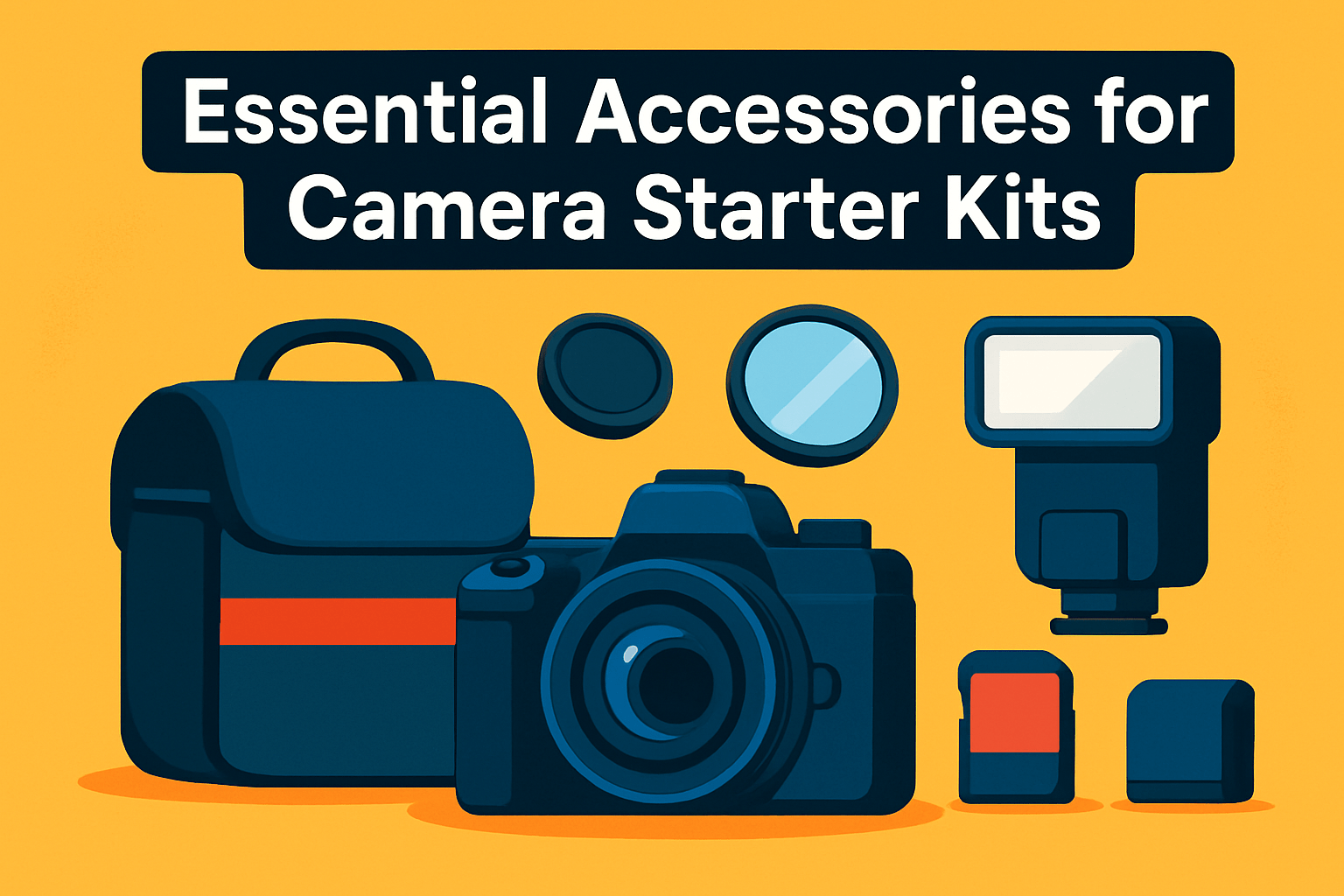
When you buy your first camera bundle, the body and lens are only part of the story. A few thoughtful accessories will change how often you shoot and how good your results look. Think of these items as insurance for better photos and less frustration.
A solid tripod is worth more than a second lens for many beginners. For travel and street work I prefer a lightweight travel tripod with a ball head, while a compact Gorillapod or mini tripod is brilliant for vlogging and self-portraits. If you plan long exposures or landscapes, prioritize stability over weight.
Memory cards are another place to be practical rather than cheap. Aim for at least one 64GB card for stills, and consider 128GB or higher with V30 or V60 ratings if you’ll shoot 4K video; SanDisk and Lexar are reliable. Buy two cards and rotate them so you always have a backup if one fails or fills up.
A camera bag you actually enjoy carrying will mean you bring the kit everywhere. Choose padded compartments and a layout that matches your routine — a sling for city days, a backpack for hikes, or a small shoulder bag for casual shoots. Organization keeps spare batteries, cards, and filters accessible when the moment arrives.
Spare batteries are non-negotiable; two extras will cover most long days. Carry a small dual charger so you can top up between shoots, and consider a power bank for mirrorless bodies that charge over USB. Battery anxiety kills creativity, so eliminate it early.
Cleaning tools and filters protect your gear and image quality. A blower, lens pen, and microfiber cloth tackle the usual dust and smudges, while a gentle sensor clean is best left to pros unless you’re confident. A clear UV/protection filter is inexpensive insurance, and a circular polarizer or ND filter pays dividends for landscapes and creative video.
Finally, add a simple remote shutter, a comfortable strap, and a screen protector to the starter kit if your budget allows. Prioritize what fits your shooting style: stabilization and batteries for travel, cards and filters for video, and a good bag for everyday use. Those few extras will keep you shooting longer and more confidently.
Lens Recommendations for Beginners
Choosing lenses is the single best way to change what your camera can do. For most beginners the bundled kit lens (18–55mm or 16–50mm) is the perfect starting point — it covers wide landscapes through short portrait focal lengths and teaches you how focal length affects composition. Learn to move with the lens before chasing expensive glass.
After you’ve spent time with the kit, add a 50mm f/1.8 prime. It’s affordable, sharp, and gives you a taste of shallow depth of field and low‑light shooting that kit zooms can’t match. On APS‑C bodies that “nifty fifty” behaves more like a short telephoto, which is flattering for portraits and great for learning subject isolation.
If you like wildlife, sports, or want to compress scenes from a distance, a 70–300mm telephoto expands your options dramatically. It’s not just about reach; being able to frame distant subjects teaches patience and movement, and it opens up new shooting situations you can’t replicate with a standard zoom.
Deciding between zooms and primes comes down to flexibility versus optical speed. Zooms give you one-lens convenience for travel and run‑and‑gun days. Primes usually deliver wider apertures and better image quality for the price. Start with a zoom for versatility, then add primes to upgrade sharpness and low‑light performance.
Pay attention to aperture and stabilization. Faster lenses (f/1.8–f/2.8) help in dim light and create creamy backgrounds, but they cost more. Image stabilization in a lens is a huge benefit if your camera lacks IBIS or you plan handheld telephoto work — it rescues shots at slower shutter speeds.
A simple practical path works best: use the kit lens to learn, pick up a 50mm f/1.8 as your first upgrade, and later add a 70–300mm if your interests demand reach. That order keeps costs sensible while giving you clear, useful improvements at each step.
What People Ask Most
Are camera bundles good for beginners?
Camera bundles are a convenient way to start because they include a camera body and essential items so you can begin shooting right away. They simplify early purchases and reduce the guesswork for newcomers.
What should I look for in a beginner camera bundle?
Look for a comfortable, easy-to-use camera with reliable autofocus and a versatile kit lens. Also consider useful accessories like extra batteries and a protective bag to keep shooting without interruptions.
How do I choose the right camera bundle for my needs?
Think about the types of photos or videos you plan to make and choose a bundle that aligns with those priorities. Pick a kit that feels good to hold and offers features that match your learning goals.
Should a beginner buy a mirrorless or DSLR camera bundle?
Mirrorless cameras tend to be more compact and incorporate newer features, while DSLRs offer a familiar handling style and established lens options. Choose the format that best fits your comfort and future upgrade plans.
What lenses and accessories are typically included in beginner camera bundles?
Bundles often include a general-purpose kit lens plus essentials like a camera bag, memory card, and extra battery. Some kits may also add a protective filter or a basic tripod for immediate use.
Can beginner camera bundles help me learn photography faster?
Having a ready-to-use kit reduces setup friction and encourages regular practice, which speeds learning. Bundles also often include helpful features and controls that guide beginners as they develop skills.
How easy is it to upgrade components in a camera bundle as a beginner?
Most camera systems let you add lenses and accessories over time as your skills grow, making gradual upgrades straightforward. Check the camera mount and available ecosystem to ensure a smooth upgrade path.
Conclusion for Beginner Camera Bundles
Each bundle highlights different beginner priorities—fast autofocus, in-body stabilization, video features, portability, or a broad lens ecosystem—so this comparison should help you see which strengths matter most for your first kit.
Match your choice to primary goals like stills versus video, the need for stabilization, and how much room you want to keep for future upgrades as your skills grow.
Beyond specs, consider ease of use and ergonomics since the camera you enjoy carrying and learning with will accelerate your progress more than any single number.
If you want to improve your technical skills and gear knowledge, read more articles on the site to explore practical tips, workflows, and buying guidance tailored to beginners.
Have a specific situation or budget in mind? Leave a comment below and we usually reply within a few hours to help you pick the kit that fits your needs.



0 Comments