

Ever tried to freeze a toddler’s full-speed grin and ended up with a blur? What if you could capture those blink-and-you-miss-it moments with more detail than your phone—without a photography degree?
This guide is for busy parents who want better photos and videos without complicated gear. We’ll help you find cameras that balance ease of use, portability, fast autofocus, and images that look great printed.
Inside you’ll find five recommended picks covering mirrorless bodies, compact point-and-shoots, and pocket gimbal video devices. Each selection targets a different need—whether it’s crisp portraits, grab-and-go convenience, or buttery-smooth video. Selections were chosen with real family shoots in mind.
We focus on the features that matter most: simple controls, lightweight bodies, fast and reliable autofocus, and sensors that deliver print-worthy detail. You won’t need to become an expert to get great shots.
Whether you prioritize still photos, smooth video, or something small that fits in a diaper bag, this guide narrows the choices. Expect clear recommendations, practical buying advice, and tips for matching a camera to your family’s rhythm so you can capture childhood more often and more beautifully.
1. Nikon Z30 For Parents

Nikon Z30 with 16-50mm kit lens
Compact mirrorless camera delivering sharp photos and smooth 4K video, ideal for creators and everyday photography.
Check PriceNikon Z30 For Parents is a fuss-free mirrorless option aimed squarely at busy families who want better results than a smartphone without a steep learning curve. It’s ideal for parents who want an easy-to-use camera that still delivers high-quality photos of their family.
In the field you notice the intuitive controls immediately; menus are straightforward so you’re not fumbling through settings while a moment unfolds. That simplicity makes it easy to hand to a partner or grandparent and still get great shots.
Autofocus is a standout for family use — fast, reliable autofocus that keeps up with energetic children — so you get sharp images of toddlers mid-run or a cousin blowing out candles. Real-world feedback praises its crisp image quality in various lighting, which translates to fewer missed moments.
The body is lightweight and compact; easy to carry in a diaper bag or backpack, so it actually gets used on outings rather than sitting at home. Portability combined with responsive handling means you’re more likely to grab it for everyday life.
Image quality is strong enough that the camera produces images that look great printed, even at larger sizes, giving you physical keepsakes that hold up. If you want a genuine step above smartphone photos for family albums and wall prints, this is a compelling choice.
It’s not perfect for everyone — not the most advanced for enthusiasts seeking manual control or pro-level video features — and it has a limited lens selection compared to some other mirrorless systems (basics well-covered). For busy parents wanting reliable, print-ready results with minimal fuss, the Z30 is an excellent fit.
- Super simple to use with straightforward menus and controls
- Fast, reliable autofocus that keeps up with energetic children
- Lightweight and compact; easy to carry in a diaper bag or backpack
- Produces images that look great printed, even at larger sizes
- Not the most advanced for enthusiasts seeking manual control or pro-level video features
- Limited lens selection compared to some other mirrorless systems (basics well-covered)
2. Fujifilm X-T30 II For Parents

Fujifilm X-T30 II with XC15-45mm kit lens
Stylish retro-bodied camera offering vibrant film-simulation colors, fast autofocus, and lightweight handling for travel and street photography.
Check PriceIf you want a camera that makes portraits pop without hours of editing, the Fujifilm X-T30 II is an excellent pick for parents who value style and image quality. It’s aimed at photographers who care about portability and beautiful color rendition—especially for portraits—so you get lovely family shots right out of camera.
Handling is a joy: tactile dials and vintage-style ergonomics make it feel like a proper camera rather than a gadget. That classic control layout helps you work quickly when kids aren’t willing to sit still, and the compact, lightweight body means it’s easy to carry on outings or tuck into a day bag.
What really sells the X-T30 II is Fujifilm’s color science—skins tones and lifestyle images look vibrant and natural straight from the JPEGs, which cuts down on editing time. It also offers good video capabilities for capturing short clips of kids’ milestones, so you can grab both beautiful stills and usable video without swapping tools.
There are a couple of practical things to keep in mind: the menus can be a bit complex for absolute beginners, so expect a short learning curve if you’re new to interchangeable-lens cameras. Battery life is average too—plan to bring a spare for longer days out—but overall it’s a high-performing, visually appealing camera that parents who enjoy photography will love.
- Compact and lightweight
- Beautiful Fujifilm colors — great out-of-camera portraits
- Good for short milestone videos
- Tactile vintage-style controls
- Menus can be complex for absolute beginners
- Average battery life — carry a spare
3. Sony ZV-1F For Family Video

Sony ZV-1F
Purpose-built vlogging compact with bright lens, clear autofocus, and user-friendly features for polished social videos on the go.
Check PriceThe Sony ZV-1F is built for parents who want video as much as stills and refuse to be slowed down by fiddly settings. It’s a pocketable, grab-and-go camera that makes capturing family life easy and even a little fun.
In the real world it shines because of its lightning-fast autofocus and creative, user-friendly features. Built-in presets and background-blur modes mean you get pleasing results without needing technical know-how or hours of editing.
Portability is a standout — it’s extremely small and easy to carry, so it lives in a diaper bag or pocket and is ready when unpredictable moments happen. That compactness also makes it well-suited for both photos and video, plus the sharing features are tuned for parents who want quick uploads to phones or social apps.
Be aware of the trade-offs. The smaller sensor won’t match larger cameras in low light, so indoor evening shots may need extra care or brighter rooms. The fixed lens also limits flexibility for wide group shots or tight portraits, so if you want one tool to do everything, this might feel limiting.
- Extremely small and easy to carry
- Fast, dependable autofocus that tracks kids
- Creative presets and background blur modes
- Well-suited for both photos and video
- Smaller sensor — weaker low-light image quality
- Fixed lens limits shooting flexibility
4. Canon PowerShot G7 X Mark III

Canon PowerShot G7 X Mark III
High-performance pocket camera with large sensor, excellent low-light capability, and livestream-ready features for creators.
Check PriceThe Canon PowerShot G7 X Mark III is a win for parents who want serious image quality without hauling a bag of gear. Its compact size makes it a true grab-and-go option, so you’re far more likely to have it on hand for the little moments that disappear fast.
What really sells this camera for family use is the bright lens. It performs well in low light for indoor parenting shots, so you won’t be fighting blur or noisy ISO every time you photograph bath time or bedtime stories.
The wide-angle zoom is a practical bonus for group shots, parties and family gatherings — you can fit grandma and the whole crowd without awkward backing up. The intuitive touchscreen interface is familiar to smartphone users, which shortens the learning curve and speeds up shooting when patience is short.
There are trade-offs. It’s not as customizable or expandable as interchangeable-lens cameras, so you’ll hit limits if you want specialized lenses or deep manual control later on. Autofocus, while good, isn’t as advanced as the best mirrorless models, but for most parents capturing everyday life this camera strikes a great balance of image quality, portability and ease of use.
- Compact size makes it a true grab-and-go option
- Bright lens performs well in low light for indoor parenting shots
- Wide-angle zoom great for group shots, parties and family gatherings
- Intuitive touchscreen interface familiar to smartphone users
- Not as customizable or expandable as interchangeable-lens cameras
- Autofocus, while good, isn’t as advanced as the best mirrorless models
5. DJI Pocket 3 For Family Video

DJI Osmo Pocket 3
Ultra-portable stabilized camera offering cinematic 4K capture, intelligent tracking, and effortless gimbal-smooth footage everywhere.
Check PriceAs a photographer who shoots both stills and video for family life, I appreciate how the DJI Pocket 3 makes high-quality video absurdly easy to capture. It’s a smartphone-sized device with class-leading stabilization thanks to its built-in gimbal, so footage stays buttery-smooth even when you’re chasing toddlers down the playground.
The flip-up touchscreen is a small detail that matters a lot in practice. It makes framing selfies and low-angle shots intuitive, and the interface is clearly designed for quick operation when you’ve only got seconds to catch a moment.
For parents who prioritize video, the Pocket 3 is a great compromise between convenience and image quality. Recent updates like lossless digital zoom extend its versatility for capturing faces from a short distance without swapping gear.
There are trade-offs to be aware of. The sensor is smaller than an APS-C chip, so expect less low-light performance and slightly softer stills compared with larger cameras. The fixed lens also limits creative flexibility if you like changing focal lengths or shooting wide environmental portraits.
In short, if your main goal is fuss-free, always-with-you video of family life—vlogs, milestones, candid play—the DJI Pocket 3 is an excellent choice. If you need strong low-light stills or want interchangeable lenses, you’ll notice its limits.
- Incredibly compact and lightweight—fits in a pocket or small bag
- Built-in gimbal delivers ultra-smooth video, even when chasing energetic kids
- Flip-up touchscreen convenient for framing; interface designed for quick operation
- Recent updates added features like lossless digital zoom
- Smaller sensor than APS-C; low-light image quality is a step below larger cameras
- Fixed lens limits flexibility compared with interchangeable-lens systems
Choosing The Right Family Camera
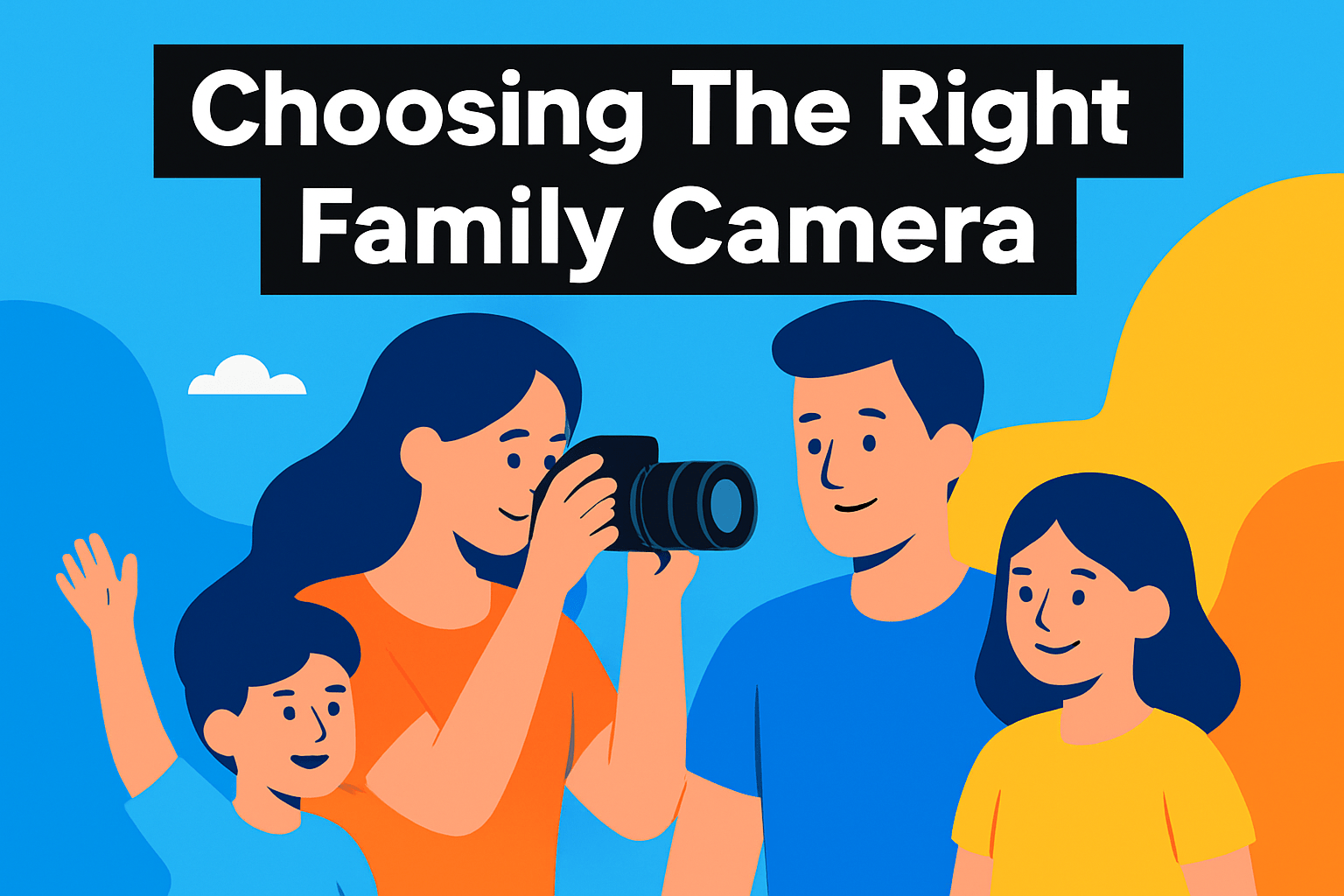
Picking the right family camera is less about specs on paper and more about how easily it lets you capture real life. You want something that disappears into the background while you catch smiles, spills and kid chaos, not a gadget that requires a manual to operate whenever the moment happens.
Simplicity matters. Intuitive controls, clear menus and helpful guide modes let you react quickly instead of fiddling with settings, and a responsive touchscreen speeds framing and focus so you don’t miss the laugh or the tumble.
Autofocus is the feature you’ll use every day. Look for fast continuous AF and reliable subject-tracking — eye or body detection is a huge advantage with squirmy toddlers — so the camera keeps pace with unpredictable movement and you get sharp frames more often.
Portability and ergonomics determine whether the camera actually comes along. Lightweight mirrorless bodies are usually the best compromise between image quality and carryability, and a comfy grip makes shooting during long outings less of a chore.
Think about final use: if you like printing 8x10s or larger, sensor size and lens quality matter. APS-C and full-frame sensors render detail and tone better in prints and give you more margin in low light, which is helpful for indoor birthday parties and dim nurseries.
Versatility keeps one camera useful for many situations. A tilting or fully articulated screen helps with low-angle shots and selfies, while a zoom lens buys convenience for everything from group photos to close-ups without swapping glass mid-chaos.
In short, favor fast AF, straightforward controls, comfortable handling and strong image quality. Those elements together let you be present with your family while still coming away with photos worth printing.
Before you buy, hold the camera, try the menus and, if possible, test it shooting moving subjects. Small practical choices — the right lens, an extra battery and a light bag — make a huge difference in everyday use.
Zoom vs Prime Lenses For Parents
As a parent you want gear that keeps up with unpredictable kids. The zoom vs prime debate comes down to convenience versus image quality. Both have real advantages; the right choice depends on how you shoot and what you value most.
Zooms are the everyday workhorses. A 16–50mm or 24–70mm covers group shots, playground close-ups and candid moments without you swapping lenses between tantrums. Modern kit zooms are lightweight and often stabilized, so you’ll capture sharp images while moving, which is a huge practical win for family life.
Primes reward intention. A 35mm on an APS-C camera (or 50mm on full frame) is perfect indoors — wide enough for family rooms but with a wide aperture for low light and creamy background separation. An 85mm shines for portraits and flattering compression outdoors. Shooting with a prime forces you to move, interact and connect with your kids, which often translates into better photographs.
My go-to advice: start with a useful zoom for day-to-day flexibility, and add one prime for portraits. For most parents a 24–70mm (or 16–50mm on crop bodies) plus a 35mm prime covers almost every situation. If you love headshots, swap the 35mm for an 85mm prime for that extra subject isolation.
Finally, consider weight, autofocus speed and whether your zoom has a bright constant aperture—if you shoot a lot in dim homes it matters. Keep one lens mounted for quick access, practice changing lenses fast and safely, and if you’re unsure, rent a prime for a weekend before committing. You’ll learn fast which style fits your family’s rhythm.
What People Ask Most
What is the best camera for parents to use for everyday moments?
Look for fuss-free operation, portability, fast autofocus and good image quality for prints. A camera that is easy to carry and quick to use will make capturing daily moments much simpler.
What camera is best for photographing babies and toddlers?
Prioritize fast, reliable autofocus, good low-light performance and easy portability. A camera that focuses quickly and performs well indoors will help you catch fleeting expressions and movements.
Are mirrorless cameras better for parents than DSLRs?
Mirrorless cameras are often favored because they tend to be smaller, lighter and offer advanced autofocus that helps with moving children. DSLRs can still be a solid option when paired with suitable lenses.
Is a point-and-shoot camera good for parents?
Yes. High-quality point-and-shoots offer true pocketability, bright lenses and intuitive touchscreens for grab-and-go family use, though they trade expandability for convenience.
What camera features should parents look for when photographing kids?
Seek simplicity and intuitive controls, fast autofocus, comfortable ergonomics and image quality that holds up for prints. Features like articulated screens and bright lenses also help in low light and awkward angles.
What is the easiest camera for parents to learn to use?
Cameras with straightforward menus, clear controls and helpful guide modes are the easiest to learn. Compact and mirrorless models that emphasize user-friendly interfaces tend to suit busy parents best.
Can a smartphone replace a dedicated camera for parents?
Smartphones can handle many everyday shots, but dedicated cameras often offer advantages like brighter lenses, better stabilization and options for larger prints. If you want improved image quality or smoother video, a compact camera or small gimbal device can be a worthwhile step up.
Conclusion For Best Camera For Parents
Choosing the right camera for family life comes down to matching the gear to your priorities: ease of use, portability, fast autofocus and image quality that holds up for prints.
Whether you prefer a fuss-free mirrorless option, a stylish APS‑C body, a video‑forward compact, a bright pocketable point‑and‑shoot or a stabilized pocket gimbal, there’s a practical pick here to fit different parenting needs.
Think first about whether stills or video matter more, how much weight and expandability you can tolerate, and whether you want instant portrait look versus everyday flexibility.
If you’d like to improve your shooting and get more comfortable with family photography, spend some time browsing the other articles on our site for practical tips and quick techniques you can use on outings and at home.
Have a question or want help choosing for your family—leave a comment below and tell us what you shoot; we usually reply within a few hours.



0 Comments