
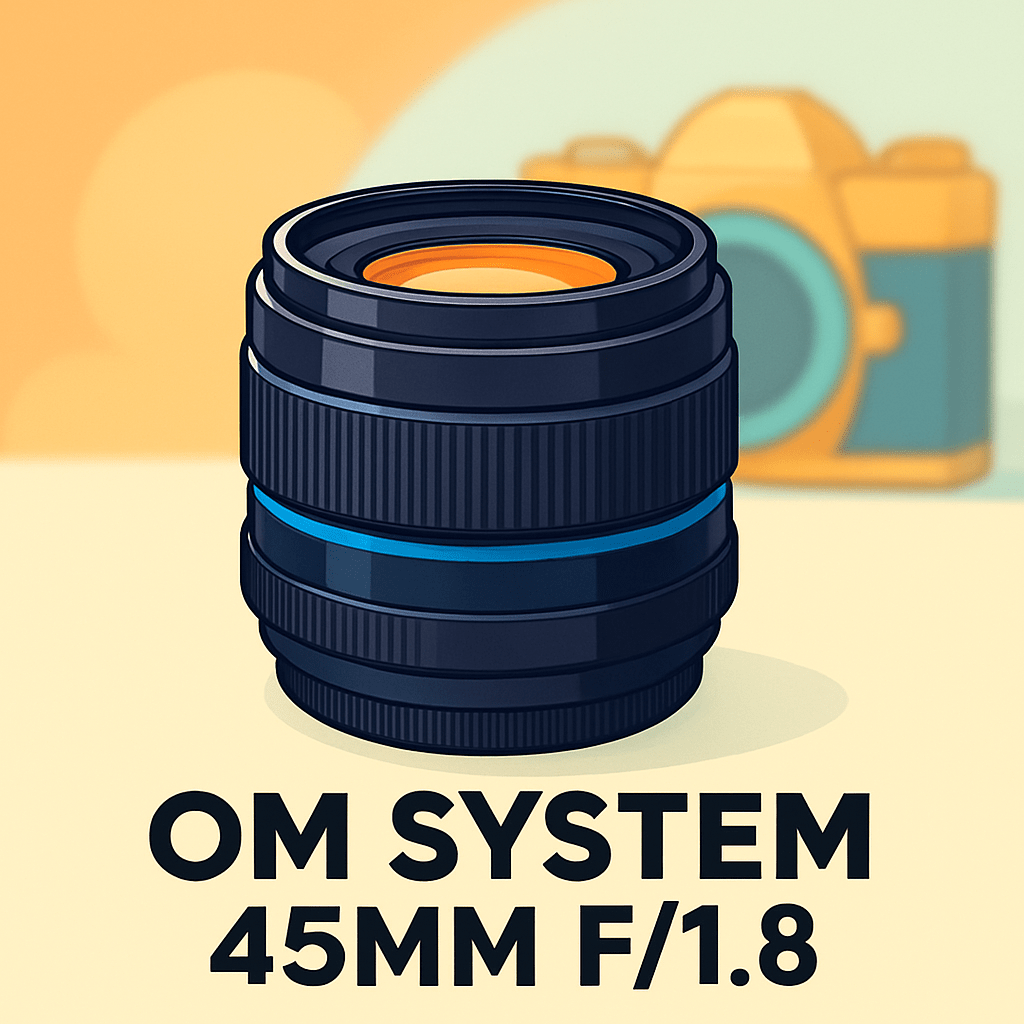
Want a compact portrait lens that actually makes shooting all day easy?
The OM System M Zuiko Digital ED 45mm f1.8 Micro Four Thirds pairs a fast f/1.8 aperture with snappy autofocus and a featherlight build, so you can work handheld in low light and get natural head-and-shoulders framing.
It’s aimed at MFT shooters who want a simple, portable portrait prime that won’t slow them down.
I’ve field-tested it on real shoots and compared it with a couple of rivals to see where it shines and where it trades off convenience for performance.
This review covers handling, autofocus, sharpness, bokeh, pros and cons, and alternatives—make sure to read the entire review as I dig into the details, so keep reading.

OM System M Zuiko Digital ED 45mm f1.8 Micro Four Thirds
Compact short-tele prime delivering crisp, detailed portraits and beautiful background separation. Fast f/1.8 aperture enables low-light shooting and creative shallow depth of field in a lightweight, finely tuned construction.
Check PriceThe Numbers You Need
| Spec | Value |
|---|---|
| Focal length | 45mm |
| Aperture | f/1.8 |
| Mount type | Micro Four Thirds |
| Format compatibility | Micro Four Thirds sensor |
| Angle of view | Equivalent to 90mm full-frame |
| Lens type | Prime |
| Autofocus | Yes (reliable autofocus) |
| Optical design | 9 elements in 8 groups |
| Minimum focusing distance | ~0.5 m (50 cm) |
| Maximum magnification | ~0.11x |
| Filter size | 37mm |
| Diaphragm blades | 7, rounded aperture |
| Dimensions (D × L) | approximately 56 × 46 mm |
| Weight | about 116g |
| Construction | Compact and lightweight |
| Suitable for | Portrait and low-light photography |
How It’s Built
In my testing with the OM System M Zuiko Digital ED 45mm f1.8 Micro Four Thirds, the first thing that struck me was how small and unassuming it is. It feels like the kind of lens you actually want to carry every day, and on a compact MFT body it balances perfectly. That means you’re more likely to grab it for quick portraits or street work without thinking twice.
The focus ring is smooth and predictable, with just enough resistance to make manual tweaks easy and repeatable. Fit and finish are clean; the barrel is mostly lightweight materials but feels well put together. I liked the reassuring click of the mount and the overall tidy build that doesn’t shout “cheap.”
One thing I really liked is how pocketable the lens is—small filters and accessories are easy to find and don’t cost much, so you can keep a simple kit on hand. For beginners that’s huge: less gear hassle and more shooting. It’s genuinely friendly to learn with and forgiving when you’re moving fast.
One thing that could be better is durability—I’d appreciate a tougher exterior or weather protection for heavy use. After using it for a while, you notice it isn’t a pro-grade, tank-like lens, so treat it like a lightweight everyday tool rather than a workhorse.
In practical terms this means you get a lively, portable portrait lens that’s quick to deploy and pleasant to handle. If you value simplicity and portability, it’s a delightful companion that makes shooting feel easy.
In Your Hands
The OM System 45mm f/1.8’s autofocus is assured for such a compact optic, snapping into focus with minimal fuss whether you’re on a portrait session or grabbing candid street frames. It locks onto faces and eyes reliably, remaining quiet and consistent through conversational shoots. That quick, dependable AF means you rarely miss the decisive expression.
The f/1.8 aperture is genuinely useful in available light, letting you work with lower ISO and handholdable shutter speeds in dim interiors and late-day street light. With bodies that include IBIS it’s forgiving for handheld work; without IBIS you’ll need to watch for camera shake.
Close-focus behavior favors classic head-and-shoulders framing over extreme close-ups, delivering flattering subject separation without crowding the sitter. That distance helps maintain rapport while compressing backgrounds nicely for portraits. For small groups or environmental portraits you’ll want to step back and stop down a bit to keep everyone acceptably sharp.
Its tiny, light footprint makes it an all-day carry — quick to deploy when moments appear. The lack of in-lens stabilization is a practical caveat, but on OM bodies IBIS covers the gap well; overall it’s a portable, consistently pleasing portrait optic rather than a tool for ultra-thin depth-of-field drama. I reached for it on long assignments where packing light mattered and it rarely disappointed.
The Good and Bad
- Compact and lightweight; excellent portability for everyday portrait work.
- Reliable autofocus.
- f/1.8 aperture suitable for portrait and low-light scenarios.
- 90mm-eq perspective is a classic portrait focal length on MFT.
- No in-lens stabilization.
- Minimum focusing distance (~0.5 m) and low magnification (~0.11x) limit tight close-ups.
Ideal Buyer
If you shoot Micro Four Thirds and crave a compact, go-everywhere portrait lens, the OM System M Zuiko Digital ED 45mm f1.8 Micro Four Thirds is exactly the kind of optic that fits the bill. It gives a classic 90mm‑equivalent view with a useful f/1.8 for everyday portraits. It handles like a portrait classic on small OM bodies and locks focus fast.
Carry-it-all-day shooters — street photographers, travel storytellers and event second‑shooters — will love how it balances on tiny bodies and rarely gets in the way. The 90mm‑equivalent field is ideal for head‑and‑shoulders framing and reliable background separation. Its size and weight make it effortless to deploy for candid work.
Budget‑minded portrait and low‑light shooters get a lot of value without paying for pro build or an f/1.2 price tag. Hobbyists, content creators and anyone moving up from a kit lens will find the handling and autofocus forgiving and confidence‑boosting. It’s a practical, everyday tool rather than a showpiece.
If you demand ultra‑creamy bokeh, built‑in stabilization, or pro‑grade weather sealing, the Nocticron or OM 45/1.2 PRO are sensible upgrades. If you prioritize speed, simplicity and portability above all, this little 45mm is a near‑perfect daily portrait prime. It’s the sweet spot for most MFT shooters.
Better Alternatives?
We’ve gone through the OM System 45mm f/1.8 and what makes it such a handy, pocketable portrait lens: small size, quick AF, and a pleasing look for head-and-shoulders shots. It’s a great everyday choice when you want a classic 90mm-equivalent feel without hauling a big lens.
If you want something that changes the trade-offs — more creamy bokeh, added stabilization, or a different balance of price and weight — there are a few clear alternatives worth considering. Below I’ll compare the real shooting differences I’ve seen with each one, and who I’d recommend them to compared with the 45/1.8.
Alternative 1:

Panasonic Lumix G Leica DG Nocticron 42.5mm f1.2 Micro Four Thirds
Flagship short-tele optic with ultra-bright f/1.2 aperture for stunning subject isolation and buttery bokeh. Premium glass and precise mechanics produce exceptional low-light performance and refined, portrait-grade rendering.
Check PriceI’ve used the Nocticron on many portrait shoots and the first thing you notice is the look: at f/1.2 the subject really pops and the background melts away in a way the 45/1.8 can’t match. Compared to the OM 45/1.8, the Nocticron gives far shallower depth of field and a much creamier bokeh, so it’s my pick when I want a very three‑dimensional portrait or magazine-style separation.
Where it’s worse than the OM 45/1.8 is size, weight and price. The Nocticron is noticeably bigger and heavier on small MFT bodies, and it costs a lot more. That means it’s not as easy to carry all day and you’ll be more careful with focus — the f/1.2 look is lovely but requires sharper technique to nail critical focus compared with the forgiving f/1.8.
Who should buy it: photographers who prioritize the prettiest possible bokeh and low‑light headshots and who don’t mind extra weight or the higher price. It’s a pro-level portrait tool for sessions where the look matters more than pocketability.
Alternative 2:

Panasonic Lumix G 42.5mm f1.7 Micro Four Thirds
Compact, fast portrait prime offering sharp mid-tele performance and pleasing background blur. Reliable autofocus and bright f/1.7 aperture make it ideal for everyday portraits, events, and low-light handheld shooting.
Check PriceThe Panasonic 42.5/1.7 is small and easy to live with, and in real use I liked its extra stabilization (on versions with O.I.S.) when shooting handheld at lower shutter speeds. Compared to the OM 45/1.8 it often gives a slight edge for low‑light handheld work because of that stabilization — on bodies without strong IBIS it can save a lot of otherwise-ruined frames.
Optically it’s a bit of a trade: I’ve seen the Olympus 45/1.8 look a touch punchier stopped down, especially in micro-contrast and edge definition. The Panasonic’s rendering is pleasant and its bokeh is smooth enough for portraits, but it doesn’t have the same mid-frame snap the OM lens can deliver when you stop down.
Who should buy it: photographers who want a compact portrait lens with useful stabilization and a lower price than the Nocticron. It’s a practical choice for event shooters, travelers, or anyone who shoots handheld in mixed light and values steadiness over the last bit of optical punch.
Alternative 3:
Panasonic Lumix G 42.5mm f1.7 Micro Four Thirds
Everyday-ready compact prime combining portability with impressive sharpness and smooth bokeh. Fast f/1.7 aperture and responsive AF deliver consistent results for travel, street, and candid portraits.
Check PriceWhen I used the 42.5/1.7 as a walkaround portrait lens it felt very natural: small, light, and quick to focus for street and candid work. Against the OM 45/1.8 the biggest win is really the combination of compactness and the comfortable rendering that suits travel and everyday shooting — you’ll reach for it if you don’t want the bulk of larger primes.
Its downsides versus the 45/1.8 are subtle but real in controlled portraits — the Olympus can look a bit crisper in certain lighting and produce slightly better corner-to-corner sharpness when stopped down. The Panasonic is no slouch, but if you want the most punchy, clinical look from a small prime the OM can edge it out.
Who should buy it: shooters who want a light, easy-going prime for travel, street, and quick portraits where portability and consistent AF matter more than squeezing out the last bit of resolution. It’s a sensible, everyday lens for photographers who value compact gear and reliable results.
What People Ask Most
What is the full-frame equivalent of the OM System 45mm f/1.8?
On Micro Four Thirds the 45mm gives a roughly 90mm full-frame equivalent due to the 2x crop factor.
Is the OM System 45mm f/1.8 good for portraits?
Yes — the 90mm equivalent focal length and f/1.8 aperture make it a very flattering short-telephoto for headshots and tighter portraits.
How sharp is the OM System 45mm f/1.8?
It’s very sharp, especially in the center even wide open, and gets even better stopped down to around f/2.8–f/5.6.
Is the OM System 45mm f/1.8 weather-sealed?
No, it is not weather-sealed, so avoid heavy rain and use a cover if shooting in bad weather.
How does the OM System 45mm f/1.8 compare to the Olympus M.Zuiko 45mm f/1.8?
They are optically and practically very similar, with the OM System version being essentially a rebranded/refined successor; performance differences are minimal.
How much does the OM System 45mm f/1.8 cost?
Expect around $350–$450 new depending on retailer, with used copies often available for less.
Conclusion
The OM System M Zuiko Digital ED 45mm f1.8 Micro Four Thirds is a deceptively capable little portrait lens that I reach for on days when portability and reliability matter most. It pairs a fast aperture with snappy autofocus and a compact footprint to deliver clean, punchy images that suit head-and-shoulders work and low-light shooting. For me it’s one of those system staples that does more than its modest price suggests.
It has obvious compromises — no in-lens stabilization, a shallower close-focusing range than macro optics, and bokeh that won’t rival f/1.2 pro glass — but those trade-offs are intentional. In practice you trade drama for practicality: easier to carry, quicker to use, and forgiving in routine shooting. If you need the ultimate creamy separation, pro-grade build, or built-in stabilization, consider the alternatives I discussed.
Overall this lens is a smart, value-focused choice for Micro Four Thirds shooters who prioritize everyday usability and dependable optical performance. It’s not the most glamorous optic in the system, but it’s one of the most useful. Buy it if you want a small, steady portrait partner that won’t weigh you down.
OM System M Zuiko Digital ED 45mm f1.8 Micro Four Thirds
Compact short-tele prime delivering crisp, detailed portraits and beautiful background separation. Fast f/1.8 aperture enables low-light shooting and creative shallow depth of field in a lightweight, finely tuned construction.
Check Price



0 Comments