
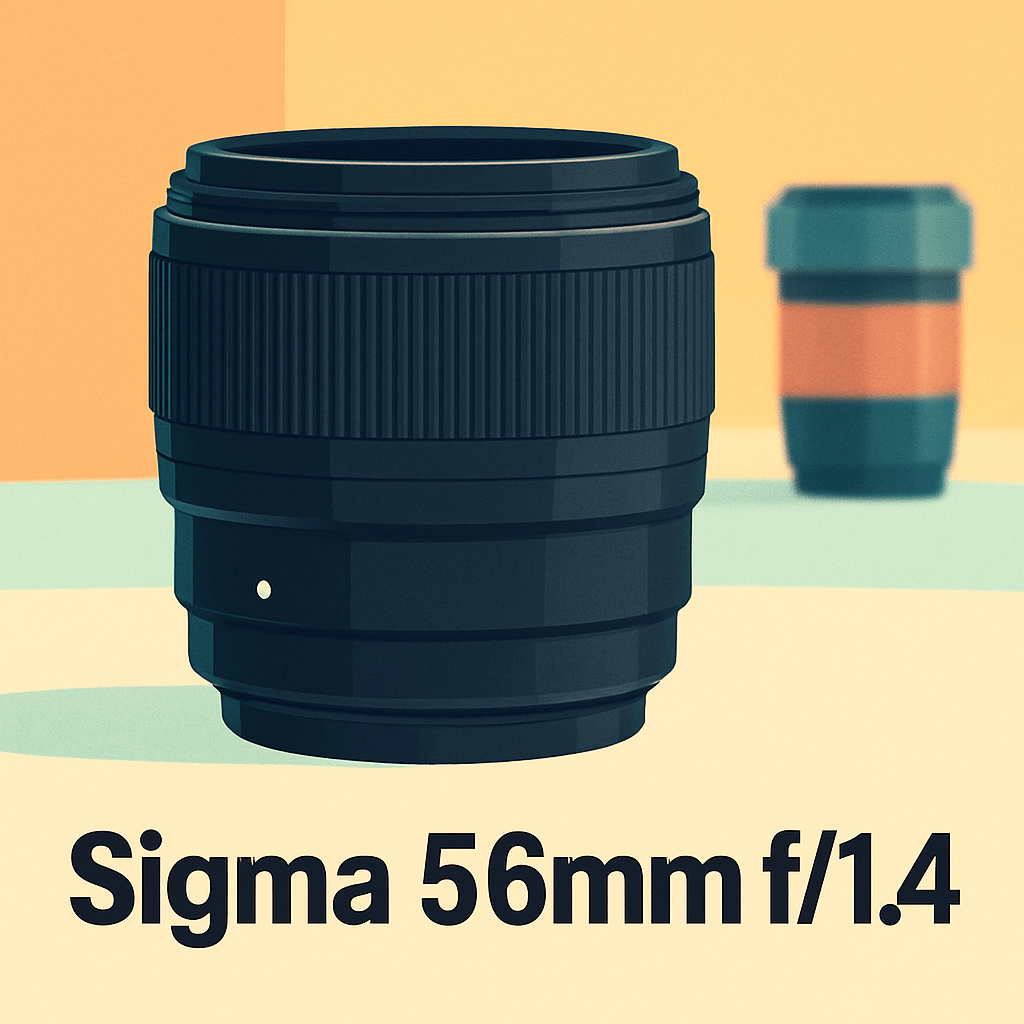
Want to make your portraits pop with richer subject separation and smoother backgrounds?
I field-tested the Sigma 56mm f/1.4 E mount on real shoots to see how it performs in everyday portrait and low‑light work, and it felt worth a closer look.
If you shoot on Sony APS‑C bodies and care about headshots, available‑light flexibility, and a compact setup, this review will help you figure out whether this lens belongs in your kit. Make sure to read the entire review as I break down when it truly shines and when another choice might serve you better—keep reading.

Sigma 56mm f/1.4 E mount
Short telephoto prime crafted for mirrorless APS-C systems; delivers razor-sharp images, creamy background separation, excellent low-light performance and reliable autofocus in a compact, well-built optical package.
Check PriceThe Numbers You Need
| Spec | Value |
|---|---|
| Focal length | 56 mm |
| Maximum aperture | f/1.4 |
| Lens type | Prime |
| Mounts | Sony E; Micro Four Thirds; Nikon Z (DC DN APS-C versions) |
| Format | APS-C |
| Image stabilization | No (not listed in official documentation) |
| Weather sealing | No (not listed in official documentation) |
| Weight | Approximately 280 g (approx.) |
| 35mm (full-frame) equivalent focal length | Approximately 84 mm |
How It’s Built
In my testing the Sigma 56mm f/1.4 E mount felt like a perfect match for small Sony mirrorless bodies. It’s compact and light (roughly 280g), so it balances nicely and doesn’t pull you forward during a long portrait session. That makes it easy to carry all day and less tiring for beginners.
The control layout is refreshingly simple — the focus ring is the main interaction point and it has a smooth, not-too-long throw that’s easy to dial in by hand. I found manual focus pleasant for careful portraits and the ring gives predictable feedback for repeatable framing. There aren’t a bunch of extra switches to learn, which is great if you’re just starting out.
Build feels solid with tight assembly and clean fit between parts, so it inspires confidence on shoots. One thing I really liked was how refined it feels in the hand; it doesn’t creak or wiggle even after putting it through a few gigs. Long-term I’d watch for finish wear and dust getting in since there’s no gasket protection.
Speaking of that, there’s no weather sealing and no in-lens stabilization, so you’ll want to be careful in drizzle and rely on your camera’s IBIS or faster shutter speeds. One thing that could be better is adding sealing or stabilization for rougher outdoor use. On Sony E bodies the handling is ideal, though other mounts may feel a bit different.
In Your Hands
On assignment the Sigma 56mm f/1.4 E mount feels like a short‑tele portrait lens in small‑body clothing. It excels for headshots through half‑body frames and tucks into street and event workflows where subject separation matters, though you’ll find yourself stepping back in cramped interiors to keep flattering compression and framing.
Because there’s no in‑lens stabilization, exposure strategy matters—on stabilized Sony bodies the lens becomes forgiving at available‑light gigs, but on unstabilized setups you’ll lean on faster shutter speeds, raised ISO, or a monopod/tripod for any extended low‑light work. That tradeoff feels deliberate: portability and speed over hand‑held slack.
Autofocus is a practical highlight; Eye and Face AF lock quickly and maintain a high keeper rate even when subjects move through complex backgrounds or low contrast. Manual focus is smooth and predictable, with a ring that responds cleanly to fine adjustments and camera focus aids making critical focus straightforward.
Optically it holds contrast well in backlight, resisting veil‑like wash in most shooting angles, though strong sun flaring still benefits from mindful positioning or a thumb over the hood. Color and micro‑contrast renderings are honest and grade gracefully in post, which keeps turnaround reliable for paid assignments across apertures.
The Good and Bad
- Fast f/1.4 aperture for subject separation and low‑light flexibility
- Portrait‑friendly ~84mm equivalent field of view on APS‑C
- Compact and lightweight (approx. 280g) for everyday carry
- Available across multiple APS‑C mounts for system flexibility
- No optical stabilization
- No weather sealing
Ideal Buyer
The Sigma 56mm f/1.4 E mount is for APS‑C photographers who live and breathe portraits. On Sony E bodies it gives roughly an 84mm full‑frame feel that excels for headshots, short‑tele portraiture and tight environmental work. Fast f/1.4 makes subject separation and available‑light shooting straightforward while keeping your kit light for location days.
Choose this lens if you trade optical stabilization and weather sealing for compactness, consistent rendering, and an f/1.4 look. Wedding shooters doing reception detail work, street portraitists who need a pocketable short‑tele, and content creators prioritizing shallow depth of field will find it hard to beat. If you need IBIS‑free low‑light help or plan heavy outdoor use, however, consider options with OSS or weather protection.
For mirrorless shooters who want a dependable portrait prime without hauling large glass, the Sigma is a tidy, characterful choice. Those who shoot video and require stabilized handheld footage or professionals who work in rain and grit should weigh Sony’s stabilized 50mm option or more rugged alternatives. In short, buy it for isolation, bokeh and portability; skip it if stabilization or sealing are dealbreakers.
Better Alternatives?
We’ve gone over what the Sigma 56mm f/1.4 brings to the table: a compact, fast short-tele prime that’s great for portrait work on Sony APS‑C bodies. It gives you strong subject separation and a very usable f/1.4 look without weighing you down on shoots.
If that package doesn’t quite match your needs, there are solid alternatives that trade some of the Sigma’s strengths for other real-world benefits — creamier bokeh and a different color character, built‑in stabilization, or even a lighter, more travel-friendly footprint. Below are options I’ve used that illustrate those tradeoffs in everyday shooting.
Alternative 1:

Fujifilm XF 56mm f/1.2 R
Premium portrait optic tuned for beautiful skin tones, velvety bokeh and exceptional subject isolation; tactile aperture ring, fast focusing and rich color rendering ideal for professional portraiture.
Check PriceThe Fujifilm XF 56mm f/1.2 R gives a very different look from the Sigma 56mm f/1.4 — it’s creamier and more “dreamy” at the wide end. In practical terms that means heads and shoulders pop with a softer falloff in the background; skin tones have a warmth and character that many portrait shooters love. If you’re after that classic, romantic portrait look, the Fuji’s f/1.2 does more of that out of camera than the Sigma.
Where it falls behind the Sigma is in portability and practicality. The Fuji is heavier and bulkier, and if you’re shooting run‑and‑gun events or long sessions the extra size is noticeable. I also found that on some bodies the Fuji’s autofocus can feel a touch slower or more prone to hunting than the Sigma on a modern Sony body, and unlike some Sony bodies you can’t rely on in‑body stabilization to make up for slower shutter speeds.
Pick the Fujifilm if you’re a portrait photographer who values that specific, film‑like rendering and you shoot on Fuji bodies. If you want the soft, velvety background and rich skin tones more than maximum portability or the fastest AF tracking, the Fuji will suit you. If you need something lighter, cheaper, or with steadier AF on Sony bodies, stick with the Sigma instead.
Alternative 2:

Sony E 50mm f/1.8 OSS
Compact standard prime with built-in stabilization for steady handheld stills and smooth video; lightweight design, sharp optics and fast aperture make it perfect for everyday portraits and low-light shooting.
Check PriceThe Sony E 50mm f/1.8 OSS beats the Sigma in one clear, everyday way: it has built‑in stabilization. When I’m shooting handheld in low light or doing casual video, the OSS lets me hold slower shutter speeds without raising ISO as much — something the Sigma can’t do on its own. The 50mm field is a touch wider than 56mm, so you get a more general-purpose portrait and head‑and‑shoulders coverage that works well in tighter spaces.
What the Sony gives up compared to the Sigma is subject separation and the slightly tighter compression of the 56mm focal length. At f/1.8 the blur isn’t as strong or as buttery as the Sigma’s f/1.4; highlights and background elements can look a bit busier. The Sony also feels cheaper in the hand and its bokeh and micro‑contrast don’t have the same refined look when you are shooting wide open.
Choose the Sony 50mm if you want a small, affordable lens that makes handheld low‑light work easier — especially if your camera lacks strong in‑body stabilization. It’s ideal for run‑and‑gun shooters, vloggers, and photographers who need steadier shots without carrying extra support gear. If you prioritize the shallowest background blur and a slightly longer portrait reach, the Sigma remains the better pick.
Alternative 3:
Sony E 50mm f/1.8 OSS
Affordable, pocket-friendly prime offering dependable image stabilization, quick autofocus and pleasing out-of-focus rendering; a versatile go-to lens for travel, street photography and casual portraits in challenging light.
Check PriceSeen from a travel and street point of view, the Sony E 50mm f/1.8 OSS is a very practical alternative to the Sigma 56mm f/1.4. It’s lighter in the bag, less likely to draw attention on the street, and the stabilization is a real help for handheld evening shots or quick interiors where you don’t want to bump ISO. The AF is reliable and quiet, which makes it a friendly option for mixed stills and video work.
That practicality comes with visible tradeoffs next to the Sigma: the Sony’s bokeh and edge‑to‑edge rendering aren’t as refined, and you won’t get the same short‑tele compression that flatters faces in tight headshots. If your work depends on the cleanest possible subject isolation or you shoot a lot at the widest apertures for studio‑style portraits, you’ll notice the Sigma’s edge.
Go with this Sony option if you need a do‑it‑all, lightweight prime that helps you handhold in tough light and travel light. It’s for street shooters, travelers, and content creators who value a small package and steady images over the last bit of background separation and portrait compression the Sigma provides.
What People Ask Most
Is the Sigma 56mm f/1.4 worth buying?
Yes—it’s a compact, affordable APS-C portrait prime with excellent sharpness and great value for most photographers. Choose something else only if you need image stabilization or the extra character of an f/1.2 lens.
Is the Sigma 56mm f/1.4 good for portraits?
Yes—on APS-C it gives a flattering focal length and strong subject separation, ideal for headshots and short-telephoto portraits.
How sharp is the Sigma 56mm f/1.4 wide open?
Very sharp in the center at f/1.4 with some corner fall-off that improves noticeably by f/2–f/2.8.
Does the Sigma 56mm f/1.4 have image stabilization?
No—it has no optical stabilization, so rely on camera IBIS or faster shutter speeds in low light.
How does the Sigma 56mm f/1.4 compare to the Fujifilm XF 56mm f/1.2?
The Sigma is smaller, cheaper, and very sharp, while the Fuji offers creamier bokeh, a shallower f/1.2 look, and a more premium build at a higher price.
What is the bokeh like on the Sigma 56mm f/1.4?
Smooth and pleasant with rounded highlights—very good for isolating subjects, though not as buttery or dreamy as wider f/1.2 glass.
Conclusion
The Sigma 56mm f/1.4 E mount is a clear, purposeful tool for APS‑C portrait work. It does one thing very well: it isolates subjects and delivers a confident look in available light. For photographers who prize image character and handling over bells and whistles, it’s an easy lens to recommend.
Where it shines is obvious in practice. The fast aperture gives subject separation that lifts skin tones and backgrounds, and the compact, lightweight feel makes it a joy to carry on small Sony bodies. Put simply, it’s a portraitist’s lens that lets you work quickly and creatively in tight spaces and dim rooms.
There are trade‑offs worth owning in your decision. You won’t get in‑lens stabilization or weather sealing, and those omissions matter for video shooters and photographers who work in harsh conditions. Also remember this is an APS‑C prime, so its field of view and use cases are tuned to that format.
If you shoot portraits on Sony APS‑C bodies and value a fast, compact short‑tele prime, this is a practical, high‑value choice. If stabilization, sealing or a different focal character are priorities, look to the alternatives mentioned earlier. Also verify any unconfirmed specs before buying, and test real‑world samples at f/1.4 and stopped down to confirm the rendering you want.
Sigma 56mm f/1.4 E mount
Short telephoto prime crafted for mirrorless APS-C systems; delivers razor-sharp images, creamy background separation, excellent low-light performance and reliable autofocus in a compact, well-built optical package.
Check Price


0 Comments