
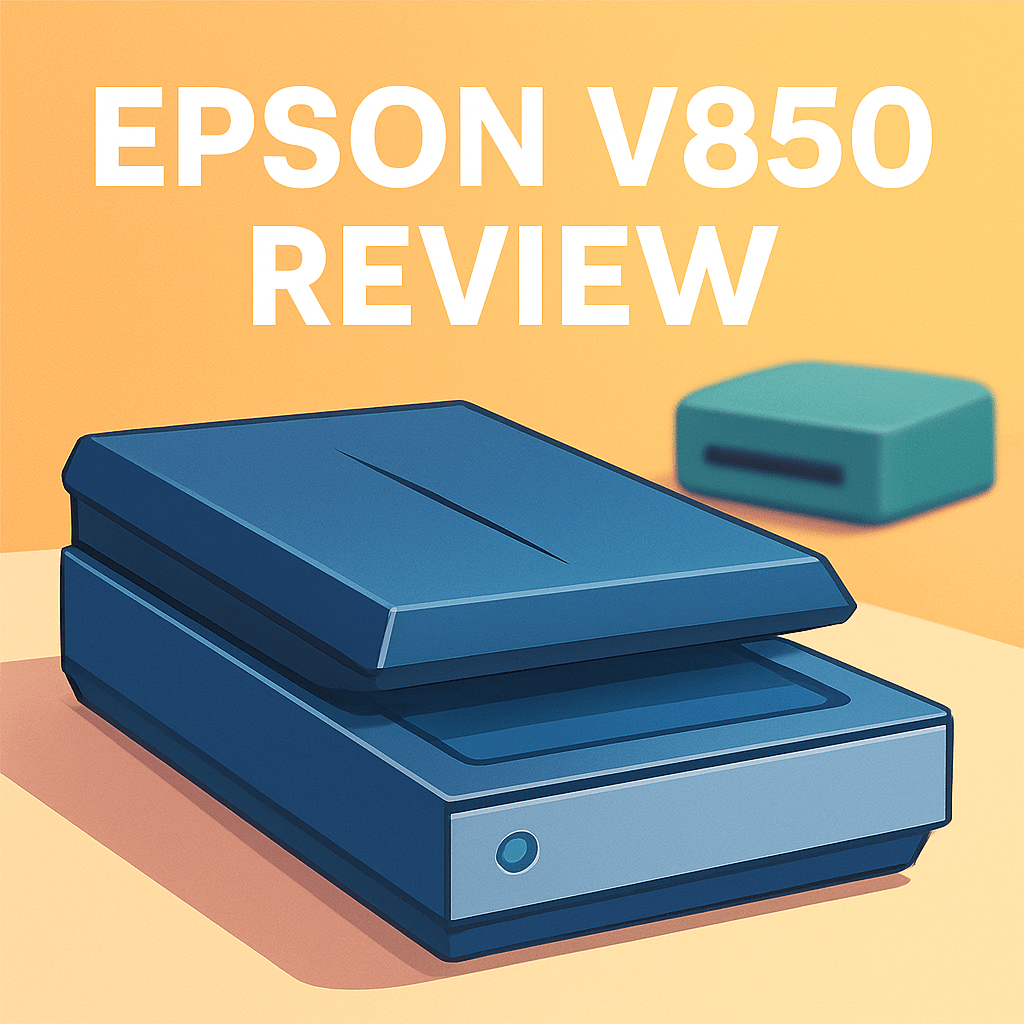
Want to turn your negatives and slides into digital files that actually do justice to your work?
I’ve field-tested the Epson Perfection V850 Pro Scanner across studio and location sessions.
It’s built for photographers and archivists who need format flexibility and dependable results.
You’ll get a look at film handling, tonal depth, and time-saving dust removal in real-world use—Make sure to read the entire review as I separate what matters from marketing, keep reading.

Epson Perfection V850 Pro Scanner
Studio-grade film and print scanner delivering exceptional dynamic range and dual-optical scanning for ultra-sharp 35mm and medium-format captures. Includes precision calibration, advanced dust/scratch removal, and fast, color-accurate results.
Check PriceThe Numbers You Need
| Spec | Value |
|---|---|
| Scanner type | Flatbed film and photo scanner |
| Optical system | Dual-lens |
| Maximum optical resolution | 6400 dpi |
| Color depth | 48-bit color (16-bit per channel) |
| Grayscale depth | 16-bit |
| Supported media formats | 35mm film strips; medium format up to 6×22 cm; 4×5 in large format |
| Film holders included | Advanced multi-format holders for 35mm, medium, and large format |
| Digital ICE technology | Yes (dust and scratch removal) |
| Connectivity | USB 2.0 |
| Maximum scan size (reflective) | Up to 8.5 × 11.7 inches (216 × 297 mm) |
| Compatibility | Windows and macOS |
| Scan speed | Approx. 20 seconds per 35mm positive at max resolution |
| Software | Epson Scan software included with advanced controls |
| Dimensions (W × D × H) | Approx. 12.2 × 19.1 × 5.5 inches |
| Weight | About 13 lb (5.9 kg) |
How It’s Built
In my testing the Epson Perfection V850 Pro feels like a tool made to last. It’s solid and has real heft, so plan for a dedicated spot on a sturdy table away from noisy foot traffic. For beginners that means fewer surprises from bumps or wobbly scans.
I really liked the multi-format film holders — they’re robust and hold film flat without fuss. I found alignment repeatable from frame to frame, and swapping holders mid-session is straightforward once you get the rhythm. That flatness and repeatability make batch scanning far less painful for anyone new to the process.
The lid and hinge have a confidence-inspiring feel and the trays fit snugly with neat tolerances. In my use the lid stayed put where I set it and there was minimal wobble when loading delicate negatives. One thing that could be better is the overall footprint — it’s not tiny and needs space and a steady surface.
After using it for a while I appreciated how the build supports a steady workflow and reliable scans. The sturdy holders were my favorite part, while the need for a dedicated workspace was the main drawback. For beginners, that trade-off is worth it if you want consistent, repeatable results.
In Your Hands
In real-world use the Epson Perfection V850 Pro Scanner feels like a studio workhorse: scans deliver clean, nuanced files and the bundled Epson Scan software gives granular, hands-on control over exposure, color balance, and sharpening decisions without feeling cryptic. Images pop with smooth tonal transitions and the dual-lens approach keeps detail where it matters, so minimal post-scan rescue is needed in most frames.
Throughput depends more on workflow than raw scanner speed; high-resolution scans take noticeably longer per frame, and total session time grows when you factor in holder loading, previewing, and software adjustments. That said, the included multi-format holders let you process strips and batches with fewer interruptions than single-frame solutions, making a roll of 35mm or a handful of medium-format frames practical for an afternoon’s work.
Film handling is one of the scanner’s strengths: holders register reliably, film lies flat without fuss, and repeatability between frames is excellent, which is a boon for color consistency across a shoot. Scanning a 4×5 transparency requires slightly more care in alignment, but once set the results are predictably high quality and easy to match to earlier scans.
Reflective scanning of prints up to letter size is straightforward and faithful to the original, and the workflow perks—solid lid action, sensible previews, and conservative default processing—keep the experience professional. Main practical trade-offs are session cadence and a modest learning curve in the software; for careful archiving or client deliveries the trade-off is worth the time.
The Good and Bad
- Dual-lens optical system
- High optical resolution (6400 dpi)
- 48-bit color and 16-bit grayscale support
- Supports 35mm, medium format up to 6×22 cm, and 4×5 large format
- USB 2.0 only
- Approx. 20 s per 35mm positive at max resolution may affect high-volume throughput
Ideal Buyer
If you shoot across formats—35mm, medium format and large‑format—and need one dependable machine to handle transparencies, negatives and reflective prints, the Epson Perfection V850 Pro is built for that workflow. It’s a practical studio centerpiece for photographers and small archives that prefer not to juggle multiple dedicated scanners.
Restorers and archivists who value automated dust and scratch removal will like Digital ICE, and the 48‑bit/16‑bit capture gives plenty of headroom for color grading and shadow recovery. The V850’s steady tonal response and dual‑lens optics mean fewer surprise rescans when you’re translating dense slides or low‑contrast negatives to digital files.
Choose this scanner if you prioritize flatbed versatility and batch‑friendly holders that keep strips and medium frames consistently aligned for repeatable throughput. It’s ideal for mixed jobs—a roll of 35mm, a handful of 6×6 frames, and an occasional 4×5 transparency—where convenience trumps the last ounce of single‑frame sharpness. Expect a modest desk footprint and a USB‑2.0 connection as trade‑offs for that flexibility.
Windows and macOS users who want an all‑in‑one scanning solution with robust software controls will find the V850 Pro satisfies most pro and enthusiast needs. If your top priority is absolute 35mm micro‑detail or the fastest high‑volume production, this is still a great compromise but not the only option to consider.
Better Alternatives?
We’ve gone deep on the Epson Perfection V850 Pro — its strengths, workflow, and where it fits in a serious film-to-digital setup. If the V850 sounds like overkill or you want other price and workflow trade-offs, there are a few solid alternatives worth considering.
Below I’ll run through three scanners I’ve used in the real world, explaining what each does better and worse than the V850 and which kind of photographer is likely to prefer them.
Alternative 1:

Epson Perfection V800 Scanner
High-resolution flatbed engineered for serious hobbyists and pros, capturing detailed prints and negatives with wide tonal range. Built-in transparency adapter, efficient workflow, and strong color fidelity for archival scanning.
Check PriceThe Epson Perfection V800 is the most natural step down from the V850. In daily use I found its scans nearly as clean and detailed as the V850 for most work — 35mm and medium format scans looked excellent and the color felt right out of the box. If you don’t need the small workflow refinements the V850 adds, the V800 delivers almost the same image quality for less money.
Where the V800 falls short versus the V850 is mostly in the small but tangible workflow pieces: the film holders and lid mechanics on the V850 feel a bit more robust and easier to use when you’re doing long sessions. I also noticed the V850’s layout makes swapping holders and aligning frames quicker. For one-off scans or lighter workloads the V800’s differences are minor, but for heavy batch sessions the V850’s refinements save time and frustration.
If you’re a hobbyist or a pro on a budget who scans occasionally or in moderate batches, the V800 is a great pick. Choose it if you want very good image quality and Digital ICE without paying extra for the V850’s incremental workflow comforts.
Alternative 2:

Canon CanoScan 9000F Mark II Scanner
Flatbed scanner with dedicated film adapter that extracts fine detail from slides and negatives, offering deep color reproduction and intuitive software for quick, high-resolution digitization of cherished images.
Check PriceThe Canon CanoScan 9000F Mark II is a budget-friendly flatbed I’ve used for quick home scans. It’s compact and fast for prints and occasional film frames, and in good light it produces pleasing color for family photos and slides. For casual work or archival duties where you don’t need extreme dynamic range, it gets the job done with minimal fuss.
Compared with the V850, the 9000F simply can’t match shadow detail or the same consistent tonal range on dense slides and negatives. Its film holders and dust correction are more basic, so you’ll spend more time cleaning and retouching if you scan lots of dusty film. In short: you lose some image depth and pro-level robustness for convenience and cost savings.
Buy the Canon if you’re scanning occasionally, want a small desk-friendly unit, or you’re converting family prints and a few slides. It’s best for hobbyists and anyone who wants a quick, affordable route to decent scans without the investment in a pro-level flatbed like the V850.
Alternative 3:
Canon CanoScan 9000F Mark II Scanner
Versatile imaging solution ideal for film and print enthusiasts, delivering precise scans with robust color accuracy, easy batch processing, and a compact design that fits any home studio setup.
Check PriceUsed a little differently, the Canon 9000F can shine as a fast, no-nonsense scanner for documents and prints alongside occasional film work. In my experience it’s reliable for bulk scanning and quick archiving where ultimate film detail isn’t the priority. The software is straightforward, so you can get usable results quickly without tweaking every setting.
That said, if your priority is the best possible capture from negatives and slides — especially medium format or 4×5 — the V850 is still the clear winner. The Canon’s dynamic range and fine shadow handling simply don’t match the V850, and you’ll notice the limits if you push exposure recovery or want archival-grade scans. The Canon is a practical, lower-cost tool, not a replacement for a pro scanner.
Pick this Canon again if you need a compact, budget scanner for everyday scanning tasks, fast digitization, or someone starting out with film who doesn’t yet need the V850’s full capabilities. It’s a sensible choice for home studios and casual shooters who value speed and simplicity over absolute film fidelity.
What People Ask Most
Is the Epson Perfection V850 Pro worth it?
Yes — if you scan lots of film and want pro-level image quality, its dual-lens optics, robust holders and wide dynamic range make it worth the price; casual scanners may prefer a cheaper model.
How good is the Epson V850 for scanning film and negatives?
It’s excellent for negatives and slides, delivering sharp, detailed scans with strong color and shadow detail when you use the film holders properly.
What is the optical resolution of the Epson V850?
The V850 offers up to 6400 dpi optical resolution.
How does the Epson V850 compare to the Epson V600?
The V850 has better optics, a dual-lens system, stronger film holders and higher dynamic range for cleaner scans, but it is significantly more expensive than the V600.
Can the Epson V850 scan medium format as well as 35mm film?
Yes — it includes medium-format holders and scans 120/220 negatives very well, giving more detail and tonal range than most consumer flatbeds.
Does the Epson V850 include Digital ICE dust and scratch removal?
Yes — it supports Digital ICE dust and scratch removal, though ICE can have trouble with certain black-and-white films and heavily damaged negatives.
Conclusion
The Epson Perfection V850 Pro Scanner earns its place as a true do‑it‑all flatbed for photographers and archivists who work across 35mm, medium format, large‑format and reflective prints. In real use it delivers consistently usable scans with a neutrality and tonal smoothness that matter when you’re restoring or archiving. It feels engineered for the studio, not the casual desk drawer.
Its standout strengths are workflow and practicality. The robust multi‑format holders and repeatable alignment remove a lot of the fiddly guesswork that kills throughput. Combined with thoughtful software controls and reliable dust‑and‑scratch correction, it speeds real projects more than its nominal scan times suggest.
There are trade‑offs worth acknowledging. The machine is sizeable and assumes a dedicated workspace, and its connection and top‑end throughput ask for patience when you push for the absolute best images. If you scan at scale every day and value raw speed over versatility, there are faster or more specialized paths.
Overall, buy the V850 if you want one competent, professional scanner to handle everything from negatives to prints with minimal compromise. If budget or single‑format obsession drives your decision, consider the earlier Epson model for savings, a consumer flatbed for occasional use, or a dedicated 35mm scanner for ultimate small‑frame detail.
Epson Perfection V850 Pro Scanner
Studio-grade film and print scanner delivering exceptional dynamic range and dual-optical scanning for ultra-sharp 35mm and medium-format captures. Includes precision calibration, advanced dust/scratch removal, and fast, color-accurate results.
Check Price

0 Comments