
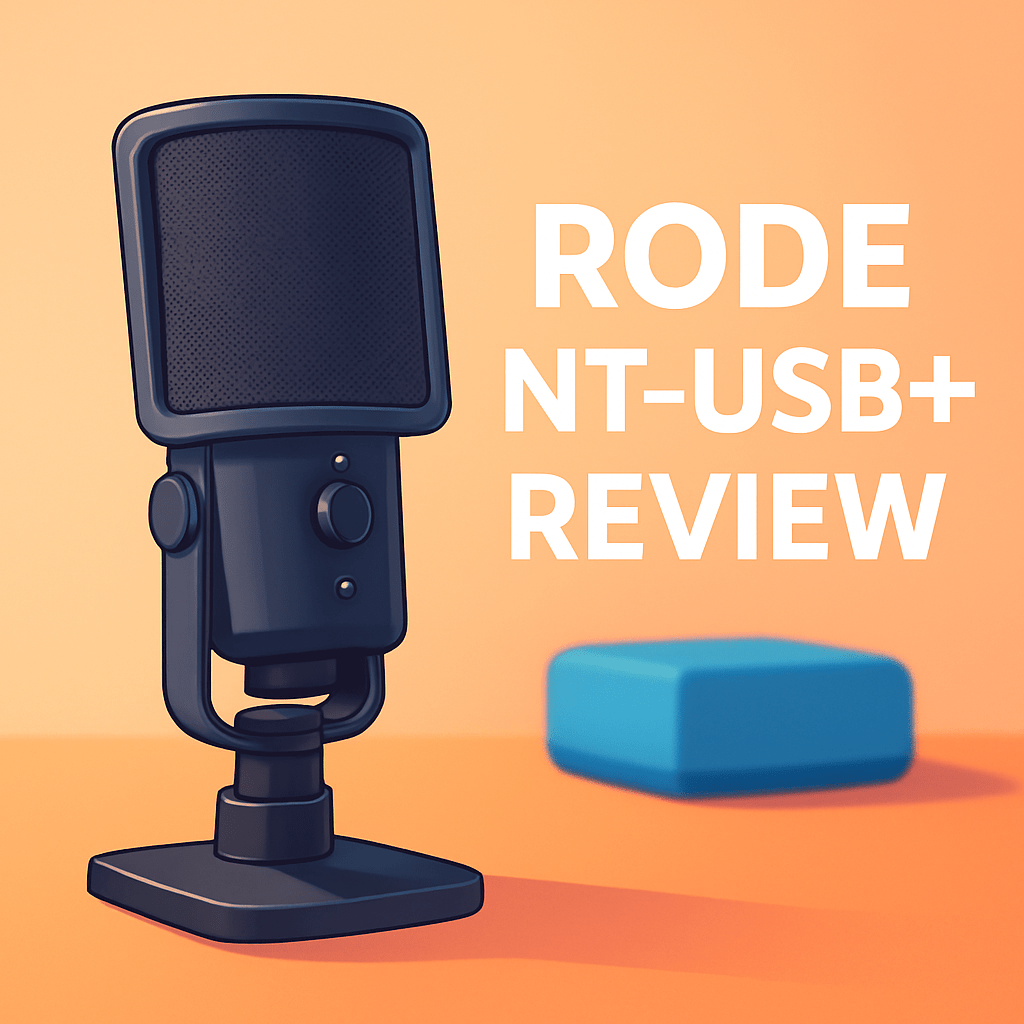
Want studio-style vocal quality without wrestling with interfaces and drivers?
You’re in the right place — the Rode NT USB Plus aims to give creators clean, neutral capture and simple monitoring, all via plug-and-play USB. I’ve spent sessions with the mic in real rooms to see how it performs where most people actually record.
This intro covers who benefits (podcasters, streamers, voice actors, and creators wanting a tidy desktop setup), its top strengths like detailed capture and smooth monitoring, and what I’ll test next. Make sure to read the entire review as I dig into real-room tone, monitoring workflow, noise floor, and head-to-head alternatives — keep reading.

Rode NT USB Plus Microphone
Studio-quality condenser capture with plug-and-play USB connectivity, integrated headphone jack for zero-latency monitoring, and intuitive controls—perfect for streaming, podcasting, voiceover work, and home recording sessions.
Check PriceThe Numbers You Need
| Spec | Value |
|---|---|
| Microphone type | Condenser USB |
| Polar pattern | Cardioid |
| Frequency response | 20 Hz – 20 kHz |
| Bit depth / Sample rate | 24-bit / 48 kHz |
| Connectivity | USB-C plug-and-play |
| Onboard monitoring | Zero-latency headphone output |
| Controls | Volume dial; mix control (mic to playback balance) |
| Internal microphone capsule | 1″ gold-sputtered diaphragm |
| Compatible platforms | Windows, macOS |
| Included accessories | Detachable tripod desk stand; USB-C to USB-C cable; USB-C to USB-A adaptor |
| Dimensions | Approximately 110 mm × 160 mm × 280 mm |
| Weight | Approximately 0.85 kg (850 g) |
| Power | USB bus-powered (no external power needed) |
| Stand mount | 3/8″ thread (supports desk stand or boom arm) |
| Special features | High-quality internal pop filter; 20 Hz low-frequency response for bass pickup |
How It’s Built
In my testing the Rode NT USB Plus feels like a proper little studio mic, not a toy. The metal body and snug fit of the parts gave me confidence it would survive regular use. What that means in real life is simple: it stays put on your desk and doesn’t creak when you adjust it.
I found the on-mic controls easy to use when the mic is on the included desk stand, so you can tweak volume and the mic-to-playback mix without opening software. The built-in pop filter impressively tames hard P sounds at normal speaking distance, which is great if you’re new to mic technique. One thing I really liked was that internal pop filter; one thing that could be better is the overall footprint—it takes up noticeable desk space and can block a keyboard or monitor if you don’t plan placement.
The small tripod it ships with is handy for beginners and gets you recording right away, but moving it to a boom arm cleans up desk vibrations and gives better positioning. I also liked that the USB-C cable and adapter make cable routing straightforward. After using it for a while, the build and fit make it feel like a mic you can grow with as your setup improves.
In Your Hands
Out of the box the Rode NT USB Plus simply behaved: it showed up in macOS and Windows apps without fuss and began sending a clean signal the moment it was plugged in. Setup in a typical DAW or streaming app is predictable and quick, so you spend more time recording and less time wrestling with drivers or phantom power. The bus-powered, plug-and-play nature makes it work in both desktop and mobile creator rigs with minimal fuss.
Monitoring is a highlight: the zero-latency headphone feed and on-mic mix control make tracking and live streaming feel immediate. The headphone output drives common studio cans comfortably and the mix dial is genuinely useful for balancing playback with live voice without diving into software menus. Real-time adjustments while recording are smooth and intuitive, which keeps momentum during sessions.
In use the mic favors a studio-leaning, detailed presentation — vocals sit forward with natural midrange clarity and restrained top-end air. The cardioid pickup does a good job tamping down room reflections when used close to the source, and the internal pop filter controls plosives convincingly at normal speaking distances. Detail retrieval is strong, so soft consonants and subtle breath textures come through without sounding brittle.
Practical testing on the included desk stand versus a boom arm exposed predictable trade-offs: the desk mount is stable but transmits more vibration, while a boom arm improves isolation and positioning. Because there’s no dedicated hardware gain control, sensible gain-staging in your DAW is part of the workflow, yet small changes in distance or angle yield consistent tonal results until proximity effect is intentionally exploited for warmth. Overall it’s a reliable, creator-friendly tool that behaves the way a studio USB condenser should in everyday scenarios.
The Good and Bad
- 1-inch gold-sputtered diaphragm for detailed capture
- USB-C plug-and-play; USB bus-powered (no external power)
- Zero-latency headphone output with on-mic volume and mix control
- High-quality internal pop filter
- Cardioid-only polar pattern (no multi-pattern flexibility noted)
- Limited on-mic controls: no dedicated hardware mic gain knob listed
Ideal Buyer
The Rode NT USB Plus Microphone is for creators who want studio‑leaning, neutral capture with plug‑and‑play simplicity. It’s ideal if you value a pure condenser sound with clear midrange, restrained top‑end air, and zero‑latency headphone monitoring for tracking or live streaming.
Podcasters, voice‑over artists, and streamers who prefer clean, consistent vocal tracks will appreciate the built‑in pop filter that tames plosives at normal speaking distances and the straightforward mix and volume controls. It works seamlessly on Windows and macOS and sits well on a desk, yet it migrates easily to a boom arm for better isolation and positioning. The 24‑bit/48k path gives ample headroom and resolution for polished spoken‑word takes and simple multi‑take workflows.
Avoid it if you need multi‑pattern voicings, heavy onboard DSP, or the smallest possible footprint; it’s larger and heavier than many desktop USB mics. It also lacks an analog XLR output and a dedicated external mic‑gain knob, which matters for complex studio routings. If you want low noise, natural tone, and an intuitive monitoring workflow—especially in untreated home rooms—the NT‑USB+ is a very sensible, studio‑minded, reliable pick.
Better Alternatives?
We’ve gone through the Rode NT‑USB+ in detail and covered how it sounds, how it behaves on a desk or boom arm, and where it shines for creators who want a neutral, studio-style USB mic. That mic is a great all-rounder, but not everyone needs the same mix of features, tone, and workflow.
Below are a few real-world alternatives I’ve used that pull the tradeoffs in different directions — more live/streaming features, simpler budgets, or a slightly different vocal character. I’ll say what each one does better and worse than the Rode, and who will likely prefer it.
Alternative 1:

Blue Yeti X USB Microphone
Versatile multi-pattern USB mic offering professional four-capsule capture, customizable gain and real-time LED metering, plus low-latency monitoring—engineered for streamers, podcasters, musicians, and content creators seeking detailed vocal clarity.
Check PriceFrom my time using the Blue Yeti X, the first thing you notice is how many live‑friendly tools it gives you: multi-pattern options, Blue VO!CE vocal presets, a big gain knob and a clear LED meter. Compared to the Rode NT‑USB+, the Yeti X makes it easier to shape your sound on the fly and to see if you’re clipping — that helps a lot when you’re streaming or doing live interviews.
Where it loses to the Rode is in pure, natural capture. The Yeti X often sounds a touch more “produced” and can make voices feel larger and sweeter, which is great for streams but less honest for studio work. It also tends to pick up more room sound unless you get very close, so in an untreated room the Rode’s capsule and internal pop filter can give a cleaner, more consistent take.
If you stream, podcast live, or want a lot of desktop controls and presets, the Yeti X is a strong pick. If you want the most neutral, studio-like recording for voiceovers or music takes, stick with the Rode NT‑USB+ instead.
Alternative 2:

Audio Technica AT2026USB Plus Microphone
Cardioid condenser with USB connectivity delivers clear, low-noise recordings, onboard headphone monitoring and gain control, and rugged construction—ideal for home studios, voiceovers, podcasting, and high-quality remote sessions.
Check PriceThe AT2026USB+ is what I reach for when I need a simple, reliable capture without a lot of extras. Compared to the Rode NT‑USB+, it’s more stripped down: fewer on‑mic bells and whistles, but a clear, plain sound that’s easy to work with. In practice it records voice cleanly and with less flattering coloration, so it’s great if you plan to edit and EQ later.
Where it falls short versus the Rode is workflow convenience. The AT2026USB+ has a basic headphone jack and gain control, but it lacks the Rode’s internal pop filter and the same on‑mic mix control. I found myself using a pop filter and spending more time in post to get the same smoothness the Rode delivers straight out of the box.
Choose the AT2026USB+ if you want a low-cost, honest-sounding mic for home studio work, voiceovers, or podcasting where you’ll do some editing. If you want built-in polish, on‑mic mixing, and the internal pop control that make recording faster, the Rode is the better fit.
Alternative 3:
Audio Technica AT2026USB Plus Microphone
Detailed large-diaphragm capture with USB plug-and-play simplicity, low-latency monitoring, and precise midrange reproduction; built for consistent studio-grade results when tracking vocals, acoustic instruments, streaming, and content creation.
Check PriceUsing the AT2026USB+ for tracking acoustic guitar and spoken word showed me its strength: a steady, midrange-forward sound that sits in a mix without surprises. Compared to the Rode NT‑USB+, the AT2026USB+ can feel a little more clinical, but that clinical nature helps when you need predictable results across takes and want to shape tone later in the edit.
It’s not as forgiving in a noisy room or for up-close pop control. I noticed more plosives and room reflections unless I added an external pop shield and worked on mic placement. The Rode’s internal filter and slightly warmer tone make it faster to get a good usable take in cramped or untreated spaces.
This third take on the AT2026USB+ is for buyers who prioritize straightforward, repeatable recordings — small home studios, musicians tracking ideas, and anyone who prefers to do tonal shaping in post. If you want a faster, more polished beginning-to-end workflow on the desk, the Rode NT‑USB+ will save time.
What People Ask Most
Is the Rode NT-USB+ worth buying?
Yes — it’s a strong plug-and-play mic for creators who want clear, broadcast-quality voice without a complicated setup.
How does the Rode NT-USB+ compare to the original Rode NT-USB?
The NT-USB+ improves the preamp and modernizes connectivity (USB-C) and monitoring features, so it generally sounds cleaner and feels more polished than the original.
Is the Rode NT-USB+ good for podcasting, streaming, and vocals?
Absolutely — its cardioid condenser capsule and clear voice reproduction make it well suited for podcasting, streaming, and vocal work.
Does the Rode NT-USB+ work with iPad, iPhone, Mac, and Windows?
Yes — it’s plug-and-play with Mac and Windows, and works with iPad/iPhone using the appropriate USB-C or Lightning adapter.
What is the sound quality of the Rode NT-USB+ like?
Sound is clear, detailed and warm for spoken word and singing, with better noise handling than typical consumer mics.
How do you set up the Rode NT-USB+ and is there any latency?
Setup is simple: plug into USB-C and select it as your input; there’s zero-latency headphone monitoring built in, while DAW latency depends on your buffer settings.
Conclusion
The Rode NT USB Plus Microphone is a clear, studio-minded USB condenser that delivers neutral, detailed capture with the convenience of true plug-and-play operation. Its zero-latency monitoring and effective internal pop protection make tracking and live work straightforward and confidence-inspiring.
In real rooms it behaved like a refined, no-nonsense studio tool—consistent tonality, reliable off-axis rejection, and a monitoring path that lets you hear exactly what you’re committing to. For podcasters, voiceover artists, and creators who value fidelity over color, it simply gets the job done without fuss.
That focus brings tradeoffs. The single cardioid pattern limits flexibility for multi-source setups, the body and stand presence demand a little desk real estate, and on-mic controls are deliberately minimal. If you need built-in DSP, multi-pattern options, or lots of streaming-centric routing, other modern USB mics are more feature-rich.
Bottom line: if your priority is clean, neutral recording with dependable monitoring and easy setup, the Rode NT USB Plus Microphone is a strong, sensible buy. If you want flamboyant tones or streaming-first workflow tools, look to the alternatives. This one rewards listeners who care about sound quality above extra bells and whistles.
Rode NT USB Plus Microphone
Studio-quality condenser capture with plug-and-play USB connectivity, integrated headphone jack for zero-latency monitoring, and intuitive controls—perfect for streaming, podcasting, voiceover work, and home recording sessions.
Check Price



0 Comments