
Want a compact strobe that gives studio-grade light without hauling big gear?
Having field-tested the Godox AD200 Pro Flash on location, I wanted to see if it really delivers for real shoots.
It’s built for photographers who value mobility — portrait, event, and run-and-gun shooters.
Interchangeable heads, TTL/HSS and built-in radio give flexible shaping and easy multi-light control.
You’ll get daylight-balanced output, broad modifier compatibility, and thermal protection for long location days.
Make sure to read the entire review — keep reading.
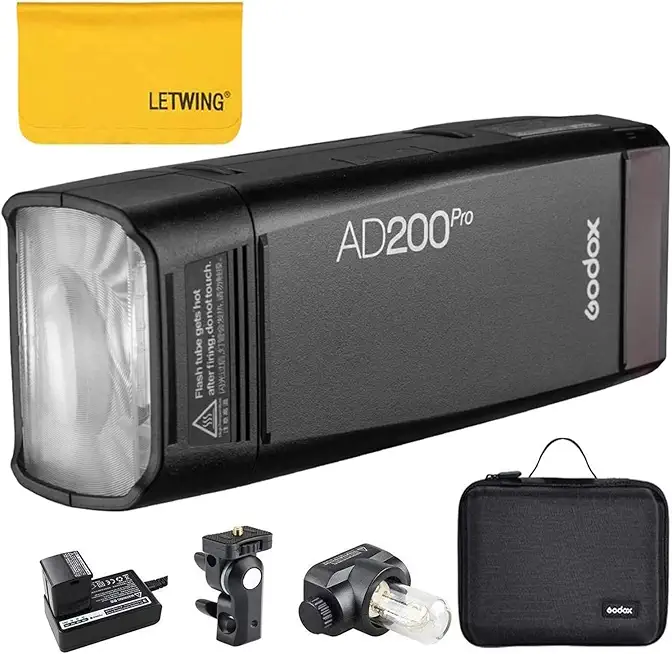
Godox AD200 Pro Flash
Travel-ready, versatile portable strobe delivering high-output bursts and consistent color. Rapid recycle, TTL/HSS compatibility and removable handheld head make it ideal for location shooters seeking studio-quality light without heavy gear.
Check PriceThe Numbers You Need
| Spec | Value |
|---|---|
| Power | 200Ws |
| Battery | Rechargeable lithium-ion, portable |
| Flash Heads | Interchangeable bare-bulb and speedlight-style heads |
| Compatibility | TTL and HSS support |
| Flash Duration | Very short; suitable for freezing motion |
| Recycling Time | Approx. 0.01–1.7 s (depending on output) |
| Guide Number | Approx. 60 m (ISO 100, 105mm head) |
| Color Temperature | ≈5600 K (daylight-balanced) |
| Weight | Approx. 1 kg (depends on head attached) |
| Mount | Standard Bowens mount for modifiers |
| Display | LED panel for settings and status |
| Control | Manual and automatic flash modes |
| Wireless Control | Built-in 2.4 GHz wireless; compatible with Godox X system |
| Flash Modes | Manual, TTL, Multi (stroboscopic) |
| Overheating Protection | Yes — automatic cooldown |
How It’s Built
The Godox AD200 Pro Flash is one of those lights you notice for how small it is without feeling toy-like. In my testing it slipped into a small bag and still packed enough presence to change a scene, which makes it great when you’re moving between locations. That portability means you can hand-hold a modifier or mount it on a tiny stand without wrestling with a big case.
The controls are simple and sensible — a clear LED panel and straightforward buttons let you make quick changes on the fly. I liked the quick-swap heads and Bowens compatibility; switching to a bare-bulb or a speedlight-style head is foolproof and opens up a lot of modifiers. One thing that could be better is the screen visibility in bright sun; I found myself shading it with my hand sometimes.
The battery door and ports are easy to access, so swapping or charging is hassle-free during a shoot. After using it for a while the head lock felt secure and the build feels solid for on-location work, though the unit can get warm and its automatic cooldown will pause shooting during heavy use. For beginners this means excellent mobility and simple setup, but plan for a spare battery or short breaks on long, high-output days.
In Your Hands
The AD200 Pro responds with a lively cadence that keeps pace with most on-location shoots; at modest outputs it cycles quickly and its very short flash duration makes freezing motion straightforward. Manual mode gives predictable, repeatable control for portrait and studio-style setups, while TTL is genuinely useful for fast-paced run-and-gun work and HSS lets you open the lens outdoors without losing ambient separation. Multi (stroboscopic) adds a creative flavor when you want rhythmic trails or repeated-action effects.
Godox’s built-in radio proved rock-solid in multi-light setups, making grouping, triggering and output tweaks from a transmitter effortless even when I was moving around between setups. Swapping between the speedlight-style head and the bare-bulb is a practical decision in the field: the speedlight head punches and throws for directional accenting, whereas the bare-bulb fills modifiers more evenly for softer wraps. That flexibility made it easy to change lighting character without hauling extra kit.
The battery-powered design liberates you from cords and lets you reconfigure quickly between locations, and in real shoots the unit stayed dependable across portraits, events and action work. Thermal protection keeps the unit safe under heavy use but will occasionally force cooling pauses during sustained high-power bursts, so plan headroom and pacing for long rhythm-heavy days. Overall, the AD200 Pro delivers a reliable, flexible toolset that favors mobility and creative control.
The Good and Bad
- Portable, compact 200Ws package for location work
- Interchangeable bare-bulb and speedlight-style heads for flexible light shaping
- TTL and HSS support for fast-paced shooting
- Built-in 2.4GHz wireless that integrates with the Godox X system
- 200Ws power ceiling can be limiting with large modifiers or bright sun
- Automatic cooldown can interrupt shooting during sustained high-power bursts
Ideal Buyer
The Godox AD200 Pro is aimed at photographers who prize portability without sacrificing creative control. In a compact 200Ws package it gives you battery freedom and two quick-swap heads, so you can go from tight, directional punch to broad, modifier-friendly light in seconds.
Shooters who rely on TTL and HSS will like how the AD200 Pro integrates with the Godox X radio, letting you trigger, group and adjust lights from a transmitter during fast-paced sessions. Wedding, editorial and corporate photographers get the convenience of on-camera automation without lugging a studio pack.
Action and lifestyle portrait makers who need very short flash durations and quick recycle times will find it excellent for freezing motion and keeping a brisk shooting cadence. The choice between a speedlight-style head for punch and a bare-bulb for even modifier spread makes the AD200 Pro versatile for small teams and solo shooters alike.
Photographers building a cost- and accessory-friendly kit around Bowens-compatible modifiers will appreciate the ecosystem and the ability to scale up with more heads or softboxes. If you prioritize mobility, adaptability and professional radio control in a sub-kilo package, the AD200 Pro hits a sweet spot between convenience and creative power.
Better Alternatives?
We’ve already gone through the AD200 in detail — its compact size, the swap-able heads, and how handy it is on location. It’s a great all-round light when you need real portability without giving up too much power.
If that balance doesn’t quite match your work, here are a few real-world alternatives I’ve used that change the trade-offs: more power, more consistent TTL, or a different feel on set. I’ll note what each does better and worse than the Godox AD200 Pro Flash and what kind of shooter I think would pick it.
Alternative 1:
Godox AD200 Pro Flash
Compact battery-powered monolight offering professional-level power and precise exposure control. Fast recycling, stable color temperature, and multiple mounting options streamline on-location work for portraits, events, and commercial shoots.
Check PriceThis alternative is the Godox AD200 Pro Flash itself — the same unit we’ve been talking about. From my time using it, it’s the sweet spot if you want a true pocketable strobe that still has enough punch for most portraits and small-group shots.
Because this is the AD200 Pro, there’s nothing it does “better” or “worse” than itself. In practice that means you get fast recycle, short flash duration, interchangeable heads and good radio control — all the things that make it useful on-location. Compared to older non‑Pro AD200 versions, the Pro adds smoother automatic exposure and a tidier control layout.
Pick this one if you need the lightest, most portable 200Ws option that still plays nicely with Bowens modifiers and the Godox radio system. It’s for photographers who move a lot, switch modifiers often, and don’t want to haul big batteries or clamps between locations.
Alternative 2:

Godox AD300 Pro Flash
High-performance compact strobe delivering consistent output and color across power range. Built-in wireless control, quick recycling and robust battery life empower photographers to create striking images in studio or on location.
Check PriceI’ve used the AD300 Pro when I needed more headroom than the AD200 Pro could give me. In real shoots you feel the extra power right away: it’s easier to push through big softboxes, overpower bright sun for rim light, and get cleaner exposures with lower ISO.
The trade-offs are real. The AD300 Pro is heavier and a bit bulkier, so it doesn’t disappear on a small stand the way the AD200 Pro does. Battery life also drops faster when you lean on the extra power, so expect fewer full-power flashes per charge during long event runs.
This one is for shooters who want almost the same portable workflow as the AD200 Pro but need more light — wedding photographers fighting daylight, location portrait shooters using large modifiers, or anyone who got frustrated when the AD200 hit its limits. If you value a little extra oomph over ultimate portability, the AD300 Pro is a solid step up.
Alternative 3:
Godox AD300 Pro Flash
Streamlined, powerful lighting solution with reliable TTL/HSS performance and easy-to-use controls. Lightweight construction and fast flash durations make it perfect for dynamic action, portrait and editorial photography on the move.
Check PriceUsed slightly differently, the AD300 Pro becomes my go-to for mixed-action and editorial days. It keeps fast flash durations and reacts quickly between shots, so it freezes motion nicely while giving you more control in bright scenes than the AD200 Pro.
Where it’s worse than the AD200 Pro is in pure packability — if you need the smallest, lightest kit for long handheld days, the AD200 Pro still wins. The AD300 Pro also costs a bit more to run if you’re constantly pushing power, and it adds a little bulk to your light stands and bags.
Choose this configuration if you shoot run-and-gun editorial, sports, or active family sessions where freeze-frame performance and extra output matter. It’s a good middle ground: not as small as the AD200 Pro, but more capable on location when you need reliable power and quick flash response.
What People Ask Most
Is the Godox AD200 worth buying?
Yes — it’s one of the best value-to-performance flashes: 200Ws output in a compact, interchangeable-head package that’s great for location work.
How long does the Godox AD200 battery last on a single charge?
Expect roughly 300–500 full-power pops per charge, and many more at mid-to-low power settings with fast recycle times.
Does the Godox AD200 support TTL and HSS?
The original AD200 is manual only, while the AD200Pro adds TTL and HSS when used with Godox X-series transmitters.
What are the pros and cons of the Godox AD200?
Pros: powerful 200Ws output, interchangeable heads, portable and affordable; Cons: smaller battery life than studio packs, earlier models lack TTL and the build/TTL can’t match top-tier brands.
How does the Godox AD200 compare to the Profoto A1?
The AD200 offers much more power and better value, while the Profoto A1 gives a nicer round-head light, smoother TTL and premium build at a significantly higher price.
Is the Godox AD200 good for portrait and wedding photography?
Yes — it’s excellent for portraits and smaller weddings thanks to its power and modifier options, though for large venues you may need multiple units or higher-output lights.
Conclusion
The Godox AD200 Pro Flash packs the portability and flexibility that location photographers crave into a compact, battery-powered unit with interchangeable heads, TTL/HSS and native radio control. It feels engineered for run-and-gun work where speed, short flash durations and modifier compatibility matter more than brute power. In use it delivers predictable, usable light while staying compact enough to carry all day.
Its real-world strengths are obvious: switchable bare-bulb and focused head options, on-board wireless integration and a workflow that keeps you untethered and mobile. The trade-offs are also clear — its top-end output can be stretched by large modifiers or bright sun, and thermal management can force quiet pauses during intense bursts. Head choice changes beam and apparent output enough that you’ll quickly learn to work around each mode and modifier.
If portability, creative head options and Godox system integration are your priorities, the AD200 Pro Flash is a smart, practical purchase that punches above its class and stays approachable for most budgets. If you regularly need more sustained power or absolute studio-grade repeatability, plan to step up to a higher‑watt or premium system. For most on-location shooters building a flexible, travel-ready kit this one delivers an excellent balance of value and capability.
Godox AD200 Pro Flash
Travel-ready, versatile portable strobe delivering high-output bursts and consistent color. Rapid recycle, TTL/HSS compatibility and removable handheld head make it ideal for location shooters seeking studio-quality light without heavy gear.
Check Price

0 Comments