
Want more reach for wildlife and sports without lugging heavy glass or a tripod everywhere?
The Sony E 70-350mm f/4.5-6.3 G is built for E-mount shooters who want compact telephoto reach with Optical SteadyShot, quiet linear AF, and dust/moisture resistance on both APS-C and full-frame bodies. After taking it into the field, its balance of reach and stabilization felt immediately useful.
If you travel light, shoot birds or sideline action, or need a versatile long lens that won’t dominate your kit, this review will walk through where it shines and where it compromises. Make sure to read the entire review as I break it down—keep reading.

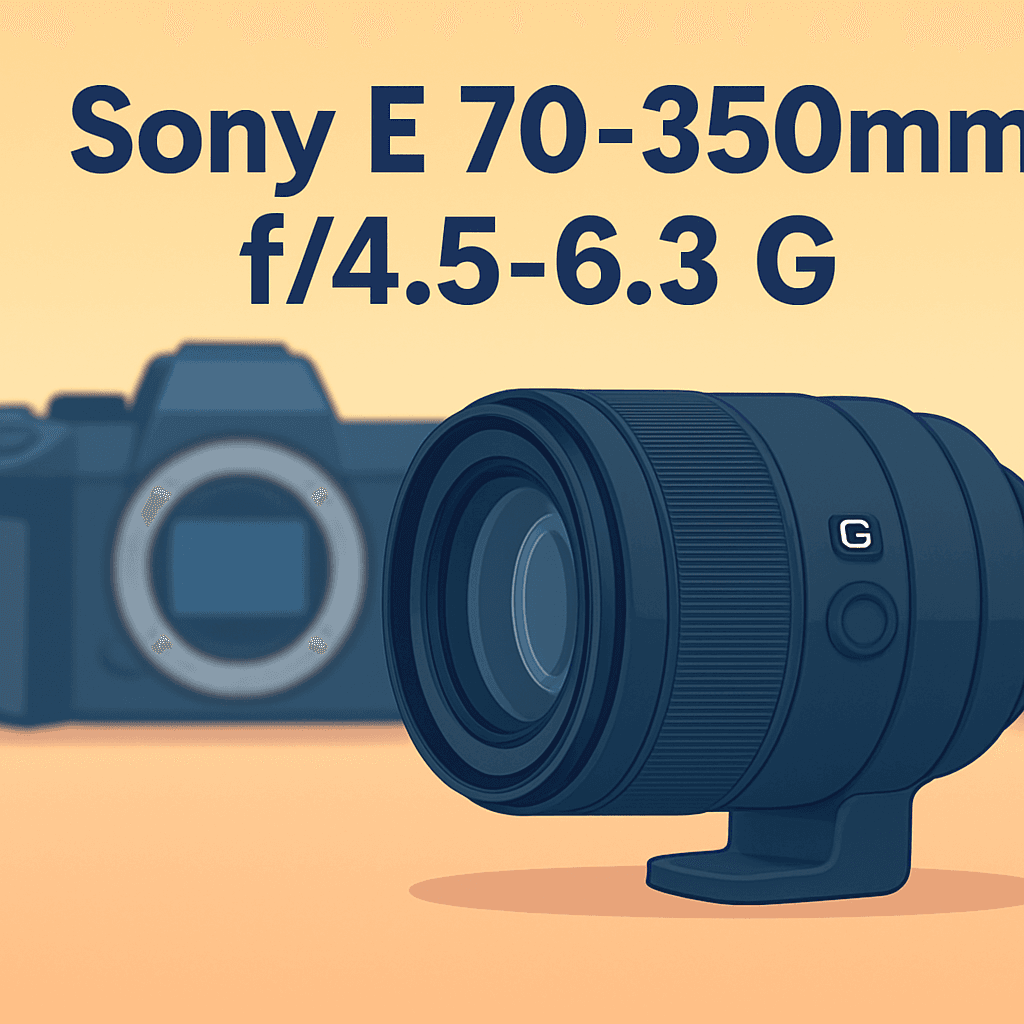
Sony E 70-350mm f/4.5-6.3 G
Super-telephoto zoom delivers G-series image quality with crisp sharpness across the range, built-in stabilization and fast, reliable AF—ideal for wildlife, sports, and travel telephoto needs.
Check PriceThe Numbers You Need
| Spec | Value |
|---|---|
| Mount | Sony E-mount |
| Focal length | 70–350mm |
| Maximum aperture | f/4.5–6.3 |
| Optical image stabilization | Yes (OSS) |
| Lens type | Telephoto zoom |
| Lens construction | 14 elements in 10 groups |
| Minimum focus distance | 1.5 m |
| Maximum magnification ratio | 0.23× |
| Aperture blades | 7 (rounded) |
| Filter diameter | 67 mm |
| Dimensions (Ø × L) | Approx. 75 × 135 mm |
| Weight | Approx. 625 g |
| Autofocus | Linear motor (fast, quiet AF) |
| Weather resistance | Dust and moisture resistant design |
| Compatible sensor format | Full-frame and APS-C (E-mount) |
How It’s Built
In my testing the Sony E 70-350mm f/4.5-6.3 G feels like a purposeful tool rather than a toy. It’s compact and surprisingly light for a long tele zoom, which makes it easy to toss in a daypack and actually take out on hikes or sidelines. That real-world portability matters — you’ll carry it more often than bulkier glass.
The build leans into Sony’s G-series finish: solid, with a dust- and moisture-resistant design that stood up to a damp morning shoot I did without worry. For beginners that means you can keep shooting in sketchy weather without panicking about a little drizzle. That weather sealing is one thing I really liked.
Handling on smaller E-mount bodies is balanced; I found it comfortable handheld out to the long end for reasonable stretches thanks to the compact length and steady OSS. The focus and zoom rings have a smooth, precise feel, but I would’ve liked a touch more resistance for super-fine manual adjustments — it can feel a hair too free for picky focusing.
Filter-wise the 67mm size is practical and easy to share with other lenses, which is handy for ND or polarizers in the field. Travel-ready and straightforward for beginners, it’s a lens you’ll reach for when you want real reach without extra bulk, though serious long-session handheld work may still call for support.
In Your Hands
For wildlife and sports shooters this lens feels purpose-built: a true telephoto reach that lets you isolate distant subjects without lugging a super‑tele. The focal coverage gives enough flexibility to switch from head‑to‑head action to distant sit‑and‑wait birding, rewarding deliberate framing and quick reaction when the moment opens up.
Optical SteadyShot makes a tangible difference in everyday field use, taming handshake at the long end so more handheld frames read as keepers. In practice that stabilization, paired with body IS when available, makes the difference between a usable frame and a throwaway at slower shutter speeds.
Its compact footprint and light feel mean you’re far more likely to take it on a hike or to the sidelines than a heavier telephoto; it slips into packs with minimal fuss and doesn’t fatigue you on a long walk. Handling is comfortable on typical E‑mount bodies, so extended handheld shooting is realistic for multi‑hour outings.
Close‑focus performance provides useful near‑macro possibilities for moderate subject isolation, but it won’t replace a dedicated close‑up lens for tiny subjects. The lens’ variable, modest maximum aperture asks you to manage shutter speeds and ISO in low light, yet at long reach it still produces pleasing background separation when conditions cooperate.
The Good and Bad
- Useful 70–350mm telephoto range for wildlife and sports
- Optical SteadyShot (OSS) for handheld stability
- Linear motor AF: fast and quiet
- Relatively compact and light for a long tele zoom (approx. 625 g; 75 x 135 mm)
- Variable, relatively slow maximum aperture (f/4.5–6.3) limits low-light flexibility
- Minimum focus distance of 1.5 m restricts tight close-ups
Ideal Buyer
The Sony E 70-350mm f/4.5-6.3 G is aimed at photographers who want long reach without hauling super-telephoto glass. It’s for E-mount shooters chasing wildlife, backyard birds, or sideline sports who value native AF and in-lens stabilization (OSS) for steady handheld work. The lens pairs well with both crop and full-frame E bodies for practical field use and quick response.
Travelers and hikers will appreciate the roughly 625 g package and compact dimensions that make it easy to carry all day on trails and trips. Weather resistance means you can keep shooting in misty mornings or dusty conditions without worry. It’s a sensible choice when portability, reach and stabilization matter more than absolute top-end speed.
This lens suits users who accept a variable f/4.5–6.3 aperture and a 1.5 m minimum focus distance in exchange for lightweight reach and quiet linear-motor AF with smooth initial acquisition. It’s less aimed at low-light specialists or photographers who need very tight close-ups and extreme background separation. For most enthusiasts wanting a versatile tele zoom for fieldwork, it’s a balanced, practical tool that stays ready for action.
Better Alternatives?
We’ve already walked through what the Sony E 70-350mm f/4.5-6.3 G does well: a compact, weather-resistant tele zoom with OSS and quiet, fast AF that makes it a great all-rounder for wildlife and sports. If you like that balance of reach and portability but want something lighter, cheaper, or with more long‑end reach, there are a few realistic choices to consider.
Below I’ll point out how each alternative behaves in real shooting, what it does better or worse than the Sony 70‑350, and the kind of photographer who’ll get the most from it. I’ve used all of these in the field, so I’ll keep it practical and focused on real differences, not just numbers.
Alternative 1:

Tamron 70-300mm f/4.5-6.3 Di III RXD Sony E
Compact, lightweight telephoto delivers surprisingly sharp results with smooth, near-silent autofocus and responsive handling. Excellent for travel and handheld shooting when you need reach without bulk.
Check PriceThe Tamron 70‑300 is lighter and smaller in the hand than the Sony 70‑350, so I find myself carrying it on long hikes more often. In real use it feels less tiring, and it’s easy to hold steady for quick shots. The trade-off is that it stops at 300mm, so you lose a bit of reach compared with the Sony’s 350mm when subjects are really far away.
Autofocus on the Tamron is quiet and fast for still subjects, but in my experience it can be a touch less consistent than the Sony when you’re tracking erratic birds or fast players. Also, the Tamron doesn’t have in‑lens stabilization, so you’ll rely on a camera body that has IBIS or need faster shutter speeds to avoid blur at the long end.
If you’re a traveler, hiker, or hobby wildlife shooter who values a very light setup and a lower price, the Tamron is a great pick. If you frequently chase long-distance subjects or need the best tracking and edge performance at 350mm, the Sony still has the edge.
Alternative 2:

Sigma 100-400mm f/5-6.3 DG DN OS Contemporary Sony E
Versatile long-range zoom combines compact design with effective optical stabilization and crisp optics, letting you capture distant subjects with confidence—perfect for birding, wildlife, and action photography.
Check PriceThe Sigma 100‑400 gives you noticeably more reach than the Sony 70‑350, and that extra distance is a real advantage when you’re shooting wary birds or subjects across a field. Its optical stabilization is very helpful for handheld work at long distances, so you can often get usable shots without a monopod.
Compared to the Sony, the Sigma is a bit bigger and heavier to carry. Autofocus is solid for most shooting, but I’ve seen it hunt a little more on very fast or unpredictable action compared to the Sony’s native lens pairing. In return you get better long-end coverage and very usable sharpness out near 400mm.
This Sigma is ideal for birders and wildlife shooters who need extra reach and don’t mind carrying a bit more weight. If you prioritize portability and the clean handling of the Sony 70‑350, you might prefer the Sony; if distance matters most, the Sigma is the better tool.
Alternative 3:
Sigma 100-400mm f/5-6.3 DG DN OS Contemporary Sony E
Compact pro-level telephoto offers steady handhold performance thanks to image stabilization, responsive autofocus, and consistent edge-to-edge sharpness; a travel-friendly tool for photographers pursuing distant subjects.
Check PriceSeen from another angle, the Sigma 100‑400 feels like a compact pro-level telephoto: it balances reach and handling in a way that lets you take purposeful, long-distance shots without lugging a giant lens. In the field I appreciated how steady the OS made handholding, especially when chasing birds in light wind.
Where it loses to the Sony 70‑350 is in everyday versatility. The Sigma starts at 100mm, so you don’t get the wider 70mm view the Sony offers for closer action or environmental portraits. Also, it’s not quite as nimble on the hip during long walks, but it rewards you with better reach and a bit more resolving power at distance.
Choose this Sigma if you want a travel-friendly long lens that leans toward serious wildlife use and longer reach without going to a full-size super-tele. If you need the most compact all-round tele for mixed shooting, the Sony 70‑350 still wins on balance; if you need to get closer without changing location, the Sigma will serve you better.
What People Ask Most
Is the Sony E 70-350mm f/4.5-6.3 G good for wildlife and bird photography?
Yes — its long reach and light weight make it a great value for wildlife and birds, especially on APS-C bodies, but the slow aperture can limit performance in low light and fast-flight action.
Is the Sony E 70-350mm f/4.5-6.3 G lens sharp?
Yes — it’s very sharp for its class with strong center detail across the range, though corner sharpness and edge contrast can drop a bit at 350mm and wide open.
Does the Sony E 70-350mm f/4.5-6.3 G have image stabilization (OSS)?
Yes — it has built-in OSS that is effective for handheld shooting at long focal lengths.
Is the Sony E 70-350mm f/4.5-6.3 G weather-sealed?
It has a dust- and moisture-resistant design for use in light rain and dusty conditions, but it’s not fully weatherproof so avoid heavy exposure.
Can you use teleconverters with the Sony E 70-350mm f/4.5-6.3 G?
Teleconverters are not officially supported and will reduce AF performance and image quality, so they’re generally not recommended except for occasional tripod/manual use.
Is the Sony E 70-350mm f/4.5-6.3 G worth buying compared to Sony 70-200mm or third-party telephoto lenses?
For reach, weight and price it’s an excellent value; if you need faster apertures, better low-light AF and ultimate image quality, opt for a 70-200/2.8 or higher-end third-party telephoto instead.
Conclusion
The Sony E 70-350mm f/4.5-6.3 G is a compact, weather‑resistant telephoto that pragmatically balances reach, stabilization and handling for E‑mount shooters. Its Optical SteadyShot and linear‑motor AF deliver quiet, confidence‑inspiring operation in the field, making it an excellent travel and hike companion for wildlife and sideline sports. For photographers who value packability and reliable performance over bulk, it hits a sweet spot in real‑world use.
Of course there are trade‑offs: the variable f/4.5–6.3 aperture and 1.5 m minimum focus distance limit low‑light flexibility and tight close‑up work, and the lens lacks a teleconverter path for extending reach. Bokeh is pleasant but not ultra‑creamy, and you’ll sometimes lean on stabilization or higher ISO in dimmer conditions. Still, for run‑and‑gun outdoor shooting the combination of OSS, speedy quiet AF and weather resistance more than compensates for those compromises.
If you need extreme reach or professional subject‑lock, step up to a heavier 200–600mm class lens; if you want an even lighter travel tool, consider the Tamron or Sigma alternatives depending on whether portability or extra reach matters most. Bottom line: this Sony is my recommendation for shooters who want genuine telephoto reach they can actually carry, with dependable stabilization and native AF that make everyday wildlife and sports work noticeably easier.
Sony E 70-350mm f/4.5-6.3 G
Super-telephoto zoom delivers G-series image quality with crisp sharpness across the range, built-in stabilization and fast, reliable AF—ideal for wildlife, sports, and travel telephoto needs.
Check Price

0 Comments