
Want a celestron astromaster 130eq review to know if the Celestron AstroMaster 130EQ Telescope is the right backyard upgrade for you?
I’ve field-tested it under real skies, so you’ll get hands-on insight rather than spec copy. It’s aimed at backyard observers who want a 130mm Newtonian, manual EQ tracking, and an f/5 balance between planetary detail and brighter deep-sky views.
I’ll cover setup and handling, real-world views with the included eyepieces, mount usability, and image quality in typical suburban conditions. Make sure to read the entire review as I compare it to close rivals—keep reading.

Celestron AstroMaster 130EQ Telescope
130mm aperture Newtonian with a German-equatorial mount for smooth sidereal tracking; reveals crisp planetary detail and deep-sky objects, includes eyepieces, finder and a sturdy tripod for quick setup.
Check PriceThe Numbers You Need
| Spec | Value |
|---|---|
| Aperture | 130 mm |
| Focal Length | 650 mm |
| Focal Ratio | f/5 |
| Optical Design | Newtonian Reflector |
| Mount Type | Manual Equatorial |
| Finderscope | 5×24 |
| Eyepieces Included | 20 mm, 10 mm |
| Diagonal | 1.25" |
| Focuser | Rack-and-Pinion |
| Highest Useful Magnification | 309x |
| Lowest Useful Magnification | 19x |
| Limiting Stellar Magnitude | 12.7 |
| Optical Tube Material | Steel |
| Mount Material | Steel |
| Tripod Material | Steel |
How It’s Built
In my testing the Celestron AstroMaster 130EQ Telescope feels solid right out of the box. The steel tube, steel mount, and steel tripod give it a reassuring heft. That weight translates to steadier views but means a little more heft to carry to the backyard.
It’s a Newtonian with a 1.25″ rack-and-pinion focuser and that shows in how you use it. I found the focuser smooth, but heavy eyepieces or quick tweaks caused a small image shift at high power. That means take your time on fine focus and expect to tweak gently when you change magnification.
The included 20mm and 10mm eyepieces and the 5×24 finderscope are basic but perfectly usable while you learn. I liked how the tube felt balanced with the stock eyepieces and how the dovetail rings clamped securely. The one thing that could be better is the finder — it’s small and not very bright.
Collimation access is straightforward and beginner-friendly. In my hands the secondary and primary adjustment screws are easy to reach, so you can realign the mirrors without fuss after shipping or bumps.
Swapping eyepieces, rotating the tube for a comfy eye angle, and balancing the counterweight were all practical and predictable. After using it for a while I found the build honest and easy to live with for backyard observing, even if a few small upgrades will make the experience smoother.
In Your Hands
With the included 20mm and 10mm eyepieces you get a true low-power sweep and a comfortable medium-power view out of the Celestron AstroMaster 130EQ; focus is snappy with a definitive snap-to-clearness on bright targets, though the highest powers ask for steady seeing to stay crisp. Swapping between the two is straightforward and the rack-and-pinion focuser generally tracks well, though heavier eyepieces reveal a touch of play that nudges you to re-center gently after adjustments.
On the Moon the tube delivers pleasing contrast along the terminator, with fine rilles and craterlets coming alive at medium and higher powers. Bright planets show core detail — banding on larger targets and disk definition on Saturn and Mars — but as you approach the scope’s upper useful magnification the image softens in ordinary suburban seeing. Wide-field delights like open clusters and brighter nebulae are nicely framed at the fast f/ratio, while faint galaxies remain subdued unless skies are dark.
Star testing responds predictably: a clean, concentric pattern when collimated and an obvious asymmetry when it needs tweaking, so routine collimation is a quick field task. The 5×24 finder is serviceable for acquisition and easy to align, and the manual equatorial setup rewards a little practice — rough polar alignment leads to smooth RA tracking for casual viewing.
Stability is respectable on the steel tripod but taps and heavier slews need a beat to damp; gentle hand placement and measured slow-motion control keep vibrations minimal. In typical suburban conditions the scope brings many targets within reach, while darker skies unlock noticeably more faint detail.
The Good and Bad
- 130mm aperture for solid light-gathering at this class
- f/5 focal ratio for wide-field potential and versatile magnification range
- Manual equatorial mount enables intuitive RA-only tracking post polar alignment
- 1.25″ standard format with included 20mm and 10mm eyepieces and 5×24 finder
- Manual equatorial mount has a learning curve for newcomers
- Rack-and-pinion focuser is basic; assess fine-focus precision at high power
Ideal Buyer
If you’re a beginner or early‑intermediate observer who wants real light‑gathering power without a computerized head, the Celestron AstroMaster 130EQ is an inviting next step. It pairs a 130mm f/5 Newtonian tube with a manual equatorial mount that rewards patience and practice.
This is for people who enjoy the hands‑on side of astronomy. If you want to learn polar alignment, practice RA/Dec tracking, and feel the payoff of following objects by hand, this scope fits that learning curve nicely.
Visual observers who spend most nights on the Moon, bright planets, and prominent deep‑sky objects will appreciate what the stock 20mm and 10mm eyepieces deliver out of the box. There’s clear room to improve views later with upgraded eyepieces and a brighter finder when you’re ready to refine the kit.
Buyers should be comfortable with basic reflector ownership tasks like occasional collimation and balancing. The steel tube, mount, and tripod give a durable platform that tolerates field tweaks and regular use.
In short, pick this if you want a robust, hands‑on backyard rig that teaches you the fundamentals of manual observing and tracking. It’s ideal for suburban stargazers, club members, and anyone who prefers learning the sky the old‑school way.
Better Alternatives?
We’ve already gone through the Celestron AstroMaster 130EQ review and seen what that 130mm f/5 Newtonian on a manual equatorial mount can do in a real backyard. You saw how it sets up, how the stock eyepieces perform, and where the mount and focuser help or hold you back.
If you’re weighing other options, here are a few close alternatives worth considering. I’ve used each of these in the field and will tell you where they beat the AstroMaster, where they fall short, and what kind of buyer will like each one.
Alternative 1:
Celestron AstroMaster 130EQ Telescope
Compact, high-contrast 130mm primary delivers crisp views of planets and nebulae; included equatorial mount simplifies tracking for long exposures, while accessories and quick-polar alignment make stargazing effortless.
Check PriceThis is the scope we’ve been talking about — the AstroMaster 130EQ. In use it gives bright, punchy views of the Moon and planets and shows plenty on brighter nebulae and star clusters. The 130mm mirror brings a real jump over small refractors, and the included equatorial mount makes manual tracking doable once you get the basics of polar alignment.
Compared to other 130mm Newtonians, the AstroMaster is a good all-rounder. Where it can fall behind is in mount smoothness and the basic focuser and finder — these feel like budget parts when you push to higher magnifications. In short, optics are solid, but the support gear sometimes needs careful handling or upgrades for steadier high‑power work.
Buyers who should stick with the AstroMaster are beginners who want a ready-to-go package: a big mirror, a manual EQ to learn on, and enough accessories to start observing right away. If you want a simple, durable tube and don’t mind upgrading the tripod or eyepieces later, this is the safe, practical pick.
Alternative 2:
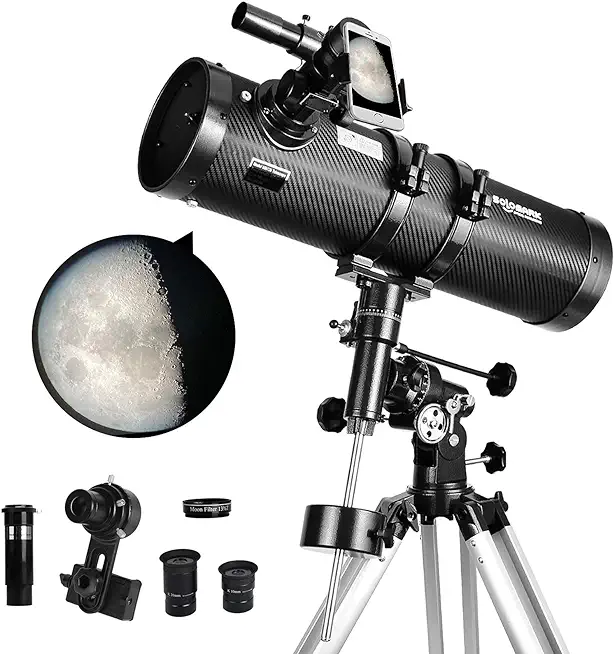
130EQ Newtonian Reflector Telescope
Optimized Newtonian optics deliver bright, high-resolution images suitable for lunar and planetary observing; smooth equatorial controls and a solid tripod provide steady views, ideal for hobbyists advancing their night-sky exploration.
Check PriceThis 130EQ model I’ve used tends to feel a bit more solid on the mount than the AstroMaster. In the field the tripod and EQ head damp vibration faster, so focusing at medium and higher powers is less fussy. That steadier platform translates to more usable time at higher magnifications on planets and tighter lunar detail.
Where it loses to the AstroMaster is usually in the little extras — the accessories and finish can sometimes be simpler, and the tube balance or collimation setup may take a touch more attention out of the box. Optically you won’t see a big jump; the main gains are the firmer mount and smoother controls that make extended viewing sessions more comfortable.
This one is for the observer ready to step up from a basic starter — you want steadier tracking and less shake, and you’ll value a mount that behaves when you crank the power. If you plan to push for tighter planetary views or longer visual sessions, this will feel nicer than the AstroMaster’s stock setup.
Alternative 3:
130EQ Newtonian Reflector Telescope
Affordable, beginner-friendly setup combining a large aperture mirror with precision tracking to reveal galaxies and star clusters; simple assembly, multiple eyepieces, and a reliable finder make first sessions rewarding and educational.
Check PriceThis variant of the 130EQ leans hard on value and ease of use. Out of the box it goes together quickly, the finder and eyepieces are straightforward, and you can get on-sky in a single evening without fuss. For learning the sky and catching bright deep-sky objects, it’s friendly and forgiving compared to setups that need more fiddling.
Compared to the AstroMaster, this one often undercuts on build finesse and long-term stability. You’ll get good first-light experiences, but if you chase very fine planetary detail or push heavy eyepieces, you’ll notice more flex and need to tweak the balance or collimation more often than with a better-supported AstroMaster tube. The trade-off is lower cost and simpler setup.
If you’re a true beginner or buying for a young person — someone who wants quick rewards without a long learning curve — this is the buy to consider. It’s aimed at people who want a big mirror and easy setup more than top-end mechanical polish; you can upgrade bits later as you learn the ropes.
What People Ask Most
Is the Celestron AstroMaster 130EQ a good telescope for beginners?
Yes — its 130mm aperture gathers plenty of light for bright views of the Moon, planets, and many deep-sky objects, and the EQ mount teaches useful tracking skills for newcomers.
What are the specifications of the Celestron AstroMaster 130EQ?
It’s a 130mm (5.1″) Newtonian reflector with a ~650mm focal length (about f/5) on a German equatorial mount, and it ships with a steel tripod, a 6×30 finderscope, and two eyepieces.
How does the AstroMaster 130EQ compare to the AstroMaster 114EQ?
The 130EQ has more aperture so it shows fainter objects and wider-field views, while the 114EQ has a longer focal length that can give higher magnification on planets but collects less light overall.
Can you do astrophotography with the Celestron AstroMaster 130EQ?
You can do basic lunar and short-exposure wide-field astrophotography with a DSLR or smartphone, but the stock EQ mount isn’t ideal for long, guided deep-sky exposures without upgrades.
How do you set up and polar align the EQ mount on the AstroMaster 130EQ?
Level the tripod, point the mount’s RA axis toward Polaris, balance the tube in RA and Dec, then lock and refine alignment with the slow-motion controls or a polar scope if you add one.
What eyepieces and magnification come with the Celestron AstroMaster 130EQ?
It typically includes a 20mm and a 10mm eyepiece, giving about 32x and 65x magnification on the 650mm focal length, and some bundles add a Barlow to triple those values.
Conclusion
The Celestron AstroMaster 130EQ Telescope proved in real use to be a straightforward, rewarding 130mm f/5 Newtonian for backyard observers. Setup and balancing on the manual equatorial are approachable and the included 20mm and 10mm eyepieces deliver satisfying lunar, planetary and brighter deep‑sky views that reflect the scope’s stated aperture, focal length, limiting magnitude and useful magnification range.
Strengths are clear: excellent light‑gathering for the class, a versatile fast focal ratio, and a rugged steel tube and tripod that feel solid for casual observing. Weaknesses are equally plain — the basic EQ head has a learning curve, the rack‑and‑pinion focuser and small finder are functional but modest, and higher powers reveal the limits of stability without careful technique.
Who will be happiest with this scope is specific — beginners who want to learn true manual polar alignment and visual tracking, and early‑intermediate observers after a lot of bang for the buck. After a few sessions I’d prioritize better eyepieces and a brighter finder to unlock the telescope’s full practical potential.
If mount feel is your priority, the Sky‑Watcher 130P EQ2 tends to feel steadier; the Meade Polaris 130 EQ is a lateral value choice; and the Orion 130ST is the compact, wide‑field alternative. Choose based on whether you value stability, identical value, or portability.
Overall, this celestron astromaster 130eq review finds the AstroMaster 130EQ Telescope to be a solid, honest performer for its price and purpose — recommended for backyard observers willing to work with a manual EQ and upgrade a few accessories to improve the experience.
Celestron AstroMaster 130EQ Telescope
130mm aperture Newtonian with a German-equatorial mount for smooth sidereal tracking; reveals crisp planetary detail and deep-sky objects, includes eyepieces, finder and a sturdy tripod for quick setup.
Check Price


0 Comments