
What if your next aerial shot could read like a frame from a feature film rather than a quick social clip? Whether you’re an experienced cinematographer, an indie director, or an ambitious content creator, the right drone changes how you tell stories from the sky. This guide sorts through the noise to highlight five picks that balance image quality, flight performance, and real-world reliability.
We put each platform through real shooting scenarios to see how they perform under pressure — from dynamic movement to long takes. The result is a short, usable breakdown that helps you match a drone to your creative goals and budget. No marketing fluff — just clear recommendations based on real-world use.
If your goal is cinematic aerials for travel, weddings, or commercial work, this shortlist will help you find a fit fast. Flip the page and we’ll walk you through five picks to help you choose the best drone for cinematography in 2026.
Think of this as a filmmaker’s field test, with candid notes on which platforms excel for different shooting scenarios. You’ll get practical direction to align your creative ambitions with the hardware that makes them possible. Ready to take your aerial storytelling up a level — let’s go.
1. DJI Mavic 4 Pro For Cinematography

DJI Mavic 4 Pro with DJI RC 2, 100MP 4/3 Hasselblad tri-camera
Capture ultra-detailed aerial imagery with 100MP 4/3 Hasselblad tri-camera, advanced RC controller, smooth cinematic footage and extended flight performance.
Check PriceAs a working cinematographer I value gear that solves real-world problems, and the DJI Mavic 4 Pro does that in spades. Its 25MP Micro Four Thirds main sensor delivers superb dynamic range and detail, so I get richer highlights and cleaner shadows straight out of camera.
The triple-camera layout is genuinely useful: a variable aperture on the main camera gives me creative exposure control without constantly reaching for ND filters, while the dual telephotos (3x and 6x) let me change framing dramatically without swapping craft or compromising flight time. For event and commercial work this means fewer retakes and smoother coverage.
Flight performance is confidence-inspiring — it holds steady in strong winds and the obstacle avoidance performs well even in low light, which lets me focus on composition and movement rather than worrying about brush or poles. OcuSync 4+ keeps the signal solid in urban shoots, with minimal drops.
Battery life is a standout: up to 51 minutes lets me plan longer passes and reduces the number of battery swaps on location. That endurance paired with versatile optics makes this a tool I rely on for weddings, real estate, and commercial projects where continuity matters.
There are trade-offs to consider. At 1063g it’s large and less pocketable than lightweight models, so it’s not ideal for ultra-mobile travel shoots. Also, the fact that different sensors cover different focal lengths means you can see slight shifts in color or noise characteristics when you switch between cameras, so expect a bit of extra grading work.
- 25MP Micro Four Thirds sensor — superb dynamic range and detail
- Two additional telephoto cameras for versatile creative shots
- Best-in-class obstacle avoidance, including low light
- Long battery life — up to 51 minutes
- Large and heavy (1063g) — less portable
- Different sensors per focal length can cause inconsistencies when switching lenses
2. DJI Mavic 3 Pro For Cinematography

DJI Mavic 3 Pro with DJI RC, triple-camera 4/3 Hasselblad
Triple 4/3 Hasselblad sensors deliver cinematic clarity, intuitive remote control, long-range transmission and rock-steady flight for professional aerial content.
Check PriceThe DJI Mavic 3 Pro is a storyteller’s drone — its triple-camera setup (4/3 Hasselblad sensor, 70mm telephoto, 166mm telephoto) gives you everything from sweeping wide landscapes to tight, cinematic close-ups without swapping aircraft. As a working photographer I lean on that flexibility: one platform covers establishing shots, medium moves, and detailed telephoto framing in a single flight.
Hasselblad color science is more than marketing; it delivers vibrant, true-to-life color straight out of the gimbal, which speeds up your grading workflow and preserves highlight and shadow detail. That native color fidelity makes match cuts between drone and ground footage much easier during post.
Battery life is a genuine advantage on location — up to 46 minutes per flight means fewer battery swaps and more consistent coverage during runs like events or long landscape passes. Pair that with omnidirectional obstacle sensing and you can trust the aircraft while executing complex moves near trees, buildings, or crowds.
This drone clearly leans toward professionals and serious enthusiasts who value image quality and operational confidence. Expect a learning curve with the richer camera controls and workflow, but the payoff is high-quality, versatile footage suitable for commercial, real estate, and event work. If you need a single-drone solution that minimizes gear swaps while maximizing creative options, the Mavic 3 Pro is hard to beat.
- Triple-camera system for wide to detailed close-ups
- Hasselblad color science for high-quality color
- Long flight time — 46 minutes
- Omnidirectional obstacle sensing for safer flying
- Larger size/weight may trigger stricter regulations
- Camera settings and workflow can be complex
3. DJI Air 3S For Cinematography

DJI Air 3S with RC-N3, dual-camera with 1-inch CMOS wide-angle
Compact powerhouse with 1-inch CMOS wide-angle sensor and dual cameras, advanced remote control, nimble handling and excellent low-light performance.
Check PriceThe DJI Air 3S is a compact workhorse built around a true dual-camera system — a 24mm wide-angle and a 70mm telephoto — that gives you real creative versatility in the air. As a photographer I appreciate how that pairing lets you move between cinematic wide establishes and tighter, more intimate shots without changing platforms. It’s well suited to travel, real estate, and event coverage where changing angles quickly matters.
Image quality benefits from improved low-light performance and smarter exposure balancing, so you get usable, cleaner footage when golden hour or indoor conditions are less than ideal. The dual cameras also enable parallax effects that add depth to your shots, and the obstacle avoidance remains reliable even in low light — a huge confidence boost when flying in crowded or complex environments. Users consistently note this combination as a practical balance between portability and professional output.
Flight time is another strong point — up to 45 minutes gives you longer windows to nail a sequence without constant battery swaps. That said, the Air 3S is larger and heavier than some competitors, so expect a bit more bulk in your bag. The camera settings and workflow can feel complex at first, but if you’re a photographer who values framing options and low-light performance, this drone is a very capable tool for cinematic work.
- Dual-camera system for creative versatility
- Improved low-light performance and exposure balancing
- Long flight time — 45 minutes
- Reliable obstacle avoidance in low light
- Larger and heavier — less portable
- Camera settings and workflow can be complex
4. DJI Mavic 3 Cine For Cinematography
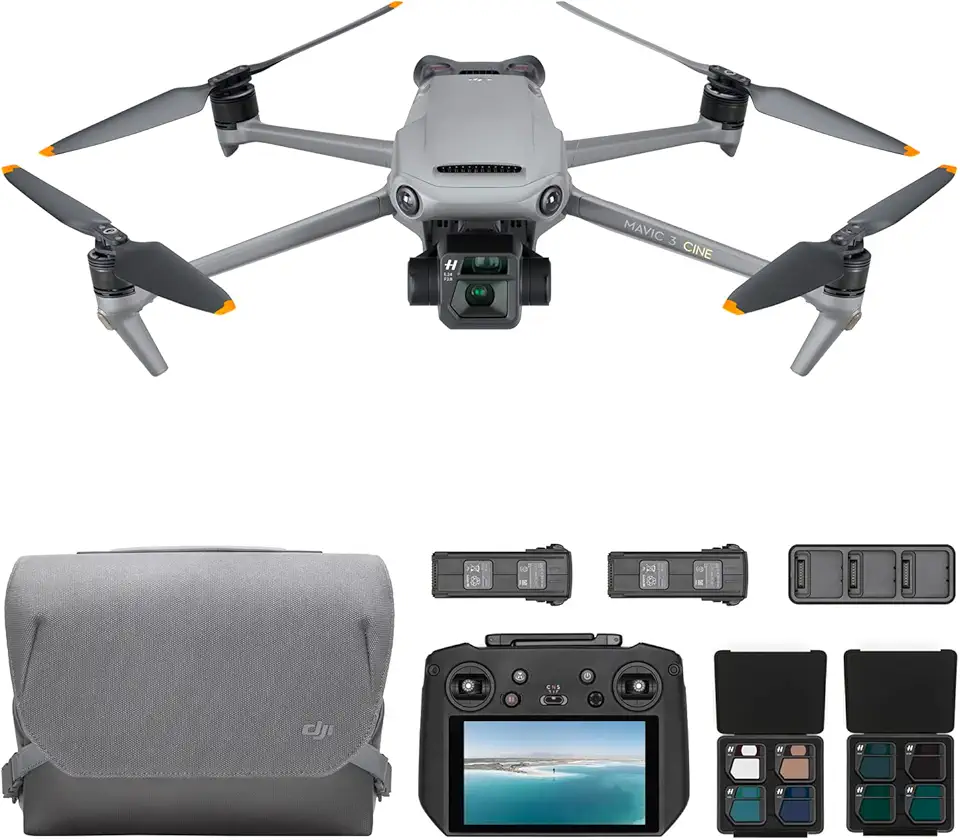
DJI Mavic 3 Cine Premium Combo with DJI RC Pro, two extra batteries, 4/3 Hasselblad
Cine-focused kit with 4/3 Hasselblad sensor, pro-level controller, dual spare batteries and high-bitrate recording for uninterrupted, film-quality aerial capture.
Check PriceFor filmmakers who need broadcast-ready footage from a compact platform, the DJI Mavic 3 Cine is a serious tool. It’s widely regarded for its triple-camera system and native ProRes recording capabilities, which push it into professional workflows without needing an external cinema rig.
The built-in 1TB SSD is a game changer for high-bitrate capture. You can record large ProRes files straight to internal storage, which simplifies on-set media management and reduces rush-to-edit headaches for commercial and broadcast-quality productions.
Battery performance is also solid for extended shoots — the Mavic 3 Cine delivers a 43-minute flight time that lets you cover longer passes and fewer battery swaps. Its reliable obstacle avoidance gives you the confidence to attempt more complex maneuvers without constantly babysitting the drone.
In practice this drone suits commercial operators, solo cinematographers who demand high data rates, and production crews that need hassle-free ProRes files. It isn’t an entry-level piece of kit though; the workflow and file sizes demand planning, and you’ll need storage and post pipelines that match its output.
If your projects require broadcast-quality delivery, minimal external hardware, and long flight windows, the Mavic 3 Cine is mostly worth the investment. Just be prepared for the learning curve and the upfront cost if you’re coming from consumer-level drones.
- Triple-camera system with ProRes recording
- Built-in 1TB SSD for high-bitrate recording
- Long flight time — 43 minutes
- Reliable obstacle avoidance
- Very expensive — barrier for some
- Complex camera settings and workflow can overwhelm new users
5. DJI Inspire 3 For Cinematography

DJI Inspire 2
High-performance cinema drone offering dual-operator workflow, swappable camera options, 360° stabilized gimbal and fast agile flight for demanding professional shoots.
Check PriceThe DJI Inspire 3 is a tool built for filmmakers who need cinema-grade footage from the air. It features a full-frame 8K ProRes RAW camera with interchangeable-lens capability, which immediately tells you this platform is aimed at broadcast and film work rather than casual shoots.
That 8K ProRes RAW pipeline gives you the latitude to push color and exposure in post without falling apart. Interchangeable lenses mean you can tailor focal lengths for each shot, and in multi-operator setups it lets one operator fly while another focuses on lens choice and framing.
For repeatable, high-precision moves, the Inspire 3 includes built-in RTK for centimeter-level repeatable routes. This is huge for complex commercial workflows where you need identical passes for VFX, plate shots, or multi-take continuity.
Operational safety is also considered — reliable obstacle avoidance reduces risk during intricate maneuvers and when flying near talent or structures. The drone is regularly used for commercial and broadcast-quality productions for that reason: image quality, safety, and precision come together.
That said, this is not a plug-and-play toy. The camera settings and high-bitrate workflow are complex and best handled by someone comfortable with professional post pipelines. It’s an investment in both money and crew expertise; if you need top-tier airborne cinema work and can support the workflow, the Inspire 3 is one of the few platforms that truly delivers.
- Full-frame 8K ProRes RAW with interchangeable lenses
- Built-in RTK — centimeter-level repeatable routes
- Reliable obstacle avoidance
- High-resolution, high-bitrate recording for pro post
- Very expensive
- Short battery life — ~20 minutes
How To Choose A Cinematic Drone
Choosing a cinematic drone starts the same way I plan any shot: what story am I trying to tell and what will make the edit sing? Spec sheets are useful, but think in terms of workflow — how the camera, flight performance, and post-production needs fit together on a real shoot.
Camera quality matters above all. I look for integrated systems that offer large sensors, 4K (or higher) codecs, and options for ProRes or RAW so colorists have room to push footage. A rock-solid 3‑axis gimbal, adjustable aperture, and reliable low‑light performance are non‑negotiable; dual or multiple lenses are a bonus when you want parallax or quick focal-length changes without swapping craft.
Stabilization and flight precision make a shot cinematic. Smooth, predictable control lets you perform slow push‑ins, gentle orbits, and complex tracking without jitter. Advanced obstacle sensing and repeatable flight paths (or RTK) are huge for complex shots or when you need centimeter-level accuracy between takes.
Practical logistics will shape the choice as much as image specs. Longer flight times and quick battery swaps reduce interruptions; lighter models are easier to travel with but may sacrifice sensor size or wind stability. Consider weight-class rules in your jurisdiction early — a heavier drone can mean extra certifications and restrictions.
Don’t forget legal and safety hoops. If you’re shooting commercially you’ll likely need licensing (FAA Part 107 in the U.S.), permissions, and insurance. Always verify local airspace rules and secure location releases when required.
Finally, match the drone to your post workflow and budget. If you need high-bitrate cinema files for color grading, prioritize ProRes/RAW and onboard storage. For one-off projects, renting a higher-end platform often beats buying. Practice with the kit before a job — smooth footage is as much about your piloting as it is about the hardware.
Tips For Cinematic Drone Footage
I always start a shoot with a simple story in mind: what am I trying to make the viewer feel? Plan your moves to serve that emotion. A slow, rising reveal creates wonder; a fast, low pass builds tension. Sketch a few key lenses and flight paths beforehand so every move has intention, not just motion for motion’s sake.
Smoothness is everything. Fly deliberately and avoid abrupt inputs — ease in and out of pans and forwards/backwards moves. Watch the wind and be ready to slow down; gusts will translate into jitter even with a great gimbal. Practice basic maneuvers until they’re second nature: clean takeoffs, precise hovers, and smooth orbits let you focus on composition when the moment arrives.
Composition still rules from the sky. Change altitude and angle to tell different parts of the story: wide high shots establish place, lower tele shots compress distance and reveal detail. Use leading lines, the rule of thirds, and parallax between foreground and background to create depth. Don’t be afraid to mix long, steady reveals with short, intimate close-ups — the contrast sells the cinematic look.
Light and exposure are your allies. Golden hour softens highlights and gives skin and landscapes a filmic glow, but when the sun is harsh bring quality ND filters and follow the 180-degree shutter rule for natural motion blur. Use adjustable aperture and ISO to protect highlight detail; shooting log or ProRes/RAW will buy you breathing room in color grading later.
Finally, think like a director-editor. Frame shots that cut together well, and capture a bit more action than you think you need for stabilization and reframing in post. Respect regulations, permissions, and safety at all times, and plan battery swaps so creative momentum isn’t lost. The more you rehearse a sequence, the more cinematic and confident your finished film will feel.
What People Ask Most
What is the best drone for cinematic shots?
The best drone depends on your project needs and workflow rather than a single model. Choose one with a high-quality camera, reliable stabilization, and flight characteristics that match the types of shots you plan to capture.
Which drone do professional filmmakers use for cinematography?
Professional filmmakers use a range of drones from compact, agile models to cinema-grade platforms depending on the production. The choice is guided by required image quality, lens options, and whether multi-operator workflows or repeatable precision are needed.
What drone has the best camera quality for filmmaking?
Drones with larger sensors and support for high-bitrate or RAW codecs generally offer the best image quality. Also look for models with proven color science and flexible recording options to suit post-production needs.
What features should I look for in a drone for cinematography?
Prioritize integrated camera quality, adjustable exposure controls, and a reliable gimbal for smooth footage. Also consider flight stability, obstacle sensing, flight time and the drone’s compatibility with your editing and workflow requirements.
How do I choose the right drone for shooting cinematic video?
Match the drone’s capabilities to your creative goals, budget, and operational needs such as portability and noise. Test the platform when possible and factor in support for your desired recording formats and post-production workflow.
Can consumer drones capture professional-grade cinematic footage?
Yes, many consumer and prosumer drones are capable of producing professional-looking results when paired with careful shooting, proper settings, and good post-production. Skill, planning, and lighting often matter more than the label on the drone.
What drone settings and accessories are essential for cinematic drone shots?
Essential items include stable gimbal settings, manual exposure controls, and ND filters for consistent motion blur in bright conditions. Useful accessories are spare batteries, extra propellers, and a reliable controller or monitor to aid framing and focus.
Conclusion: Best Drones For Cinematography
This guide recapped the top picks for cinematic drone work — from portable dual‑camera models to full‑frame cinema platforms — so you can match equipment to the scale and demands of your projects.
Choose based on the balance that matters to you: image quality, flight time, handling and portability, plus how a drone fits into your shooting and post‑production workflow rather than chasing a single spec.
To improve your skills and make smarter gear decisions, read more of our on‑site guides and tutorials to build practical techniques and a workflow that suits your projects.
Have a question or want help choosing the right setup? Leave a comment below — we usually reply within a few hours.



0 Comments