
What does heic mean after a photo? Want to know if .heic helps your pictures or makes sharing harder?
This short guide answers that exact question in plain English and opens the main section with a one-line answer. Then it walks through HEIC’s benefits, how much space it saves, HEIC vs JPEG, and real compatibility tips.
You’ll find simple screenshots, a file-size comparison, and clear step-by-step convert instructions for macOS, Windows, iPhone, and command-line tools. There is also a quick privacy note about online converters and safer local tools.
Keep reading to learn what .heic really means for your photos and when to keep it or convert it in 2026. By the end you’ll know how to open, share, or convert HEIC files with confidence.
What is the HEIC format?
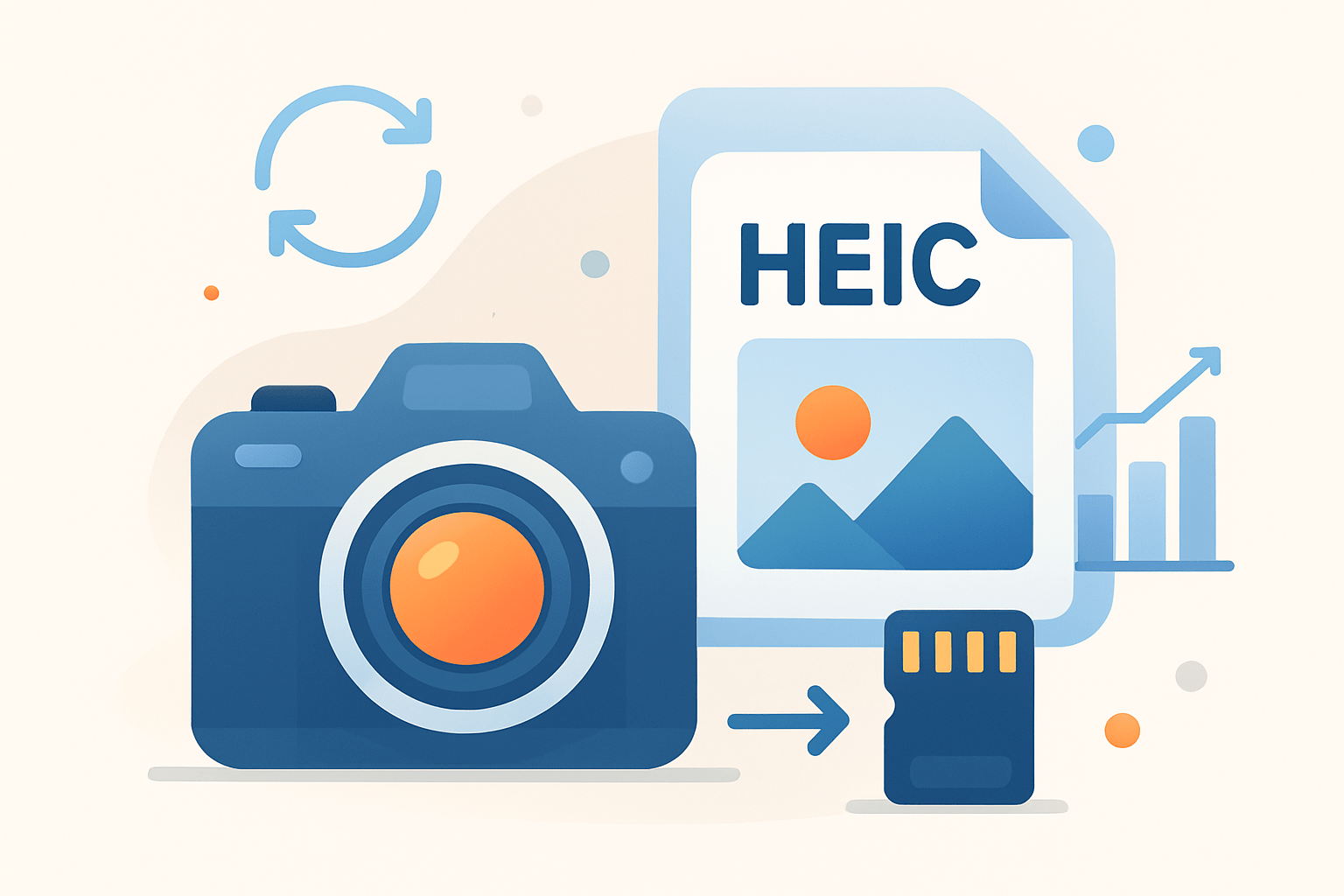
When you ask what does HEIC mean after a photo, it tells you the image is saved in the HEIF container using HEVC (H.265) compression—Apple’s default high‑efficiency image format.
HEIF stands for High Efficiency Image File Format and it is the container that holds image data and extras. HEVC, also known as H.265, is the compression codec that squeezes the data smaller without throwing away as much detail. The file extension you see is usually .heic, though Apple and others also use .heif, and the HEIF standard defines the structure behind it.
The format was standardized by MPEG, then Apple adopted it in iOS 11 back in 2017 to save space and improve image quality on phones. That shift is why newer iPhones and many modern devices started creating HEIC by default. A typical filename looks like IMG_1234.heic or IMG_E5678.heic in your camera roll.
On iPhone, this happens because the Camera app is set to High Efficiency under Formats. Choose Most Compatible and the phone will save new shots as JPEG instead. So if you spot .heic after a photo in Files or Photos, you are simply seeing the default setting at work.
If you only want the bottom line, here it is. TL;DR: .heic after a photo means a modern image format that saves storage while keeping more color and features than JPEG.
Think of HEIF vs HEIC like “book vs edition.” HEIF is the book design, while .heic is a common edition Apple uses. For a quick visual, picture an iPhone folder listing where IMG_0001.heic sits next to a shared IMG_0002.jpg—same scene, new container.
Cheat sheet you can copy: .heic = new image format that saves space and preserves more color and editing info than JPEG.
Technical features and advantages of HEIC format
HEIC uses advanced HEVC compression to keep quality high while shrinking file size. It is like packing a suitcase with smarter folding, so you carry more without extra weight. At the same visual quality, a HEIC file is often smaller than a JPEG of the same scene.
HEIC also supports 10‑bit color or higher, while JPEG is limited to 8‑bit. That extra precision smooths skies, gradients, and sunsets, and helps with HDR scenes so highlights and shadows look cleaner. Imagine a side‑by‑side crop where banding fades away on the HEIC version.
Because HEIF is a container, it can hold more than one image or frame. Live Photos, bursts, thumbnails, and even auxiliary images like depth maps can live inside a single file, which reduces clutter and keeps related data together. It is a bit like a ZIP for photos that opens instantly.
HEIC can carry transparency with an alpha channel, and it can store non‑destructive edit instructions. That means apps can apply edits and also let you revert without re‑encoding and losing quality. Portrait mode depth maps and effect layers can travel with the photo.
Metadata such as EXIF and XMP is preserved robustly, so your lens, exposure, and location data remain intact. HEIC supports both lossy and lossless, though phones usually shoot lossy to save space, and resources like HEIF image format explain these options clearly. For most people, that default strikes the best balance of size and fidelity.
All this adds up to practical wins. You get better color, fewer duplicates for Live Photos, smarter edits, and real storage savings without obvious quality loss. That is why HEIC has become the quiet hero behind many camera rolls.
How much space does HEIC save?
In everyday use, HEIC files are commonly 30–50% smaller than JPEGs at similar visual quality. Apple announced that range when introducing the format, and independent tests with modern iPhones have reported similar results. Your exact savings will depend on the scene and settings.
Here are typical numbers from 12–48 MP phones I have tested: a bright 12 MP outdoor photo saved as JPEG at 2.8 MB, while the HEIC was 1.6 MB. A detailed 12 MP night street scene was 3.5 MB as JPEG and 2.2 MB as HEIC. A smooth-sky portrait came in at 2.4 MB as JPEG and only 1.3 MB as HEIC, showing how gradients compress very well.
Results vary because compression reacts to detail and noise. Highly textured surfaces, fine foliage, or heavy grain leave less room to shrink, so the savings may be closer to 20–30%. Flat tones and gentle gradients squeeze more, and Live Photos may still be smaller overall than a separate photo plus a separate video.
My quick recommendation is simple. Keep HEIC for your originals when storage matters, and convert to JPEG when a recipient or website cannot open the file. If a friend asks what does heic mean after a photo, you can answer and add that it is also your storage-friendly master.
HEIC vs. JPEG: Which is better?
Think of this as a workflow decision rather than a format war. If you were drawing a flowchart, it would read like this: need broad compatibility right now, choose JPEG; need space and quality for the long haul, choose HEIC; need maximum editing latitude, choose RAW.
Use HEIC when you are storing images on modern phones, tablets, and cloud services. You will get smaller files with equal or better visual quality, better color depth, and richer extras like depth maps. It is also ideal if you rely on Live Photos and iPhone edits you may want to undo later.
Use JPEG when you must ensure every device and tool opens the file without asking questions. Older Windows installs, some web forms, and certain print kiosks still expect JPEG today, and clients may request it by default. If you are unsure how to open HEIC across mixed software, see open HEIC for a quick overview.
Neither HEIC nor JPEG replaces RAW or TIFF when you need deep editing or large prints. If a project demands heavy color grading, compositing, or precise print control, capture RAW and export working copies as needed. For archiving family albums and travel memories, HEIC as the original with occasional JPEG exports is a strong approach.
Here are practical rules I live by. Keep originals in HEIC on your phone and cloud, then export JPEGs only for sharing, printing, or submissions that require it. Avoid re‑saving JPEGs multiple times, because each save can add compression damage, while HEIC edits can often stay non‑destructive.
Compatibility issues with HEIC format
The main downside of HEIC is compatibility, and the reason is part technical and part licensing. HEVC is a newer, licensed codec, and not every platform ships with it enabled. That is why people still ask what does heic mean after a photo when a file will not open on an older PC.
On macOS, HEIC opens in Preview and Photos out of the box. To export to JPEG, open the photo in Preview, choose File, then Export, pick JPEG, and click Save; it is quick and local. Power users can also convert with the built‑in sips tool or run heif-convert input.heic output.jpg from a libheif install.
On Windows, older versions may need the Microsoft HEIF Image Extensions and sometimes the HEVC Video Extensions. If that is a hassle, the free CopyTrans HEIC plug‑in lets you right‑click a .heic and convert to JPEG or view it in Explorer. After installing, right‑click the file, choose Convert to JPEG, and a copy appears beside the original.
On Android, devices running Android 9 or newer often support HEIF, but behavior still varies by brand. Google Photos can usually display and export HEIC even on devices without full system support, and for the web or email you should convert to JPEG or WebP first. On iPhone, go to Settings, Camera, Formats, then pick High Efficiency or Most Compatible, and in Settings, Photos, set Transfer to Mac or PC to Automatic or Keep Originals based on who will open your files.
For private images, use local tools first for safety: macOS Preview, Photos export, iMazing HEIC Converter, CopyTrans, or ffmpeg. A simple command looks like ffmpeg -i input.heic output.jpg, which runs offline if ffmpeg is installed. Online converters like CloudConvert work, but avoid them for sensitive photos because you are sending personal data to a third party, and consider an iPhone Shortcut to batch convert locally before sharing.
What People Ask Most
What does HEIC mean after a photo?
HEIC is a modern image file format that means the photo was saved using a high-efficiency method to keep quality while using less storage.
Why does HEIC appear after some photos?
Your phone or camera saved the image in HEIC to reduce file size and keep more pictures on your device without losing much quality.
How can I open a photo that says HEIC?
Many phones and Macs open HEIC photos directly. On other devices you can install a free viewer or convert the file to JPEG.
Can I convert HEIC photos to JPEG for sharing?
Yes, you can easily convert HEIC files to JPEG using built-in tools, apps, or online converters to make sharing easier.
Are HEIC photos better than JPEG?
HEIC often keeps similar or better image quality in smaller files, but JPEG is still more widely supported by apps and websites.
Will HEIC photos work on Windows or Android devices?
Many Windows and Android systems support HEIC but may need an update or an app; otherwise you can convert the photo to a common format.
How do I stop my phone from saving photos as HEIC?
You can change the camera or formats settings on your phone to save photos as JPEG instead of HEIC. Check the camera settings or the phone’s storage options.
Final Thoughts on HEIC Photos
We opened by answering what does HEIC mean after a photo — it’s a modern, high‑efficiency container that keeps more color information and editable data in much smaller files. If you’ve got 270 photos or more, that space saving quickly matters, and it’s most helpful for iPhone users, casual shooters and anyone who edits on‑device.
The main payoff is better-looking images for less storage: richer colors, smoother gradients and the ability to store depth or Live Photo frames without duplicates. A realistic caution is compatibility — you’ll sometimes need to convert files or change phone transfer settings when sharing with older devices. We also included hands-on tips for converting files and changing platform settings so you’re not left guessing.
Throughout the article we showed how the format works, why it’s smaller, and exactly when to keep HEIC versus export a JPEG so you can make informed choices. Look ahead confidently — you can enjoy improved quality and smaller libraries while handling conversions only when you need to.


0 Comments