
What if one flight could deliver a decisive, studio-quality photograph that you can sell or print with complete confidence?
Aerial gear has matured fast, and choosing the right drone now means balancing sensor size, flight reliability, and creative flexibility.
This guide compares five top drones aimed at professional photographers, highlighting practical strengths rather than marketing claims.
We focus on image fidelity, flight features, portability, and the types of shooters each platform serves best.
You’ll get straight talk about camera systems and color science, plus how automation and obstacle avoidance change what’s possible in the field.
We also weigh real-world tradeoffs like battery workflows, handling in wind, and the regulatory realities that affect travel and shoots.
Whether you prioritize maximum image quality, cinematic motion, or the freedom to travel light, there’s a distinct sweet spot for every workflow.
This review is built to help you match features to assignments, not coax you into one-size-fits-all decisions.
If you shoot paid work, deliver prints, or demand repeatable results, the choices you make now will shape your aerial portfolio for years.
Keep reading to cut through clutter and find the aerial platform that best amplifies your vision and delivers dependable, professional imagery.
We keep the language practical and the recommendations honest, whether you’re upgrading from a compact unit or investing in studio-grade airborne gear.
Start here and make your next aerial purchase a creative advantage instead of a logistical headache.
1. DJI Mavic 4 Pro Highlights

DJI Mavic 4 Pro with DJI RC 2, Hasselblad 100MP 4/3 CMOS tri-camera
Ultra-professional aerial imaging with 100MP medium-format sensor, three-camera system, advanced autonomous flight, extended range control, and stunning RAW cinematic detail.
Check PriceAs a working photographer, the Mavic 4 Pro feels like a tool built around image-making first. Its triple-camera array gives real creative freedom: a 25MP Micro Four Thirds main shooter with variable aperture, a 12MP telephoto at 2.5x, and an additional 6x telephoto for long-reach compositions. That range lets you frame scenes without changing altitude or location, which is a huge time-saver on shoots.
Image quality is where this drone earns its keep — excellent dynamic range and color reproduction make grading straightforward, and the main sensor shows noticeable improvements over previous Mavic-class sensors. Video options include 4K and 6K, and the 6K/60fps mode is a standout if you use the higher-bitrate workflow with the 512GB option for maximum detail.
Flying the Mavic 4 Pro is reassuringly solid. Its weight contributes to exceptional stability in wind, and DJI’s LiDAR object sensing plus strong obstacle avoidance make complex shots less risky — even in lower light. Battery life is impressive on paper as well, with up to 51 minutes claimed, which translates to fewer battery swaps on location.
There are practical trade-offs to consider. It’s foldable but heavy (over 1 kg), so it’s not the best choice if you backpack or travel light. Also, the different sensors and resolutions across the three cameras can complicate your workflow; switching lenses and managing varied files has a learning curve and could benefit from smoother software integration.
- Triple-camera: 25MP MFT (variable aperture) + 12MP tele (2.5x) + 6x tele
- Excellent dynamic range and color reproduction
- 6K/60fps video (best with 512GB high-bitrate option)
- Very stable in wind; up to 51 minutes claimed flight time
- Heavy and bulky (over 1 kg) — travel-unfriendly
- Complex workflow switching three cameras; needs more software polish
2. DJI Mavic 3 Pro Highlights

DJI Mavic 3 Pro with DJI RC, Hasselblad 4/3 CMOS triple-camera
Versatile pro drone offering large 4/3-inch sensor triple-lens capture, smooth stabilized footage, precise obstacle sensing, and long-lasting intelligent flight modes.
Check PriceAs a working photographer I reach for the DJI Mavic 3 Pro when color fidelity and reliable results matter most. Its Hasselblad-tuned color science and rock-solid handling give files that hold up through heavy grading and commercial workflows.
The camera system is a true professional toolkit: a 24mm wide with a Four Thirds sensor, variable aperture, 20MP stills and 5.1K video, plus 70mm and 166mm telephoto options. That trio gives you everything from environmental panoramas to compressed perspectives without changing platforms.
Image quality is where it shines — exceptional dynamic range and Hasselblad color fidelity leave lots of room for grading. The main sensor delivers rich data for color work and the telephotos add creative reach, even if the longest reach isn’t used on every job.
Flight performance matches the imaging: excellent stability and near crash-proof obstacle avoidance via six fisheye + two wide-angle sensors. You also get robust ActiveTrack and smart flight features, and a substantial 43-minute flight time that keeps you on location longer.
It’s foldable but relatively large, which means you should check local rules since it may trigger stricter regulations. The price is high and the Cine version is overkill for many hobbyists, but for professional photographers and advanced videographers who need color accuracy, reliability, and focal-length flexibility, it’s a very strong choice.
- Hasselblad color and exceptional dynamic range
- 24mm Four Thirds main — 20MP stills, 5.1K video
- 43-minute flight time & six fisheye + two wide-angle sensors
- Flexible triple-camera system (24mm / 70mm / 166mm)
- Large; may trigger stricter regulations
- High cost; Cine version overkill for most hobbyists
3. DJI Air 3S Highlights

DJI Air 3S with RC-N3, dual-camera with 1-inch CMOS wide-angle
Compact powerhouse with dual 1-inch sensors, wide-angle clarity, responsive remote control, enhanced HDR video, and agile, reliable flight performance.
Check PriceAs a working photographer, the DJI Air 3S feels like the sweet spot between image quality and practical portability. Its dual-camera layout — a 24mm wide and a 70mm telephoto — gives you crisp framing options without the bulk and workflow complexity of a triple-camera rig.
The main sensor delivers 50MP stills and can record 4K up to 120fps, with 10-bit video and D-Log M for real grading flexibility. You also get an impressive 14+ stops of dynamic range, so highlights and shadows hold detail far better than typical travel drones.
Flight-wise it’s solid: expect around 36–37 minutes of airtime in real conditions, with a fast, stable platform capable of 40–60 mph when you need it. The 360° obstacle avoidance that operates in the dark gives me confidence shooting complex or low-light sequences without babysitting the craft.
Advanced features like waypoints and professional flight modes make it reliable for repeatable shots and client work. And at its weight it’s easier to slip into a camera bag than full-size pro models, so it really works for photographers who travel light but still demand pro-level images.
The trade-offs are straightforward: you won’t get the focal-length breadth of a triple-camera system, and some buyers will debate whether its price beats stepping down to the Mini line. For anyone upgrading from a Mini or wanting a capable professional backup that won’t slow you down on location, the Air 3S is mostly a smart, balanced choice.
- 50MP stills
- 4K up to 120fps
- 14+ stops dynamic range
- 360° obstacle avoidance (works in dark)
- Less versatile than triple-camera systems
- Price/performance may overlap with Mini series
4. DJI Mini 4 Pro and 5 Pro
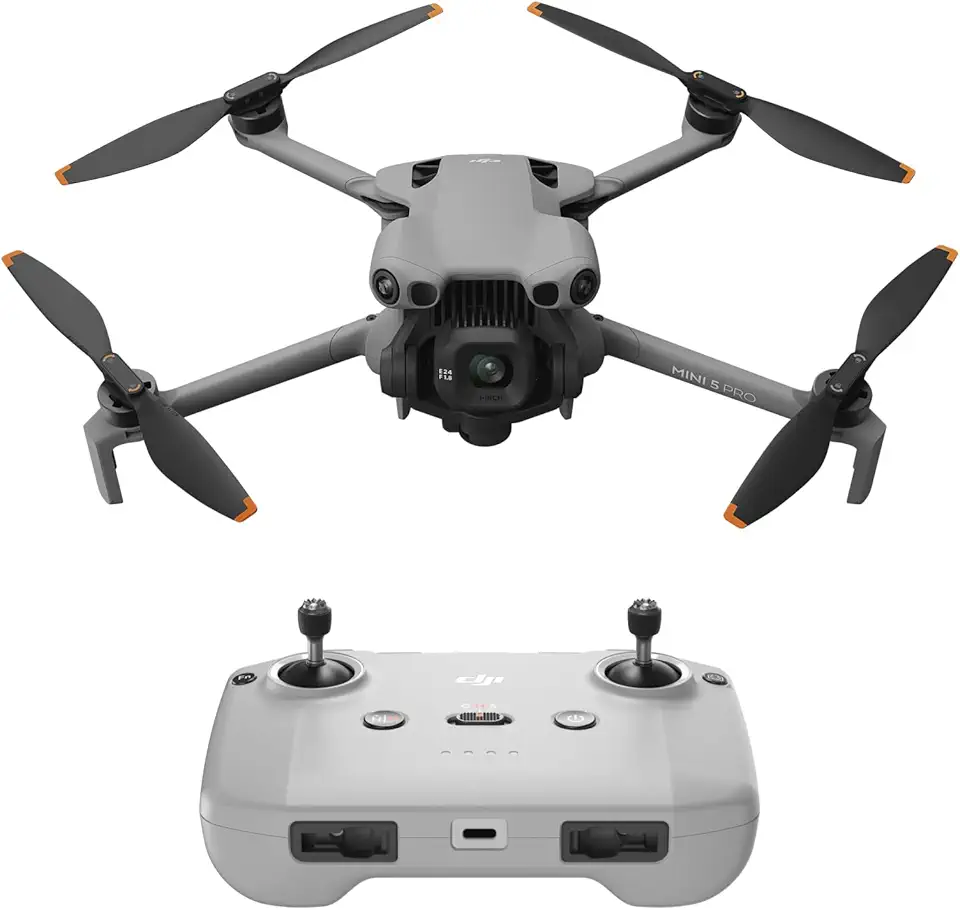
DJI Mini 5 Pro with 1-inch CMOS
Featherweight performer with large 1-inch sensor, impressive low-light imaging, simplified controls, obstacle sensing, and convenient portable aerial creativity.
Check PriceAs a photographer who travels light, the Mini 4 Pro / Mini 5 Pro feels like cheating in the best way. It packs a 48MP stills sensor and 4K/120fps video into a sub-250g package that I can legally take almost anywhere.
The camera offers vertical/horizontal switching and D-Log M for grading, so you get flexible framing and room to color-grade. D-Log M isn’t as rich as larger pro drones, but it gives you real latitude for post.
Flight-wise this drone is impressively capable for its size. It’s quiet, intuitive, and stable for a small platform, with easy return-to-home and automated flight modes that speed up shoots.
On the Mini 4 Pro you also get omnidirectional obstacle sensing, which reduces the stress of tight compositions and low-altitude work. That sensor suite makes handheld-style shots and street-level passes much safer.
Portability is the real win: it’s extremely compact and pocketable, so it’s ready whenever inspiration strikes. I reach for it on travel days and quick client calls where packing a larger rig isn’t practical.
Be realistic about limitations though. Low-light performance and wind stability lag behind heavier pro drones, and the dynamic range and color science won’t match a larger sensor system.
If you’re a travel photographer, content creator, or hobbyist who prioritizes portability and simplicity, this is mostly a very good tool. It delivers pro-feeling footage in a tiny form factor while keeping regulatory hassle to a minimum.
- Sub-250g — minimal regs and easy travel
- 48MP stills and 4K/120fps video — impressive quality for size
- Omnidirectional sensing (Mini 4 Pro) — safer, easier flying
- Pocketable and travel-friendly — always ready to shoot
- Lower dynamic range than larger drones
- Less stable in wind — not ideal for rough conditions
5. Skydio 2+ Highlights

Potensic ATOM 2 Fly More Combo, 4K camera, 3-axis gimbal, under 249g
Complete travel-ready kit featuring stabilized 4K capture, three-axis gimbal, extra batteries and accessories, compact under 249 grams for effortless portability.
Check PriceSkydio 2+ is a purpose-built tool for shooters who need rock-solid, hands‑off tracking more than they need the absolute best image sensor. It records 12.3MP stills and 4K/60fps video from a smaller sensor, and in practice that means reliable, usable footage for action and documentary work rather than studio‑grade color depth.
Where this drone shines is in-flight intelligence. Industry‑leading 360° obstacle avoidance and aggressive subject tracking let you focus on composition while the drone does the flying. Fully automated flight modes produce cinematic moves without advanced piloting skills, and control options include app, controller, or beacon for flexible setups on the go.
Portability is reasonable — heavier than the smallest Mini class, yet still compact enough to toss in a field kit. Real users consistently praise the obstacle avoidance and tracking for action and sports shoots; that reliability is a huge time‑saver when you’re single‑operator and can’t afford a crash or missed take.
The tradeoffs are real: image quality isn’t as sharp or color‑rich as DJI’s top models, and endurance is modest at a 27‑minute flight time. Transmission is also limited to about a 6 km range, so for long‑range or high‑detail aerials you may feel constrained. If your workflow prioritizes hands‑off tracking, safety, and solo operation, Skydio 2+ is an excellent, pragmatic choice.
- Best‑in‑class 360° obstacle avoidance & tracking
- Fully automated flight modes for cinematic shots
- Flexible controls: app, controller, or beacon
- Compact for its capabilities; great for solo operators
- Camera not as sharp or color‑rich as top competitors
- Shorter 27‑minute flight time and 6 km transmission limit
Automated Flight Features
Automated flight features are the quiet workhorses that let you concentrate on composition while the drone flies the hard bits. Pre-programmed flight paths and waypoints give you repeatability, which is priceless for mapping, real estate shoots, and multi-pass cinematic moves.
Use mission-planning tools to account for wind, altitude and camera settings ahead of time. Software like UgCS is great for templating missions, running operations offline, and handling battery-swap transitions during long, multi-phase shoots.
Subject-tracking has matured into a creative tool, not just a convenience. Modes such as parallel, trace and spotlight let you shape the shot while ActiveTrack, Autel Dynamic Track or Skydio’s AI keep subjects framed and moving smoothly.
Don’t assume tracking is foolproof. Test the chosen mode on the actual subject and environment before the take. Give the system a safety margin, and keep manual override ready so you can nudge framing or disengage if needed.
Obstacle avoidance is a game changer in automated work. Omnidirectional sensing and APAS-style real-time rerouting dramatically lower collision risk, and Skydio’s 360° sensing is especially reliable in cluttered scenes.
Still, sensor tech has limits in low light, glass or dense foliage. Fly conservatively around hazards, and don’t rely on avoidance to substitute for good planning. Line-of-sight and situational awareness remain your responsibility.
When precision matters, RTK-level positioning delivers centimeter accuracy for photogrammetry and repeat photography. Use RTK when you need perfectly aligned frames across passes or when stitching maps with tight tolerances.
Finally, automation benefits safety and efficiency, but it’s a tool, not a replacement for skill. Practice your automated missions, log them for repeatability, plan battery swaps, and rehearse manual takeovers. With that balance, automation will elevate your images without stealing control.
Drone Portability Considerations
Portability isn’t just about whether a drone folds up. As a working photographer I pack for hours on location, sometimes on foot, sometimes on a plane, and every gram and minute matters. Heavier craft like the Mavic 4 Pro (over 1 kg) or Mavic 3 Pro give you rock-solid wind performance and longer flight times, but they mean bigger cases, potential airline hassles, and—if you’re in Europe—C2 classification headaches that can affect where you can fly without extra certification.
On the other end, the Mini series lives in a different world. Sub-250g drones are pocketable, exempt from many rules, and perfect when you need speed and convenience. The trade-offs are clear: less low‑light capability, shorter endurance, and more vulnerability in gusty conditions. The Air 3S sits in the sweet spot for many of my jobs; it’s light enough to travel with yet still delivers serious image quality.
Think beyond the airframe. Controllers with integrated screens save you from dragging tablets, and one-touch takeoff, auto-calibration, and quick battery swaps cut setup time on windy cliffs or short golden hours. I always test my pack: case fit, tripod space, and where batteries sit. If anything feels like a game of Tetris, you’ll lose minutes—and sometimes shots—on location.
Battery strategy is a portability strategy. Long flight times are great, but carrying multiple heavy batteries defeats the point of a “light” kit. Decide whether you value longer single flights or lighter overall load with more swaps. Hot-swap workflows and modular payloads can be a lifesaver for extended jobs.
Finally, plan for real travel constraints. Check airline rules and local regs before you book. Do a practice run with your full pack and a mock shoot. That small rehearsal saves the panic of discovering your drone won’t fit into a carry-on or you’ve got no room for an essential spare prop in the field.
What People Ask Most
What is the best drone for professional photography?
The best drone depends on your workflow and priorities, such as ultimate image quality, portability, or automated tracking. For top image quality choose a pro model with a large sensor, while a lighter, more portable drone suits travel and minimal-regulation work.
What camera specs should a professional photography drone have?
Look for a drone with a large sensor, high-resolution stills, good dynamic range, and professional color profiles to allow flexible grading. Multiple focal lengths or telephoto options and video formats that support grading are also valuable.
How do I choose the right drone for professional aerial photography?
Match the drone to your typical shoots by prioritizing the features you use most, whether that is image quality, automation, or portability. Consider camera capabilities, automated-flight tools, battery workflow, and regional regulations before buying.
Which drones offer the best image quality for professional photographers?
Pro models with larger sensors and refined color science deliver the best image quality, while mid‑tier models balance quality and portability. Compact or tracking‑focused drones can be capable but usually do not match the top pro models in dynamic range and color depth.
What are the essential features for a professional photography drone?
Essential features include a high‑quality camera system, wide dynamic range and professional color profiles, robust obstacle avoidance, and reliable automated flight planning. Precision positioning and a practical battery workflow are also important for professional work.
Can professional photographers use consumer drones for work?
Yes, many consumer drones can be used professionally, especially when portability and light regulatory burden are priorities. However, they may have limitations in dynamic range, low‑light performance, and advanced color or format features compared with pro models.
What accessories are necessary for professional drone photography?
Carry extra batteries and a protective case or backpack to keep shoots running smoothly, and use a controller with an integrated screen to simplify setup. Mission‑planning software, precision positioning modules, and convenient control accessories can improve repeatability and accuracy.
Conclusion for Best Professional Photography Drones
Choosing the right drone comes down to balancing automation, portability, and image quality against the way you work in the field.
If you need the very best image data and creative flexibility, the Mavic 4 Pro and Mavic 3 Pro sit at the top; the Air 3S offers a practical middle ground, the Mini series shines for travel, and the Skydio 2+ is built for hands‑off tracking.
Factor in workflow details like flight automation, battery swappability, regulations, and mission planning to make a choice that reduces friction and improves consistency on shoots.
If you want to sharpen your aerial skills and decision-making, explore more guides and gear roundups on the site to compare features and workflows in depth.
Have questions or want advice tailored to your shooting needs? Leave a comment below and we usually reply within a few hours.



0 Comments