
How to photograph northern lights and capture their color and motion like a pro?
This 2026 guide gives clear steps you can use on your first aurora night. We keep it simple and practical.
You will learn when and where to go to spot strong aurora. You will also get a short gear checklist so you know what to bring.
We explain exact camera settings, focusing tricks, and composition tips for shooting at night. Follow the step-by-step workflow, plus quick troubleshooting, forecast apps, and safety tips to keep you warm and shooting longer.
Planning your shoot & best locations
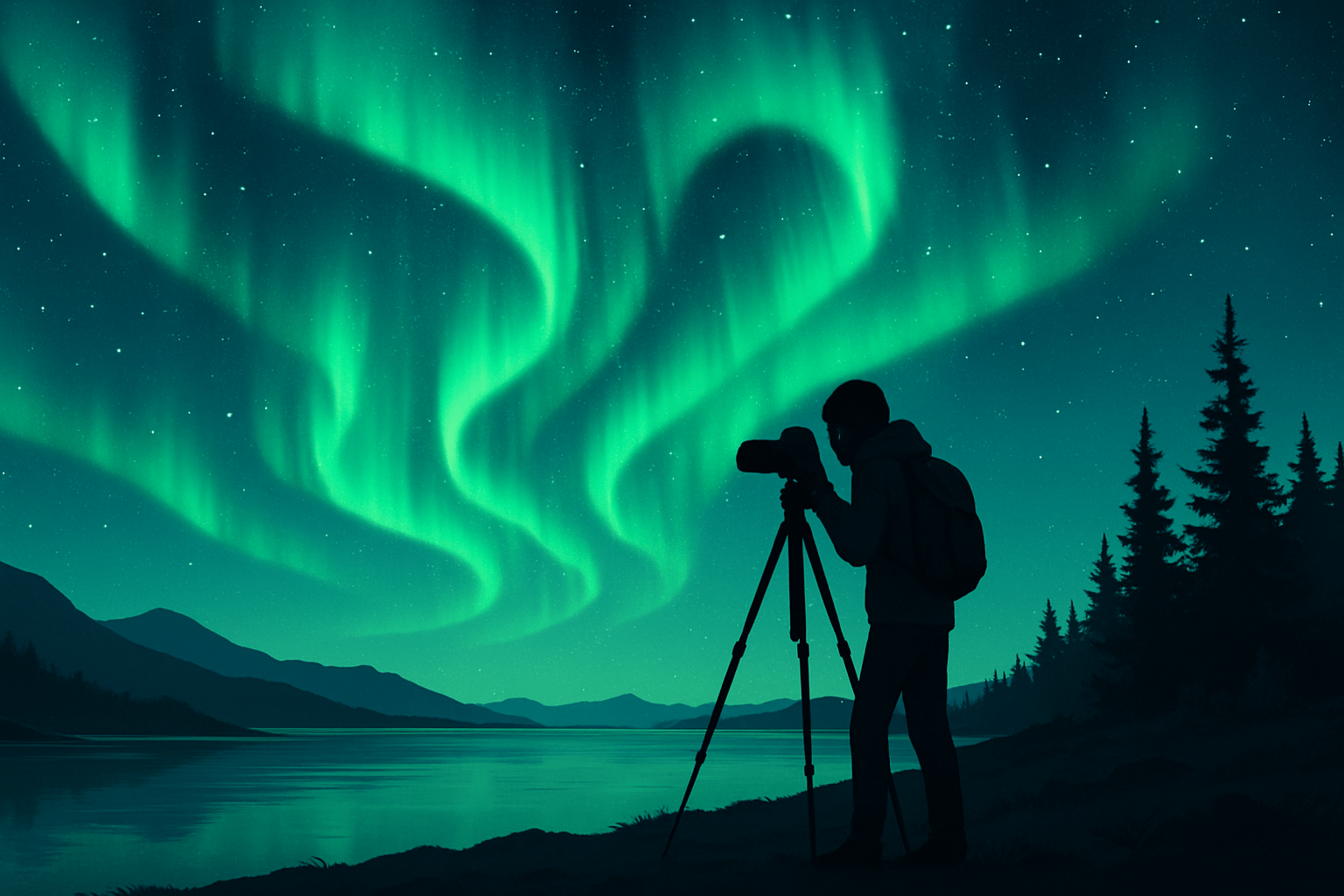
If you want to learn how to photograph northern lights, start with a plan. The aurora rewards those who check the sky, the weather, and the ground before they go. A little prep greatly increases your odds of a glowing sky and sharp, clean photos.
Winter at high latitudes brings the longest nights and the best window of darkness. The lights can appear anytime, yet activity often peaks around local midnight and near the equinox months when Earth’s tilt favors geomagnetic storms. Be patient and be ready to wait, because bursts can arrive suddenly and fade fast.
The moon can help or hurt depending on your goal. A new moon gives the darkest sky and lets faint curtains pop, while a half or rising moon can softly light your foreground and add color without overpowering a stronger aurora. If the display is weak, bright moonlight may wash it out, so choose your night to match the forecast.
Pick regions where the auroral oval commonly sits overhead. Iceland, northern Norway, Sweden, and Finland, plus Alaska and northern Canada, have frequent shows and good access by road. Look for open northern horizons, lakes for mirror reflections, and safe roadside pullouts or small hills that clear nearby light.
Light pollution steals contrast and color, so aim for a truly dark site. Use any reliable light pollution map app and seek gray or black zones away from cities and industrial sites. If you must shoot near a town, position yourself upwind and let the town sit behind terrain.
Clouds are the real showstopper, so track cloud layers with tools like ClearOutside and MeteoBlue. High, thin cloud can still glow with aurora, but low, thick cloud will block it; check separate forecasts for low, mid, and high cloud, and favor sites with local breaks. Compare the model timeline with local winds to guess when holes may drift over you.
Aurora forecasting starts with the KP index, which gives a rough strength from 0 to 9. Use NOAA SWPC or SpaceWeatherLive for big-picture trends, then rely on short-term alerts from My Aurora Forecast or AuroraWatch for 1 to 3 hour predictions that matter in the field. Watch the solar wind speed and Bz direction if your app shows them, and combine that info with your cloud forecast for go or no-go calls.
Here is simple visibility guidance many travelers use in plain language. At 65 to 70 degrees north, you can see aurora with KP 0 to 1 on clear nights; at 55 to 60 degrees north, aim for KP 4 to 5; at 45 to 50 degrees north, look for KP 6 to 7; and around 35 to 40 degrees north, you usually need KP 8 to 9 to get a visible arc. Treat these numbers as a guide, not a promise, and remember strong storms can push farther south.
Scout in daylight so you know the safe paths and the best angles. Avoid thin ice, cliffs, and tidal flats, and identify legal parking spots and any permissions you might need. Dress for standing still in cold, keep reflective gear handy if you are near roads, and tell someone where you will be and when you will return.
If you want a deeper planning walk-through, this detailed guide pairs location research with solar data in a very practical way. Use it to refine your map pins and nightly plan. Preparation is half the photograph.
Gear & essential equipment
Any modern interchangeable-lens camera can make beautiful aurora photos, but low-noise bodies help. Full-frame cameras offer cleaner high ISO, while APS-C and Micro Four Thirds still deliver great results with careful exposure. Mirrorless bodies keep weight down and offer good live view focusing in the dark.
Use a wide, fast lens to gather light quickly. On full frame, 14 to 35mm works well, and f/1.4 to f/2.8 is ideal for crisp detail in fast-moving curtains; if your lens is f/4, you can still shoot, just raise ISO or lengthen shutter when the aurora is slow. On crop sensors, 10 to 22mm or 12 to 24mm equivalents give you similar coverage.
A sturdy tripod is non-negotiable because wind and long exposures will test your setup. Choose something with a solid center column, a reliable quick-release plate, and consider spiked feet in snow or sand. Hang a small bag from the center hook for extra stability if gusts pick up.
A remote shutter or intervalometer lets you shoot without camera shake and enables timelapse. Many cameras have a built-in interval function, so check your menu before buying extras. For single frames, a two-second self-timer is a simple fallback.
Cold drains batteries quickly, so bring spares and keep them warm in an inner pocket next to your body. Rotate them as soon as you see the first bar drop, and avoid leaving your camera on between sequences. A small cloth over the viewfinder can also reduce frost buildup around the back of the camera.
Your headlamp should have a red mode to protect night vision and avoid blinding you or others. Dress in layers with windproof outerwear, and add warm boots, thin liner gloves under thicker mitts, and chemical hand warmers. Traction aids help on ice, and a reflective band makes you visible to passing cars or snowplows.
Condensation and frost can fog your lens, so carry a lens heater band or wrap a hand warmer around the lens barrel with a rubber band. Pack a microfiber cloth, but dab lightly and avoid wiping frost hard across coatings. Also try to breathe away from the front element while composing.
Use fast, high-capacity memory cards and a simple backup plan, such as copying to a portable SSD in the car after a session. Format cards in-camera before each night and bring a spare. A small notebook or phone note can track settings as conditions change.
Smartphones can capture aurora too with the right setup. Use a mini tripod, a Bluetooth remote, a wide-angle adapter if needed, and a manual camera app that lets you set ISO, shutter speed, and focus. Shoot RAW if the app supports it to recover more color and detail.
Turn off image stabilization when you are on a tripod to prevent micro-blur from the system hunting. Disable long exposure noise reduction for timelapse because it doubles frame time; deal with noise later in software. A minimal kit is a camera, a wide lens, and a tripod, while a pro kit adds a fast prime, wired intervalometer, lens heater, and high-capacity batteries and cards; pack accordingly and write a small packing checklist you can print and tape to your camera bag.
Camera settings & exposure basics
Shoot in Manual mode so you control aperture, shutter, and ISO without the camera changing exposure mid-sequence. This is the most reliable way to dial settings for how to photograph northern lights in different speeds and brightness. If you do switch modes, make changes on purpose and keep notes.
Always shoot RAW to keep full color depth and recovery headroom. Set white balance to a fixed Kelvin, usually between 2700K and 4000K, so your timelapse does not flicker; you can still fine-tune in post. Auto white balance is fine if you only shoot single frames and will correct later.
Open your lens to its widest aperture. f/1.4 to f/2.8 gathers light fast and keeps shutter short, which preserves the delicate ripples in active aurora. If your lens is f/4, compensate with more ISO, or accept a slightly longer shutter when the aurora is slow or faint.
Match shutter speed to the movement of the aurora itself. Fast, dancing curtains want about half a second to three seconds to freeze structure, moderate movement does well around two to eight seconds, and faint or static glow can stretch to 15 to 25 seconds if your stars still look round. Watch for star trails, and adjust if you see elongation.
Set ISO as low as you can while keeping the shutter short enough for the motion you see. On full frame with a fast lens, ISO 800 to 3200 is common, while smaller sensors or slower lenses may need ISO 1600 to 6400. Take a test frame, zoom in, and fine-tune until highlights hold and detail looks crisp.
Use the simple 500 rule to avoid star trailing by dividing 500 by your focal length for an approximate max shutter in seconds on full frame. If you shoot a 20mm lens, start near 25 seconds; on a 24MP or higher sensor, many photographers prefer 300 to 400 divided by focal length for a safer limit. On crop sensors, divide by focal length times the crop factor to adjust.
Judge exposure with the histogram and highlight warnings, not the bright LCD preview. Keep the right side of the histogram short of hard clipping, and accept that auroral greens and reds often sit mid to high without pure white. Review your frame at 100 percent to confirm focus and star shape before you move on.
For consistency, turn off auto ISO, disable long-exposure noise reduction when shooting sequences, and stick to single-shot RAW. If your camera has electronic front curtain or a fully electronic shutter, enable it to reduce vibration. Consider a simple two or three frame bracket if the foreground is much darker than the sky.
Here is a field cheat-sheet you can read quickly without a table. For active, fast aurora, start around f/1.8 to f/2.8, 0.5 to 2 seconds, and ISO 1600 to 6400; for moderate aurora, try f/2.8, 2 to 8 seconds, and ISO 800 to 3200; for faint aurora using a wide, long exposure look, use f/1.4 to f/2.8, 8 to 25 seconds, and ISO 800 to 3200 while watching for star trails. On crop sensors, add roughly one stop of ISO for the same shutter time, and with slower lenses, either raise ISO or lengthen shutter if the aurora is not moving fast.
Example EXIF for a faint display: full-frame camera with a 20mm lens at f/1.8, 15 seconds, ISO 1600, and 3200K white balance; stars remain round and the green arc lifts off the northern horizon. Example EXIF for a moderate display: APS-C camera with a 14mm equivalent at f/2.8, 3.2 seconds, ISO 3200, and 3600K; ribbons show texture without smearing. Example EXIF for a very active display: full-frame camera with a 24mm at f/1.4, 0.7 seconds, ISO 6400, and 3400K; fine rays are frozen with a bit of grain that cleans up later.
If you want a quick refresher while packing, bookmark a concise guide to the best camera settings and compare it to your own test frames. Use it as a starting point, then adapt to the pace of the sky. The aurora is your metronome.
Focusing and composition in the dark
Autofocus often struggles at night, so switch to manual focus and start at the infinity mark. Use live view, magnify to 10x, and focus on a bright star or a distant light until it looks as small and sharp as possible. Take a test shot and tweak in tiny steps if needed.
If you can find a bright light far away, use autofocus once, then switch the lens to manual and tape the focus ring to lock it. Pre-mark your lens for common focal lengths with a small piece of gaffer’s tape. Recheck focus when the temperature swings or you bump the lens.
Run a quick focus routine before the show peaks. Set ISO high for a five to ten second test frame, zoom to 100 percent, and confirm stars are pinpoints across the frame. If corners are soft, you may be a touch past infinity or need to stop down slightly.
Compose with a story in mind instead of only sky. A lone tree, a mountain ridge, a small cabin, or ice formations can anchor the scene and give the viewer a sense of place and scale. Water adds drama because reflections can double the aurora’s shape.
Place your horizon based on where the aurora lives that night. Keep it low when the display is overhead, and higher when the glow hugs the horizon, and always keep it level to avoid distraction. The rule of thirds is a helpful starting point, but let the shape of the aurora guide you.
Wide-angle lenses exaggerate the sky, so lean into that for sweeping arcs. If the display is huge, consider a stitched panorama with a steady overlap, or point the camera vertical to fit tall curtains. Work fast because the structure changes minute by minute.
Reflections work best on calm nights or on wet sand just after a wave recedes. If a lake has ripples, try a slightly longer shutter to smooth the water without blurring the aurora too much. Always check ice safety before stepping on any frozen surface.
People add scale and emotion when done carefully. Ask your subject to hold still, then use a short shutter and a quick flash or a brief touch of a headlamp to light them without overpowering the sky. Keep the light on them for less than a second to avoid ghosting.
Balance the foreground with natural light when you can. A dim moon can paint snow and rocks beautifully, and a gentle, warm light paint can work if you keep it soft and even; use separate short exposures if you prefer to blend later. Watch for car headlights or nearby lamps that can spill orange light across your scene.
The most common mistakes are empty foregrounds, a tilted horizon, and horizon-blocking trees you did not notice in the dark. Also watch for stray streetlights, car trails, or plane streaks. A slow scan of the frame edges before each sequence can save an otherwise perfect photo.
How to photograph the Northern Lights — step-by-step shooting workflow
Here is a simple field rhythm you can follow when you are learning how to photograph northern lights. Arrive before dark and scout, set the tripod on firm ground and level the head, mount the camera, insert a formatted card, and switch your headlamp to red. Clean the lens gently and keep your gloves on a lanyard so you can swap quickly.
Set your camera preset before the action starts. Choose Manual mode, RAW, fixed white balance, image stabilization off, and long exposure noise reduction off if you plan a timelapse. Dial initial settings from the cheat-sheet that match the current aurora speed.
Start by focusing using live view on a star or distant light, then lock focus. Compose with your foreground and the northern horizon in frame, take a test shot, and check histogram, highlights, and focus at 100 percent. Adjust shutter or ISO to protect highlights without losing structure in the curtains.
For very active bands, shorten shutter to between half a second and three seconds to freeze the texture. For faint or slow arcs, allow eight to twenty seconds but keep an eye on star shape and reduce shutter if trails appear. Stay flexible and keep testing because the sky can change in a minute.
If you want motion, set up a sequence or timelapse using an intervalometer. Keep exposure between half a second and five seconds depending on activity, and choose an interval equal to your exposure plus about half a second to two seconds to give the camera time to write. Aim for a few hundred frames for a smooth clip you can render later.
Manage the cold like a hawk. Rotate warm batteries from your pocket, keep a lens heater on low to prevent frost, and shield the camera from direct wind if possible. If the lens fogs, step inside the car briefly to warm it gently, then let it re-acclimate before going back out.
As brightness changes, adjust ISO first for quick tweaks and then refine shutter if motion demands it. If the foreground is too dark, capture a short set of brighter frames for later blending, and note your settings for each change. Consistent notes make editing faster and more accurate.
If stars streak, shorten shutter or choose a wider focal length. If frames are too noisy, try stacking several identical shots in post or lower ISO and lengthen shutter when the aurora slows. If your camera will not focus, find a distant streetlight or bright star, or pre-focus during daylight and tape the ring; if colors look dull, trust RAW and correct white balance later rather than pushing saturation in-camera.
Phones can make a memory even when you travel light. Mount the phone on a tripod, use a manual or night-mode app, set the longest shutter it allows, raise ISO until you see detail without destroying color, lock focus at infinity, and shoot RAW if the app supports it; some apps can stack multiple frames to reduce noise. Results are best under strong displays at higher latitudes where the aurora is brighter.
When the night winds down, back up cards right away and bring images into a RAW processor such as Lightroom or Camera Raw. Adjust white balance, exposure, and contrast gently, add a touch of dehaze or clarity, apply lens profiles, and use noise reduction or a dedicated denoise tool to keep a natural look; keep white balance constant across timelapse frames. For faint aurora, align and stack several frames in software like Sequator or Starry Landscape Stacker, then export timelapse sequences at 24 to 30 frames per second.
Print a tiny field-ready checklist so you can work without thinking: arrive early; set up tripod; focus on a star; choose initial settings; take a test shot; check histogram and focus; adjust shutter and ISO; start a sequence; rotate batteries; keep the lens warm; back up cards. Keep it in a clear sleeve in your bag. Repetition makes the process smooth.
Keep safety and comfort front and center while you work. Dress brighter or add a reflective band so drivers see you, never stop on blind curves, and respect private land and local rules; always let someone know your plan and carry a charged phone and a paper map. Treat batteries kindly, cap your lens when walking, and watch for sudden fog or blowing snow that can ice your gear.
If you want to compare your workflow with a detailed field routine, browse these concise notes for more tips and refine your own checklist. Use them as a springboard, then trust your test shots and your eyes. The sky will tell you what to do next.
What People Ask Most
How to photograph northern lights as a beginner?
Start with a steady tripod, a wide-angle view if possible, and manual camera settings, then be patient and shoot during clear, dark skies.
Can I photograph northern lights with a smartphone?
Yes, some smartphones can capture them using night modes or long-exposure apps, though a camera with manual controls usually gives better results.
What time of year and night is best to photograph northern lights?
Late fall through early spring and during clear, moonless nights are best, with peak activity often between late evening and early morning.
Do I need special permissions or locations to photograph northern lights?
Usually no special permission is needed in public areas, but avoid private property and respect protected sites while choosing a dark location away from city lights.
What common mistakes should beginners avoid when photographing northern lights?
Don’t rely on automatic camera settings, forget a tripod, or ignore foreground composition; take test shots and adjust as you go.
How can I improve my composition when photographing northern lights?
Include a strong foreground, use leading lines or silhouettes, and try different angles to add depth and interest to your photos.
How do I protect my gear and myself while photographing northern lights?
Dress warmly in layers, keep spare batteries warm, and shield your gear from moisture and wind while staying aware of your surroundings.
Final Thoughts on Photographing the Northern Lights
If you wanted a field-tested plan to actually capture the northern lights, this guide gives you clear, do-it-in-the-dark steps—site choices, gear lists, and repeatable camera settings that make striking shots far more likely. A small numeric cue, 270, can help you remember to check your white balance and start settings when the temperature and light change fast. It’s aimed especially at curious travelers and beginner-to-intermediate night photographers who want dependable results rather than theory.
Don’t forget that weather and timing are out of your hands — cloud cover, sudden KP drops, and cold batteries will test your patience and planning, so pack extra power and warm layers. When the article opened by asking whether you could reliably catch and record the aurora, we answered it with forecasting tricks, focusing methods, and a step-by-step shooting workflow you can follow on the night.
Use the checklists and cheat-sheets to streamline decisions, and know that small exposure or composition tweaks often make the biggest difference. Keep looking up and experimenting under clear skies — the next outing could reward you with images you’ll want to frame.



0 Comments